How Trump 2.0 could herald a new age of authoritarian capitalism
Original article by Laurie Macfarlane republished from OpenDemocracy under a Creative Commons Attribution-NonCommercial 4.0 International licence.
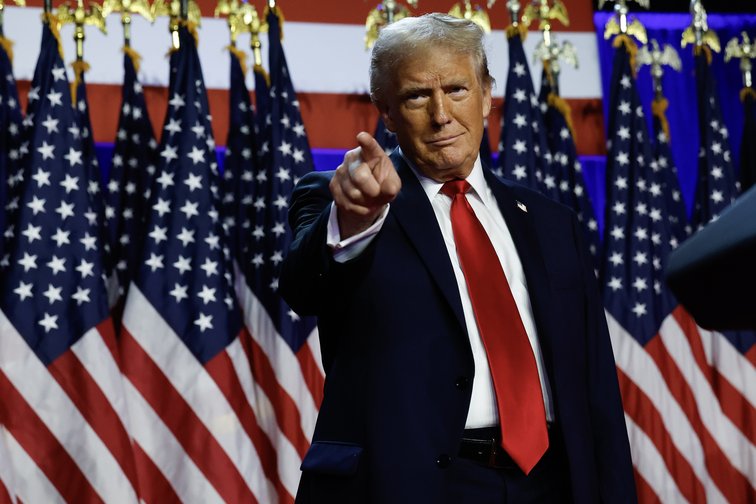
Trump’s weaponisation of US power poses a threat to peace, prosperity and the planet. It must be strongly resisted
After four years of narrowly avoiding prison, Donald Trump is back in the White House. For many observers outside the US, the re-election of a convicted felon who tried to illegally overturn an election is baffling.
But Trump’s second victory was no fluke – and nor was it merely the result of Russian interference or ‘deplorable’ voters. Although Trump left formal politics in 2021, the forces that brought him to power did not. This time, he is entering office far better organised, far stronger, and with a more diverse political base.
Trump is also not alone: across the West, right-wing populism is on the march, while progressive parties continue to find themselves on the back foot. In an increasingly unstable world, the rising tide of the authoritarian right poses huge challenges for the global economy. Left unchecked, it has the potential to imperil peace, prosperity and the planet.
To fully assess the threat this right-wing populism poses, and how to counter it, we must carefully assess the conditions under which Trump is assuming power – as well as the plans he has for wielding it. Like all political developments, Trump’s dramatic return has not happened in a vacuum. Instead, it must be viewed in the context of a series of profound political and economic shifts that are reshaping the face of Western capitalism.
The first shift – and by far most significant – is the rise of a rival economic superpower that could potentially threaten the technological supremacy that has long underpinned US hegemony.
Red Dragon Rising
Following China’s entry into the global trading system in 2001, many economists in the West assumed that China’s state-capitalist model would deliver some catch-up growth, then quickly run out of steam. The theory was that while state-led systems can be effective at rapidly mobilising existing resources, they struggle to drive productivity growth and innovation. This, it was thought, would eventually force China to open up its economy and embrace liberal democracy.
However, China’s achievements to date have made such pronouncements look remarkably naive. Not only has liberal democracy not arrived in the People’s Republic, but the Chinese Communist Party (CCP) has developed a distinct economic model that has lifted nearly a billion people out of poverty and transformed the country into one of the world’s largest and most dynamic economies. Somewhat ironically, it is Western governments that have had to adapt to China’s model – not the other way around. In recent years, China’s successes have forced Western governments to pivot away from free market orthodoxy and resuscitate muscular industrial policy, which had long been banished from Western policy toolkits.
The importance of China’s spectacular rise to Trump’s victory in 2016 cannot be overstated. At a time when most Americans felt the economy simply wasn’t working, Trump offered a clear albeit false diagnosis of the problems – China and immigration – and an aggressive strategy for dealing with them, when the Democrats were doing neither. His aim was to stand up to China, bring back jobs and put ‘America first’. His weapon of choice, tariffs, marked a major break with the neoliberal consensus of recent decades. Protectionism was back, spearheaded by the world’s largest economic and military power.
But in reality, Trump’s ‘trade war’ was never about trade or jobs. As I wrote back in 2020, it was primarily a response to US fears of losing technological supremacy in the face of successful Chinese industrial policy. From the very beginning, the ‘trade war’ was less about trade, and more about constraining Chinese development and preventing China’s rise as a rival technological power.
Since Trump’s exit from the White House in 2021, this ‘return of the state’ in Western economies has accelerated, fuelled by two other forces. The first has been a global ramping up of action to tackle the climate crisis. As a growing number of countries have embraced net zero targets, many have enacted new industrial policies to try and bolster capabilities to compete in emerging green supply chains. The second factor was the Covid-19 pandemic, which saw governments intervene in economies on an unprecedented scale. In order to contain the economic fallout, Western countries ripped up the neoliberal playbook in favour of widespread state planning and cash transfers. While the promises to ‘build back better’ inevitably rang hollow, many governments and businesses did act to bolster domestic supply chains in an attempt to address the chronic lack of resilience the pandemic exposed.
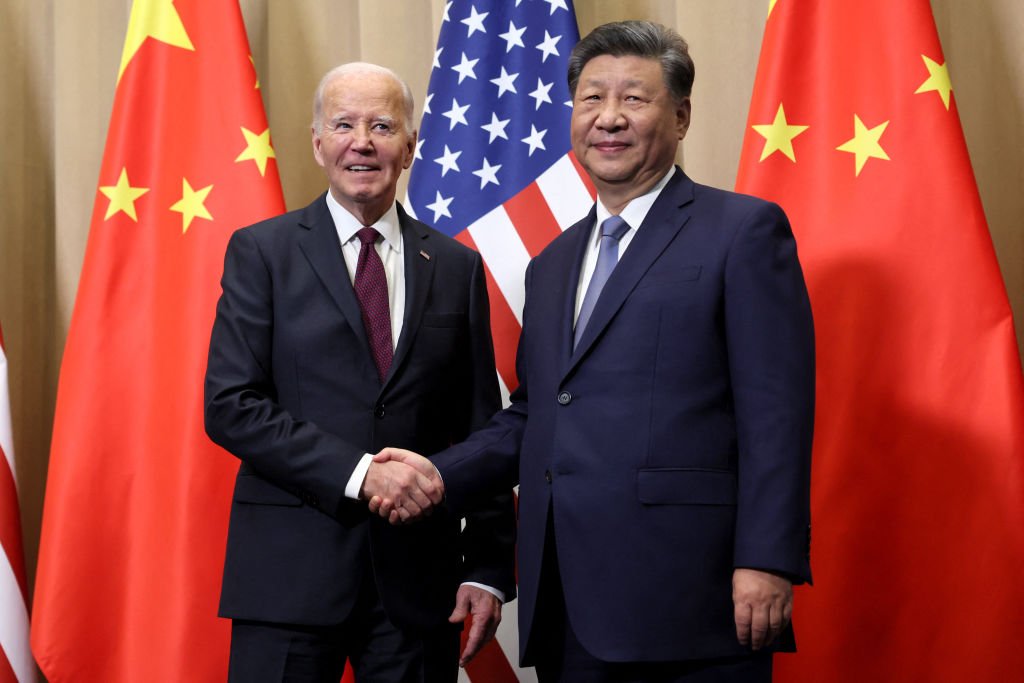
Acutely aware of these challenges, in 2021 the incoming Joe Biden administration sought to break with the economic consensus of his Democrat predecessors. Not only did Biden keep most of Trump’s tariffs on China, he increased them. His administration then embarked on the US’s most significant experiment with industrial policy for decades.
The key pillar of so-called ‘Bidenomics’ was the Inflation Reduction Act (IRA). Despite its name, the IRA was not primarily about reducing inflation. Instead, it launched the biggest investment programme in modern American history to revitalise the economy, enhance energy security, and tackle the climate crisis. The package included large tax breaks and subsidies to bolster US manufacturing capacity, and wean the US away from Chinese imports. In practice, the IRA was a significantly watered-down version of Biden’s initial ‘Build Back Better’ agenda, which, in addition to ambitious climate spending, also proposed trillions of additional dollars on social spending in areas such as housing, childcare and healthcare, as well as more progressive tax hikes. This agenda was blocked by Republicans and conservative Democratic senators, who also secured big giveaways to the fossil fuel industry.
Nonetheless, the IRA represented a significant step change in the ideological outlook of the world’s largest economy. It also posed new challenges for China, particularly as some policies were explicitly designed to discourage companies from using Chinese components. In a remarkable role-reversal, in May 2024 China lodged a complaint against the US at the World Trade Organisation (WTO), arguing that IRA subsidies “distort fair competition”.
On the basis of conventional economic metrics, Bidenomics appeared to be working. Following the pandemic, US economic growth outperformed peer nations, business investment soared, and unemployment remained low. The problem was that Americans simply weren’t feeling it. A big reason for this was inflation, which surged across the world as economies reopened after the pandemic, and Russia invaded Ukraine. Although in the US, inflation had fallen to less than 3% by the time of last year’s election, the damage had been done. Under Biden’s leadership, real earnings had fallen and satisfaction with the economy tumbled. Months before the presidential election, more than half of Americans wrongly believed the US was experiencing a recession, according to a poll for The Guardian. The consequences of this disconnect between buoyant economic statistics and peoples’ lived experiences were fatal. As economist Isabella Weber put it in the New York Times: “Unemployment weakens governments. Inflation kills them.”
As for Biden’s programme of green reindustrialisation, it didn’t quite live up to its promise. Although the IRA successfully catalysed billions of investments in clean energy, the immediate impact on jobs and living standards was modest. Since 2020, the number of manufacturing and construction jobs in the US economy has increased by around 800,000. While this might sound impressive, it amounts to less than 0.5% of the total workforce.
This does not mean the IRA should be seen as a failure – far from it. Investment takes time to deliver returns, and ironically it will be Trump who reaps the political rewards when they start to materialise. But these statistics also reveal a significant flaw in Biden’s approach to industrial policy. In the 21st century, most Americans do not work in manufacturing and construction, and likely never will. They don’t care much for semiconductors, nor do they pay much attention to GDP growth and business investment. What they care about is whether their life is getting better or worse. The initial Build Back Better agenda recognised this, while the watered-down IRA did not.
Trumpism 2.0
While Bidenomics failed to get its namesake re-elected, it played a crucial role in putting industrial policy back on the global agenda. Though this is long overdue, it is a mistake to think that a more interventionist state always pushes politics in a progressive direction. What really matters is who wins and who loses from these interventions. In other words: who are these interventions really designed to serve?
Seen through this lens, Trump’s vision for the role of the state looks rather different. He has already vowed to kill the IRA’s climate measures, referring to the act as “the greatest scam in the history of any country”. In its place, Trump has a new plan for industrial policy: “drill, baby, drill”. He has also pledged to deliver “the largest deportation operation in American history”, targeting millions of undocumented migrants whom he says are “poisoning the blood” of the US – and using the military to do so if necessary. The long-term economic impact of such a move would be severe, with some analyses estimating it could reduce annual US GDP by up to 7%, or nearly $1.7trn.
As a means of flexing American economic muscle globally, Trump has also promised to double down on tariffs, pledging to impose blanket 10-20% duties on all US imports and 60% on goods from China. In a sign of creeping paranoia that some countries may act to reduce their reliance on US trade, he recently threatened to impose 100% tariffs on the ten nations that form the BRICS bloc – Brazil, Russia, India, China, South Africa, Egypt, Ethiopia, Indonesia, Iran and the United Arab Emirates – if they create a currency aiming to challenge the US dollar’s dominance in global trade.
‘America first’ is the aim, while economic warfare is the game
In order to collect the billions in expected tariff revenues, the incoming president also recently announced the creation of a new ‘External Revenue Service’, stating: “Through soft and pathetically weak trade agreements, the American economy has delivered growth and prosperity to the world, while taxing ourselves. It is time for that to change.”
Whether these sharply higher tariffs represent a hard commitment or merely a negotiating tactic remains to be seen. However, it is clear that Trump intends to weaponise the US’s economic clout to strong-arm allies and adversaries alike. ‘America first’ is the aim, while economic warfare is the game, it would appear.
This again would not come without an economic cost – both to the US and its trading partners. Despite being Trump’s flagship policy, it remains unclear whether he knows how tariffs actually work. He has repeatedly insisted that they are paid by “other countries”, when in reality they are a tax on American companies paid when foreign-made goods arrive at the US border.
Perhaps most alarmingly, Trump has taken state interventionism to a whole new level by threatening to seize territories belonging to other sovereign nations. One prime target is Greenland, where the aim is to control its trove of natural resources to guarantee the US’s “economic security”, with a particular focus on rare earth metals. Another is the Panama Canal, which the US ceded control over to Panama in 1977 under President Jimmy Carter. Perhaps most ambitiously, Trump has floated the idea of annexing Canada, describing the two countries’ shared border as an “artificially drawn line” and vowing to use “economic force” to make Canada the 51st US state. The US projecting its power overseas to secure its economic interests is far from new. But rarely has a president been this direct and explicit about it.
The focus on Greenland’s rare earth metals is no accident. China currently dominates global rare earth metal production and has recently restricted the export of critical minerals and associated technologies ahead of Trump’s second term. These elements, which play a critical role in the manufacturing of batteries and countless high-tech products, are quickly becoming one of the most important geopolitical battlegrounds.
With China and the US each taking increasingly aggressive measures to limit the trading of key resources and components, the drift towards a new ‘technological cold war’ – as well as a military hot war – between East and West looks set to accelerate under Trump’s second reign. A partial decoupling of US and Chinese technology ecosystems is already well underway – with the extreme pressure the US applied to the UK government in 2020 to ban Huawei from the UK’s 5G network providing one example. Not unrelatedly, today the UK has among the worst-performing 5G signal in Europe. The recent US clamp down on the Chinese social media app TikTok provides another such example, with US lawmakers moving to ban the app on national security grounds. However, just before taking office Trump – who had previously backed a ban – pledged to delay implementation of the law to allow more time to “make a deal to protect our national security”.
If these trends continue to accelerate, it is possible to imagine a world that is bifurcated into distinct technological ‘zones’. In this scenario, countries would be able to use US technology or Chinese technology – but not both. Each country must pick a side.
A technological arms race
Any further slide towards technological bifurcation between East and West would pose huge challenges for the US and its allies. Whether it is clean energy, electric vehicles or radio communications such as 5G, Chinese companies are rapidly coming to dominate many critical 21st-century markets, in some cases to an extraordinary degree. As such, any further attempt to restrain Chinese technology or exclude Chinese goods from Western markets would have serious economic consequences, while also heightening military tensions. It would also pose existential challenges for China’s economic model, which has long relied on exporting to the US and other Western economies to drive economic growth.
Evidence indicates that China is also rapidly racing ahead to dominate many advanced technologies of the future. It is winning the technological race against the US in 37 of 44 advanced technology fields assessed in the report spanning defence, space, robotics, energy, biotechnology and artificial intelligence, according to a recent study by the Australian Strategic Policy Institute. The study also found there was a high risk of China establishing an effective monopoly in eight technologies – including supercapacitors, 5G and 6G communications, electric batteries, and synthetic biology – while the US enjoyed no such monopoly opportunities. For some technologies, all of the world’s top ten leading research institutions are based in China, which are collectively generating nine times more high-impact research papers than the US.
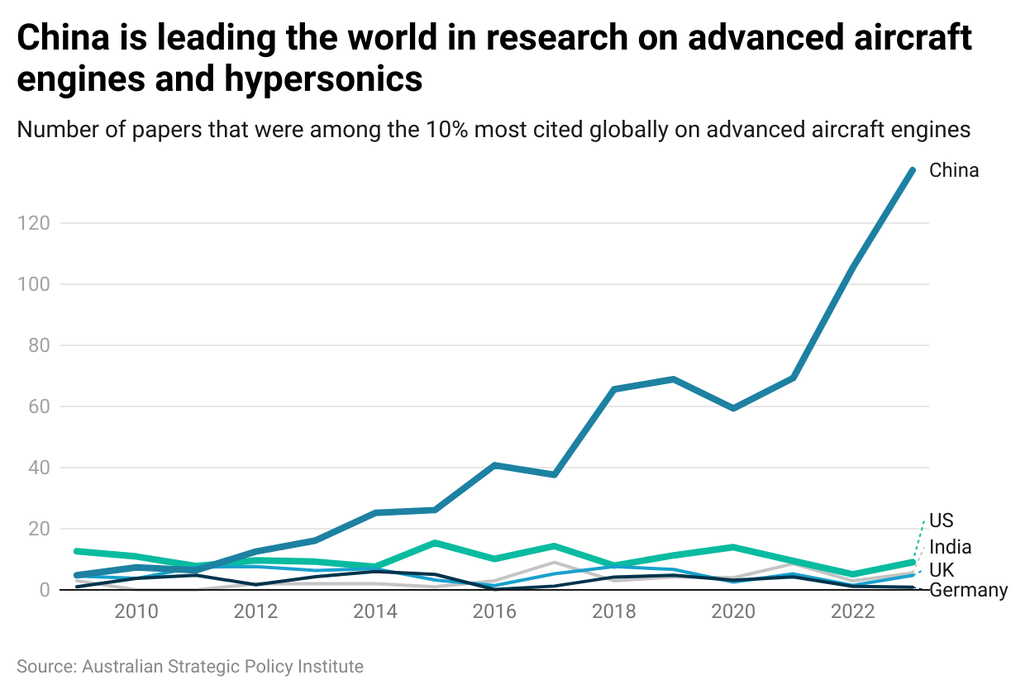
Perhaps unsurprisingly, China’s rapid advancements also extend to deadly weapons technology. While recent Chinese advances in nuclear-capable hypersonic missiles allegedly took US intelligence agencies ‘by surprise’, China has generated over 60% of the world’s high-impact research papers into advanced aircraft engines and hypersonics over the past five years, and currently hosts seven of the world’s top ten research institutions.
While China’s rapid advancements have confounded its critics, its economy is far from invincible. Despite the best efforts of the CCP’s latest five-year plan, Chinese economic growth is slowing considerably and is widely expected to fall short of its target this year. Among the reasons for this has been China’s fragile real estate sector, which after decades of debt-fuelled speculation has finally started to unravel. In 2021 China’s largest property developer, Evergrande, defaulted on its debt, with multiple other major developers following closely behind. These defaults forced Beijing to announce an emergency package of support measures to stabilise the sector, which accounts for about a fifth of the country’s economic activity. In many ways, the sector’s woes – soaring debt and slowing growth – have become emblematic of the challenges facing the wider Chinese economy. Sustaining growth in the face of an escalating trade war would require a radical reorientation of China’s economic model, lessening dependence on exports and real estate speculation towards substantially boosting domestic demand.
China’s looming demographic crisis poses another major threat to its economic future. The CCP’s ‘one-child policy’, which was enforced between 1980 and 2015, means its population is currently ageing faster than any other country in modern history. Over the next decade, about 300 million people currently aged between 50 and 60 are set to leave the Chinese workforce. In 2020, there were five workers for every retiree, by 2050 this is expected to fall to 1.6 workers per retiree. The compounding effect of a rapidly contracting labour market, and the associated shrinking tax base, poses huge challenges for future growth and fiscal policy, as well as the provision of pensions and care in old age.
The challenge facing Beijing is therefore stark: can China continue to drive growth and technological advancement in the age of Trumpism 2.0, while staving off financial contagion and a demographic time bomb? China has confounded its critics before – but never before has its outlook looked so uncertain.
Europe’s predicament
Caught in the crossfire between China and the US, Europe stands at a critical juncture. Lacking the technological dynamism to compete with the world’s two economic superpowers, and with many key industries in decline, European leaders have struggled to respond effectively. To date, its strategy has amounted to a tepid foray into industrial policy through the Green Industrial Plan, which aims to counter the EU’s import dependency for key commodities and technologies.
In a grudging admission that the free-market dogma underpinning the single market might be a barrier to an industrial revival, the European Commission has also relaxed state aid rules, enabling states to provide more generous subsidies for green industries. While these necessary reforms to the single market are long overdue, the ongoing failure to reform the eurozone’s fiscal architecture makes it difficult to see the EU posing a serious threat to US and Chinese technological dominance anytime soon.
For EU leaders, the most pressing issue is the prospect of new tariffs and threats to sovereign European territory. While Europe cannot compete with the US technologically or militarily, as the world’s largest trading bloc it can compete on trade. Reports suggest the European Commission is exploring a ‘carrot and stick’ approach: implementing its own retaliatory tariffs while also pledging to buy more US goods. A trade war between the US and Europe is unlikely to end well for either party, but would be particularly painful for Europe.
The prospect of escalating transatlantic coordination between the authoritarian right and billionaire egomaniacs is one of the biggest threats to Europe’s future
Even if transatlantic tariffs are avoided, there is still the question of what to do in relation to China. If Trump follows through with imposing 60% tariffs on Chinese goods, should the EU do the same? If it doesn’t, Europe may face a flood of cheap Chinese goods dumped on its doorstep, further harming domestic producers. Then there is the question of how Europe should respond to the accelerating technological decoupling between East and West. While the EU has taken various steps to try and turbocharge research and innovation in recent years, it still lags significantly behind the US and China. In theory, there is a strong case to be made for Europe to forge its own path, neither bowing to US or Chinese authoritarianism. However, this ambition may be thwarted by challenges closer to home.
In recent years, far-right parties have seen a dramatic surge in support across the continent. Last year France came inches away from electing Marine Le Pen’s Rassemblement National, while in 2023 the Netherlands elected an Islamophobic populist. Far-right parties continue to make considerable inroads in Germany, Spain, Italy and elsewhere. Many of these parties are in direct contact with Trump’s wider networks and have also received glowing endorsements from billionaire and Trump fanboy Elon Musk, the owner of X (formerly Twitter). As well as being Trump’s largest donor, Musk has quickly positioned himself as one of the president’s most influential aides. The prospect of escalating transatlantic coordination between the authoritarian right and billionaire egomaniacs represents one of the biggest threats to Europe’s future.
Britain’s alignment problem
The challenges faced by the EU are perhaps even more acute in the UK. Brexit was supposed to unleash Britain as a great, swashbuckling trading nation once again. But this fantasy was always rooted in a failure to come to terms with the UK’s rapidly diminishing power in the world. While the EU lacks technological leadership but has considerable trade power, the UK has neither. At a time of growing geopolitical tensions over technology and trade, the UK is a sitting duck.
In the event that Trump does escalate a global trade war, Keir Starmer’s government will likely have to pick a major bloc to align with – or absorb considerable economic pain. This was always the deep irony of Brexit; while it was supposed to be about “taking back control”, the UK was always going to be forced to align with decisions taken by one of the world’s major power blocs, albeit having no control over the rules.
This reality was recently bluntly spelt out by Stephen Moore, one of Trump’s closest economic advisers. “The UK really has to choose between the European economic model of more socialism and the US model, which is more based on a free enterprise system,” Moore told the BBC last year. Moving towards the US model of “economic freedom” would significantly increase the likelihood of securing a US trade deal, he added. However, this would also likely involve bowing to US demands to open up key British markets – such as agriculture and pharmaceuticals – to American competitors. Given the gulf in bargaining power and Trump’s notoriously aggressive deal-making, this would almost certainly not end well for the UK.
Starmer’s government therefore faces an unenviable lose-lose dilemma. Align with the US to avoid tariffs and secure a trade deal, and suffer the deeply unpopular consequences of Trump’s trade conditions, from chlorinated chicken to significantly higher NHS drug prices. Or align more closely with the EU once again, and risk plunging the country into civil war over Brexit all over again. Given the present political dynamics in Britain, this could be disastrous for the Labour Party.
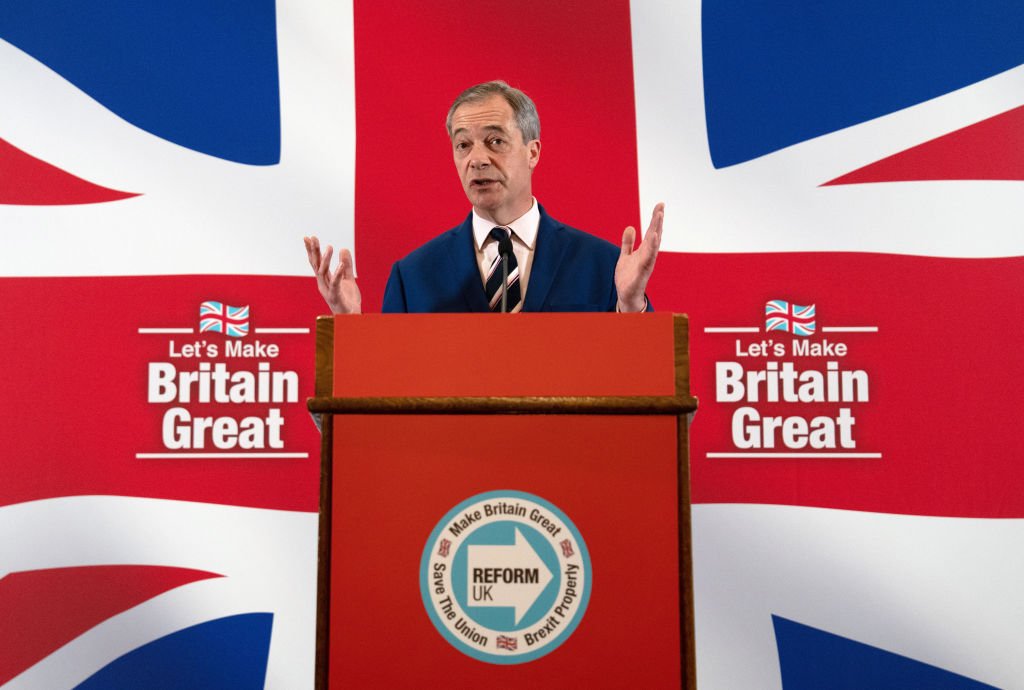
While, on paper, the landslide victory Labour secured at last year’s election victory appeared decisive, looks can be deceiving. In reality, the party’s majority was built on incredibly fragile foundations – and the UK is far from immune to the threat of right-wing populism. Since then, election support for the party has plummeted, while support for Nigel Farage’s pro-Brexit Reform party has surged. With the two parties neck and neck in the polls, any attempt to align more closely with the EU would be capitalised on by Reform, likely to devastating effect. Even without this, Reform could be on track to upend British politics in the next election, subverting the traditional two-party system, perhaps with help from an increasingly unhinged Musk.
Global fractures
China’s global ascendency, combined with the US’s political fracturing, has led some to speculate that we may be witnessing the ‘end of the American century’. Back in 2020, I argued that such premonitions were premature. The two pillars of the US’s global power – military and financial – remained rooted in place.
However, it was clear that the election of Trump in 2016 was eroding the US’s soft power, and its ability to act as the paragon for liberal democracy. Trump’s subsequent attempt to overturn the result of the 2020 election only put this on steroids. Far from being viewed as a successful model to emulate, the US began to resemble a cautionary tale to avoid.
Biden made a conscious effort to repair US prestige on the world stage. “America is back,” he vowed at his first address to world leaders from the State Department in February 2021. “We are a country that does big things. American diplomacy makes it happen. And our Administration is ready to take up the mantle and lead once again.”
However, polling undertaken in 2021 found that while most people in Europe were happy to see Biden elected, they believed that the US political system was “broken”. Perhaps most alarmingly for US strategists, a majority also believed that China would be more powerful than the US within a decade – and said they would want their country to stay neutral in a conflict between the two superpowers. In the years since, Biden’s international standing has been further stained by his resolute support for Israel’s brutal assault on Gaza, which has generated intense animosity towards the US in many parts of the world.
Despite Biden’s efforts, it is likely that a second Trump term will fracture relations in the West further, as tensions relating to tariffs, Ukraine and NATO start to bite. How this plays out remains to be seen, any prolonged souring of relations among Western countries would likely benefit China, and hasten the transfer of global power from West to East.
Meanwhile, the much-vaunted ‘rules-based international order’ looks more fragile than ever before. Under Trump’s first reign, the US pulled funding from multiple UN agencies, withdrew from the Paris Agreement on climate change, and even pulled out of the World Health Organization (WHO) during the Covid-19 pandemic. Meanwhile, Trump and his allies severely criticised institutions such as the IMF and World Bank, long a critical tool for projecting US power. At the same time, the number of countries turning to Chinese-backed alternatives to fund development projects and joining China’s Belt and Road Initiative has continued to grow over the past decade.
In recent months, the ongoing war in the Middle East has exposed the feebleness of international law, with multiple signatory countries openly defying the International Criminal Court’s (ICC) arrest warrant for Israel’s prime minister and former defence minister. The US has never become a signatory to the ICC, but Trump previously sanctioned two ICC prosecutors after they began investigating whether US forces committed war crimes in Afghanistan – with secretary of state Mike Pompeo declaring it as a ‘kangaroo court’. At the start of this year, the US House of Representatives voted once again to sanction the ICC in retaliation for its arrest warrants against Israeli leaders.
What Trump’s stance towards such international institutions will be in his second term remains to be seen. But with his “America first” stance unlikely to soften anytime soon, the so-called ‘crisis of multilateralism’ looks set to deepen.
A global wake up call
Overall it is clear that Trump’s re-election represents a critical turning point for the West. While his first victory represented a high-risk gamble into the unknown, this time Americans fully knew what they were voting for. Far from softening the autocratic tendencies he was widely criticised for, he has doubled down on them.
Towards the end of Trump’s last reign, I argued that the West was being haunted by the spectre of ‘authoritarian capitalism’. The analysis identified three profound economic and political shifts that were reshaping Western economies: a China-induced pivot away from free-market orthodoxy, a clampdown on democratic freedoms, and a rise in state surveillance. Together, these shifts represented a distinct political economy that, if not contained, could usher in a new age of more authoritarian governance.
Thanks to the emerging transatlantic alliance between Trump, the European far-right and billionaire social media moguls, this is a reality we now face. Exactly what Trump will do in power, and whether his far-right allies in Europe will succeed in following his footsteps, is impossible to predict. But we should be under no illusions about the threat that this alliance poses. This is not the same Trumpism that won the election in 2016: it’s an altogether different – and more dangerous – project. How should progressives seek to counter the ascendance of a new authoritarianism?
One thing is clear: stoking anti-China sentiment will not cure the ills of Western capitalism. The roots of these problems, and therefore their solutions, can be found much closer to home. Simply trying to ban or censor voices on the authoritarian right won’t work either. When the voices in question include the US president and the second most popular party in the beating heart of Europe, silencing them isn’t an option (although that hasn’t stopped hundreds of German politicians from trying). Instead, the roots of these problems need to be dealt with at the source. In reality, it is not China or immigrants that are screwing over ordinary working people, but an extractive and unequal economic system.
Capitalism in the ‘developed world’ has primarily become an engine for redistributing wealth upward
The world’s richest 1% today owns more wealth than 95% of humanity. Last year total billionaire wealth increased by $2trn, growing three times faster than the year before. The wealth of the world’s five richest men has more than doubled since 2019, soaring from $506bn to over $1.1trn. That list includes Trump’s cheerleader-in-chief, Musk, who paid a true tax rate of just over 3% in the US between 2014 and 2018, according to an investigation by ProPublica. The average worker in advanced economies, meanwhile, has typically seen their real pay fall or stagnate.
The contrasting fortunes of the mega-rich and everyone else are not unconnected. Despite what our leaders claim, capitalism in the ‘developed world’ has primarily become an engine for redistributing wealth upwards – both from its own citizens and the rest of the world. Skyrocketing inequality is also inextricably linked to the climate and environmental crisis. As well as hoovering up much of the world’s wealth, the richest 1% emit as much carbon pollution as the poorest two-thirds of humanity. As such, tackling the climate crisis and reducing inequality must go hand in hand.
But by deflecting legitimate economic grievances towards external bogeymen and migrants, it is the authoritarian right – not the progressive left – that has most successfully capitalised on this broken system. If we are to address the central economic and environmental challenges we face, this urgently needs to change.
Progressive forces have transformed Western political economy before, and the task before us is to do so again. The goal must be to tackle inequalities, raise living standards and address the environmental crisis – while standing with migrants and other minoritised groups against persecution and oppression. This will inevitably involve a more proactive role for the state. The key question is: in whose interests will it act? The lesson from Bidenomics is that focusing primarily on industrial sectors such as renewable energy and manufacturing won’t work unless it is accompanied by policies to rein in corporate power and redistribute wealth. This means challenging the power of vested interests head-on, not cowering to them.
This project must also aim to strengthen democracy and protect civil liberties at a time when both are increasingly under threat. In recent years governments across the US, Europe and the UK have cracked down on the right to protest with draconian legislation. Given Trump’s terrifying track record – including calling for the military to quash peaceful protests by “radical left lunatics” – we should expect the assault on the right to protest to intensify, alongside a curtailing of civil liberties more broadly. Peaceful protest will be absolutely critical for resisting the authoritarian right across the world, which is exactly why it is likely to be suppressed.
At the global level, lessons can be learned from Trump’s own playbook. In power, Trump has not shied away from breaking international norms or shaking up global institutions. Progressives must be willing to do the same – albeit for very different ends. While this may make some uncomfortable, it is a necessary prerequisite to delivering the kind of global transformation needed. The existing ‘rules-based international order’ is meaningless when some of the most powerful actors are not playing by these rules. Global cooperation is needed more than ever, but the existing multilateral order is fundamentally broken. It must undergo sweeping reforms to promote a more prosperous, peaceful and sustainable world.
Perhaps most importantly, however, there needs to be a clear focus on who the real enemy is – and the goals that need to be achieved to defeat them. For decades, the left has viewed its enemy as neoliberalism, and its main task as building an alternative to it. But if neoliberalism is not dead yet, it is slowly dying.
Instead of fighting the last war, progressives must start grappling with the distinct political economy of a new authoritarianism. In practice this requires developing a completely new set of strategies, tactics and policies. We are not only losing – we are losing badly. More of the same simply will not cut it.
The challenge now is therefore much greater than when Trump last took office. The spectre of authoritarian capitalism is not just haunting the West, it is already here, and it is actually quite popular. Now it must be resisted from the ground up.
The key question is: can we build the power needed to challenge it? Right now, it’s not looking promising. We can only hope that the arrival of Trump 2.0 provides the wake-up call the world so desperately needs.
Original article by Laurie Macfarlane republished from OpenDemocracy under a Creative Commons Attribution-NonCommercial 4.0 International licence.