Palestinians mourn nine people killed in an Israeli strike in Bureij refugee camp, Gaza Strip, November 15, 2024
A COURT case against the British government over arms exports to Israel could be the most important challenge to the legal system in “generations,” arms expert Andrew Feinstein has said.
The case, brought by the Global Legal Action Network and the human rights group Al-Haq, will be heard in the High Court on Monday.
It calls on the government to suspend all arms exports, citing a clear risk that these could be used by Israel to violate international law.
Currently only 30 out of 350 licences are suspended and components for the lethal F-35 fighter jet are exempt.
Speaking to the Morning Star’s deputy news editor Ceren Sagir in a video interview, Mr Feinstein warned that if the legal system sides with the British state as it has done before, effectively allowing it to “trample” over British and international law, “then we will be able to say without a shadow of a doubt that the legal system in Britain is broken.
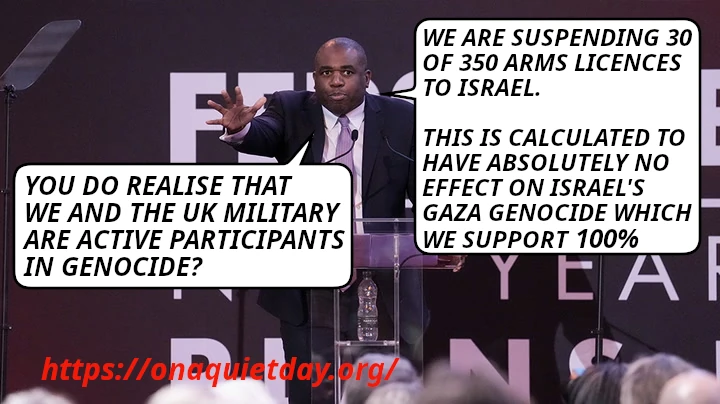
Genocide denying UK Foreign Secretary David Lammy says that UK is suspending 30 of 350 arms licences to Israel. He also confirms the UK government’s support for Israel’s Gaza genocide and the UK government and military’s active participation in genocide.Genocide denier and Current UK Prime Minister Keir Starmer is quoted that he supports Zionism without qualification. He also confirms that UK air force support has been essential in Israel’s mass-murdering genocide. Includes URLs https://www.declassifieduk.org/keir-starmers-100-spy-flights-over-gaza-in-support-of-israel/ and https://youtu.be/O74hZCKKdpAVote For Genocide Vote Labour.
Peace campaigners protest against the Gaza genocide at the Welsh Labour conference, November 17, 2024
HUNDREDS of peace campaigners marched on the Welsh Labour conference venue at the weekend, calling for an immediate ceasefire in Gaza.
Stop the War Cymru (STW) and Palestine Solidarity Campaign Cymru (PSC) organised the Llandudno rally to pressure the Welsh government to join calls to end the genocide in Gaza and stop arms sales to Israel.
Campaigner Sara Roberts said it was beyond comprehension “that we have had to stand outside the Welsh Labour conference and challenge our elected representatives to support calls for peace in Gaza and the Middle East.
“Shame on Starmer who as a human rights lawyer knows the legal definition of genocide.”
Genocide denier and Current UK Prime Minister Keir Starmer is quoted that he supports Zionism without qualification. He also confirms that UK air force support has been essential in Israel’s mass-murdering genocide. Includes URLs https://www.declassifieduk.org/keir-starmers-100-spy-flights-over-gaza-in-support-of-israel/ and https://youtu.be/O74hZCKKdpAGenocide denying UK Foreign Secretary David Lammy says that UK is suspending 30 of 350 arms licences to Israel. He also confirms the UK government’s support for Israel’s Gaza genocide and the UK government and military’s active participation in genocide.Vote For Genocide Vote Labour.
Genocide denier and Current UK Prime Minister Keir Starmer is quoted that he supports Zionism without qualification. He also confirms that UK air force support has been essential in Israel’s mass-murdering genocide. Includes URLs https://www.declassifieduk.org/keir-starmers-100-spy-flights-over-gaza-in-support-of-israel/ and https://youtu.be/O74hZCKKdpAGenocide denying UK Foreign Secretary David Lammy says that UK is suspending 30 of 350 arms licences to Israel. He also confirms the UK government’s support for Israel’s Gaza genocide and the UK government and military’s active participation in genocide.Vote For Genocide Vote Labour.
Italian Prime Minister Giorgia Meloni and British Prime Minister Keir Starmer take a walk after meeting to discuss migration in Rome | Filippo Monteforte/AFP/Getty Images. All rights reserved
There’s no smuggling ‘kingpin’ to take down. Instead, Labour’s security rhetoric risks putting more people in danger
Labour lost no time burying the Conservatives’ tawdry Rwanda plan in favour of something a little more, well, Churchillian. In July, as he welcomed European leaders to Winston’s birthplace of Blenheim Palace, Keir Starmer framed border security not as some nationalist vote-fishing expedition but rather as a pragmatic British undertaking “at the heart of the Government’s reset with Europe”.
It would also involve fighting them on the beaches. Gangs would be suitably smashed, he told his guests, by a new Border Security Command armed with “counter terrorism-style powers”. Elsewhere Starmer has also enthused over Giorgia Meloni’s ‘upstream’ fight against irregular migration — including offshoring asylum processing to Albania and outsourcing crackdowns to Tunisia.
So far, so familiar. If there’s anything European political leaders of different stripes and nationalities have united around since the 1990s, it’s more border security. But what will a counterterror-style crackdown actually achieve this time around?
Is Labour offering anything new on migration?
For some of those relieved to see Rishi Sunak exit stage right, his meaningless “stop the boats” sign tucked under his arm, there are grounds for optimism. The counterterror rhetoric, they say, hides humane openings elsewhere, especially when it comes to breaking the massive backlog of asylum cases. Respecting the European Court of Human Rights also looks like a welcome return to normality – and legality.
Starmer has further promised that his approach will be more cost-efficient. That’s easy enough to believe, as it’s hard to imagine anything more wasteful than spending “£700m to persuade four volunteers to go to Rwanda,” as Starmer himself described it. Supporters will add that smuggling is a rapacious business. Going after its economics is key, as is respectful collaboration with partner states rather than grandstanding. Reinstating EU returns (lost after Brexit), cracking down on smugglers, and expediting asylum cases will work where ‘invasion’ rhetoric failed.
In this take, Starmer offers strategic “competence with compassion” that also helps placate the tabloids. It’s a method that, if it works out, means everybody wins except the cold-hearted smugglers.
Not so fast. A brief look at the past decades’ border dynamics suggests that Starmer’s initiatives may well end up being as gimmicky as those they replace. If politicians genuinely want to stop profiteering as people drown in the English Channel or the Mediterranean Sea, they must first understand the drivers of migration and the smuggling business. Otherwise they will simply fail again – with more lives lost, and even harder rhetoric to come from the hard right.
Smuggling 101: supply and demand
It’s peculiar how difficult it is for mainstream politicians, who are otherwise so keen on market economics, to learn that human smuggling is a market driven by demand. It responds to incentives, and its strongest incentive by far is the disappearance of legal routes. The market is further buoyed by crackdowns of the kind seen around the Channel Tunnel in recent years. The displacement of routes has predictably increased danger and desperation – and thus reliance on professional smugglers. The border security system perversely feeds on the very problem it ostensibly combats.
True, deterrence-signalling measures may put a damper on the market – for a while. Cue Starmer’s nod towards Italy, where Meloni and her authoritarian Tunisian partner claim credit for bringing down maritime migration this past year. But sooner or later, the market will re-emerge unless the underlying dynamics and drivers are addressed.
Ever-tougher approaches targeting the supposed ‘kingpins’ have merely shifted the modus operandi
Reproducing new versions of the same threat and then combating them again is bad enough. But Starmer’s reference to counterterrorism — now accompanied by a doubling of the funding for the new Border Security Command — raises additional red flags.
Consider the US Homeland Security behemoth spawned by the George W. Bush administration after 9/11. Rather than changing dynamics at the US-Mexico border – the stage of spectacular enforcement all through the 1990s – it worsened it.
The cartels started playing an unpaid role in ‘prevention through deterrence’. At the same time, border crackdowns and technology imported from the war on terror pushed migrants away from smaller smuggling operations and into the hands of larger, more predatory players with the necessary economic margins.
Yet that inconvenient reality was never really acknowledged. As I heard some years ago, Customs and Border Protection bureaucrats repeatedly magicked up models showing their method ‘works’ by denting the revenue of smugglers and ramping up deterrence. It didn’t. Instead it reproduced a deadly dynamic and spawned fresh political crises.
Or consider Italy itself. Rome has deployed anti-mafia methods against smugglers, but it has little to show for these efforts except perverse results such as jailing a presumed “Al Capone of the desert”, who was later released in a case of mistaken identity. As the man’s lawyer said, “After three years, finally the judge confirmed what we have been saying: we had a farmer in jail and a smuggler at large.” The prosecutors kept insisting they had the right man, waging a war less on smugglers than on reality.
Fighting an elusive enemy
For years, ever-tougher approaches targeting the supposed ‘kingpins’ have merely shifted the modus operandi, in Libya and elsewhere. Instead of piloting a boat, the smugglers make passengers steer it. The latter then bear the legal — or lethal — consequences when it is seized or sinks.
People on the move, of course, also adapt their behaviour to crackdowns. As one Senegalese man explained to me 15 years ago, before his wooden fishing boat approached the Canary Islands, he threw “food, GPS and the compass into the sea”. The shift in tactics in response to enforcement has hugely increased the risk, pushing responsibility of the vessels onto migrants who cannot navigate or do not want to be seen doing so.
It is possible that Labour’s smuggling crackdown will not get stuck either in the bureaucratic swamp of ‘Homeland Security’, or get distracted by the catch-the-small-fry fracas. But its own alarmist rhetoric, combined with tabloid and Tory pressure, feed bureaucratic incentives to produce ‘results’ – and these are the easiest ways of showing such results. So beware the hyperbole: it makes meaningful ‘results’ more difficult to achieve.
Underneath all the tactics and rhetoric, however, a more fundamental analytical problem is lurking. Unless the threat has been correctly diagnosed, there’s little chance the remedy will work.
Starmer’s approach is based on the idea that smuggling is in the hands of very well-organised, transnational crime. That there is, somewhere, a kingpin to take down. But while it is true that human smuggling has become more predatory, profitable and professional as the market has grown with each short-sighted crackdown, that model is, at absolute best, extraordinarily incomplete.
The outsourcing of draconian migration controls has benefited repressive state and para-statal actors, while increasing the very dangers that drive people to move
Precision is needed, not alarmism. On the Spanish borders, for instance, politicians, police and reporters for years talked of ‘mafias’, even while small operators and migrants themselves kept organising crossings.
‘Upstream’, in North Africa and the Sahel, the authorities themselves are involved. They benefit from the security largesse provided by their European ‘partners’ in fighting irregular migration, and from the ever-increasing bribes needed to evade their own controls. Rather than a straightforward ‘battle’ between clear adversaries, we see here more of a symbiosis between the border security and smuggling businesses.
The outsourcing of draconian migration controls has benefited repressive state and para-statal actors, such as Libya’s militias, while increasing the very dangers that are driving people to move with the aid of smugglers. If we account for this political dynamic, Meloni’s ‘success’ looks fragile indeed. It is based on a drop of arrivals in 2024 from the previous year. Yet the chaos in Italian ports in 2023 was, to no small extent, the result of Tunisia’s president using African migrants as a bargaining chip with Europe.
Kelly Greenhill has called it “weapons of mass migration”. It’s something the EU says it wants to combat. Instead, European leaders seem to be rewarding it.
The smuggler factory
A ‘counterterror’ approach to smuggling, combined with further reliance on non-European buffer states, risks further skewing the border-crossing market from smaller players to more organised and rapacious ones while shifting the risks from smugglers to their increasingly desperate passengers. This, in turn, risks fuelling the trend towards captive markets that we see today from Libya to northern Mexico.
It’s been said many times that a ‘war on smugglers’ swiftly turns into a war on migrants. As David Keen and I show in our book Wreckonomics, politicians have kept learning the wrong lessons from their various short-sighted ‘wars’ against smuggling, terror, crime and drugs.
They keep choosing to go in hard with the security theatre and target the symptoms not the causes, hoping to reap short-term electoral rewards. They keep producing figures showing that the ‘fight’ is succeeding – and numbers may even really go down for a bit. But they don’t create sustained change. Look at the long term and we see above all a displacement of routes and methods – whether in the Channel, the Mediterranean or across the Rio Grande – with a corresponding boost for the smuggling market.
Starmer may still play smart and prioritise reinstating European returns, speeding up processing, and going after the big players and the money. The UK does not have Italy’s Mediterranean border, after all, and its main ‘outsourcing’ partner is France not Libya.
But in this context, it’s all the more worrying that we hear the language of counterterror and ‘upstream’ controls dominate the messaging. If the measures don’t match the problem, and if the relevant actors themselves remain poorly understood, the problem will simply keep being reproduced — as indicated by the past two decades of Labour and Tory enforcement efforts around the Channel.
For a more visionary political figure there is surely a chance here to offer a different kind of security
To Starmer’s supporters — eyeing tabloids and Faragists on the warpath — the gambit may still look appealing, or at least like some kind of lesser evil. Yet here awaits one further fallacy. For if there’s one other group besides smugglers that has predictably and consistently gained from ‘securitisation’ over the past decades, it is the far right.
Offering a lighter version of hard-right securitisation simply increases voter appetite for the full-fat version. The political appeal of repeatedly announcing an ‘emergency’ or ‘invasion’ is not based on numbers. Channel crossings, we know, are vanishingly small relative to overall immigration into the UK. But if the big politics of ‘small boats’ is not driven by numbers, the corollary is that even if Starmer were to get numbers down temporarily, the appetite for more border security would remain.
Starmer’s problem today is that of the left in general, which increasingly finds itself trapped in security logics — something we’ve equally seen in the recent US elections. This is unfortunate, since for a more visionary political figure there is surely a chance here to offer a different kind of security.
Instead of dismissing legal pathways, for instance, these could be reframed as bringing humanity, control and predictability to migration policy — while fundamentally creating a disincentive to use smugglers, as border guards themselves often insist.
Instead of trumpeting ‘counterterror’, there is scope for a sophisticated overarching strategy against organised crime and exploitative actors that targets the regulations and loopholes that these actors feed upon. This means working inland, where the exploitation of migrant labour, for instance, is a huge and neglected problem. Waiting in the wings is also a much wider conversation about how politicians’ economic choices and foreign policy fuel migration and displacement.
But all this involves open democratic debate and oversight. Counterterror approaches have tended to do the opposite: fuel a fear-based politics, increase secrecy, sidestep audits, benefit the big criminal players and corrupt partner authorities. They also unfailingly feed the very crises forcing people to leave countries such as Afghanistan in the first place.
A Churchillian rhetoric of unity-through-security is tempting. So is the language of counterterror. But to end with a warning from the failed war on terror, let’s perhaps listen to Richard C. Holbrooke, the US special representative to Afghanistan and Pakistan, who said: “We may be fighting the wrong enemy in the wrong country.”
Starmer may at least be in the right country. But if he insists on misunderstanding the problem he will confront the wrong enemy yet again.
Explore the rest of the series
This series looks at how the UK, EU and bordering countries are increasingly treating migration as a criminal offence, and targeting migrants and solidarity actors in the name of ‘anti-smuggling’ and ‘border control’.
Caught in the net: how migration became a criminal offence Melissa Pawson, Vicky Taylor
Scientists and campaigners are calling on governments and tech companies to tackle climate disinformation. Credit: MauriceNorbert via Alamy
An open letter from climate scientists and campaigners warns of the dangers associated with false climate claims.
Governments around the world must take “immediate and decisive action” to tackle climate disinformation, scientists and campaign groups have urged as talks at the COP29 climate summit in Baku, Azerbaijan enter their fourth day.
A coalition of 55 climate information integrity groups and 42 leading climate scientists and experts have signed an open letter urging countries to counter the risk of false and misleading claims that are wrecking efforts to slow climate change.
It comes two days after UK Prime Minister Keir Starmer spoke at COP29 arguing that “there is no national security without climate security” – and a week after the election in the United States of Donald Trump, who has previously called climate change a “hoax”.
The letter published today – signatories to which include Friends of the Earth, the Institute of Strategic Dialogue, and regional branches of Greenpeace and WWF – lists steps governments could take.
These include adopting a universal definition of climate disinformation, such as the working definition proposed by the Climate Action Against Disinformation (CAAD) coalition, another signatory.
According to the letter, the definition should cover anything that misrepresents scientific data or “falsely publicises” supposed solutions to climate change which in fact contribute to global warming, often referred to as “greenwashing”.
Such a definition should cover “deceptive or misleading online behaviour” that undermines public understanding of climate change, the fact it is caused by human activity, and the need for urgent mitigation and adaptation action, the letter said.
Signatories also urged governments to take action against organisations which give a platform to climate disinformation – including social media outlets, advertising technology providers, broadcasters, and publishing companies.
“The spread of disinformation continues to undermine and delay our collective ability to act, jeopardising progress at crucial negotiations and the upcoming G20 Summit in Brazil”, the letter said.
“Climate disinformation, waged by vested interests, undermines climate action and puts our collective future at risk. Our information ecosystem is being damaged, and those responsible must be held accountable.”
The letter ends by arguing that “by adopting these principles, governments can foster a healthier and safer online environment that supports informed decision-making and enables effective climate action.”
The world’s leading climate science group, the UN’s Intergovernmental Panel on Climate Change (IPCC), has warned that efforts to tackle climate change were being delayed by “rhetoric and misinformation that undermines climate science and disregards risk and urgency”.
“As disinformation continues to be an obstacle to vital climate action, the message from this open letter to decision makers globally is clear: protecting truth in the climate conversation is critical if we are to secure meaningful change”, said Max MacBride, Head of Counter-Disinformation at Roots Greenpeace, the NGO’s grassroots campaign initiative.
“At Roots, we see every day how climate disinformation stifles youth advocacy, and we join this call to hold governments and platforms accountable for enabling informed, equitable climate action”, he said.
Climate Disinformation Threats
A CAAD report published earlier this week found that climate disinformation is widespread online, and is hobbling efforts to address climate change.
The report said that social media platforms bear responsibility for allowing “super spreaders” to “pollute their platforms with debunked claims attacking renewable energy and electric vehicles”.
CAAD also found that fossil fuel companies were allowed to use digital advertising across Meta platforms to greenwash their reputations, by promoting false solutions or presenting fossil fuels as essential to the energy transition.
A study published in February found that 14 percent of Americans don’t believe climate change is real – even as growing numbers of Americans say they are concerned about the climate.
“In the US, we’ve painfully experienced the role disinformation has played in thwarting disaster response and threats to the lives of responders”, Kate Cell, Senior Climate Campaign Manager at the Union of Concerned Scientists, told DeSmog.
“As climate-fueled disasters become more common around the world, governments can protect their residents by addressing the problem of climate disinformation systemically.”
Another report released this week by the scrutiny NGO InfluenceMap found 2.500 cases of fossil fuel companies pushing arguments which contradict IPCC recommendations since COP28 last year.
Thais Lazzeri, founder of educational group FALA, a signatory to the letter, told DeSmog: “The letter comes at a unique time for Brazil, which is hosting the G20 and the incoming COP30 Presidency. The alliance of so many Brazilian institutes and professionals shows the urgency for answers and the intersectoral power of this Brazilian network, willing to work together.”
She added: “At the opening of the Brazil space at CO29, Environment Minister, Marina Silva, said that denialism doesn’t fit. The Brazilian government can lead by example and guarantee information integrity policies and strategic, connected actions to change the game.”
DeSmog has previously reported on news media spreading false climate claims, with The Telegraph newspaper in the UK attacking climate solutions – a trend that has increasing since July’s general election. As revealed by DeSmog in 2023, one in three presenters on the right-wing broadcaster GB News had spread climate disinformation during the previous year.
“It is much easier to pollute the waters of public discussion on climate change causes and consequences than it is to keep them clean and productive,” said Max Boykoff, signatory to the letter and professor of Environmental Studies at Boulder University in Colorado and founder of the Media Climate Change Observatory, a project which analyses mentions of climate change in news media.
“Therefore, more proactive, clear, accurate and effective communication efforts are consistently and repeatedly needed. That motivates this call for government action to curb disinformation about climate change.”