Responding to David Lammy’s statement to the Commons in which he said that the UK is to suspend 30 arms export licences to Israel after a review found a “clear risk” that UK arms may be used in serious violation of humanitarian law, Ellie Chowns MP said:
Ellie Chowns, Green Party MP for North Herefordshire. CC image Wikipedia.
“Green MPs have long called for a suspension of arms exports to Israel. The Foreign Secretary’s announcement today is therefore a welcome and significant step, but leaves vital questions unanswered.
“Primarily, why are so many licences exempt from this suspension? I am very concerned that the Government is not consistently applying the principle that there is a clear risk of UK licensed weapons being used in breach of international humanitarian law. The justification for continuing to licence F-35s is no justification at all. There is an ongoing and clear risk and we urge the Foreign Secretary to look again and suspend these licenses.
“If, as he says, the Foreign Secretary takes seriously the risk of UK licensed weapons being used in breach of international humanitarian law, he must go further and suspend all export licences.”
Introducing a wealth tax would indicate this is a progressive government. But that seems unlikely
Taking as his theme the need to “fix the foundations” after “14 years of rot” under Tory rule, new Labour prime minister Keir Starmer this week delivered a message that should bring discomfort to everyone in the months and perhaps years to come.
Those “14 years of rot” are of no surprise to voters; indeed, they helped ensure a landslide Labour victory in the election in July. But Starmer’s plans to resolve them appear likely to be far harsher than many voters expected.
The chancellor of the Exchequer, Rachel Reeve, has made numerous hints that hard times are ahead. Her October budget will be uncompromising in its commitment to raising revenue to help fill a fiscal hole reckoned to be around £20bn – but much of this money seems likely to be taken from the poorer sections of society, not the rich.
Labour will retain unpopular policies introduced by the Conservatives – the ‘bedroom tax’ and limiting child benefit allowances to the first two children, for example – while introducing its own cost-cutting measures, such as reducing the winter fuel allowances for many pensioners.
These actions contribute to a growing sense that the Starmer government will prove to be decidedly right-of-centre in a country beset with deep divisions of wealth and poverty. Some areas may see an improvement, such as labour rights, but even there, it is a matter of the devil in the detail.
One area where the government does apparently have cash to spash, though, is military spending, which is set to be substantially increased despite the manifest failures in Afghanistan, Iraq and Libya, and the deeply unpopular Israeli wars on Gaza and the West Bank.
Labour’s attitude to Israel is certainly unlikely to change, with the Department for Business and Trade reporting on efforts to strike a new trade deal with the country, saying: “Our teams will be entering negotiating rooms as soon as possible, laser-focused on creating new opportunities for UK firms.” An official from the British Embassy in Israel also recently wrote of the “tremendous opportunity for collaboration between Israeli and British companies”.
A full-scale Strategic Defence Review is also underway, and there are few if any indications that it will start by addressing the grievous failures of the past two decades. If previous experience is anything to go by, it will likely also omit the main challenge to international security: climate breakdown. Without that, the review will not be worth the paper it is written on. Net zero secretary Ed Miliband may be doing his best to maintain the idea of a green transition but the issue would be sidelined by any major increase in government spending.
On the domestic front, less than two months into the new Labour government the contrast between Food Bank Britain and the ludicrous levels of runaway wealth is apparent. It was coincidentally yet powerfully illustrated just four days before Starmer’s pre-budget speech, by a full-page property advertisement from Sotheby’s in the Financial Times.
Of the seven properties on sale, one was a relatively modest three-bedroom apartment in Chelsea, on sale for a mere £5m, while the others included a six-bedroom house in Belgravia offered at £18m and a nine-bedroom/five-bathroom place near Regent’s Park for £20m. Another Regent’s Park number was on sale for £25m million, which at least had 7 bathrooms for the 6 bedrooms. Trumping all was a triplex number in Knightsbridge – £50m with exclusive access to Hans Place Gardens.
While we have to wait for the October budget announcements, we can be reasonably sure that there will be some attempts to raise modest amounts from the wealthier sectors of society, possibly involving changes in capital gains and inheritance taxes. But the best indicator of a changed government would be one willing to bring in wealth taxes, especially those directed at the super-rich.
Onee of Britain’s largest trade unions, Unite, recently proposed a 1% per annum tax on those with net assets of over £4m, which would include property, shares and bank holdings but not mortgaged property. That is estimated to yield £25bn a year but would be bitterly opposed, with the Daily Mail informing us that: “Millionaires are looking to flee the UK in their droves to escape Labour’s tax raids – with a record number of wealthy Britons tipped to leave the country this year.”
As things stand, the budget is expected to include substantial cuts in public spending that could be at least partly avoided by such a wealth tax, and it is worth noting that some European countries such as Switzerland and Spain have already introduced them. At least Britain’s wealthy won’t be fleeing “in their droves” to those countries.
If adopted in October, in even a modest form, a wealth tax would be a reasonable marker for a progressive government. If not, then an opportunity will be missed for placing Labour in a more progressive place in the political spectrum than currently seems at all likely.
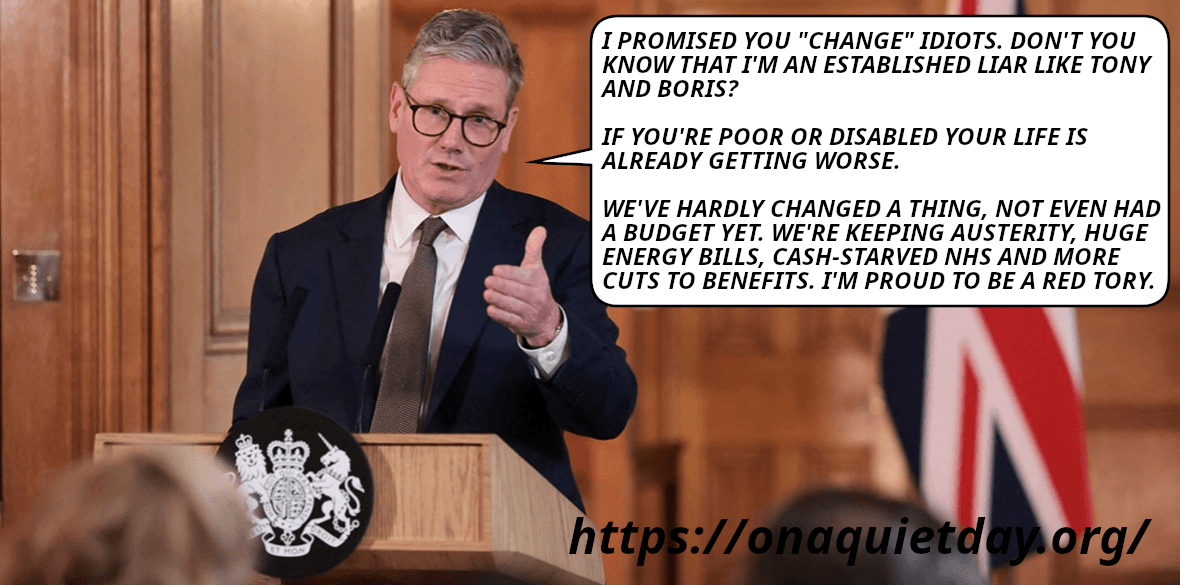
Keir Starmer confirms that he is continuing Tory policies and that he’s proud to be a red Tory.Keir Starmer says pensioners can freeze to death and poor children can starve and be condemned to failure and misery all their lives.
Starmer announces plan to stop the boats in May 2024 | Dan Kitwood/Getty Images
The UK immigration system is racist by design. The Border Security Bill will make it worse
Over the past few years of increasingly hostile migration policies, many in the migrant, including refugee, charity sector have looked to the dawn of a new government with eager anticipation. Surely, a Labour government would undo so many of these cruel anti-migration laws and mark a more ‘progressive’ chapter in migrant rights?
While the new government wasted little time in scrapping the infamous Rwanda Plan (and rightly so) it has diverted funds from that scheme into yet another anti-migrant policy in the form of the Border Security, Asylum and Immigration Bill. The announcement of this bill proves our caution was completely justified. It’s simply a continuation of the UK’s track record of enacting immigration policies that disproportionately impact people of colour.
We only have to look at the record of the last Labour government to see that they are no different to the Conservatives in embedding anti-migrant policies and rhetoric. Let’s not forget it was a Labour home secretary who first coined the term ‘hostile environment’ and it was New Labour that brought in the restrictive Immigration and Asylum Act 1999 and Nationality, Immigration and Asylum Act 2002, which laid the foundation for the hostile environment policies of the past 14 years.
In the past year itself, now-prime minister, Keir Starmer, has made plenty of not-so-subtle signs indicating what approach his government would take towards people seeking safety, including a promise to treat so-called ‘smugglers’ like “terrorists”.
Fast forward one year and these ideas have materialised in the form of the new Border Security Bill. The bill was announced as part of the King’s Speech and is part of a turn towards approaching migration through counter-terror, making space for even greater surveillance of and denial of rights for migrants, including refugees.
This dangerous bill would introduce powers previously been confined to alleged terror offenders, including travel bans and restrictions in the UK and abroad, restrictions on access to the internet and banking, and the ability to apply these measures before someone is even convicted of smuggling offences.
UK’s immigration policy has always been racist
Successive UK governments have essentially tried to ‘outdo’ each other when it comes to making the lives of migrants, including refugees, and racialised communities unbearable. In fact, these rafts of policies stem from a long history of targeting ‘unwelcome’ groups based on colonial constructions of the ‘threat’ and who are considered to be of ‘good character’.
In the Migrants’ Rights Network’s new Hostile Office report, we demonstrate that from the 1905 Aliens Act to the inhumane Migration Act 2023 (Illegal Migration Act), as well as the suffering of the Windrush victims and the government’s ability to deprive people of their citizenship, it should be evident to all of us that immigration laws are underpinned by a desire to limit the presence and freedom of racialised people in the UK.
Proposed powers in the new Border Security Bill would enable border force officers to search people and examine and seize their belongings, including copying data from and retaining people’s mobile phones, without a requirement for reasonable suspicion. It mirrors Schedule 7 of the Terrorism Act 2000, where someone can be arrested and convicted for refusing to hand over sensitive and personal information, including passcodes to devices, in addition to failing to answer all questions or refusing to provide biometric data – all without the need for reasonable suspicion.
However, implementing counter-terrorism policies into immigration is hardly surprising or new. It marks just another chapter of an increasingly cruel, racist and Islamophobic trajectory in the immigration system.
Take citizenship laws, for example. Deprivation of citizenship and counter-terror laws are linked: most cases of deprivation on ‘public good’ grounds have been justified using counter-terror legislation. We have been campaigning against the expansion of deprivation of citizenship powers and highlighting the racist, Islamophobic nature of them.
Since the 2003 ‘Hamza amendment’ to the British Nationality Act 1981 (an amendment that was passed specifically to deport one man, Abu Hamza, a naturalised British citizen), of those who have had their citizenship revoked since 2002, the majority of people affected have been British Muslims.
Our findings show that between 2002 and 2022, 85% of those stripped of their citizenship had, or were deemed to have, nationalities of countries in Africa, South Asia or West Asia (the Middle East) and 83% were from former British colonies. Of this, 41% were South Asian, all being Pakistani or Bangladeshi.
It is, therefore, not a huge leap to understand that the presence of counter-terror measures serves to limit the freedom, security and sense of belonging for racialised people in the UK, particularly those from a Muslim background.
Meanwhile, in December 2023, the Home Office published an Independent Review of Prevent’s report and the government’s response by William Shawcross (Independent Reviewer of Prevent) in which he recommended the Government explore extending Prevent into the immigration and asylum system. Make no mistake, linking the racist criminal (in)justice and counter-terror systems will further the harm and punishment to people seeking safety and a new life. It will do nothing to target the true roots of why people migrate and are forced to make dangerous border crossings.
The answer to a lack of safe routes is not further criminalisation through the introduction of counter-terror powers, which are often opaque and almost impossible to challenge. This lack of safe routes is why brokers exist, to capitalise on people’s desperation.
The Border Security Bill, and the counter-terrorism approach as part of a package deal, will just continue a long tradition of punishing people of colour at the UK border.
The video shows that Rachel Reeves intended to means test winter fuel payments in 2014. Her claims that she was forced to take this action because of the economic position inherited from the Tories is – therefore – very suspect. Labour weren’t forced to do it as she repeatedly claims – she and they intended to do it 10 years ago.
Keir Starmer says pensioners can freeze to death and poor children can starve and be condemned to failure and misery all their lives.