NATO Secretary General Jens Stoltenberg (left) and Prime Minister Rishi Sunak during a press conference at the Warsaw Armoured Brigade in Warsaw during Rishi Sunak’s visit to Poland and Germany, April 23, 2024
Leaders join forces to condemn Farage for comments on Nato expansionism
RISHI SUNAK and Sir Keir Starmer united in support of their bipartisan war policy as the row spread over Nigel Farage’s remarks blaming Nato and European Union expansion for contributing to the Ukraine conflict.
The two leaders expressed outrage that anyone would make an election issue out of the apparent drive to a wider war in Europe and Britain’s complicity in it.
But anti-war campaigners warned that the conflict could not be swept under the carpet.
Reform Party owner Mr Farage had been the first to break through the wall of silence surrounding British policy towards Russia and Ukraine during the election.
Mr Farage said: “The West’s errors in Ukraine have been catastrophic. I won’t apologise for telling the truth.”
He had told the BBC that “the ever-eastward expansion of Nato and the European Union was giving this man a reason to say to his Russian people, ‘they’re coming for us again’ and to go to war,” referring to Russian President Vladimir Putin.
Making it clear that he did not support Russia’s 2022 invasion of Ukraine, he added: “I am not, and never have been, an apologist or supporter of Putin.
“As a champion of national sovereignty, I believe that Putin was entirely wrong to invade the sovereign nation of Ukraine.
“What I have been saying for the past 10 years is that the West has played into Putin’s hands, giving him the excuse to do what he wanted to do anyway.”
The squabbling Tory Party briefly united to condemn Mr Farage.
Mr Sunak said he had played “into Putin’s hands” and former defence secretary Ben Wallace called him, somewhat irrelevantly, “a pub bore.”
Security minister Tom Tugendhat linked the Reform leader with the left, telling the press: “It doesn’t matter whether you’re Jeremy Corbyn or Nigel Farage — if you parrot the Kremlin’s lies, you cannot be trusted with our national security.”
Not to be outdone, Sir Keir huffed that Farage’s comments were “disgraceful,” adding that Ukraine was basically off-limits as a subject for political debate.
“Anyone who is standing for Parliament ought to be really clear that Russia is the aggressor, Putin bears responsibility, that we stand with Ukraine — as we have done from the beginning of this conflict — and Parliament has spoken with one voice on this since the beginning of the conflict,” the Labour leader said.
Indeed, he threatened a dozen Labour MPs with loss of the whip for expressing concern at Nato policy slightly before the 2022 invasion.
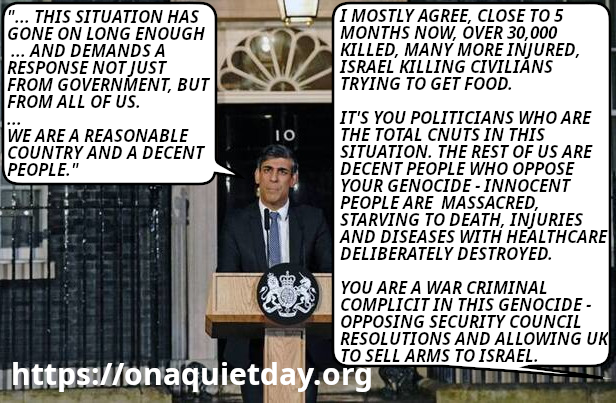
Response to Rishi Sunak’s extremism speech at Downing Street 1 March 2024. Second version of this image with text slightly altered.Zionist Keir Starmes is quoted “I support Zionism without qualification.” He’s asked whether that means that he supports Zionism under all circumstances, whatever Zionists do.
Image of InBedWithBigOil by Not Here To Be Liked + Hex Prints from Just Stop Oil’s You May Find Yourself… art auction. Featuring Rishi Sunak, Fossil Fuels and Rupert Murdoch.
… UK political parties’ plans for climate and the environment have been jointly assessed by Greenpeace and Friends of the Earth in a new election scorecard published today, which ranks Labour far ahead of the Conservatives across all key green policy categories.
Published just 10 days before voters head to the polls on July 4th, the scorecard assesses the Labour, Conservative, Liberal Democrat and Green Party manifestos released in the past fortnight against 40 policy recommendations set out by the two environmental campaign groups.
Overall, the Green Party topped the league table with a near-perfect 39 score out of a possible 40 recommended policies, ahead of the Liberal Democrats in second place with 31.5.
Labour, meanwhile, scored 20.5 against the 40 green policy recommendations, over four times higher than the Conservatives’ which scored only five points.
Rishi Sunak on stopping Rosebank says that any chancellor can stop his huge 91% subsidy to build Rosebank, that Keir Starmer is as bad as him for sucking up to Murdoch and other plutocrats and that we (the plebs) need to get organised to elect MPs that will stop Rosebank.
Neither Keir Starmer nor Rishi Sunak has any real plan to improve the lives of Disabled people | Jonathan Hordle – ITV via Getty Images
So far, we’ve heard more about Starmer and Sunak’s parents than the UK’s 16 million Disabled people
“This election is about who our country works for — the patriotic belief that Britain can be better and must be better,” said Kier Starmer concluding the first leaders’ debate earlier this month.
Yet every leadership debate so far has given more time to talking about Starmer and Rishi Sunak’s parents than these problems, which face millions of Disabled people up and down the country.
The general election campaign has solidified that neither the Labour leader nor his rival, incumbent Conservative prime minister Rishi Sunak, has any interest in improving our lives.
It is not as if the Conservatives or Labour don’t know about the issues we face. A United Nations report published in April confirmed that the UK is violating our human rights; a parliamentary committee last month found that “Disabled people undeniably encounter unnecessary and severe barriers to accessing suitable housing in England”; and the Department of Work and Pensions is under investigation by the Equality and Human Rights Commission over its treatment of Disabled claimants.
Disabled people in the UK are not a homogenous group. Some of us experience greater injustice than others. But we also have many things in common. We all want to live in an inclusive society where everyone has a fulfilling life and feels connected and valued.
We know politicians do not place the same worth on our lives as others; every day we experience discrimination, oppression and barriers to our inclusion and full participation in society because they won’t take the action needed to change it.
Years of deep cuts to services and neglect mean societal infrastructure, such as housing, transport and street environment, consistently fails to meet our needs. This structural decline has coincided with anti-migrant, anti-trans and racist policies, leaving ever-increasing numbers of us in poverty, homeless, incarcerated or dead.
The UN report was clear: “There has been no significant progress for Disabled people throughout the UK concerning their right to living independently and being included in the community.
“While some reforms and policies have been undertaken to provide financial support, accessible housing, and transport, this has been inadequate considering the cost-of-living crisis.”
One would expect this damning conclusion to be a key feature of the election campaign. But over the past four weeks, Labour and the Tories have both failed to provide anything of substance to help Disabled people.
Sunak’s Conservatives have instead pledged to shave £12bn a year from the cost of benefits, much of which would come from a crackdown on the personal independence payment (PIP) given to people with extra care or mobility needs. The party also seeks to tighten the work capability assessment (WCA), which would see more Disabled people declared fit to work and denied their benefit.
Labour’s manifesto, meanwhile, is notable for what it lacks. Previous promises to overhaul the welfare system, end punitive sanctions and co-produce disability-related policy with Disabled people are all missing – as are commitments to end care charges, increase carers’ allowance and ensure better provision of accessible housing.
Labour’s vows to improve SEN (special education needs) provision in schools and introduce changes to support Disabled people to gain and retain jobs are sticking plasters at best. Its manifesto sports a glaring lack of immediate investment in disability and carer benefits and social care – and we all know you can’t fix things without investment.
With so little real change on offer, Disabled people must unite and fight back. We can draw inspiration from the experiences of UK-based Disabled activists and the radical disabled resistance of the past 40 years. No changes affecting us have come through without collective struggle and organising.
As part of the DPO Forum England, a collective of Disabled people’s organisations in England, we are committed to joining forces nationwide and unifying our demands. That’s why we came together to create the Disabled People’s Manifesto, which contains radical policy demands for systemic overhaul and transformation.
We, as Disabled people, must now come together and demand our politicians take up the manifesto and commit to creating a country that values equity, dignity, respect, trust, and support as much as we value anything else. Our political system should be focused on supporting Disabled people to live the lives we have a right to, which no candidate sweating under the bright studio lights can deliver on their own.
Together, we can create space for ourselves and our ideas, and integrate the energy, dedication and skills of our community to create a new future.
Palestinians inspect the damage following an Israeli airstrike on the El-Remal aera in Gaza City on October 9, 2023. Israel continued to battle Hamas fighters on October 10 and massed tens of thousands of troops and heavy armour around the Gaza Strip after vowing a massive blow over the Palestinian militants’ surprise attack. Photo by Naaman Omar apaimages. licensed under the Creative Commons Attribution-Share Alike 3.0 Unported license.
Britain is complicit in mass slaughter on a horrifying scale. But those campaigning for our votes pretend it’s not happening
…
This week alone, Israel has threatened “all out war” with Lebanon, while Hezbollah’s leader threatens a war “without rules or ceilings”, dangling the prospect of a far graver bloodbath than that unleashed by Israel’s genocidal rampage in Gaza. The spokesperson of the Israel Defense Forces has admitted that Hamas cannot be destroyed militarily: this amounts to a confession that the central war goal used to justify the slaughter of tens of thousands is unattainable. And the UN has released a report offering evidence as to how Israel’s bombing campaign in Gaza may have systematically violated the laws of war on protecting civilians and civilian infrastructure.
Remember: this is an onslaught that Britain’s government and opposition squarely backed at the start. Back in October, our prime minister promised “unequivocal” support for Israel for all time, while his inevitable successor, Keir Starmer, backed Israel’s right to cut off energy and water, though he later claimed he had been misinterpreted, and had never supported this. Neither political party will commit to ending arms sales, even though the chief prosecutor of the international criminal court – himself a British lawyer – has requested arrest warrants for both the Israeli prime minister, Benjamin Netanyahu, and his defence minister, Yoav Gallant, for alleged war crimes and crimes against humanity. This itself points to what should be a major domestic political scandal. Both party leaders should be scrutinised for having backed what became one of the great atrocities of our age, despite the bloodcurdling promises made by Israeli leaders from the start.
…
Given that this is a question of life and death on a colossal scale, our politicians should be forced to answer. Yet when our foreign secretary, David Cameron, was interrogated last week on the BBC Today programme, the interviewer spent the slot questioning him about trust and housebuilding. On Thursday night’s BBC Question Time leaders’ special, there was not a single question or answer on Gaza.
Of course, straight after 7/10, mainstream journalists were quick to promote the deployment of planes and personnel to support “our ally” in the region.
While the Sun splashed photos of British jets and frigates heading to the eastern Mediterranean with the headline “United We Stand”, the BBC basically reproduced a Ministry of Defence press release in its story, “UK to deploy Royal Navy ships to Middle East to ‘bolster security’.”
On 2 December, the Ministry of Defence released a short statement on UK military activity in the region, ostensibly to secure the release of (only) Israeli hostages.
The BBC, along with other news outlets, immediately ran a story repeating the MoD’s words verbatim (with a sprinkling of additional text from the Pentagon) as if these were to be innocent “surveillance flights” despite the fact that over 15,000 Palestinians had already been killed in brutal air strikes since 7/10.
This was followed by a flurry of highly bullish coverage of two further military interventions directly related to bolstering UK support for Israel – evidence of the “extensive defence and security cooperation” between the two countries that was embedded in the ‘Roadmap’ agreement signed in 2023 (and ignored by the media).
…
Censorship by omission
This lack of interest in the British government’s military links to Israel shouldn’t suggest, however, that there is nothing to investigate.
Indeed, Declassified UK has published multiple stories on the more opaque actions of the UK government that have been largely ignored by mainstream news including the deployment of a British spy team in Israel since 7/10, the dozens of flights by UK military aircraft to Israel in this period, the surveillance activities in support of Israel and the training of Israeli military personnel in the UK. Almost none of these have been followed up in broadcast bulletins and articles.
There is one area, however, in which the media do appear to have engaged with this topic: British arms sales to Israel that, according to the Campaign against Arms Trade, amount to £576 million since 2008.
That there were 2,648 stories mentioning “arms sales to Israel” and “UK” between 7 October and 19 June 2024 might suggest this is a major area of concern for journalists.
Not so fast. 85% of all stories appeared after 1 April when three UK citizens were among seven aid workers killed when Israeli jets attacked the food convoy they were managing.
For the 177 days between 7/10 and 1 April, the media (with the exception of the Scottish National, Guardian and BBC Parliament) showed little inclination to open up discussion on the issue.
Despite serious concerns that, through its exports of weapons to the Israeli military, the UK is complicit in ongoing war crimes, major news outlets only started to show an interest in the topic once British people, not Palestinians, were the story.
…
Response to Rishi Sunak’s extremism speech at Downing Street 1 March 2024. Second version of this image with text slightly altered.Zionist Keir Starmes is quoted “I support Zionism without qualification.” He’s asked whether that means that he supports Zionism under all circumstances, whatever Zionists do.