Morning Star: Fight the far right to commemorate the D-Day heroes
Republished from https://morningstaronline.co.uk/article/editorial-fight-far-right-commemorate-d-day-heroes
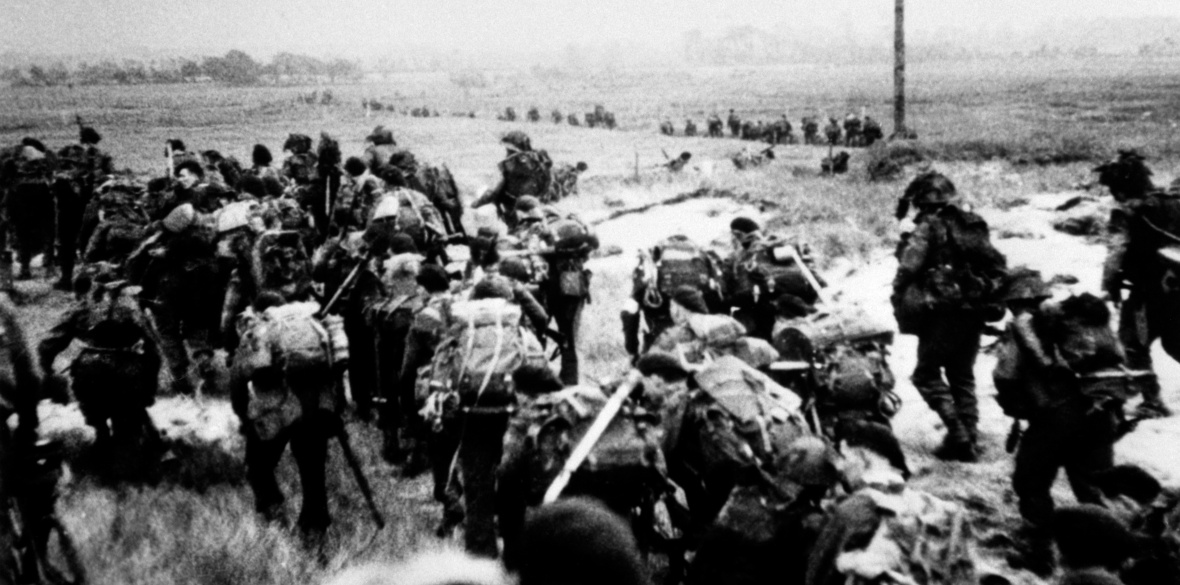
WITH the Tories and Labour exchanging blame over Channel crossings, we mark 80 years since a Channel crossing of a different kind.
On June 6 1944 British, US and allied troops crossed the Channel to open a second front against the Nazis in Europe, something the Soviet Union, which had borne the brunt of the war against fascism for the previous three years, had long urged.
Veterans are arriving in Normandy for commemorations of this heroic chapter in Europe’s liberation. Modern hostilities overshadow celebration of the anti-Nazi alliance of the 1940s, with the US and Britain criticising France for inviting Russia because of its invasion of Ukraine, though they themselves have never been excluded from World War II memorials while laying waste to countries from Vietnam in the cold war to Afghanistan, Iraq and Libya more recently.
These diplomatic divisions raise a question we should be asking our own politicians. Have you any right to claim the inheritance of anti-fascist victory if you are dismantling its achievements?
The world war against fascism was the crucible of international institutions as we know them today. The United Nations was established in a joint declaration by Britain, the United States, the Soviet Union and China on January 1 1942: it formalised the alliance against the Axis powers Germany, Italy and Japan, and a condition of membership was to declare war against Nazi Germany and its allies.
The foundation of the UN and new treaties like the Geneva Conventions of 1949 (on the conduct of war) and 1951 (on the treatment of refugees) expressed hope that a more civilised world order would stop any future descent into Nazi barbarism.
These agreements are not perfect, and powerful countries have often ignored them. But their existence is a legacy of the sacrifice made by those who gave their lives to smash fascism on D-Day, or at the battles of Stalingrad or Berlin, or among the heroic resistance movements that sprang up across Nazi-occupied Europe.
Politicians talk now as if the rules are outdated: the refugee conventions were drawn up by people who couldn’t conceive of the scale of “irregular” migration today. It isn’t true: World War II and its aftermath saw huge population displacement, the uprooting of millions of people. The Refugee Convention of 1951 set out universal obligations to refugees because of these horrific experiences.
Those obligations are ones governments across Europe, including ours, are trying to erase. The end of EU search-and-rescue operations, the active persecution of civil rescue crews by states like Italy, have fatally undermined the binding responsibility to aid anyone in distress at sea. The odious Nigel Farage clearly approves, having insulted brave volunteer lifeboat crews by calling the Royal National Lifeboat Institution a “migrant taxi service” for presuming to save people from drowning.
Farage has never yet been elected, but his ability to call the tune at Westminster is as great as ever if the first leaders’ debate is anything to go by: with Labour’s Keir Starmer calling Rishi Sunak, the PM of the Rwanda deportations scheme and the Bibby Stockholm prison barge, “the most liberal prime minister we have ever had on immigration.”
This is gutter politics, and a betrayal of what the D-Day heroes fought for. But so, at home, is the systematic destruction of the NHS and welfare state built after defeating fascism, fruits of a victorious people’s war and a recognition that fascism had emerged from a Europe wracked by poverty and unemployment.
It is no coincidence that today, with living standards falling, public services failing and the brazen theft of our wealth by an ever smaller corporate elite, the far-right politics of grievance and hate are on the march across the continent.
The real commemoration of D-Day must be to mobilise against them. For peace and socialism, against fascism and war.
Republished from https://morningstaronline.co.uk/article/editorial-fight-far-right-commemorate-d-day-heroes
More than 200 Labour members call on party to reconsider Kemptown selection

Hundreds of local Labour members have called on their party to reconsider parachuting in a candidate after the Kemptown MP was unexpectedly barred from standing.
More than 200 people have signed a petition started by the Kemptown and Peacehaven Constituency Labour Party (CLP) ahead of a meeting where new candidate Chris Ward’s selection is set to be rubber stamped.
Mr Ward was announced as the new candidate last week, just a day after the previous MP Lloyd Russell-Moyle was suspended over unspecified allegations dating from 2016.
Journalist Michael Crick, who has been chronicling all the main parties’ selections, tweeted on Thursday afternoon that he was likely to get the seat – before another potential candidate. Nancy Platts, had even been interviewed.
Ms Platts, who has previously been leader of Brighton and Hove City Council and a parliamentary candidate in the same seat, called for an investigation into the fairness of the process.
…
7 Labour Councillors quit party over Faiza Shaheen deselection and ‘institutional racism’

“This purging of loyal members in favour of subservient candidates reflects a party more concerned with power than principles.”
The row over Labour’s last minute deselection of general election candidates continues to rumble on. In a new development, seven Labour Councillors in Slough have quit the party over, among other things, the decision to block Faiza Shaheen from standing as a Labour candidate.
In a letter published on June 3, the seven Councillors cite a number of reasons for their decision including concerns over the democratic processes in the Labour Party. They go on to write that the deselection of Shaheen and the treatment of Diane Abbott “highlight the institutional racism within the party”.
They added: “This purging of loyal members in favour of subservient candidates reflects a party more concerned with power than principles. Slough [Constituency Labour Party], predominantly composed of BAME members, has faced threads of deselection for speaking out against injustices in Gaza and criticising Israel.”
Their letter concludes by saying: “We have exhausted every party mechanism to ensure our residents’ concerns were heard at both local and national levels. In light of these insurmountable barriers, we, the rank-and-file members, are left with no option but to resign. We must stay true to our values and conscience, even if the party we once believed in has abandoned them.”
…
Greens call for real change to deliver energy security

Responding to Labour’s announcement on energy and security, Green Party co-leader Adrian Ramsay said:
“The road to national energy security must lead to real change – a turn away from fossil fuels and a massive investment in renewable energy generation and energy saving programmes like home insulation delivered through local authorities right across the country.
“Anything less – and Labour is offering much less – will leave people with higher bills and do nothing to solve the climate crisis that is leaving communities up and down the land vulnerable.
“It is Labour’s lack of ambition and refusal to make the real change needed that is leaving us all less secure.
“Compared to Labour’s original commitment to spend £28bn a year on green investment, Labour plans to spend just £8.3bn over the course of the parliament.
“That is nowhere near enough to deliver energy security.
“Labour’s targets focus on the electricity supply. However, to achieve net zero we need to see the electrification of home heating. This aim was ditched when Labour cancelled its £28 billion investment pledge.”