Morning Star Editorial: We can and must force the government to change course on Israel

Spread the love

https://morningstaronline.co.uk/article/editorial-we-can-and-must-force-the-government-to-change-course-on-israel

Palestinian children play next to buildings destroyed by Israeli army strikes in Khan Younis, Gaza Strip, January 7, 2025

PRESSURE continues to mount on the government over its backing for Israel and its failure to take any serious measures to impede its genocide of the Palestinian people.

MPs from all parts of the Commons united at the first opportunity in the new year to demand that ministers act.

Even many Tory backbenchers — although not Kemi Badenoch’s front bench — seem disgusted at Britain’s continuing complicity with Israeli war crimes.

Vocal support for Israel seems to be draining away on the Labour back benches, while Liberal Democrat, SNP, Green and independent MPs are more-or-less united in urging a change of course.

There are several concrete actions they are demanding that the government should take.

First is an end to all arms sales to the Israeli regime. So far the government has only suspended a minority of the licences which permit the export of British military equipment to Israel.

Yet there is now little room for doubt that the Israeli military is engaging in war crimes daily and is in continual breach of international law.

Continuing to supply the Israeli war machine with equipment makes ministers themselves culpable for the consequences.

Article continues at https://morningstaronline.co.uk/article/editorial-we-can-and-must-force-the-government-to-change-course-on-israel

Experiencing issues with this image not appearing. I suspect because it's so critical of Zionist Keir Starmer's support of and complicity in Israel's genocides.
Genocide denier and Current UK Prime Minister Keir Starmer is quoted that he supports Zionism without qualification. He also confirms that UK air force support has been essential in Israel’s mass-murdering genocide. Includes URLs https://www.declassifieduk.org/keir-starmers-100-spy-flights-over-gaza-in-support-of-israel/ and https://youtu.be/O74hZCKKdpA
UK Foreign Minister David Lammy confirms that UK government and military are active participants in Israel’s genocides and that the F-35 parts that they suspended from supplying to Israel are instead simply diverted via the United States. He says see https://youtu.be/QILgUHrdWRE
Continue ReadingMorning Star Editorial: We can and must force the government to change course on Israel

From a Trump presidency to ‘game-changing’ lawsuits: Seven big climate and nature moments coming in 2025

Spread the love

[I’m only able to quote a small part of this copyrighted article, read it here.]

https://www.bbc.com/future/article/20250107-the-key-climate-and-nature-moments-to-look-out-for-in-2025

Donald Trump has voiced plans to withdraw the US from the Paris Agreement, and possibly from the entire UNFCCC, after assuming the US presidency this year (Credit: Getty Images)

Yearlong: Extreme weather continues

As these global opportunities to make a difference on climate roll around, there is another certainty running through the calendar year: climate-driven extreme weather. 

In 2024, billions of people around the world experienced heatwaves and extreme weather, including deadly floods in Spainhurricanes in the US and severe drought in the Amazon. In fact, 2024 was the hottest year on record, with global temperatures breaching the critical 1.5C threshold for a full year for the first time. 

As long as we continue to burn fossil fuels, headlines in 2025 and beyond will continue to be dominated by large death tolls, suffering and destruction due to ever more extreme weather events – Friederike Otto

What’s harder to know is exactly when disasters will hit. But 2025 is also expected to be a scorcher: it will be one of the three hottest years on record globally, according to an outlook from the UK’s Met Office, falling just behind 2024 and 2023. Warm temperatures are forecast in 2025 despite the Pacific Ocean moving into a La Niña phase, in which sea surface temperatures are lower than usual and conditions overall are cooler. 

“Years such as 2025, which aren’t dominated by the warming influence of El Niño, should be cooler,” Adam Scaife, head of long-range prediction at the Met Office, stated in the outlook. 

Still, the Met Office expects average global temperature in 2025 to be 1.29C to 1.53C above pre-industrial temperatures. 

The world experienced an additional 41 days of dangerous heat due to climate change last year, according to a report by the World Weather Attribution group at Imperial College London, and the non-profit Climate Central.

Friederike Otto, who leads World Weather Attribution group, says the La Niña predictions mean 2025 “might be cooler than 2024” but argues “this is really irrelevant” if natural climate variability is masking the overall warming trend. 

https://www.bbc.com/future/article/20250107-the-key-climate-and-nature-moments-to-look-out-for-in-2025

Continue ReadingFrom a Trump presidency to ‘game-changing’ lawsuits: Seven big climate and nature moments coming in 2025

Repression of climate and environmental protest is intensifying across the world

Spread the love
Image of a Just Stop Oil participant getting arrested at Kingsbury oil terminal.
A Just Stop Oil participant getting arrested at Kingsbury oil terminal. A JSO / Vladamir Morozov image.

Oscar Berglund, University of Bristol and Tie Franco Brotto, University of Bristol

Climate and environmental protest is being criminalised and repressed around the world. The criminalisation of such protest has received a lot of attention in certain countries, including the UK and Australia. But there have not been any attempts to capture the global trend – until now.

We recently published a report, with three University of Bristol colleagues, which shows this repression is indeed a global trend – and that it is becoming more difficult around the world to stand up for climate justice.

This criminalisation and repression spans the global north and south, and includes more and less democratic countries. It does, however, take different forms.

Our report distinguishes between climate and environmental protest. The latter are campaigns against specific environmentally destructive projects – most commonly oil and gas extraction and pipelines, deforestation, dam building and mining. They take place all around the world.

Climate protests are aimed at mitigating climate change by decreasing carbon emissions, and tend to make bigger policy or political demands (“cut global emissions now” rather than “don’t build this power plant”). They often take place in urban areas and are more common in the global north.

Greenpeace cover Rishi Sunak's home in black oily fabric in protests at Sunak's intended huge expansion of North Sea fossil fuel exploration.
Greenpeace cover Rishi Sunak’s home in black oily fabric in protests at Sunak’s intended huge expansion of North Sea fossil fuel exploration. Image © Greenpeace.

Four ways to repress activism

The intensifying criminalisation and repression is taking four main forms.

1. Anti-protest laws are introduced

Anti-protest laws may give the police more powers to stop protest, introduce new criminal offences, increase sentence lengths for existing offences, or give policy impunity when harming protesters. In the 14 countries we looked at, we found 22 such pieces of legislation introduced since 2019.

2. Protest is criminalised through prosecution and courts

This can mean using laws against climate and environmental activists that were designed to be used against terrorism or organised crime. In Germany, members of Letzte Generation (Last Generation), a direct action group in the mould of Just Stop Oil, were charged in May 2024 with “forming a criminal organisation”. This section of the law is typically used against mafia organisations and had never been applied to a non-violent group.

In the Philippines, anti-terrorism laws have been used against environmentalists who have found themselves unable to return to their home islands.

Criminalising protest can also mean lowering the threshold for prosecution, preventing climate activists from mentioning climate change in court, and changing other court processes to make guilty verdicts more likely. Another example is injunctions that can be taken out by corporations against activists who protest against them.

3. Harsher policing

This stretches from stopping and searching to surveillance, arrests, violence, infiltration and threatening activists. The policing of activists is carried out not just by state actors like police and armed forces, but also private actors including private security, organised crime and corporations.

In Germany, regional police have been accused of collaborating with an energy giant (and its private fire brigade) to evict coal mine protesters, while private security was used extensively in policing anti-mining activists in Peru.

4. Killings and disappearances

Lastly, in the most extreme cases, environmental activists are murdered. This is an extension of the trend for harsher policing, as it typically follows threats by the same range of actors. We used data from the NGO Global Witness to show this is increasingly common in countries including Brazil, Philippines, Peru and India. In Brazil, most murders are carried out by organised crime groups while in Peru, it is the police force.

Protests are increasing

To look more closely at the global picture of climate and environmental protest – and the repression of it – we used the Armed Conflicts Location Event database. This showed us that climate protests increased dramatically in 2018-2019 and have not declined since. They make up on average about 4% of all protest in the 81 countries that had more than 1,000 protests recorded in the 2012-2023 period:

Graph
Climate protests increased sharply in the late 2010s in the 14 countries studied. (Data is smoothed over five months; number of protests is per country per month.) Berglund et al; Data: ACLED, CC BY-SA

This second graph shows that environmental protest has increased more gradually:

Graph
Environmental protests in the same 14 countries. Data: ACLED, CC BY-SA

We used this data to see what kind of repression activists face. By looking for keywords in the reporting of protest events, we found that on average 3% of climate and environmental protests face police violence, and 6.3% involve arrests. But behind these averages are large differences in the nature of protest and its policing.

A combination of the presence of protest groups like Extinction Rebellion, who often actively seek arrests, and police forces that are more likely to make arrests, mean countries such as Australia and the UK have very high levels of arrest. Some 20% of Australian climate and environmental protests involve arrests, against 17% in the UK – with the highest in the world being Canada on 27%.

Meanwhile, police violence is high in countries such as Peru (6.5%) and Uganda (4.4%). France stands out as a European country with relatively high levels of police violence (3.2%) and low levels of arrests (also 3.2%).

In summary, while criminalisation and repression does not look the same across the world, there are remarkable similarities. It is increasing in a lot of countries, it involves both state and corporate actors, and it takes many forms.

This repression is taking place in a context where states are not taking adequate action on climate change. By criminalising activists, states depoliticise them. This conceals the fact these activists are ultimately right about the state of the climate and environment – and the lack of positive government action in these areas.

Oscar Berglund, Senior Lecturer in International Public and Social Policy, University of Bristol and Tie Franco Brotto, PhD Candidate, School for Policy Studies, University of Bristol

This article is republished from The Conversation under a Creative Commons license. Read the original article. [Accompanying images are selected by dizzy deep of https://onaquietday.org.]

Youth Demand shit in Rishi Sunak's private lake 25/6/24
Youth Demand shit in Rishi Sunak’s private lake 25/6/24

Continue ReadingRepression of climate and environmental protest is intensifying across the world

Trump Won’t Rule Out Military Force to Seize Control of Panama Canal, Greenland

Spread the love

Original article by Julia Conley republished from Common Dreams under Creative Commons (CC BY-NC-ND 3.0). 
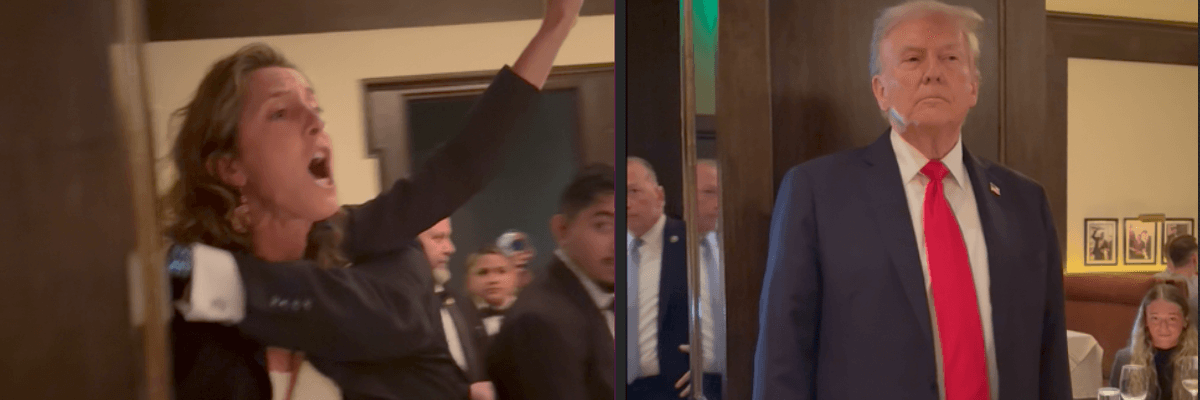
People demonstrate against U.S. President-elect Donald Trump in Panama City, Panama on December 31, 2024, as the country marks the 25th anniversary of the United States’ handover of the Panama Canal. (Photo: Arnulfo Franco/AFP via Getty Images)

Trump claimed both the canal and the Danish territory are needed for U.S. “economic security.”

U.S. President-elect Donald Trump has been rebuked in recent days by the leaders of both Panama and Denmark for his insistence that the Panama Canal and Danish territory Greenland must be under American control, and his latest comments on Tuesday were expected to garner more anger—and eye-rolling—from abroad.

At a press conference at his Florida resort, Mar-a-Lago, the Republican leader refused to rule out using military force to take over the canal and Greenland.

“It might be that you’ll have to do something. The Panama Canal is vital to our country,” said Trump. “We need Greenland for national security purposes.”

He added that both the canal and Greenland, the world’s largest island and home to a U.S. military base, are needed for U.S. “economic security.”

https://twitter.com/cspan/status/1876678479053259091?ref_src=twsrc%5Etfw%7Ctwcamp%5Etweetembed%7Ctwterm%5E1876678479053259091%7Ctwgr%5E1af877e8e497c3f3120f46d71803440dd1f466b5%7Ctwcon%5Es1_c10&ref_url=https%3A%2F%2Fwww.commondreams.org%2Fnews%2Fpanama-canal-importance-us-history

Sorry, this content could not be embedded.

X

Under President Jimmy Carter, who died late last month, the U.S. signed a treaty returning the Panama Canal Zone to Panama in 1979, and the waterway connecting the Atlantic and Pacific Oceans has been solely controlled by the Panamanian government since 1999.

Trump repeated a false claim that the canal is being “operated by China.”

Last month, after the president-elect demanded “that the Panama Canal be returned to the United States of America in full, quickly and without question,” Panamanian President José Raúl Mulino posted a video to social media in response.

“As president, I want to clearly state that every square meter of the Panama Canal and its adjoining zone is Panama’s and will remain so,” Mulino said. “The sovereignty and independence of our country is non-negotiable.”

Trump’s comments came as his son, Donald Trump Jr., joined right-wing activist Charlie Kirk and other Trump allies on a visit to Greenland.

The president-elect suggested in a social media post that the trip was made in an official capacity, writing: “The reception has been great. They, and the Free World, need safety, security, strength, and PEACE! This is a deal that must happen. MAGA. MAKE GREENLAND GREAT AGAIN!”

But Greenland officials clarified that Trump Jr. was visiting only as a “private individual” and said no representatives would be meeting with him.

Trump said at his press conference that “people really don’t even know if Denmark has any legal right to [Greenland], but if they do they should give it up because we need it for national security.”

Greenland is home to 60,000 people, and is self-ruling with its own legislature while its foreign and defense policy are controlled by Denmark. The Arctic island lies in a region where global powers are vying for military and economic control.

Trump also expressed a desire to purchase Greenland during his first term, a goal that was dismissed at the time as “absurd” by Danish Prime Minister Mette Frederiksen.

“Greenland belongs to the Greenlanders,” Frederiksen reiterated on Tuesday.

Original article by Julia Conley republished from Common Dreams under Creative Commons (CC BY-NC-ND 3.0). 

Continue ReadingTrump Won’t Rule Out Military Force to Seize Control of Panama Canal, Greenland

The far right’s dangerous new playbook for 2025

Spread the love

https://morningstaronline.co.uk/article/far-rights-dangerous-new-playbook-2025

RISING RIGHT: Activists wearing masks of far-right politicians (L-R) Marine Le Pen, former Polish Prime Minister Mateusz Morawiecki, Vox leader Santiago Abascal, Hungarian Prime Minister Viktor Orban and Italian Prime Minister Giorgia Meloni protest before the EU elections, Madrid, May 19 2024

Driven on by novel forms of hard-right populism like Modi and Trump, European neofascists are skillfully rebranding themselves and taking power by copying the left’s language — just as they did in the last century, writes JOHN GREEN

AROUND the world, we have been witnessing the rise of new right-wing and neofascist political forces at the same time as we have experienced the demise or marginalisation of strong left-wing forces.

We face a new and more virulent Donald Trump presidency in the US, we have seen the success of Giorgio Meloni’s Fratelli d’Italia party in Italy, Modi’s fundamentalist Hinduism in India, Javier Milei’s neoliberal extremism in Argentina, Victor Orban’s authoritarian regime in Hungary and the jack-in-the-box rise of Nigel Farage, who sees himself as a prime minister in waiting, here in Britain.

The right loves using the German fascists’ full name, National Socialist German Workers Party, rather than the shortened term Nazi in order to deliberately conflate fascism with socialism and communism in the public’s mind.

As we know, Hitler only belatedly incorporated the term socialist into his party’s name in order to sow confusion and win over working-class voters, which he managed to do very successfully. The National Socialists were soon demasked as firm upholders of rampant capitalism, not socialism.

Of course, drawing comparisons between 1930s Germany and our world today can be dangerous, but there are undoubted parallels from which we can learn. Once again, world capitalism is in a deep crisis, and fascism is seen in some quarters, once again, as offering an apparent way out.

Just as the Nazis did, the neofascists today, recognising the widespread anger among large sections of the population at the way the super-wealthy are destroying our societies with impunity, are pretending to attack the unaccountable oligarchs and super-wealthy tech CEOs, big pharma and authoritarian government.

This is, however, mere rhetoric in order to win over the disaffected working classes; they have no intention of doing anything about the super-rich and tech monopolies who are or will be funding them.

I recommend this article at https://morningstaronline.co.uk/article/far-rights-dangerous-new-playbook-2025. I didn’t understand the reference to Tucker Carlson.

Continue ReadingThe far right’s dangerous new playbook for 2025