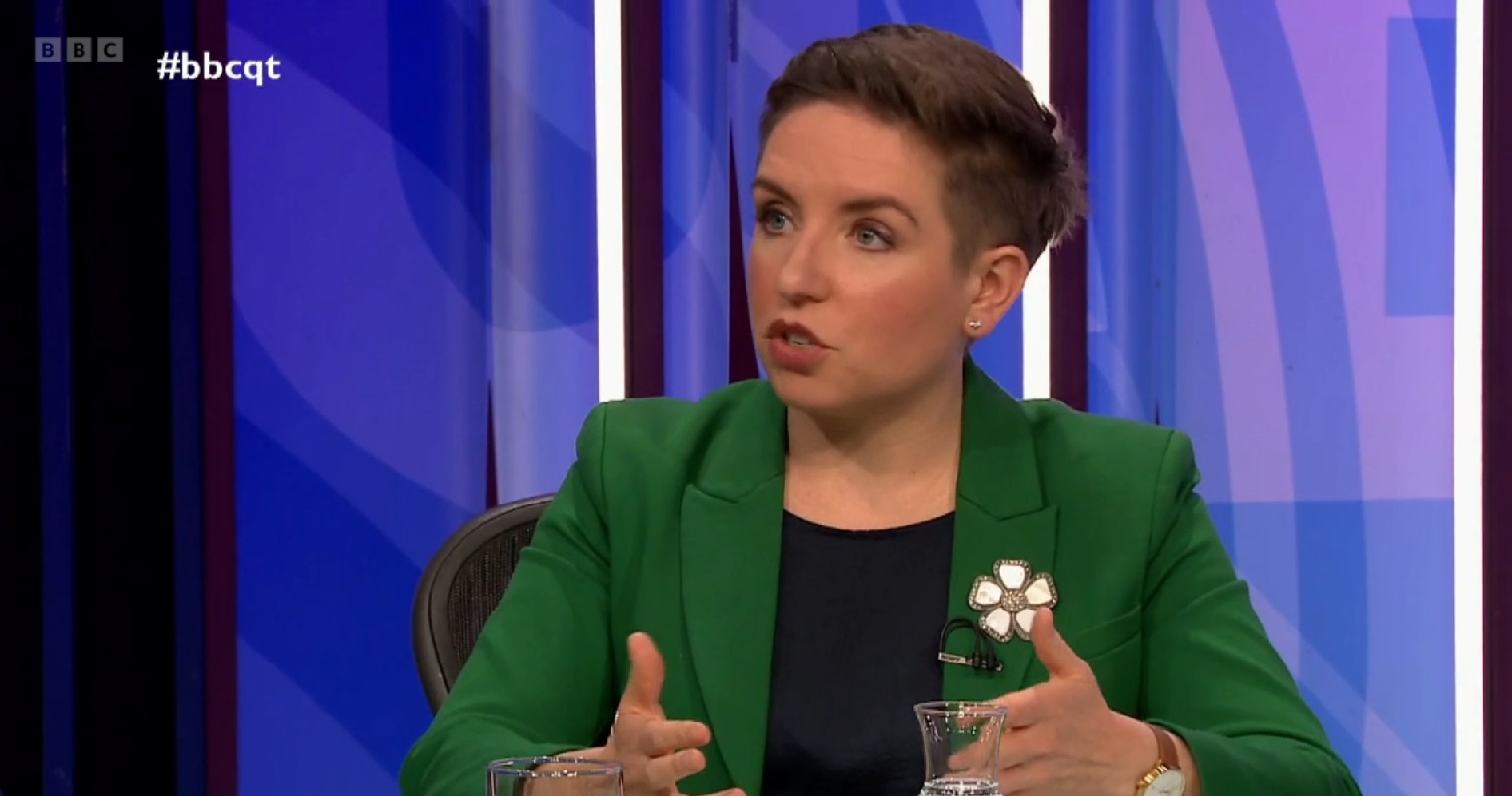
Image of the Green Party’s Carla Denyer on BBC Question Time.
“Energy bills up to nearly £2000 a year. Water bills up by 31% in some areas. Basic food prices keep rising – the list goes on. People aren’t fooling around when they say today is the start of “Awful April”. Especially awful for single parents who we know will be hit hardest by these price hikes.
“These spiralling costs come on the back of axing winter fuel payments for pensioners, refusing to remove the two-child benefit cap and cutting benefits for the sick and disabled.
“These are political choices. Rather than making the poorest and most vulnerable in society bear the brunt of the cost of living crisis, Labour could have chosen instead to tax a tiny percentage of the wealth of multi-millionaires and billionaires. They’ve made a choice, to take money off the old, ill and disabled.
“Labour have again and again made the wrong choices, which has left many of the poorest households at breaking point.”
Keir Starmer says that his Labour Party is intensely relaxed about assaulting the very poorest and most vulnerable.
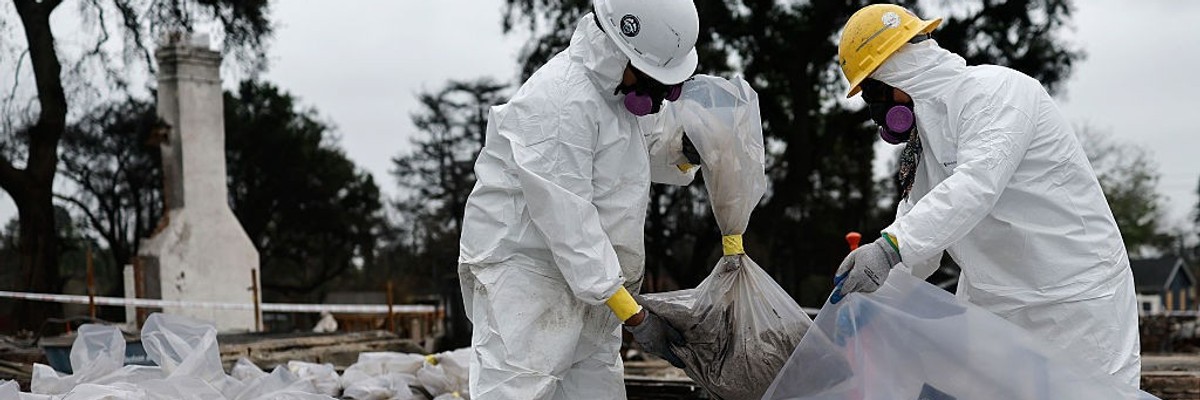
U.S. Army Corps of Engineers contractors in protective gear remove hazardous materials from a home destroyed in the Eaton Fire on March 26, 2025 in Altadena, California. (Photo: Mario Tama/Getty Images)
“We’ve got to work fast to end fossil fuel operations near our homes, schools, and hospitals and trade fossil fuel infrastructure for healthy, clean energy,” said one co-author.
“The evidence is clear that fossil fuels—and the fossil fuel industry and its enablers—are driving a multitude of interlinked crises that jeopardize the breadth and stability of life on Earth.”
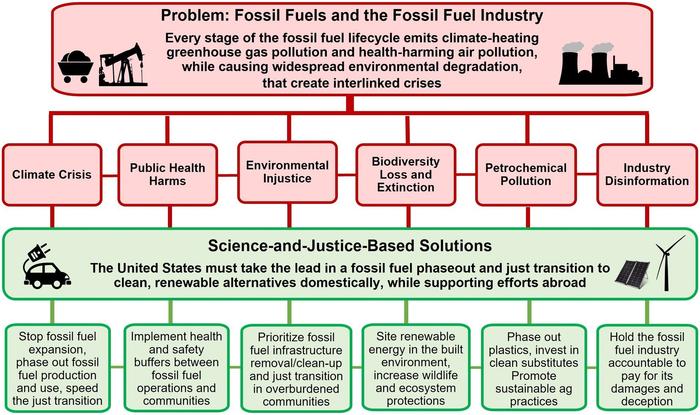
That’s the first line of the abstract for an article published Monday by top scientists who reviewed “the vast scientific evidence showing that fossil fuels and the fossil fuel industry are the root cause of the climate crisis, harm public health, worsen environmental injustice, accelerate biodiversity extinction, and fuel the petrochemical pollution crisis.”
The new paper in the peer-reviewed journal Oxford Open Climate Change highlights the diverse impacts of “every stage of the fossil fuel life cycle” and stresses that the “industry has obscured and concealed this evidence through a decadeslong, multibillion-dollar disinformation campaign aimed at blocking action to phase out” its deadly products.
“The fossil fuel industry has spent decades misleading us about the harms of their products and working to prevent meaningful climate action,” said co-author Naomi Oreskes, professor of the history of science at Harvard University, in a statement. “Perversely, our governments continue to give out hundreds of billions of dollars in subsidies to this damaging industry. It is past time that stops.”
“The most polluted communities should be prioritized for clean energy investments and removal and cleanup of dirty fossil fuel infrastructure.”
While the researchers focused on the United States, “as the world’s largest oil and gas producer and dominant contributor to these fossil fuel crises,” their review—including proposed “science-and-justice-based solutions” for an economywide effort to “forge a path forward to sustaining life on Earth”—applies to the whole world, which is quickly heating up due to emissions from coal, gas, and oil.
The article features sections on the fossil fuel-driven climate crisis, public health harms, environmental injustice, biodiversity loss and extinction, petrochemical pollution, and industry disinformation. Each section lays out the “problem” and “solutions.”
The climate emergency section includes details such as “the production and combustion of oil, gas, and coal are responsible for nearly 90% of human-caused carbon dioxide (CO2) emissions and approximately 79% of total greenhouse gas emissions,” and “failures in political will to implement necessary climate action have made the 1.5°C benchmark nearly impossible to achieve without overshoot,” referring to a primary goal of the 2015 Paris agreement.
Although the current U.S. administration has demonstrated its alliance to the fossil fuel industry—including with President Donald Trump’s recent energy emergency declaration—the scientists still emphasized what’s possible in the country.
“In the USA, powerful policy levers are available to governments and civil society at the local, state, national, and international levels to phase out fossil fuels and transition to a clean, renewable energy economy,” they wrote. “These levers include regulation (e.g. applying and enforcing existing laws), legislation (e.g. polluters pay laws, fossil fuel subsidy reform, land use laws limiting drilling), and litigation (e.g. holding fossil fuel companies accountable, defending existing law).”
They also warned that “last-ditch efforts to prolong the fossil fuel industry are proliferating. These include counterproductive false solutions, like carbon capture and storage (CCS), which would perpetuate fossil fuel use while capturing only some of the resulting emissions, and hydrogen made from fossil fuels.”
The public health section notes that “air pollution from fossil fuel combustion accounts for 8.7 million (equaling 1 in 5) premature deaths per year worldwide and 350,000 premature deaths per year in the USA. In a single year, air pollution from oil and gas production in the USA resulted in 410,000 asthma exacerbations, 2,200 new cases of childhood asthma, and 7,500 premature deaths in 2016.”
Co-author David J.X. González, an assistant professor of environmental health sciences at the University of California, Berkeley, said Monday that “we’ve got to work fast to end fossil fuel operations near our homes, schools and hospitals and trade fossil fuel infrastructure for healthy, clean energy.”
“Oil, gas, and coal will continue to condemn us to more deaths, wildlife extinctions, and extreme weather disasters unless we make dirty fossil fuels a thing of the past.”
The paper points out that “climate change is increasing incidence of physical and mental health impacts and mortality through multiple pathways: worsening extreme events including heatwaves, severe storms, floods, droughts, and wildfires; shifting ranges of disease vectors; threats to food security; and displacement and forced migration, which restrict access to healthcare and other basic services.”
“These harms, though broadly felt, also disproportionately impact marginalized communities which are already disproportionately burdened by other socioenvironmental hazards, as well as susceptible populations including young children, people with certain disabilities, people experiencing homelessness, pregnant people, people with chronic diseases, and older adults,” the publication continues.
University of Montana associate professor of environmental studies Robin Saha, another co-author, said that “decades of discriminatory policies, such as redlining, have concentrated fossil fuel development in Black, Brown, Indigenous, and poor white communities, resulting in devastating consequences.”
“For far too long, these fenceline communities have been treated as sacrifice zones by greedy, callous industries,” Saha added. “The most polluted communities should be prioritized for clean energy investments and removal and cleanup of dirty fossil fuel infrastructure.”
The paper’s other co-authors are Robert Bullard of Texas Southern University, Boston University’s Jonathan J. Buonocore and Mary D. Willis, Trisia Farrelly of the Cawthron Institute, William Ripple of Oregon State University, and the Center for Biological Diversity’s Nathan Donley, John Fleming, and Shaye Wolf.
“The science can’t be any clearer that fossil fuels are killing us,” declared Wolf, the paper’s lead author and the center’s climate science director. “Oil, gas, and coal will continue to condemn us to more deaths, wildlife extinctions, and extreme weather disasters unless we make dirty fossil fuels a thing of the past. Clean, renewable energy is here, it’s affordable, and it will save millions of lives and trillions of dollars once we make it the centerpiece of our economy.”
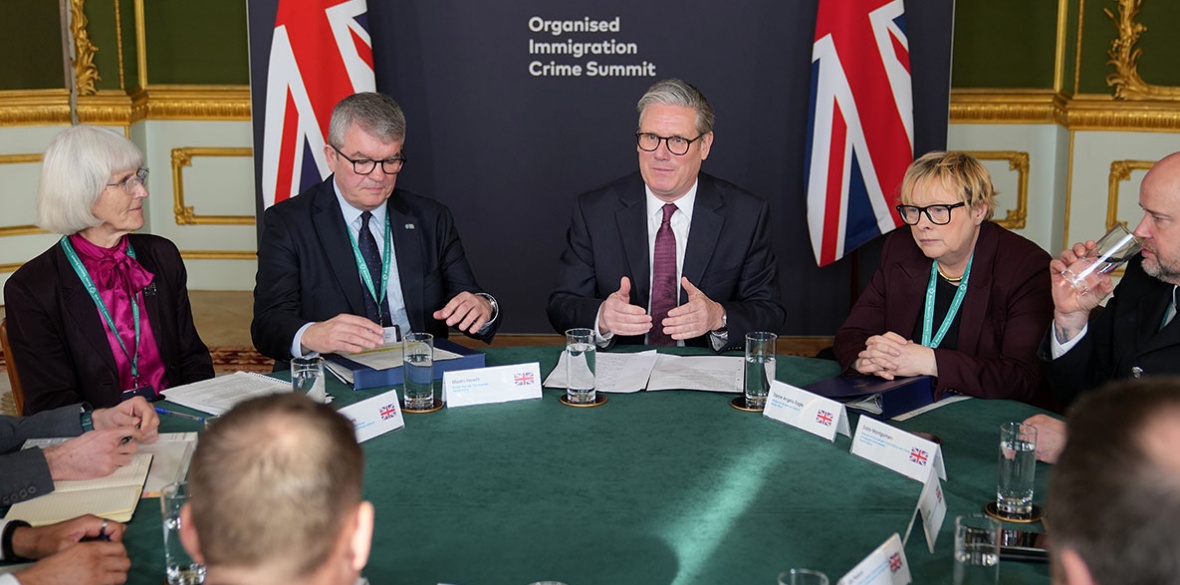
Prime Minister Sir Keir Starmer leads a roundtable discussion at the Organised Immigration Crime Summit at Lancaster House in central London, March 31, 2025
KEIR STARMER’S anti-refugee summit picks up where the Tories left off in giving unauthorised migration exaggerated status as some kind of national crisis.
Just as Rishi Sunak penned a joint article with Italy’s far-right Prime Minister Giorgia Meloni calling for a Europe-wide crackdown on irregular arrivals, Meloni took centre-stage by video link today, citing Italy’s use of a third-country processing hub in Albania as a model increasingly adopted across the continent.
Meloni depicts Italy as a pioneer. It is, though not in a good way. It successfully pushed the EU to abolish its last official search-and-rescue service in the Mediterranean nearly five years ago and it has led the way too in prosecuting civilian search-and-rescue missions it smears as people-smugglers.
As the Public and Commercial Services union and Care4Calais recently urged, the easiest way to end criminal people-smuggling operations would be to provide safe routes for people to claim asylum, perhaps through an extension of the scheme for Ukrainian refugees to people of other backgrounds.
There is no reason why victims of one war should be privileged over victims of others, and Britain bears responsibility for many of those wars. Yvette Cooper’s own reference to gangs working from the “hills of Kurdistan to the money markets of Kabul” cites two countries devastated by invasions we took part in, Iraq and Afghanistan.
…
The international refugee crisis is driven by war, poverty and climate change.
More than 100 people gathered in Bristol on Saturday
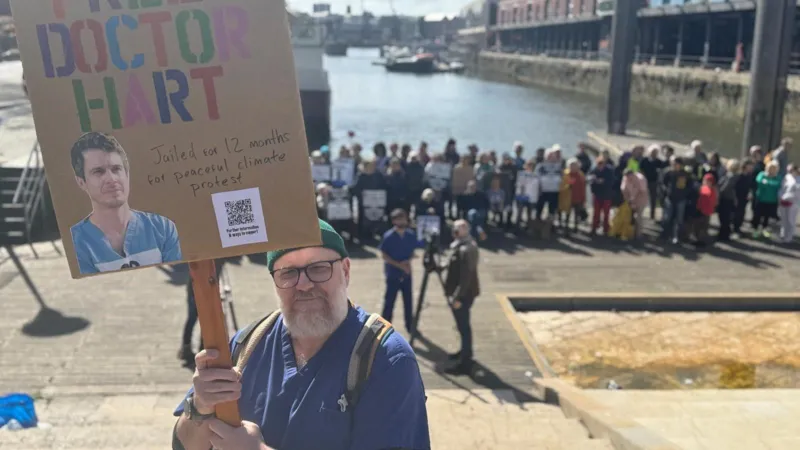
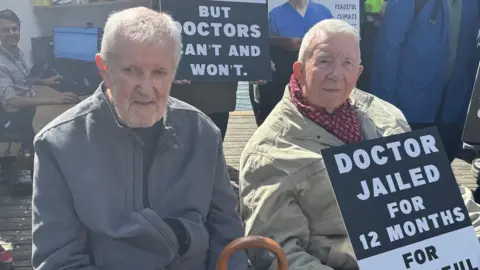
Scores of people took part in a city centre vigil for a GP jailed over his role in a Just Stop Oil protest.
Dr Patrick Hart, 38, was sentenced to 12 months in prison in January after causing thousands of pounds worth of damage to 16 fuel pumps at a service station in Essex in August 2022.
In March, Dr Hart also had his General Medical Council registration suspended for an interim 12-month period, and faces a possible further suspension following his release.
About 150 people, including former colleagues and patients, gathered at Cascade Steps in Bristol on Saturday to raise awareness of his sentence.
Dr Romola Pocock, a GP and former colleague of Dr Hart’s at Bridge View Medical Practice, said he had shown “care, integrity and dedication” to his job and was “greatly missed by patients and colleagues”.
Fellow GP at the practice Dr Emily Pollard said: “Will history remember doctors who stood against the destruction of the health of our planet as criminals?”
Colleagues of Dr Hart said he was “greatly missed” by his patients
Dr Hart was arrested after hitting petrol pumps with a hammer, spraying them with orange pain and “obstructed or otherwise interfered with the refuelling of vehicles”, and was found guilty of causing criminal damage.