The campaign will highlight existing protections for transgender and gender-nonconforming New Yorkers.
To kick off Pride Month, Mayor Zohran Mamdani and the New York City Commission on Human Rights announced the launch of a public awareness campaign dedicated to the safety of transgender and gender-nonconforming people.
In partnership with the newly established Office of LGBTQIA+ Affairs as well as the Department of Mental Health and Hygiene, the “Trans Rights Are Human Rights” campaign will highlight existing protections for trans and gender-nonconforming New Yorkers covered by the city’s Human Rights Law. Throughout June, informational graphics and banners designed by artist Dez Stavracos will be displayed on public transit, paper advertisements, and electric kiosks across the city, outlining the rights to which trans New Yorkers are already entitled.
Currently, the New York City Human Rights Law protects trans and gender non-conforming people’s right to be addressed by the correct name, be gendered correctly, express their gender freely, and use facilities such as restrooms, locker rooms, and saunas that correspond with their gender. The law also prohibits housing, employment, and public space discrimination based on someone’s gender identity or expression, as well as gender-based bias, harassment, and retaliation from law enforcement.
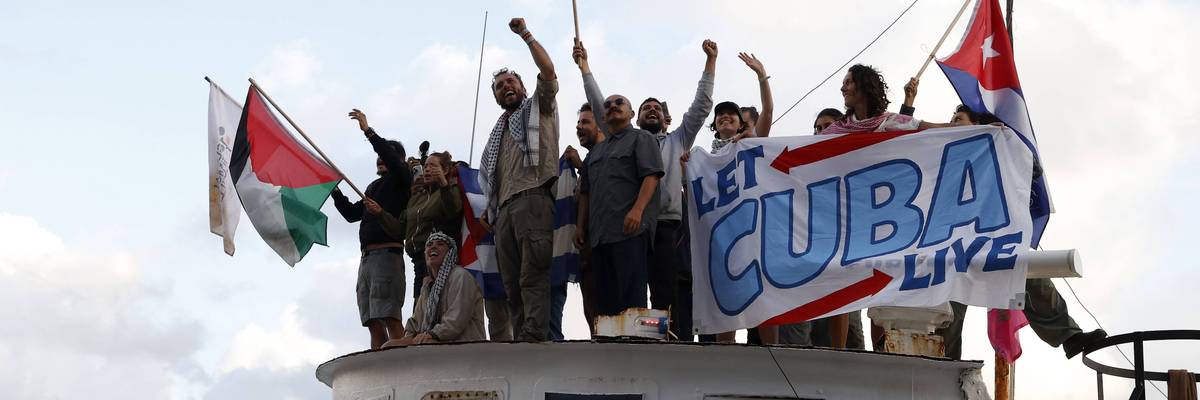
People arrive with the first ship of the humanitarian convoy in solidarity with Cuba, in Havana on March 24, 2026. (Photo by Angelo Mastrascusa/Anadolu via Getty Images)
“It is outrageous that the US government would target people for bringing humanitarian aid… But even more disturbing is the cruel and deeply immoral policy the United States continues to impose on Cuba.”
The antiwar group CodePink it has yet to be served with any subpoenas after it was reported over the weekend that the Trump administration has opened an investigation into a recent humanitarian trip it helped organize to Cuba, but vehemently denied wrongdoing and said any government probe, if there is one, would only show that “this administration is beyond grotesque.”
“Taking medical supplies to pediatric hospitals in Cuba is now a crime?” asked co-founder Medea Benjamin on social media on Saturday after Fox News reported that organizers had been served subpoenas. “Saving the lives of babies is a crime?”
Fox reported that Benjamin and left-wing commentator Hasan Piker had been subpoenaed by federal investigators two months after they were among 40 Americans who sailed to Havana on the Nuestra America Convoy, which carried 20 tons of humanitarian aid to the island nation.
The Fox reporting claimed the subpoenas issued to Benjamin and Piker seek to obtain financial, logistical, and communications information related to the trip, which was organized in response to the Trump administration’s decision in late January to threaten to impose tariffs on any country that provided Cuba with oil.
The administration cut off Cuba’s main source of fuel at the beginning of the year when it sent US troops into Venezuela to abduct President Nicolás Maduro and took control of the country’s vast oil supply.
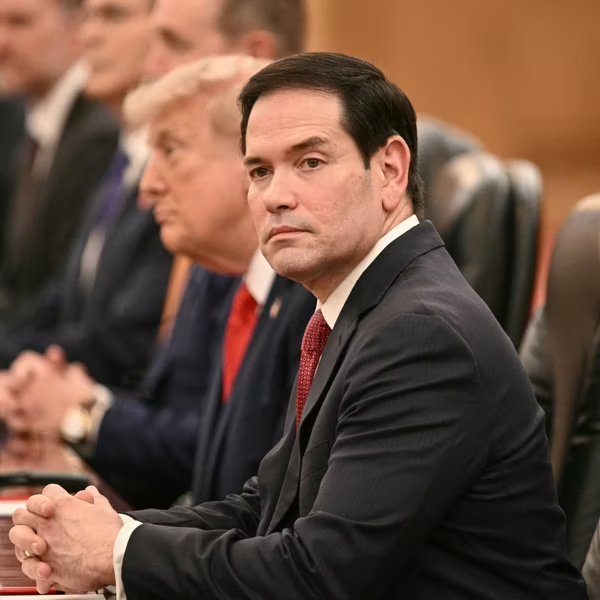
White House officials, including Secretary of State Marco Rubio, the son of Cuban immigrants, have long desired regime change in the communist country, and rights advocates have warned the administration appears to be moving toward just that as it strangles the island’s oil supply—causing frequent blackouts and impacting the healthcare and food systems—and claims the Cuban government poses a threat to the US.
In organizing the Nuestra America Convoy, said Benjamin on Sunday, the advocates were acting “as moral US citizens trying to bring some relief to a population being deliberately starved by the cruel policies of our own government.”
“This policy has contributed to catastrophic shortages of medicine and electricity, massive blackouts, transportation collapse, and a public health crisis that has hurt the most vulnerable, especially children and the elderly,” said Benjamin. “It is a policy that is, literally, killing babies, as we have seen in the recent tragic doubling of the infant mortality rate. This is why we focused our donations on medical supplies for pediatric hospitals.”
The blockade is compounding the suffering caused by the trade embargo the US has imposed for decades, said Benjamin.
The Cuban Assets Control Regulations law prohibits US citizens from conducting unlicensed travel-related transations with Cuba, but the law makes exceptions for humanitarian endeavors and other activities aimed at supporting the Cuban people.
“We traveled to Cuba under the US government-authorized category of providing humanitarian aid to the Cuban people. We brought desperately needed medicines and medical supplies at a time when Cuba is suffering catastrophic shortages caused by the crippling US blockade,” said Benjamin.
Benjamin, Piker, and Drop Site News co-founder Ryan Grim emphasized that the group stayed in Spanish-owned hotels that are “explicitly permitted under” the US law—while right-wing influencer Nick Shirley allegedly stayed in a sanctioned hotel on a recent trip to Cuba.
This is amazing: “According to public statements, it's believed that delegation members stayed at a hotel the U.S. State Department has put on a "Cuba Restricted List," as businesses directly tied to the communist government of Cuba, designated a state sponsor of terrorism.”
“It is outrageous that the US government would target people for bringing humanitarian aid to suffering Cuban children,” Benjamin said. “But even more disturbing is the cruel and deeply immoral policy the United States continues to impose on Cuba—a policy designed to strangle the island economically, deprive people of food, fuel, medicine, and basic necessities, and make daily life unbearable.”
Piker said the reports of the investigation indicate that “the American government would rather try to criminalize delivering aid to a country we’ve starved, than punish the Epstein class.”
Benjamin emphasized that the reports of the probe come as the administration intensified its threats against Cuba, having indicted former President Raúl Castro last week on charges related to the shooting down of a plane operated by Cuban-American exiles in the 1990s. Trump and his allies have repeatedly mused about invading the country following his military attacks on Venezuela and Iran.
“President Trump already has his hands full trying to disentangle himself from the disastrous US war with Iran,” said Benjamin. “He should not start another one in Cuba. The American people are tired of endless wars, interventions, sanctions, and suffering imposed in our name.”
Members of the Revolutionary Armed Forces attend a rally in support of former President Raul Castro in front of the U.S. Embassy in Havana, Cuba, May 22, 2026
ROGER D HARRIS and SARA FLOUNDERS challenge propaganda against the blockaded socialist island
MAY Day is the most important public celebration in Cuba. This year, which marked the 100th anniversary of Fidel Castro’s birth, carried special significance in light of heightened US aggression. Over 5 million Cubans reportedly mobilised island-wide under the slogan of la patria se defiende (the homeland must be defended). The largest demonstration took place in Havana in front of the US embassy.
The symbolism of International Workers’ Day was not lost on the White House. President Trump chose that day, May 1, to impose yet more sanctions on top of the already draconian illegal measures immiserating Cuba. Cuban journalist Norland Rosendo Gonzalez called this latest escalation Trump’s “imperial order to kill the Cuban people without bullets.”
The world’s leading imperial power falsely claims that Cuba poses “threats to United States national security.” Secretary of State Marco Rubio subsequently announced additional measures to “defend” the US homeland from its peaceful neighbour.
Jill Clark-Gollub with the Americas Without Sanctions Campaign explains the underlying reason for Washington’s animosity: “Cuba is sanctioned for the crime of being a good example.” A small, formerly colonised country, Cuba simply claims its sovereign right to determine its own destiny without foreign interference.
…
In 1976, Cuban voters ratified a constitutional referendum with a reported 97 per cent approval rate and high voter turnout, which formally defined Cuba as a socialist state. Last year in the United States, the House of Representatives passed a resolution “denouncing the horrors of socialism” by a lopsided bipartisan margin of 285–98.
Capitalism itself, however, has never been subject to a democratic vote of the American people. Perhaps for good reason: recent polls show a growing popularity for socialism, especially among the youth.
Shortly before May Day, President Miguel Diaz-Canel addressed the Cuban nation: “The socialist character of our revolution is not a phrase from the past; it is the shield of the present and the guarantee of the future.” With characteristic Cuban humility, he acknowledged “our own mistakes in this process of social construction” but added that “the main cause of our problems is the genocidal blockade.”
Directly addressing Washington – “gentlemen of manipulation and lies” – Díaz-Canel proclaimed: “Cuba is not a failed state; Cuba is a besieged state.”
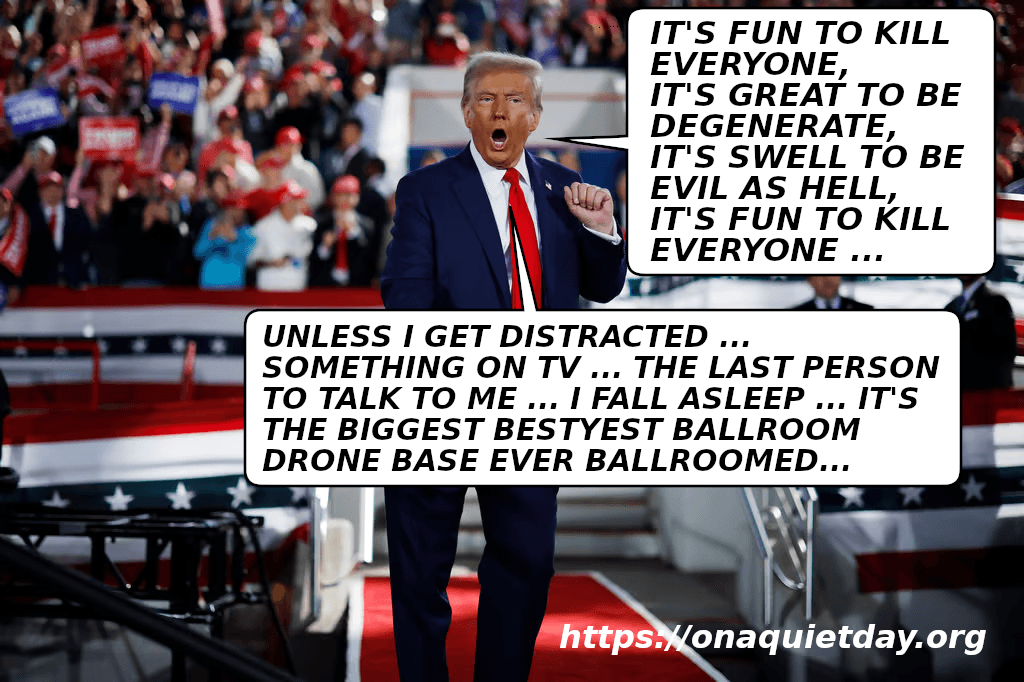
Orcas discuss Donald Trump and the killer apes’ concept of democracy. Front Orca warns that Trump is crashing his country’s economy and that everything he does he does for the fantastically wealthy.Donald Trump sings and dances, says that it’s fun to kill everyone … unless he gets distracted or falls asleep.
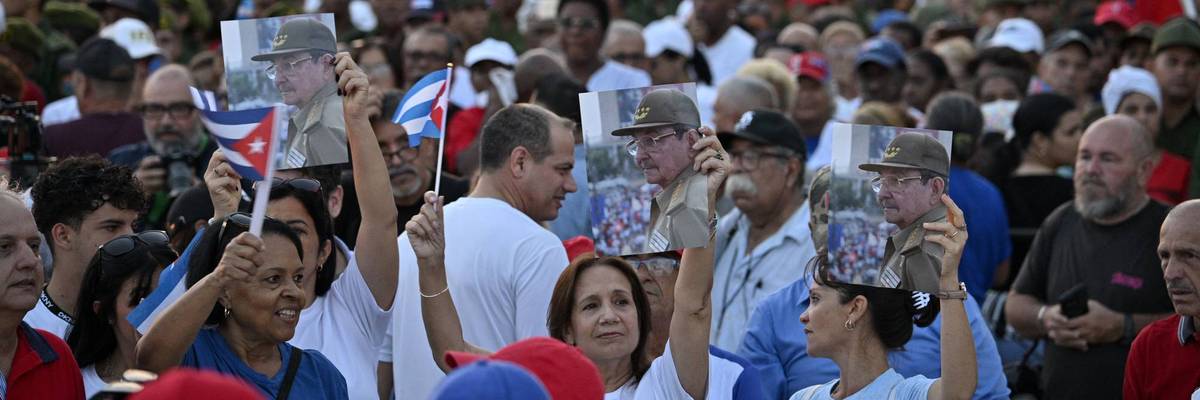
Cubans hold photos of revolutionary hero and former President Raúl Castro outside the US Embassy in Havana on May 22, 2026 amid threats of attack by the United States. (Photo by Adalberto Roque/AFP via Getty Images)
“Here we are prepared to fight imperialism,” said Cuban lawmaker Mariela Castro, daughter of Raúl Castro. “Cuba is a small and poor country, but one with experience confronting US imperialism.”
Tens of thousands of Cubans rallied Friday in Havana to denounce the Trump administration’s indictment of former President Raúl Castro and threats to attack the island nation, whose socialist government has been preparing its citizens to defend their homeland and revolution against US aggression.
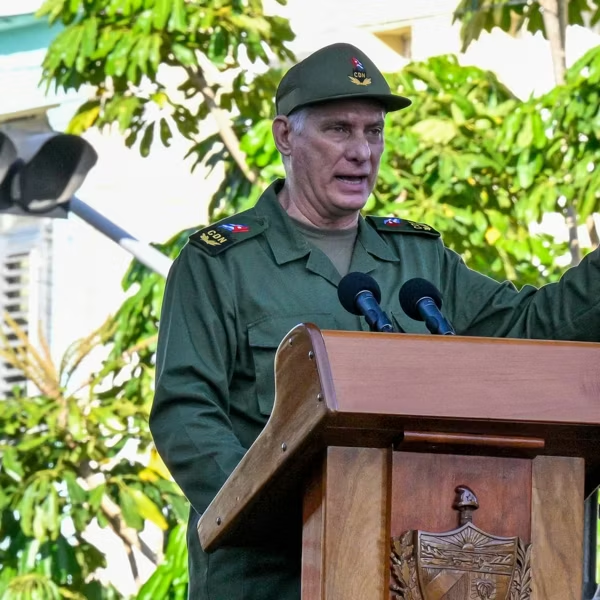
“No disrespect is shown to the heroes of the homeland!” Cuban President Miguel Díaz-Canel said as people flooded the streets outside the US Embassy in Havana. “History and traditions are not insulted without a response! That does not happen in Cuba!”
The massive rally followed Wednesday’s US Department of Justiceindictment of revolutionary hero Raúl Castro, who served as president for a decade after his older brother, Fidel Castro, stepped down in 2008. The DOJ indicted Castro for his alleged role in the 1996 shoot-down of planes operated by the counterrevolutionary group Brothers to the Rescue after repeated warnings that they had violated Cuban airspace.
🇨🇺 Tens of thousands of Cubans took to the streets of Havana to show support for the Cuban leader Raúl Castro. Cubans are rejecting the US accusations against former president, and US threats and hostilities against the Caribbean nation. pic.twitter.com/v9bHnClfDI
— Peoples Dispatch (@peoplesdispatch) May 22, 2026
Rallying under the slogan “Raúl is Raúl”—originally popularized during the transitional period of rule between the Castros to highlight the younger brother’s reforms—Cubans vowed to defend their revolution in the face of the latest US threats.
“This new aggression has united us more and elevated the honor, dignity, and anti-imperialist spirit of a people already recognized around the world for their brave resistance to any form of subordination to the empire,” Díaz-Canel said.
Cuban legislator Mariela Castro, Raúl’s granddaughter, told rallygoers that “we are prepared for combat.”
“No one is going to kidnap him. I can assure you of that,” she said, alluding to the US invasion and abduction of Venezuelan President Nicolás Maduro on dubious narco-terrorism charges earlier this year. “Neither him nor anyone else.”
“My father is very calm, watching and smiling,” Castro added. “Here, we are prepared to fight imperialism. Cuba is a small and poor country, but one with experience confronting US imperialism. We know that as long as there is an anti-imperialist revolution, there will be a gigantic and ruthless enemy.”
Critics noted the hypocrisy of the Castro indictment, given the ongoing illegal US bombing of boats that the Trump administration claims—without providing evidence—were smuggling drugs in the Caribbean Sea and Pacific Ocean.
“Washington has no moral authority to judge anyone,” Gerardo Hernández, coordinator of the Committees for the Defense of the Revolution, said, referring to the boat-bombing campaign, which has killed nearly 200 people in close to 60 reported attacks. “Cuba is a people of peace and reaffirms its legitimate right to self-defense.”
“Cuba does not constitute a threat to US security,” he continued. “On the contrary, Cuba is a state under attack by the United States.”
«Los aviones de Hermanos al Rescate derribados sobre Cuba formaban parte de la misma red terrorista con sede en Miami y respaldada por la CIA que mató a cubanos en atentados con bombas en hoteles y que voló el vuelo 455 de Cubana en 1976, asesinando a los 73 pasajeros
“The Cuban people reaffirm the unwavering decision to defend their homeland and revolution,” Hernández added. “With the greatest determination, they reaffirm their absolute and firm support for Army General Raúl Castro.”
Mariela Castro said that “my family, like all Cuban families, is waiting for instructions to know where we need to go” in the event of a US attack.
As US Secretary of State Marco Rubio—whose parents immigrated to the United States from Cuba during the US-backed dictatorship that preceded the Castro-led revolution—said Thursday that the chances of a “negotiated and peaceful agreement” with Havana are “not high,” Deputy Cuban Foreign Minister Carlos Fernández de Cossío acknowledged that his country is preparing for war, asserting that “we would be naive not to.”
Cuban officials have been circulating a pamphlet titled a “Family Guide for Protection Against Military Aggression.” The publication warns that the US is preparing “to launch a military assault and destroy our society with the aim of perpetuating capitalism… and annihilating the dream of our Commander-in-Chief, Fidel Castro.”
The pamphlet instructs Cubans to pack survival kits and seek shelter in the event of air-raid alerts. It also contains life-saving first aid instructions.
“Should the enemy attack, our Revolution will defend itself until victory is achieved and the aggressor is expelled,” the pamphlet states.
US President Donald Trump recently tightened the internationally condemned 65-year US economic embargo on Cuba, imposing a fuel blockade that has exacerbated an energy emergency characterized by blackouts and deadly suffering among the most vulnerable Cubans, including sick people and children.
Last month, Trump said that “we may stop by Cuba after we’re finished” with the illegal US-Israeli war of choice against Iran. The president has also stated he believes he’ll “be having the honor of taking Cuba,” language echoing the 19th-century US imperialists who conquered the island along with Puerto Rico, Guam, and the Philippines from Spain in another war waged on dubious pretense.
“Whether I free it, take it—I think I can do anything I want,” Trump said of the island and its 11 million inhabitants.
BreakThrough News interviewed Havana residents earlier this week about the specter of US attack.
"We won't hand over Raúl to any foreigner."
Havana residents are rejecting the new indictments against Raúl Castro, dismissing the possibility of handover to the US. They also accuse the US of "inventing" another justification for military aggression against Cuba.
“We Cubans have to protect ourselves,” elderly Havana resident Juan Hernández said. “We’re not going to hand any Cuban over to a foreigner, because that would be immoral. It would be treason.”
Hernández accused the US of “provocation” in order to “justify invading the country,” adding “that would only lead to bloodshed on both sides.”
“Besides,” he added, “Cuba isn’t a threat to them at all. What does Cuba have? Do we have atomic bombs? Do we have anything? We have nothing.”
Donald Trump sings and dances, says that it’s fun to kill everyone … unless he gets distracted or falls asleep.Orcas discuss how Trump was re-elected and him being an obviously insane, xenophobic Fascist.Elon Musk urges you to be a Fascist like him, says that you can ignore facts and reality then.
A marcher holds a framed composite image of Fidel Castro, Raul Castro and Cuba’s President Miguel Diaz-Canel, during the May Day parade at Revolution Square in Havana, May 1, 2025
US THREATS to Cuban revolutionary leader Raul Castro reek of the extraterritorial arrogance of a thuggish imperial power.
They indicate too that the extreme economic war Washington is waging to break the Cuban people could escalate to a direct military attack very soon.
The charges levelled at the 94-year-old former president of Cuba — a veteran of the 1959 revolution and a communist even before his great brother Fidel — are a sick joke.
Claiming the Cuban military shooting down a plane belonging to the terrorist, Miami exile-based Brothers to the Rescue outfit that had violated Cuban airspace back in the 1990s amounts to murder is to deny Havana the basic rights of a sovereign state — to protect its borders and its people.
But then, Washington has denied Cuba those basic rights for over 60 years.
…
The United States hates Cuba because it demonstrates that another world is possible — that a country can export doctors not bombs, stand for peace not war, socialism and equality not capitalist exploitation.
Those are exactly the reasons Cuba must survive. Every pressure must be brought to bear on our government to call out Trump’s lawless aggression and maximum solidarity and practical assistance to the island mobilised via the Cuba Solidarity Campaign.



 Members of the Revolutionary Armed Forces attend a rally in support of former President Raul Castro in front of the U.S. Embassy in Havana, Cuba, May 22, 2026