Inside the many, many Labour Party Conferences taking place in Liverpool

Spread the love

Original article by Seth Thévoz republished from OpenDemocracy under a Creative Commons Attribution-NonCommercial 4.0 International licence.


So disjointed is Labour’s annual meet, the messaging differs from room to room. Attendees agree only on fear of Reform

Demonstrators outside the Labour Party Conference get creative | Seth Thévoz

I’ve been attending political party conferences in the UK for over 20 years, but I’ve never seen anything like the Labour conference currently taking place in Liverpool.

The governing party is a broad coalition at the best of times. But this year’s event has been a series of “bubbles” that don’t – and won’t – interact with one another. You can experience a completely different reality from the people 50 feet away, just by going to different events.

That’s why, all week, when people have asked me, “What’s the feeling like at Labour conference?” I’ve replied that it depends on which Labour conference you’re attending. The real conference takes place not on the carefully choreographed main stage, but in a hundred meeting rooms dotted across the city, where fringe events are put on by members, activists and lobbyists – and it’s in those rooms that the party’s deep internal rifts can be seen.

On day one, in the space of four meetings, I was told, firstly, of the importance of immigrants being treated with dignity and respect; secondly, of the need for Labour to go further in cutting immigration as the only way to stop Reform UK; thirdly, of the desperate need for more immigration if we were serious about growing the economy; and fourthly, what a brilliant job the government was already doing of cutting immigration.

As an immigrant, I wasn’t quite sure what to make of this. But then, Labour conferences have always been a performance art – it’s an essential way to square the circle.

Exaggerated patriotism and mockney accents

You learn a lot by watching people at conference. A lot of play-acting goes on at Labour conference.

Take sharp-suited trade secretary Peter Kyle. Introduced to a rally organised by Labour First, a network representing those on the right of the party, Kyle spent a full minute explaining how he didn’t really like wearing suits, and protested: “I don’t own moccasins!”

Kyle isn’t alone. Elsewhere, well-spoken, public school-educated special advisers from the south-east suddenly put on mockney accents, deeply aware of the shame attached to sounding posh in Labour circles. And the party’s traumatised politicians, long nervous about having their patriotism questioned, try to take on the mantle of the keenest flag-shaggers, with fringe venues, exhibition stands, corridors and merchandise all draped in Union flags.

‘Flag-shaggers’: Labour is eager to prove its patriotism and rival Reform’s use of flags | Seth Thévoz

You soon pick up where the centres of power are around the conference hotel, its bar and its private business suites, as key party personnel are bundled away for hush-hush meetings with donors and diplomats. But for the people-watcher, there is a golden rule to observe: doughnutting.

VIPs make up the hole of a doughnut, and they’re surrounded by a gaggle of hangers-on. The more important you are, the bigger the doughnut: a backbench MP merits just one young diary secretary by their side, while a cabinet minister or a city mayor can have half a dozen staff flocking around them at all times. No one wants to be Billy No Mates.

I mention this because it was striking to see Keir Starmer’s chief of staff, Morgan McSweeney, shuttling around the lobby of the Pullman hotel at least eight times – always alone. Whether he prefers to work in isolation or is just being avoided, I don’t know. But I wasn’t the only seasoned conference-goer to observe, “That’s really weird.”

McSweeney has had a tough September. First, he’s synonymous with Starmer’s many resets and changes of strategy, which have seen Labour plummet in the polls. Second, he came under fire for having advocated for Peter Mandelson to be appointed as the UK’s Washington ambassador despite his known friendship with paedophile Jeffrey Epstein and despite concerns raised by the security services during the vetting process (Mandelson was fired after emails he sent to Epstein following his conviction emerged earlier this month). And now, thanks to a new book from investigative journalist Paul Holden, the peculiar tale of how more than £700,000 of donations to Labour Together went undeclared on McSweeney’s watch has resurfaced, heaping further pressure on the man many believe to be the architect of Starmerism.

But it was the sight of him hurrying around the conference on his own, not the many op-eds published questioning his political judgment in recent weeks, that made me realise McSweeney may be in deep trouble. I’ve never seen such a senior government figure alone at a party conference, let alone over and over again.

Reform agenda

Sienna Rodgers of The House magazine wasn’t wrong when she wrote, “the motivation for those targeting McSweeney is clear: Starmer, it is widely believed, is finished without him.” McSweeney has become a lightning rod because he is seen as the cause of so many of Starmer’s changes of direction.

Many of the Labour members who voted for Starmer in the party’s 2020 leadership election expected a more radical figure. Instead, they have been baffled by a series of policy U-turns and an increasingly socially conservative approach to policy, aimed at wooing Reform UK voters. McSweeney is seen as being behind this shift.

The dilemma over the rise and rise of Nigel Farage’s Reform party has hit Labour hard. It’s not just obvious in ministers’ speeches; all around the conference, you can hear the chatter of endless conversations along the same lines. “We’re quite fearful, to be honest,” activists tell one another. “It’s all about how to beat Reform, basically.”

Labour has historically taken its working-class voter base for granted, while it wins or loses elections on the back of middle-class voters. To suddenly find another party, claiming the mantle of being more working class, accusing Labour of being a party of southern elites, has really knocked people’s confidence. It goes to the heart of how Labour politicians see themselves: “Are we the baddies?”

And so activists seek solace in comfortable old certainties. In the conference’s ‘Labour shop’, a whole range of nostalgia merchandise has been launched this year, from mugs to T-shirts, commemorating 80 years since the Labour government of 1945. If Labour in 2025 can’t offer members a better future, it can at least offer up a better yesterday.

The Good Old Days: Labour is flogging a range of 1945 nostalgia merchandise | Seth Thévoz

Ad-libbing policies

This does not feel like a party that won a landslide only 14 months ago. Its conference has had a level of exhaustion normally seen only in parties that have been in power for over a decade. At fringe event after fringe event, the most interesting or lively guest speaker was usually the person brought in from outside the party: a social worker, an economist, or a local imam.

MPs and councillors, by contrast, often sounded shell-shocked and afraid to say too much. Part of this stems from how Starmer led Labour in opposition. The party’s strategists congratulated themselves on a brilliant wheeze, through the years of 2020 to 2024, of not being tied down to anything too specific. They were the textbook opposition, they believed: attacking the Tories in government, without having policies of their own that could be counter-attacked. They had learned from the Corbyn years, when lengthy manifestos were a hostage to fortune. No one wanted a repeat of Labour’s mammoth 1983 policy manifesto under Michael Foot, famously dubbed “The longest suicide note in history.” Policies could be left to the very end of the last Parliament, before being hammered out.

Unfortunately, Rishi Sunak’s call for an early election in May 2024 surprised many people, not least those strategists. And a lot of vital work never happened, from scheduled briefings with civil servants to agreeing on detailed policy proposals. Labour accidentally found itself in power several months too early and has been making up policy as it goes ever since.

This is how the government ended up quietly ditching several of its established policies, such as proportional representation and an elected House of Lords, while spending political capital on major new policies that weren’t even in its manifesto and which often divide people across political lines, such as last week’s new digital ID cards proposal.

Incidentally, a popular topic of conference gossip has been to speculate about which companies might get the lucrative government contract for ID cards, estimated by Labour Together as being worth up to £400m.

‘A ghastly job’

But the existential ennui has not stopped the glad-handing. There are plenty of lobbyists in town to do business, and Labour is in the middle of an election for a new deputy leader.

Education secretary Bridget Phillipson has been pushed by the party machine for that position at every stage, being unveiled at several rallies with slick leaflets promoting her campaign handed out by the entrance. In one flyer, Phillipson promises, “I won’t defend our mistakes” – a bold pitch, since being wheeled out to apologise for the party is basically the deputy leader’s job description. Indeed, earlier this month the role was described as “a terrible job, really ghastly” by Labour peer Margaret Beckett, who held the title in the 1990s.

At the rally by campaign group Labour to Win, Luke Akehurst MP put on a brave face, admitting the party has had “a couple of weeks where things have not gone well for us, and we need to put a stop to them not going well for us”. He pleaded with delegates not to go leaking stories to the press, with “a story of division and chaos and in-fighting”, and “taking the people at the top of the party out in front and critiquing them.”

And he lashed out at hints that Manchester’s Mayor Andy Burnham might challenge Keir Starmer: “Most of the cameras are following someone who isn’t even qualified to run!”

Akehurst – a veteran fixer on the Labour right – knows a thing or two about winning internal Labour elections. At the Labour First rally the next day, he boasted of how he was able to “completely confound” journalists with floor votes still favourable for the leadership, because of “organising all year”, electing “speaker after speaker after speaker” as delegates, “which is like bloody herding cats, trying to get people, just, oooh trust us, here’s seven really obscure topics that would be really quite ideal for us to debate. We got about 67% of the vote or something on that.”

There were theatrical pledges of support, as cabinet ministers at rallies lined up to praise the prime minister.

Health secretary Wes Streeting is an ambitious political operator, whom I’ve known since he was my student union’s president 20 years ago. Even back then, he was clearly already running to be prime minister; like Cassius in Shakespeare’s Julius Caesar, he often “has a lean and hungry look.” Yet at the Labour rally, he was doing his best to channel the manner of a North Korean MP theatrically clapping the Dear Leader, not wanting to be seen as half-hearted in his applause.

Health secretary Wes Streeting is among those keen to be seen loyally applauding | Seth Thévoz

But the mood of delegates was far less chipper. When chancellor Rachel Reeves told the rally, “It’s great to see Keir come out fighting this week!”, the Labour member next to me – who had been loyally applauding up until this point – muttered, “Yeah, too late!”

Ultimately, the Labour conference in Liverpool reminded me of grief. And grief has five stages. I saw plenty of denial, anger, bargaining and depression. I saw little of the last stage, acceptance. But then again, even some of the bargaining was surreal. One delegate I overheard in the café was musing on whether the coming England match might help the government’s popularity. He earnestly predicted, “When England do well, the whole community do well, so maybe if we, er, hope…?”

Original article by Seth Thévoz republished from OpenDemocracy under a Creative Commons Attribution-NonCommercial 4.0 International licence.

dizzy: Yes that Wes Streeting is a lil turd. 

Keir Starmer objects to criticism of the IDF. He asks how could anyone object to them starving people to death, forced marches like the Nazis did, bombing Gaza's hospitals and universities, mass-murdering journalists, healthworkers and starving people queuing for food, killing and raping prisoners and murdering children. He calls for people to stop obstructing his genocide for Israel.
Keir Starmer objects to criticism of the IDF. He asks how could anyone object to them starving people to death, forced marches like the Nazis did, bombing Gaza’s hospitals and universities, mass-murdering journalists, healthworkers and starving people queuing for food, killing and raping prisoners and murdering children. He calls for people to stop obstructing his genocide for Israel.
Keir Starmer says that the Labour Party under his leadership all feel a small part of Scunthorpe.
Keir Starmer explains that he feels no shame or guilt benefitting personally from gifts from the rich and powerful while insisting on policies of severe austerity causing suffering and death.
Continue ReadingInside the many, many Labour Party Conferences taking place in Liverpool

Dementia President: Could It Be That Trump Has Truly Lost His Mind?

Spread the love

By Robert Reich

https://www.commondreams.org/opinion/does-trump-have-dementia

US President Donald Trump walks to board Marine One as he departs from the South Lawn of the White House in Washington, DC on September 22, 2025.
 (Photo by Saul Loeb / AFP via Getty Images)

Given his behavior, it could very well be that the President of the United States is going nuts.

Trump is showing growing signs of dementia. He’s increasingly unhinged. He’s 79 years old with a family history of dementia. He could well be going nuts.

You might think this would be covered in the news, but he isn’t facing anything like the scrutiny for dementia that Joe Biden did.

Perhaps the most telling evidence of Trump’s growing dementia is his paranoid thirst for revenge, on which he is centering much of his presidency.

Article continues at https://www.commondreams.org/opinion/does-trump-have-dementia

Orcas discuss how Trump was re-elected and him being an obviously insane, xenophobic Fascist.

Elon Musk urges you to be a Fascist like him, says that you can ignore facts and reality then.
Donald Fuhrump says that Amerikkka doesn't bother with crimes or charges anymore, not being 100% Amerikkkan and opposing his real estate intentions is enough.
Donald Fuhrump says that Amerikkka doesn’t bother with crimes or charges anymore, not being 100% Amerikkkan and opposing his real estate intentions is enough.
Continue ReadingDementia President: Could It Be That Trump Has Truly Lost His Mind?

Underreported Memo Is ‘Declaration of War’ Against Trump Opponents

Spread the love

Original article by Olivia Rosane republished from Common Dreams under Creative Commons (CC BY-NC-ND 3.0). 

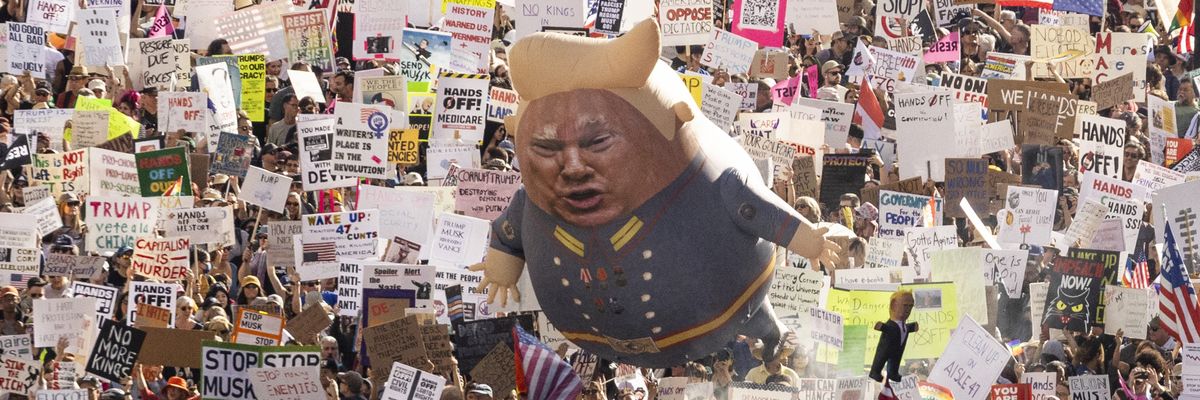
Protesters hold signs and flags and a large balloon with an image of US President Donald Trump during the nationwide “Hands Off!” protest against Trump and his adviser, Tesla CEO Elon Musk, in downtown Los Angeles on April 5, 2025. (Photo by Etienne Laurent/AFP via Getty Images)

“By targeting beliefs and protest activity, the directive positions dissent itself as a potential crime,” one news organization said.

In between his highly publicized designation of Antifa as a domestic terror organization and his indictment of former FBI Director James Comey, US President Donald Trump signed a little-reported national security memorandum that gives law enforcement new tools to target his critics.

Trump signed National Security Presidential Memorandum 7 (NSPM-7) on Thursday. The directive, titled “Countering Domestic Terrorism and Organized Political Violence,” focuses exclusively on “anti-fascist” or left-wing activities, and mandates a “national strategy to investigate and disrupt networks, entities, and organizations that foment political violence so that law enforcement can intervene in criminal conspiracies before they result in violent political acts.”

“I don’t want to sound hyperbolic but the plain truth is that NSPM-7 is a declaration of war on anyone who does not support the Trump administration and its agenda,” journalist Ken Klippenstein wrote in a piece raising alarm about the directive on Saturday.

Klippenstein argued that the memorandum was worrying on several fronts. For one, its focus on preventing crimes before they are committed opens the door to rights violations.

“In other words, they’re targeting pre-crime, to reference Minority Report,” Klippenstein wrote.

For another, the memorandum casts a very wide net, targeting groups, individuals, funders, and “entities” and listing several protected beliefs as “indicia” of extremism.

These include:

  • “Anti-Americanism, anti-capitalism, and anti-Christianity;
  • Support for the overthrow of the United States Government;
  • Extremism on migration, race, and gender; and
  • Hostility towards those who hold traditional American views on family, religion, and morality.”

What’s more, the memorandum entrusts enforcement to the FBI’s over 4,000-strong Joint Terrorism Task Forces (JTTF), which removes the legal challenges to directing the National Guard or other military forces to quash domestic dissent.

“For the Trump White House, the beauty of using an already existing network is that it bypasses Congressional oversight and scrutiny and even obscures federal activity to governors and legislatures at the state level,” Klippenstein wrote.

The types of activities that will be targeted are also quite broad, with the document defining “organized doxing campaigns, swatting, rioting, looting, trespass, assault, destruction of property, threats of violence, and civil disorder” as “domestic terrorist acts.”

The memorandum also targets any individual or group who might fund activity the administration deems terrorism and directs the Internal Revenue Service to “take action to ensure that no tax-exempt entities are directly or indirectly financing political violence or domestic terrorism,” which could be a means of threatening the status of nonprofits.

Finally, as Drop Site News pointed out, the memo authorizes the attorney general to designate domestic groups as terrorist organizations for the first time in US history.

“By targeting beliefs and protest activity, the directive positions dissent itself as a potential crime,” Drop Site wrote.

The Trump administration’s focus on violence associated with left-wing beliefs and groups is not supported by the facts. National Institute of Justice data found that right-wing violence had led to 520 deaths since 1990 compared with 78 deaths due to left-wing violence. However, the administration removed that study from the Department of Justice website shortly after Charlie Kirk was killed, The Guardian reported earlier this month.

The administration’s efforts, while accelerated, build on processes that began during the US response to the September 11 attacks, as Klippenstein explained:

A “pre-crime” endeavor, preventing attacks before they happen, is core to the post-9/11 concept of counterterrorism itself. No longer satisfied to investigate acts of terrorism after the fact to bring terrorists to justice, the Bush administration adopted preemption. Overseas, that led to aerial assassination by drones and “special operations” kill missions. Domestically, it led to a counter-terrorism campaign whose hallmark was excessive and illegal government surveillance and the use of undercover agents and “confidential human sources” to trap (and entrap) would-be terrorists.

However, the Trump administration is expanding the War-on-Terror mandate with fewer guardrails.

“Now, with Donald Trump’s directive retooling the counter-terror apparatus to go after Americans at home, this means monitoring political activity, or speech, as an investigative method to discover ‘radicalism,‘” Klippenstein said, noting that the NSPM-7 breaks with post-Watergate national security documents by failing to mention the First Amendment rights to protest and organize.

White House Deputy Chief of Staff Stephen Miller is already eager to make use of the document.

“We are witnessing domestic terrorist sedition against the federal government,” he wrote on social media on Friday. “The JTTF has been dispatched by the Attorney General, pursuant to NSPM-7. All necessary resources will be utilized.”

In an interview with Greg Sargent for the New Republic, Trump ally Steve Bannon confirmed that Miller and others in the administration were preparing to go after left-liberal groups and media whose criticism of Immigration and Customs Enforcement (ICE) could be interpreted as “goading” on violence against the agency.

Referring to Miller’s comments that calling ICE authoritarian incited violence and terrorism, Bannon responded, “Stephen Miller is correct—more importantly he’s in charge.”

The threats of investigations put liberal and left-leaning organizations in a tough place. On the one hand, they want to prepare as best they can. On the other, they do not want to obey in advance.

“Officials at these groups tell me they must strike a balance between being clear-eyed about how bad this could get while not letting it discourage political activity,” Sargent wrote. “That latter form of surrender is exactly what Trump and Miller want. And under no circumstances should anybody willingly hand it over to them.”

Original article by Olivia Rosane republished from Common Dreams under Creative Commons (CC BY-NC-ND 3.0). 

Donald Fuhrump says that Amerikkka doesn't bother with crimes or charges anymore, not being 100% Amerikkkan and opposing his real estate intentions is enough.
Donald Fuhrump says that Amerikkka doesn’t bother with crimes or charges anymore, not being 100% Amerikkkan and opposing his real estate intentions is enough.
Orcas discuss how Trump was re-elected and him being an insane, xenophobic Fascist.

Continue ReadingUnderreported Memo Is ‘Declaration of War’ Against Trump Opponents

Alligator Alcatraz Is an ‘Extrajudicial Black Site,’ Immigrant Advocates Say as Detainees Disappear

Spread the love

Original article by Stephen Prager republished from Common Dreams under Creative Commons (CC BY-NC-ND 3.0). 

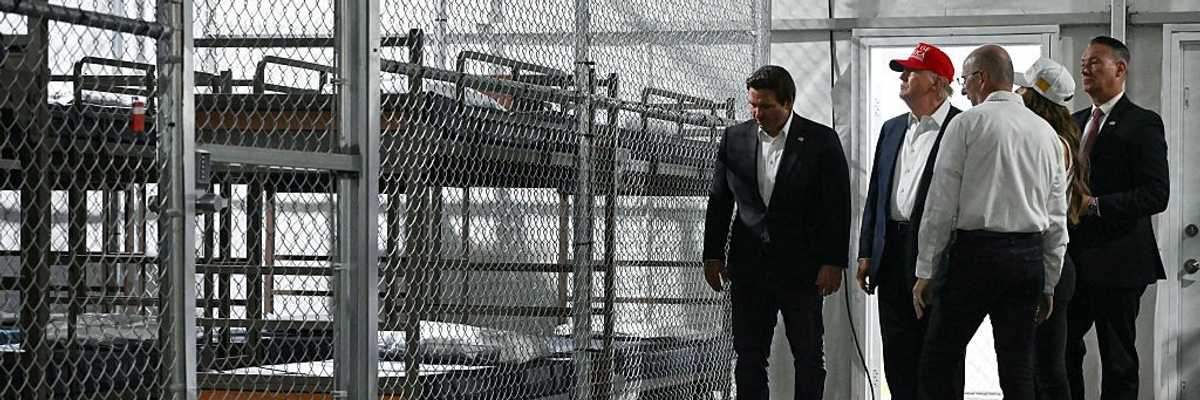
U.S. President Donald Trump and Florida Gov. Ron DeSantis tour a migrant detention center dubbed “Alligator Alcatraz” in Ochopee, Florida on July 1, 2025.
 (Photo by Andrew Caballero-Reynolds/AFP via Getty Images)

According to the Miami Herald, over 1,000 detainees in Florida’s immigrant internment camp have effectively “disappeared,” with family and attorneys unable to track their whereabouts.

Immigrant rights activists in Florida are expressing alarm as they have found themselves “unable to locate” more than 1,000 detainees who have been “administratively disappeared” from the state’s immigrant internment camp known as ”Alligator Alcatraz.”

Last week, the Miami Herald reported that “the whereabouts of two-thirds of more than 1,800 men detained at Alligator Alcatraz during the month of July could not be determined” after the paper “obtained the names from two detainee rosters.”

The reporters found that around 800 of the people on the rosters do not appear on Immigration and Customs Enforcement’s (ICE) Online Detainee Locator System, which provides publicly available information about the court status and locations of people who have been jailed by immigration enforcement. Another 450 had no location listed and instead merely instructed users to “Call ICE for details.”

The Herald also found that the vast majority of the detainees in the system did not have final orders of removal issued against them by immigration judges, which would be required for their deportation. Nevertheless, the detainees’ families and attorneys have been left unable to find them.

Detainees and other witnesses, including several members of Congress who visited in July, have described the conditions inside Alligator Alcatraz as horrific. The ramshackle tent camp was set up in a matter of days this summer in the Everglades to warehouse thousands of people detained by ICE, often without criminal charges or warrants, and with restricted access to attorneys.

While people in federal immigration facilities are typically able to be tracked through the system, the state-run Alligator Alcatraz works differently.

(Video: Democracy Now!)

Shirsho Dasgupta, one of the reporters who broke the story for the Herald, told Democracy Now! on Thursday that attorneys he’s spoken to often “don’t know who to call” to get in contact with their clients.

Operations at Alligator Alcatraz were briefly halted in August when a federal district judge ruled against the facility on environmental grounds. But that ruling was stayed by a federal appeals court just two weeks later, allowing operations to resume.

While the state of Florida runs the facility, it has requested and was promised reimbursement from the Federal Emergency Management Agency’s (FEMA) Shelter and Services Program, which was initially created to provide housing and other services to individuals released from ICE custody who were awaiting immigration court proceedings.

In a statement on Friday, the Florida Immigrant Coalition (FLIC), which has also attempted to track the detainees, said that the Herald’s report shows what they “have been warning about for months,” that “those detained in this detention camp have effectively been administratively disappeared.”

FLIC said that the state of Florida has refused to confirm how many detainees are currently in Alligator Alcatraz and that, in addition to those not listed on the ICE locator tool, they have also seen people deported before scheduled bond hearings. The group also said it had “confirmed data showing Florida is lying when claiming those detained at the Everglades camp had final orders of removal.”

“Since this depraved torture camp funded with state FEMA funds reopened,” said Tessa Petit, FLIC’s executive director, “we have been unable to locate the fathers, brothers, friends, and sons that are caged there without due process in the ICE locator. Hospitalizations for severe medical incidents, which include cardiac incidents and surgeries, go unreported.”

Thomas Kennedy, a policy analyst at FLIC, said: “What we’re seeing at Alligator Alcatraz is basically a new model of immigration detention, where a state-run facility is operating as an extrajudicial black site, completely outside of the previous models of immigration detention in this country. It’s making what was already a terrible system somehow even worse.”

Original article by Stephen Prager republished from Common Dreams under Creative Commons (CC BY-NC-ND 3.0). 

Donald Fuhrump says that Amerikkka doesn't bother with crimes or charges anymore, not being 100% Amerikkkan and opposing his real estate intentions is enough.
Donald Fuhrump says that Amerikkka doesn’t bother with crimes or charges anymore, not being 100% Amerikkkan and opposing his real estate intentions is enough.
Orcas discuss how Trump was re-elected and him being an insane, xenophobic Fascist.
Continue ReadingAlligator Alcatraz Is an ‘Extrajudicial Black Site,’ Immigrant Advocates Say as Detainees Disappear

‘No War Crimes Are Off Limits’ as Trump Reportedly Mulling Bombing Targets in Venezuela

Spread the love

Original article by Olivia Rosane republished from Common Dreams under Creative Commons (CC BY-NC-ND 3.0). 

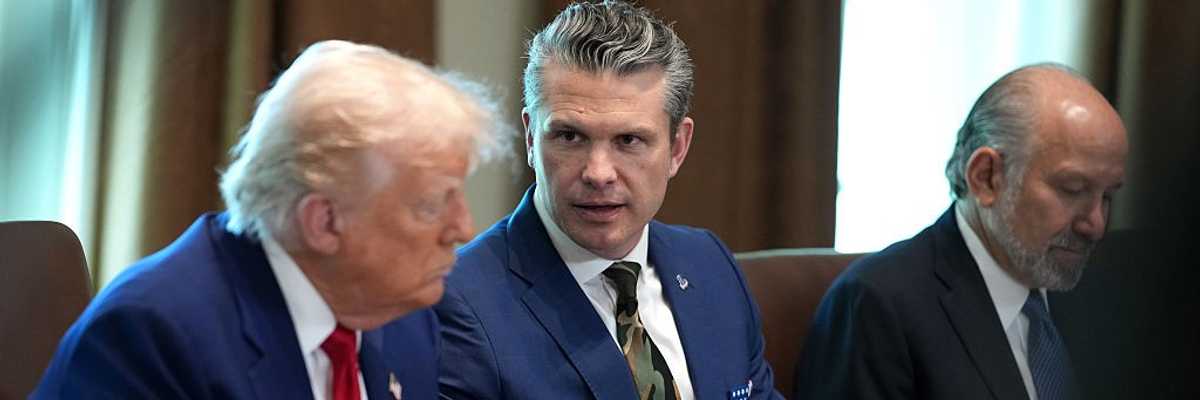
US Defense Secretary Pete Hegseth (R) looks on as US President Donald Trump speaks during a Cabinet meeting at the White House on April 30, 2025 in Washington, DC. (Photo by Andrew Harnik/Getty Images)

NBC reported Friday that the US military is considering options including drone strikes against drug cartel members within the South American country, prompting fears of escalation.

The Trump administration may strike alleged drug targets inside Venezuela’s borders within weeks, sources familiar with the situation told NBC News on Friday.

Two US officials and two other sources with knowledge of the conversations that had taken place said that the US military was considering plans that could include drone strikes against members and leaders of drug trafficking groups as well as drug laboratories. If approved, the strikes would be a further escalation following three Trump administration attacks on alleged drug-carrying boats in the Caribbean that have killed at least 17 people, even though the administration has provided no evidence that those killed were actually smuggling drugs.

“More mass murder on the cards?” the news outlet Venezeulanaysis wrote in response. “NBC reports that the Trump administration is weighing strikes against ‘drug targets’ (emphasis on the air quotes) inside Venezuelan territory. Lots of speculation and anonymous sources, but it shows that no war crimes are off limits.”

US President Donald Trump has already come under heavy criticism for authorizing boat strikes that many decry as illegal. Democratic lawmakers have moved to bar the president from authorizing further attacks, and Colombian President Gustavo Petro called for the United Nations to take criminal proceedings against the US president in a speech on Tuesday.

“This is the most egregious instance of disinformation against our nation, intended to justify an escalation to armed conflict that would inflict catastrophic damage across the entire continent.”

Now, observers are responding with alarm to the news that the administration might go even further.

El Pais correspondent Juan Diego Quesada wrote on social media that strikes within Venezuelan territory “would escalate the conflict to a level whose consequences I dare not measure.”

“How would this not be considered an act of war?” asked poster Cindy Gossett. “Trump can’t just claim Venezuelan citizens are drug lords therefore he’s going to fly a drone over and destroy them. If Venezuela did the same in our country it wouldn’t be accepted.”

Speaking at the UN General Assembly on Friday, Venezuelan Foreign Minister Yvan Gil Pinto said that the US had an “illegal and completely immoral military threat hanging over our heads.”

Pinto also cast doubt on the notion that the Trump administration’s true aim was to combat the drug trade.

He accused the US of trying to permit “external powers to rob Venezuela’s immeasurable oil and gas wealth” and said that the administration was using “vulgar and perverse lies” to “justify an atrocious, extravagant, and immoral multibillion-dollar military threat.”

Trump has yet to authorize any particular plan, according to NBC. The Pentagon declined to comment on their report, and the White House referred the outlet to a previous statement from Trump: “We’ll see what happens. Venezuela is sending us their gang members, their drug dealers, and drugs. It’s not acceptable.”

Venezuelan President Nicolás Maduro has denied that his administration has not done enough to prevent drug trafficking through the South American country, as Trump has accused.

Maduro sent a letter to the White House on September 6 calling for peace and dialogue and defending his record, noting that, according to a UN report, only 5% of the drugs that leave Colombia do so via Venezuela.

He wrote of the trafficking claims, “This is the most egregious instance of disinformation against our nation, intended to justify an escalation to armed conflict that would inflict catastrophic damage across the entire continent.”

Toward the end of the letter, he appealed to Trump to work with him to reduce tensions.

“President, I hope that together we can defeat the falsehoods that have sullied our relationship, which must be historic and peaceful,” Maduro wrote.

Original article by Olivia Rosane republished from Common Dreams under Creative Commons (CC BY-NC-ND 3.0). 

Donald Fuhrump says that Amerikkka doesn't bother with crimes or charges anymore, not being 100% Amerikkkan and opposing his real estate intentions is enough.
Donald Fuhrump says that Amerikkka doesn’t bother with crimes or charges anymore, not being 100% Amerikkkan and opposing his real estate intentions is enough.
Orcas discuss how Trump was re-elected and him being an insane, xenophobic Fascist.
Continue Reading‘No War Crimes Are Off Limits’ as Trump Reportedly Mulling Bombing Targets in Venezuela