People participate in a protest and vigil after an Immigration and Customs Enforcement officer shot and killed a woman in Minneapolis, on January 7, 2026. Photo: Christopher Katsarov/The Canadian Press via AP
Protests erupt across US after ICE agent shoots woman dead
CITIES across the United States continued to erupt in protest today after a woman was shot dead by a federal immigration officer.
Thousands of people took to the streets to vent their anger at Wednesday’s shooting of Renee Nicole Macklin Good, including in New York, Seattle, Chicago, Boston, Phoenix, Tucson, Columbus and Minneapolis, where the shooting took place.
The killing of Ms Macklin Good by an Immigration and Customs Enforcement (ICE) agent came during US President Donald Trump’s latest armed operation against the Somali community.
More than 1,500 people have been arrested during the raids carried out by around 2,000 ICE agents.
…
Eyewitness Emily Heller said officers had screamed at Ms Macklin Good to “move, move, move!”
But when she moved, an officer shot her multiple times.
Elon Musk urges you to be a Fascist like him, says that you can ignore facts and reality then.The original Fascists Mussolini and HitlerOrcas discuss how Trump was re-elected and him being an obviously insane, xenophobic Fascist.
Plans to delay access to the universal credit health element until age 22 have triggered fierce opposition from disabled people’s groups, who warn it would deepen poverty and entrench discrimination against young disabled people under the guise of ‘encouraging work.’ DYLAN MURPHY reports
IN A MOVE that has sent shockwaves through disabled communities across the country, the Labour government is considering a policy that would slash vital financial support for young disabled people aged 18 to 21.
As the campaign group Benefits and Work has pointed out, “One of the proposals in the Pathways to Work green paper was to delay access to the UC [universal credit] health element until age 22, meaning that younger people would not be eligible. The claim is that this would make it less likely that young people would be trapped in a life on benefits. The proposal is pencilled in for 2027/28.”
This has sparked a firestorm of criticism from disabled people’s organisations (DPOs), which warn of a “devastating financial impact” that will push a vulnerable generation further into poverty and away from the very employment opportunities the government claims to be promoting.
The government’s rationale for this drastic measure is to prevent young people from being “trapped in a life on benefits.” However, this narrative has been widely condemned as a gross misrepresentation of the reality faced by young disabled people.
Keir Starmer confirms that he’s proud to be a red Tory continuing austerity and targeting poor and disabled scum.Keir Starmer explains the moral case for cutting disability benefits. He says work will set you free.
The 150m long mountain of rubbish that has been illegally dumped beside the A34 and near the River Cherwell in Kidlington, Oxfordshire, December 12, 2025
THE government and regulators may have failed to comply with key laws on protecting water quality in rivers, lakes and seas, the environmental watchdog said today.
The Office for Environmental Protection (OEP) confirmed it had identified possible failures by the Department for Environment, Food and Rural Affairs (Defra) and the Environment Agency to comply with rules designed to protect and improve water quality.
Under the regulations, water quality plans have to be in place for individual water bodies.
But the OEP said it found the plans tended to be too generic, did not address specific issues at individual sites and were being put in place despite low government confidence their objectives could be met.
As a result, key targets for improvement of water bodies by 2027 are highly likely to be missed, the watchdog said.
The OEP has sent both Defra and the Environment Agency “information notices” setting out the suspected failures, and they have two months to formally respond.
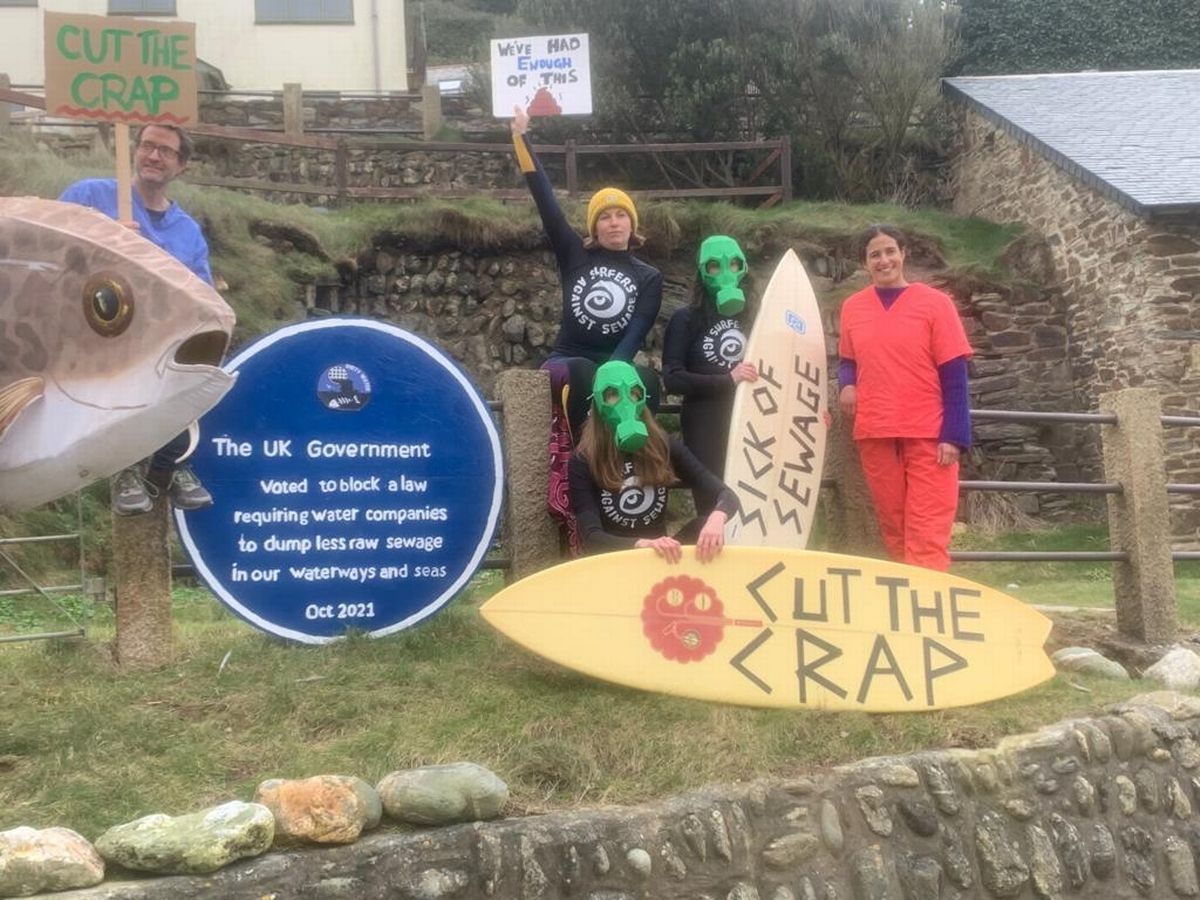
April 2023 Surfers Against Sewage and Extinction Rebellion protests in St Agnes, Perranporth, Truro and Charlestown which unveiled spoof Blue Plaques to the MPs and Conservative Government who allowed raw sewage to be dumped in the sea (Image: Surfers Against Sewage)
Tony Blair hosted Hugo Chávez at Downing Street months before the coup. (Photo: Gerry Penny / Alamy)
Exclusive: UK embassy feared backlash from “wealthier residents of Caracas” if it helped save Venezuelan president’s life in 2002
Britain’s embassy in Caracas rebuffed appeals to help Venezuela’s democratically elected president during a right-wing coup, newly unearthed documents reveal.
The coup that ousted Hugo Chávez on 11 April 2002 was orchestrated by dissident military officers and opposition figures, with support from Washington.
After 47 hours, however, Chávez had been reinstated as Venezuela’s president following massive popular mobilisations against his removal.
Newly released documents reveal how, during those two tumultuous days, Chávez appealed to the British embassy in Caracas to help save his life.
…
[T]he British embassy in Caracas was reluctant to help him during the coup.
UK officials worried about the possible reaction from Venezuela’s upper classes, who had overwhelmingly supported the coup against Chávez.
…
After appealing for Britain’s help, Chávez was arrested and taken to a military base during the early hours of 12 April.
“As Chavez is now under arrest”, the Foreign Office noted later that day, “the question” of helping him travel safely to the airport “no longer arises”.
The Revolution Will Not Be Televised: Venezuela 2002
The Revolution Will Not Be Televised  is a 2003 film focusing on events in Venezuela leading up to and during the April 2002 coup d'état attempt, which saw President Hugo Chávez removed from office for two days.

While the makers of this film are scrupulous in avoiding attributing the origins of the coup against the popular and progressive, democratically elected, Venezuelan President Hugo Chávez and his constitutional government, this contemporary film footage makes it abundantly clear that the imperialist government  and state agencies of the United States of America are behind this illegal and anti-democratic coup.

It is particularly important and timely to relive and remember this anti Chávez coup, at the present moment in early 2019, as the US is again attempting to remove the democratically elected president, and close comrade of Chavez, Nicholas Maduro.

There is no crime that capital will not commit to secure a high profit margin, and Venezuelan proven oil reserves are the largest on Earth. Larger even than Saidi Arabia's, and they are in Uncle Sam's back Yard.

The arrogant Monroe doctrine, that the American hemisphere 'belongs' to the US imperialists is the living creed of the billionaire parasites who grow fat by ensuring the poverty of the masses of the Latin American people.

They are aided and abetted by local elites throughout Latin America and accross the world. This documentary footage is a primary source that reveals the truth of their shady and conspiratorial dealings to cheat humanity of our rights - a share of the wealth that our labour generates, and the beautiful and harmonious society it could bring to the benefit of all.

The Venezuelan people deliver a mighty popular lesson that is recorded live in this film: that the people when organised and united hold real power, but require courageous and revolutionary leadership. This film is a tribute to the Venezuelan masses, and to Hugo Chávez! It is compelling viewing. Watch it and share. Be inspired to fight for a better world.

"The people, united, will never be defeated!"

With particular emphasis on the role played by Venezuela's private media, the film examines several key incidents: the protest march and subsequent violence that provided the impetus for Chávez's ousting; the opposition's formation of an interim government headed by business leader Pedro Carmona; and the Carmona administration's collapse, which paved the way for Chávez's return.
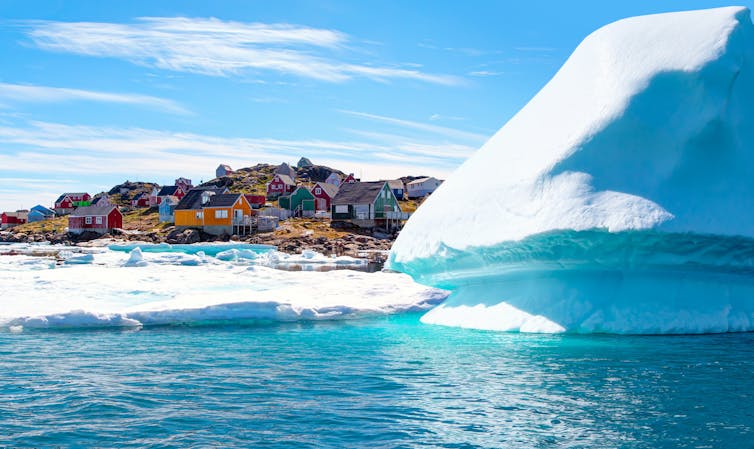
In 2018, a colleague and I, together with a team of Greenlandic research assistants, conducted one of the most comprehensive surveys to date on public opinion in Greenland. We travelled to 13 randomly selected towns and settlements across the island nation, conducting in-person interviews with a representative sample of adult residents.
The survey explored a wide range of topics. We asked for views on climate change, economic matters – and the prospect of independence from Denmark. Until recently, this was the latest poll on what the people of Greenland thought about this issue.
Greenland, a former Danish colony, is currently an autonomous territory within the Kingdom of Denmark. This political arrangement grants Greenland extensive self-rule, including control over most domestic affairs, as well as its own prime minister and parliament. However, Denmark retains authority over foreign policy, defence and monetary policy.
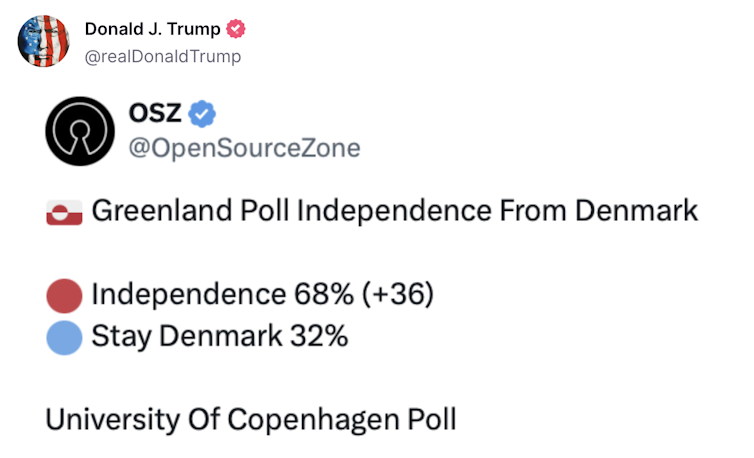
While our survey results were covered in Greenlandic and Danish media upon their release, they received scant international attention. This changed abruptly on January 15, when newly re-elected US president Donald Trump reposted an old news article about our results. The headline stated that two-thirds of Greenlandic citizens support independence.
Trump did not add a comment in the post but the insinuation was clear given his recent statements about annexing Greenland from Denmark: Greenlandic residents want independence from Denmark, and therefore, they might be open to other political or economic arrangements with the US.
“I think we’re going to have it,” Trump recently said after a phone call with the Danish prime minister, Mette Frederiksen, who told him the land was “not for sale”. Trump has in the past spoken of somehow “purchasing” Greenland but has since moved on towards speaking in more assertive terms about taking control of the territory.
Back in 2018, when we conducted the survey, Trump had not yet revealed any plans to annex the island nation. It was a scenario we could hardly even have imagined and therefore did not ask our participants about. As such, regardless of how Trump framed them, the survey results in no way indicated that the population harboured a desire to join the US.
In fact, a recent survey conducted by Sermitsiaq (a Greenlandic newspaper) and Berlingske (a Danish newspaper) directly addressed this question and found that only 6% of respondents wanted Greenland to leave Denmark and instead become part of the US.
In the study I published based on the 2018 data collection, I reported that a majority of the Greenlandic population aspired to independence. Two-thirds of the participants thought that “Greenland should become an independent country at some point in the future”.
Opinions were more divergent regarding the timing of independence. When asked how they would vote in an independence referendum if it were held today, respondents who stated a preference were evenly split between “yes” and “no” to independence.
The Act on Greenland Self-Government, passed in 2009, grants the Greenlandic government the legal authority to unilaterally call a referendum on separating from the political union with Denmark. According to the law, “the decision regarding Greenland’s independence shall be taken by the people of Greenland”.
During the 15 years since its passage, the option to call a referendum has not been exercised. This is likely due to the potential economic consequences of leaving the union with Denmark.
Each year, Denmark sends a block grant that covers approximately half of Greenland’s budget. This supports a welfare system that is more extensive than what is available to most Americans. In addition, Denmark administers many costly including national defence.
This backdrop presents a dilemma for many Greenlanders who aspire to independence, as they weigh welfare concerns against political sovereignty. This was also evident from my study, which revealed that economic considerations influence independence preferences.
For many Greenlanders, the island nation’s rich natural resources present a potential bridge between economic self-sufficiency and full sovereignty. Foreign investments and the associated tax revenues from resource extraction are seen as key to reducing economic dependence on Denmark. Presumably, these natural resources, which include rare earths and other strategic minerals, also help explain Trump’s interest in Greenland.
As Greenland’s future is likely to remain at the centre of a geopolitical power struggle for some time, it is crucial to remember that only Greenlanders have the right to determine their own path. What scarce information is available on their views suggests that while many aspire to independence, it is not driven by a desire to join the US.

 People participate in a protest and vigil after an Immigration and Customs Enforcement officer shot and killed a woman in Minneapolis, on January 7, 2026. Photo: Christopher Katsarov/The Canadian Press via AP