A private jet making its final approach into Edinburgh airport
Private flights at the Scottish government-owned Glasgow Prestwick Airport increased by more than a third last year, according to figures from Oxfam Scotland.
The charity says there were more than 12,000 private flights in and out of Scottish airports in 2024, with the busiest being Edinburgh, Glasgow Prestwick and Inverness.
Oxfam says that if an Air Departure Tax had been in place, and applied at the highest possible rate, that would have generated an extra £29m in tax revenue.
The Scottish government says it is reviewing rates and bands and is open to introducing a higher tax on private jets.
The rise reflects a global trend in private jets being used increasingly by the super-rich, with climate scientists warning that they can be up to 30 times more damaging for the planet than scheduled flights.
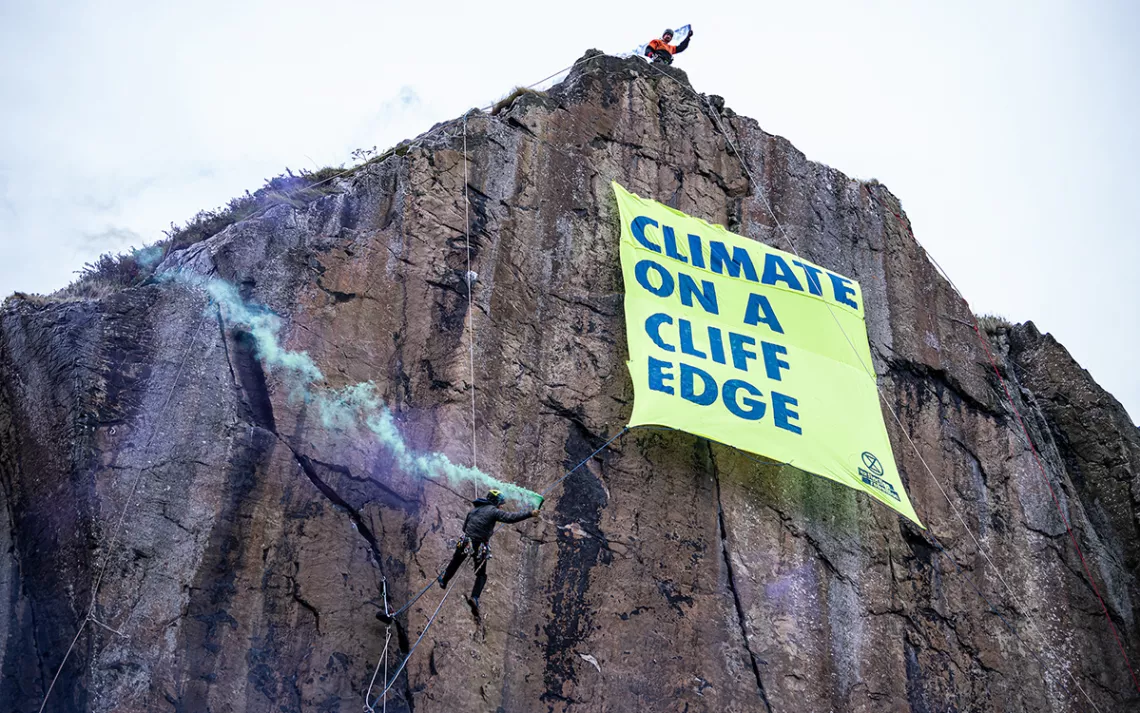
Experienced climbers scale a rock face near the historic Dumbarton castle in Glasgow, releasing a banner that reads “Climate on a Cliff Edge.” One activist, dressed as a globe, symbolically looms near the edge, while another plays the bagpipes on the shores below. | Photo courtesy of Extinction Rebellion and Mark Richards
Human-caused greenhouse gas (GHG) emissions in 2024 continued to drive global warming to record levels.
This is the stark picture that emerges in the third edition of the “Indicators of Global Climate Change” (IGCC) report, published in Earth System Science Data.
In doing so, the IGCC fills the gap between the IPCC’s sixth assessment (AR6) in 2021 and the seventh assessment, expected in 2028.
Following IPCC methods, this year’s assessment brings together a team of over 60 international scientists, including former IPCC authors and curators of vital global datasets.
As in previous years, it is accompanied by a user-friendly data dashboard focusing on the main policy-relevant climate indicators, including GHG emissions, human-caused warming, the rate of temperature change and the remaining global carbon budget.
Below, we explain this year’s findings, highlighting the role that humans are playing in some of the fundamental changes the global climate has seen in recent years.
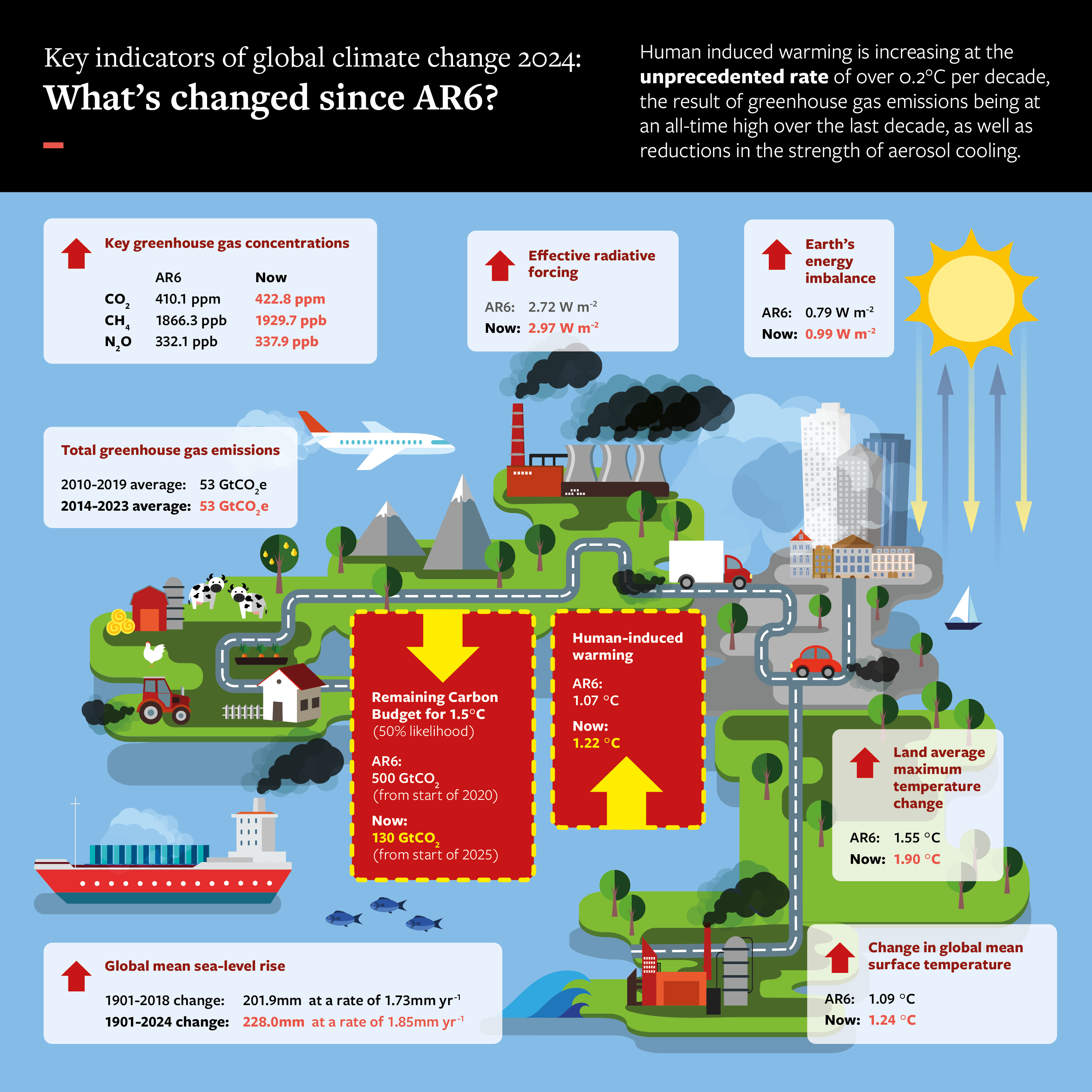
Headline results from an analysis of key climate indicators in 2024, compared to the IPCC AR6 climate science report. Source: Forster et al. (2025)
(For previous IGCC reports, see Carbon Brief’s detailed coverage in 2023 and 2024.)
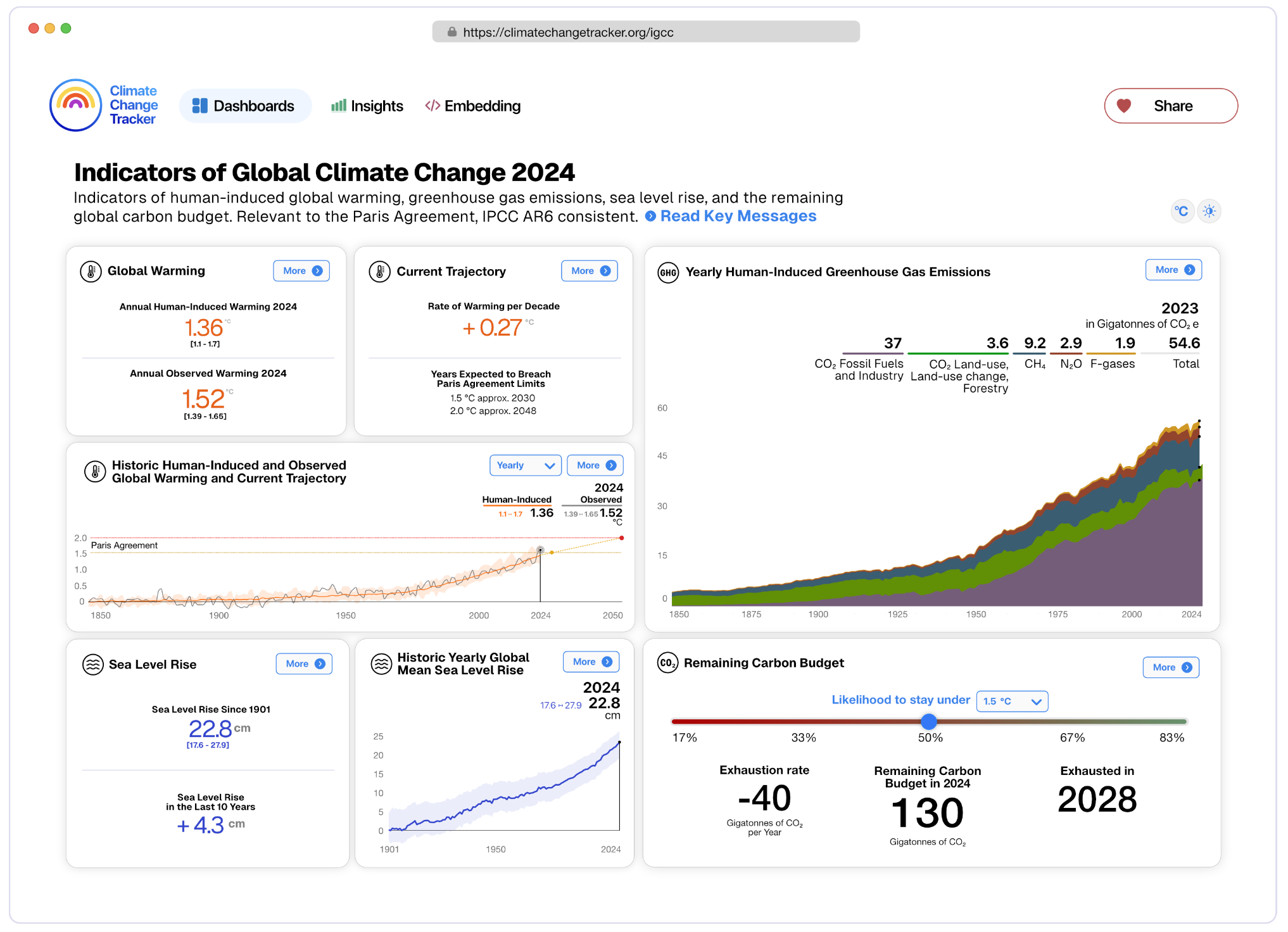
Our best estimate is a rise of 1.52C (with a range of 1.39-1.65C), of which human activity contributed around 1.36C. The rest is the result of natural variability in the climate system, which also plays a role in shaping global temperatures from one year to the next.
Our estimate of 1.52C differs slightly from the 1.55C given by the World Meteorological Organisation (WMO) state of the global climate 2024 report, published earlier this year. This is because they make slightly different selections on which of the available global land and ocean temperature datasets to include. (The warming estimate has varied by similar amounts in past years and future work will aim to harmonise the approaches.)
The height of 2024’s temperatures, while unprecedented in at least the last 2,000 years, is not surprising. Given the high level of human-induced warming, we might currently expect to see annual temperatures above 1.5C on average one year in six.
However, with 2024 following an El Niño year, waters in the North Atlantic were warmer than average. These conditions raise this likelihood to an expectation that 1.5C is surpassed every other year.
From now on, we should regard 2024’s observed temperatures as unexceptional. Temperature records will continue to be broken as human-caused temperature rise also increases.
Longer-term temperature change
Despite observed global temperatures likely rising by more than 1.5C in 2024, this does not equate to a breach of the Paris Agreement’s temperature goal, which refers to long-term temperature change caused by human activity.
IGCC also looks at how temperatures are changing over the most recent decade, in line with IPCC assessments.
Over 2015-24, global average temperatures were 1.24C higher than pre-industrial levels. Of this, 1.22C was caused by human activity. So, essentially, all the global warming seen over the past decade was caused by humans.
Observed global average temperatures over 2015-24 were also 0.31C warmer than the previous decade (2005-14). This is unsurprising given the high rates of human-caused warming over the same period, reaching a best estimate of 0.27C per decade.
This rate of warming is large and unprecedented. Over land, where people live, temperatures are rising even faster than the global average, leading to record extreme temperatures.
But every fraction of a degree matters, increasing climate impacts and loss and damage that is already affecting billions of people.
Driven by emissions
Undoubtedly, these changes are being caused by GHG emissions remaining at an all-time high.
Over the last decade, human activities have released, on average, the equivalent of around 53bn tonnes of CO2 into the atmosphere each year. (The figure of 53bn tonnes expresses the total warming effect of CO2 and other greenhouse gases, such as methane and nitrous oxide, using CO2 as a reference point.)
Emissions have shown no sign of the peak by 2025 and rapid decline to net-zero required to limit global warming to 1.5C with no or limited “overshoot”.
Most of these emissions were from fossil fuels and industry. There are signs that energy use and emissions are rising due to air conditioning use during summer heatwaves. Last year also saw high levels of emissions from tropical deforestation due to forest fires, partly related to dry conditions caused by El Niño.
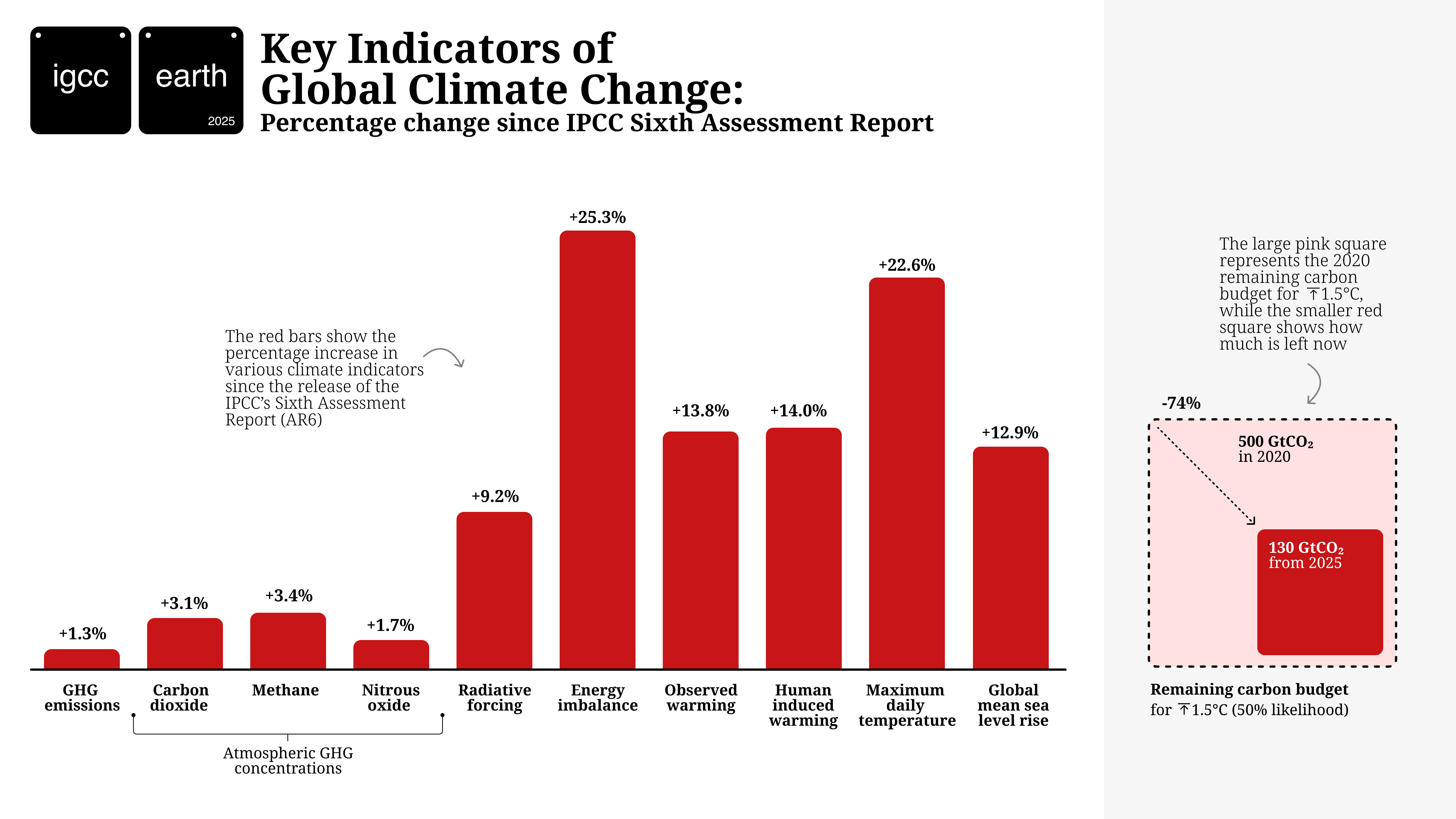
The amount of CO2 in the atmosphere, alongside the other major GHGs of methane (CH4) and nitrous oxide (N2O), is continuing to build up to record levels. Their concentrations have increased by 3.1, 3.4 and 1.7%, respectively, since the 2019 values reported in the last IPCC assessment.
At the same time, aerosol emissions, which have a cooling effect, are continuing to fall as a result of important efforts to tackle air pollution. This is currently adding to the rate of GHG warming.
Notably, cutting CH4 emissions, which are also short-lived in the atmosphere, could offset this rise. But, again, there is no real sign of a fall – despite major initiatives such as the Global Methane Pledge.
The effect of all human drivers of climate change on the Earth’s energy balance is measured as “radiative forcing”. Our estimate of this radiative forcing in 2024 is 2.97 Watts per square metre (W/m2), 9% above the value recorded in 2019 that was quoted in the last IPCC assessment.
This is shown in the figure below, which illustrates the percentage change in an array of climate indicators since the data update given in the last IPCC climate science report.
Percentage changes in key climate indicators in 2024, compared to the IPCC AR6 climate science report. The remaining carbon budget given on the right is the only indicator to show a reduction and is the change since IPCC AR6, presented as a shrinking box. Source: Forster et al. (2025)
Continued emissions and rising temperatures are meanwhile rapidly eating into the remaining carbon budget, the total amount of CO2 that can be emitted if global warming is to be kept below 1.5C.
Our central estimate of the remaining carbon budget from the start of 2025 is 130bn tonnes of CO2.
This has fallen by almost three-quarters since the start of 2020. It would be exhausted in a little more than three years of global emissions, at current levels.
However, given the uncertainties involved in calculating the remaining carbon budget, the actual value could lie between 30 and 320bn tonnes, meaning that it could also be exhausted sooner – or later than expected.
Beyond global temperatures
Our assessment also shows how surplus heat is accumulating in the Earth’s system at an accelerating rate, becoming increasingly out of balance and driving changes around the world.
The data and their changes are displayed on a dedicated Climate Change Tracker platform, shown below.
Snapshot of Climate Change Tracker
The radiative forcing of 2.97 W/m2 adds heat to the climate system. As the world warms in response, much of this excess heat radiates to space, until a new balance is restored. The residual level of heating is termed the Earth’s “energy imbalance” and is an indication of how far out of balance the climate system is and the warming still to come.
This residual rate of heat entering the Earth system has now approximately doubled from levels seen in the 1970s and 1980s, to around 1W/m2on average during the period 2012-24.
Although the ocean is storing an estimated 91% of this excess heat, mitigating some of the warming we would otherwise see at the Earth’s surface, it brings other impacts, including sea level rise and marine heatwaves.
Global average sea level rise, from both the melting of ice sheets and thermal expansion due to deep ocean warming, is included in the IGCC assessment for the first time.
We find that it has increased by around 26mm over the last six years (2019-24), more than double the long-term rate. This is the indicator that shows the clearest evidence of an acceleration.
Overall, our indicators provide multiple lines of evidence all pointing in the same direction to provide a clear and consistent – but unsurprising and worsening – picture of the climate system.
It is also now inevitable that global temperatures will reach 1.5C of long-term warming in the next few years unless society takes drastic, transformative action – both in cutting GHG emissions and stopping deforestation.
Every year of delay brings reaching 1.5C – or even higher temperatures – closer.
This year, countries are unveiling new “nationally determined contributions” (NDCs), the national climate commitments aimed at collectively reducing GHG emissions and tackling climate change in line with the Paris Agreement.
While the plans put forward so far represent a step in the right direction, they still fall far short of what is needed to significantly reduce, let alone stop, the rate of warming.
At the same time, evidence-based decision-making relies on international expertise, collaboration and global datasets.
Our annual update relies on data from NASA and the National Oceanic and Atmospheric Administration (NOAA) and input from many of their highly respected scientists. It is this type of collaboration that allows scientists to generate well-calibrated global datasets that can be used to produce trusted data on changes in the Earth system.
It would not be possible to maintain the consistent long-term datasets employed in our study if their work is interrupted.
At a time when the planet is changing at the fastest rate since records began, we are at risk of failing to track key indicators – such as greenhouse gas concentrations or deep ocean temperatures – and losing core expertise that is vital for understanding the data.
Forster, P. M. et al. (2025) Indicators of Global Climate Change 2024: Annual update of key indicators of the state of the climate system and human influence, Earth System Science Data, doi:10.5194/essd-17-2641-2025
Neo-Fascist Climate Science Denier Donald Trump says Burn, Baby, Burn.Experienced climbers scale a rock face near the historic Dumbarton castle in Glasgow, releasing a banner that reads “Climate on a Cliff Edge.” One activist, dressed as a globe, symbolically looms near the edge, while another plays the bagpipes on the shores below. | Photo courtesy of Extinction Rebellion and Mark RichardsElon Musk urges you to be a Fascist like him, says that you can ignore facts and reality then.
Activists from the U.K. action group Everyone Hates Elon and Greenpeace Italy unfolded a banner reading, “If you can rent Venice for your wedding, you can pay more tax,” on Piazza San Marco in the Italian city on June 23, 2025. (Photo: Michele Lapini/Greenpeace)
“This isn’t just about one person—it’s about changing the rules so no billionaire can dodge responsibility, anywhere,” said one Greenpeace campaigner.
Billionaire Amazon founder Jeff Bezos—the third- or fourth-richest person on the planet, depending on the list—is hosting various wedding events in Venice, Italy, this week, festivities that have drawn protests, including a massive banner on Monday.
Activists with Greenpeace Italy and the U.K. action group Everyone Hates Elon—targeting Elon Musk, U.S. President Donald Trump’s close far-right ally and the wealthiest person on Earth—unfolded a banner that read, “If you can rent Venice for your wedding, you can pay more tax,” in Piazza San Marco.
“While Venice is sinking under the weight of the climate crisis, billionaires are partying like there is no tomorrow on their megayachts,” Greenpeace campaigner Clara Thompson said in a statement. “This isn’t just about one person—it’s about changing the rules so no billionaire can dodge responsibility, anywhere.”
“The real issue is a broken system that lets billionaires skip out on their fair share of taxes while everyone else is left to foot the bill,” she argued. “That’s why we need fair, inclusive tax rules, and they must be written at the U.N.”
Jeff Bezos pays his staff poverty wages and dodges tax. No wonder he can afford to shut down half of Venice for his wedding this week. Tax billionaires NOW.Location: Piazza San Marco, Venice@greenpeace.org #JeffBezos #TaxTheSuperRich
Reporting on Monday’s display of the banner—which features Bezos’ face and is about 65 feet long and wide—Reuters detailed:
Local police arrived to talk to activists and check their identification documents, before they rolled up their banner.
“The problem is not the wedding, the problem is the system. We think that one big billionaire can’t rent a city for his pleasure,” Simona Abbate, one of the protesters, told Reuters.
A spokesperson from Everyone Hates Elon similarly said in a Monday statement that “as governments talk about hard choices and struggle to fund public services, Jeff Bezos can afford to shut down half a city for days on end just to get married.”
“Just weeks ago, he spent millions on an 11-minute space trip,” the spokesperson added, referring to the Blue Origin flight for multiple public figures, including Bezos’ fiancée, Lauren Sánchez. “If there was ever a sign billionaires like Bezos should pay wealth taxes, it’s this.”
Bezos and Sánchez’s event planners, Lanza and Baucina, toldCNN: “Rumors of ‘taking over’ the city are entirely false and diametrically opposed to our goals and to reality… From the outset, instructions from our client and our own guiding principles were abundantly clear: the minimizing of any disruption to the city.”
The details surrounding Bezos’ marriage to the former news anchor have been closely guarded, but CNN reported that around 30 of Venice’s 280 water taxis are thought to be reserved, the city’s nine yacht ports are booked, and one source said that special permission has been granted for private helicopters.
While Venice’s mayor and regional governor Luca Zaia have defended the billionaire’s luxury wedding events, citing economic benefits for local businesses, “the ‘No Space for Bezos’ movement—a play on words also referring to the bride’s recent space flight—has united a dozen Venetian organizations including housing advocates, anti-cruise ship campaigners, and university groups,” according toThe Associated Press.
The Bloomberg and Forbes lists tracking global billionaires put Bezos’ net worth between $223.4 billion and $231 billion as of Monday. At times in recent years, he has been believed to be the richest person in the world.
Green Party Co-leader Adrian Ramsay. Wikipedia CC.
Reacting to Reform UK’s plans for a “Britannia Card” which would offer wealthy foreigners and returning British expats a bespoke tax regime in exchange for a one-off payment of £250,000 – with all funds collected redistributed to Britain’s lowest-paid workers – Green Party co-leader Adrian Ramsay MP said:
“Nigel Farage’s latest wheeze to prop up the super wealthy, dressed up as helping the poorest, would result in an estimated loss of a whopping £34bn to the Treasury. Rather than enabling the super-rich to buy their way out of paying UK tax, the Green Party would tax investment income as equivalent to earned income and introduce a wealth tax based on assets. This is the way to fix our public services to benefit everyone.
“This is another reminder that Reform UK is a Party run by multi-millionaires out to look after their own and with net zero interest in the rest of us. There’s nothing patriotic about a “Britannia card” that would let the ultra-wealthy avoid paying taxes and contributing to society.”
Nigel Farage says he’s too stupid to answer questions about the hit to the UK economy of his plans to suck up to the uber-rich.