Starmer’s Iran war lies exposed


Original article by Paul Rogers republished from OpenDemocracy under a Creative Commons Attribution-NonCommercial 4.0 International licence.

After four weeks of the US-Israeli war on Iran, the conflict dynamics have become ever more complex. While none of the three main actors has achieved their aims, Iran has undoubtedly come closest, despite the gigantic clouds of hubris that have characterised Trumpian political output so far.
Ordinary Iranians have suffered appallingly – with towns and cities damaged, thousands killed and injured, food shortages and rigorous control of dissent – but there is little sign of leadership collapse. The heads of the Iranian Revolutionary Guard Corps (IRGC) will now be quietly confident in regime survival; those assassinated have been replaced, and the state remains functional.
For Donald Trump and Binyamin Netanyahu, the unexpected challenge in defeating Tehran is exposing an uncomfortable new reality: the global economic balance of power is shifting away from the North Atlantic to the Indo-Pacific.
Across the board, the IRGC’s decades of preparations have so far worked well against the immense combined military force of Israel and the US. Analysis suggests that most of Iran’s 200 kilograms of 60% enriched uranium-235 survived last year’s US attack and may be hidden in bunkers at Isfahan and at Pickaxe Mountain near Fordow. These hugely valuable stocks are close enough to “weapons-grade” enrichment, and are reportedly too deep to be destroyed by bunker-busting bombs – instead requiring very risky ground assaults.
The Pentagon is already said to be moving weapons and personnel suited to this task towards the warzone, including 2,000 troops from the Army’s 82nd Airborne Division trained “to parachute into hostile or contested territory to secure key territory and airfields”, but the IRGC has likely widely dispersed its stockpile to mitigate this risk.
Similarly, Tehran has long prepared for a confrontation over the Strait of Hormuz, including amassing a fleet of more than 1,000 fast attack craft, thousands of mines, numerous shore-based anti-ship missiles able to range widely over the Gulf, swarms of drones to saturate anti-missile defences and crewless armed subsurface craft.
The IRGC remains in control and able to fire the ballistic and cruise missiles and armed drones it has aimed variously at Israel and other nearby states in the region. Even if barely one in 20 gets through, that would be enough, symbolism being so important. Take last weekend’s Iranian attack on the Israeli city of Dimona, just five miles from the symbolically important and closely protected Shimon Perez Nuclear Research Centre, the heart of Israel’s own nuclear weapons research and development programme.
To complicate matters further for the US and Israel, Tehran is in the process of acquiring stocks of the Chinese anti-ship missiles that Beijing claims are the most effective weapon of its kind, the 180-mile-range surface-hugging CM-302. China knows all too well that the missile’s use in a successful Iranian attack on a US Navy destroyer, cruiser or even an aircraft carrier would transform its export potential for at least a decade.
If its survival becomes seriously threatened, Iran could force the long-term closure of the Strait of Hormuz and the destruction of desalination plants and the termination of oil and gas output in the region. Ask why they are hitting otherwise friendly states, and the IRGC will have a ready reply: ‘friendly’ can no longer mean allying in any way with the Americans. It will view the choice as between Muslim Iran and the bully in Washington with its Zionist ally.
That analysis may seem over the top, but anything less is dangerously missing the point.
The US and Israel have got it badly wrong, particularly as the Israeli Defence Force is also struggling on its “second front” in southern Lebanon, where it hoped to occupy and then depopulate the area to terminate Hezbollah as a functioning paramilitary movement. Hezbollah’s vigorous resistance may be one reason for the IDF’s controversial use of white phosphorus artillery shells, and also its practice of flattening entire villages with bulldozers.
Trying to understand what is likely to happen next is hugely complicated, but as I said last week, by far the most sensible action Trump can now take is to declare victory and withdraw, get his forces out of the way as quickly as possible and warn Netanyahu not to make trouble.
Will the US president do so? Highly unlikely, except for just one factor that most analysts are missing. He might be forced to.
The oil-rich Gulf states, especially Saudi Arabia, Qatar, Kuwait and the United Arab Emirates, are immensely wealthy. In terms of sovereign wealth funds alone, we are talking about over $4trn, and there are many other investment strengths to play with. Add a friendly China, and you get nearly twice that.
How that plays out in terms of withdrawal of investments and other multiple private pressures on Washington and Wall Street is not clear, but a new reality is unfolding. The US may still be the world’s leading military power, at least for now – but in this crisis, that’s less relevant than ever.
Original article by Paul Rogers republished from OpenDemocracy under a Creative Commons Attribution-NonCommercial 4.0 International licence.


The Green Party is demanding the government suspends the Israeli ambassador after Israel’s parliament approved the death penalty for Palestinians convicted for attacks deemed to be “acts of terrorism”.
Deputy Leader of the Green Party, Mothin Ali, said:
“These military courts are conducted without proper legal representation or juries. This is unconscionable – the government must immediately suspend Israel’s UK ambassador.
“Introducing the death penalty into Israel’s civil legal system, in a way that rights groups say will de facto only apply to Palestinians with Israeli citizenship, will result in Palestinians being killed without a fair trial.
“Palestinian citizens of Israel already lack certain rights granted to Israeli citizens, and their second-class status was made explicit with the passing of the 2018 Jewish Nation-State Law.
“It’s time for the Labour government to stand for truth: Israel is an apartheid state which is conducting a genocide in Gaza. Just like apartheid South Africa, it must be treated as a pariah state until the genocide is stopped, apartheid is ended, and Palestinians are granted the same rights as Israelis.
Ali repeated a call for the government to ban the sale of all weapons and weapon components to Israel:
“The government must make clear that it will not continue to sell any military weapons or weapons components to Israel. The Green Party calls for Britain to impose sanctions on Israel, as most of the world community did to South Africa, when it was also operating an apartheid state.”
https://morningstaronline.co.uk/article/nineham-and-jamal-found-guilty-dark-day-civil-liberties

 People taking part in a national march for Palestine on Whitehall in central London, January 18, 2025
TWO pro-Palestine campaigners being found guilty of breaching protest conditions yesterday is “a huge setback for civil liberties,” supporters said.
Palestine Solidarity Campaign (PSC) director Ben Jamal and Stop the War vice-chair Chris Nineham made clear they will be appealing the verdicts as they criticised the “absurdity” of the case.
Jeremy Corbyn called the verdicts “a dark day for civil liberties in this country.”
District judge Daniel Sternberg found both Mr Jamal and Mr Nineham guilty of failing to comply with conditions imposed on the January 18 2025 Whitehall protest.
Mr Jamal was in addition found guilty of inciting others to fail to comply following the trial at Westminster Magistrates’ Court.
A key part of the defence was that the conditions imposed on the protest, which prevented a march to the BBC, were unlawful.
Defence barrister, Mark Summers KC, submitted a detailed legal argument outlining this case, including that the Court of Appeal had already ruled in a previous case that imposing conditions on the basis of “more than minor” disruption was unlawful.
But Mr Sternberg told the court he was not obliged to give any reasons for his decision, instead handing it down in a 54-page written judgment, with a short summary for the media.
He gave both men conditional discharges of 18 and 12 months respectively and ordered them each to pay £7,500 in costs.
Speaking outside the court, Mr Nineham said: “We think this is an extraordinary and shocking decision and a huge setback for civil liberties in this country.
“It is clearly part of an ongoing criminalisation of the Palestine movement in which people protesting against a genocide are being targeted by a British Establishment that is colluding with it.
“It is an attempt to send a chilling message across society that people shouldn’t risk protesting. It is an attempt that will not stop us.”
Mr Jamal said: “We will be appealing. We will be appealing because of concerns about how this trial has been conducted.
“The judge did not see fit to deliver his judgment in open court.
“I have always been of the view that in a court, justice must not only be done, it must be seen to be done.
…
Article continues at https://morningstaronline.co.uk/article/nineham-and-jamal-found-guilty-dark-day-civil-liberties
 President Donald Trump answers questions from reporters after signing an executive order in the Oval Office of the White House, March 31, 2026, in Washington
US PRESIDENT Donald Trump struck a hard line today in a social media post, demanding that Iran stop blocking the Strait of Hormuz, or the US would bomb the Iranians “back to the Stone Ages.”
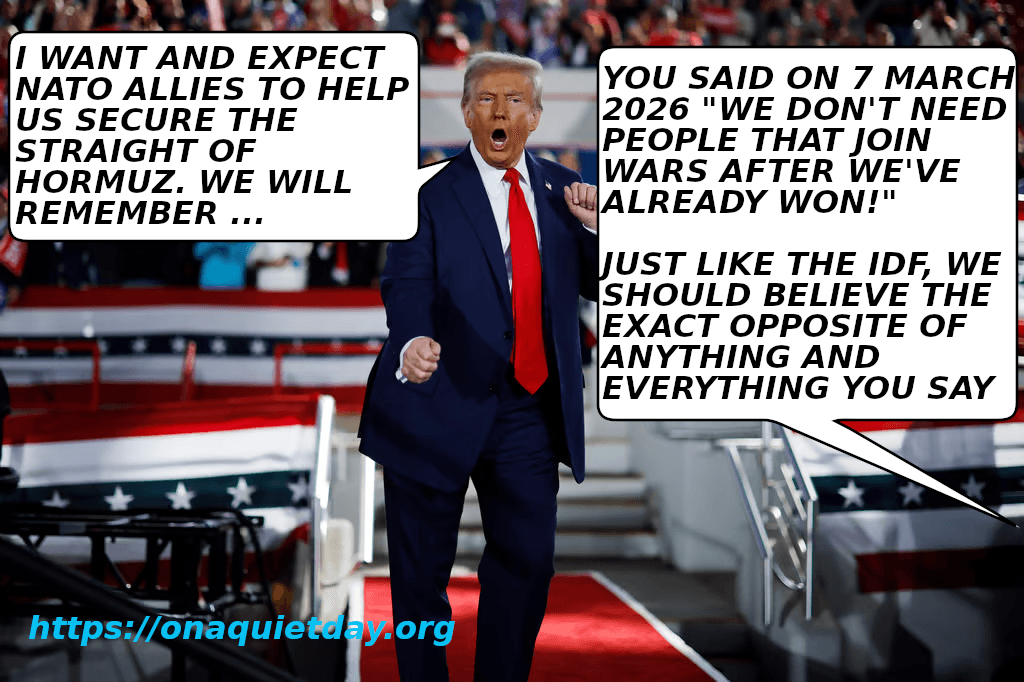
A day earlier, President Trump had said the US “will not have anything to do with” ensuring the security of ships passing through Hormuz; that was itself an apparent backtrack from an earlier threat to attack Iran’s power grid and other infrastructure if it didn’t open the strait by April 6.
…
Mr Trump has continued to insist that negotiations between the US and Iran are progressing well and claims Iran is “begging to make a deal.”
The Iranians have said that while messages have been sent between Tehran and Washington, there have been no formal negotiations.
Iranian President Masoud Pezeshkian said today his country has the “necessary will” to end the war with the US and Israel.
Talking to Al Jazeera, Iranian Foreign Minister Abbas Araghchi said: “You cannot speak to the people of Iran in the language of threats and deadlines.
“We do not set any deadline for defending ourselves.”
…
Original article at https://morningstaronline.co.uk/article/trump-threatens-bomb-iran-back-stone-ages-if-they-fail-open-strait-hormuz
