This work by Middle East Monitor is licensed under a Creative Commons Attribution-NonCommercial-ShareAlike 4.0 International License.
Trucks carrying food aid and fuel, accompanied by a United Nations team, passed through the Kerem Shalom border crossing and arrive in the city of Khan Yunis, Gaza on October 15, 2025. [Abed Rahim Khatib – Anadolu Agency]
The UN’s top humanitarian official called on Israel on Wednesday to permit a massive increase in aid deliveries to Gaza under a ceasefire agreement, Anadolu reports.
“As Israel has agreed to a ceasefire, they must allow the massive surge of humanitarian aid – thousands of trucks a week – on which so many lives depend, and on which the world has insisted,” said Tom Fletcher, UN under-secretary-general for humanitarian affairs and emergency relief coordinator.
Speaking in Cairo, Egypt, Fletcher said the UN has outlined a 60-day plan for scaling up “lifesaving aid” and that he remained in the region to coordinate the effort.
“We need more crossings open and a genuine, practical, problem-solving approach to removing remaining obstacles,” he said, stressing that withholding aid “is not a bargaining chip” and that Israel is legally obliged to facilitate humanitarian assistance to civilians.
Fletcher added that the UN would ensure all aid is delivered “neutrally and with maximum efficiency,” emphasizing that supplies must reach civilians and not armed groups. “We will not accept any interference with our aid distribution,” he said.
Last week, US President Donald Trump announced that Israel and Hamas had agreed to the first phase of a plan he laid out on Sept. 29 to bring a ceasefire to Gaza, release all Israeli captives in exchange for Palestinian prisoners, and a gradual withdrawal of Israeli forces from the entire Gaza Strip. The first phase of the deal came into force on Friday.
Under the deal, Hamas released 20 living Israeli hostages and handed over the remains of eight captives in exchange for nearly 2,000 Palestinian prisoners.
Phase two of the plan calls for the establishment of a new governing mechanism in Gaza, without Hamas’ participation, the formation of a multinational force, and the disarmament of Hamas.
Since October 2023, Israeli attacks have killed over 67,900 Palestinians in the enclave, most of them women and children, and rendered it largely uninhabitable.
This work by Middle East Monitor is licensed under a Creative Commons Attribution-NonCommercial-ShareAlike 4.0 International License.
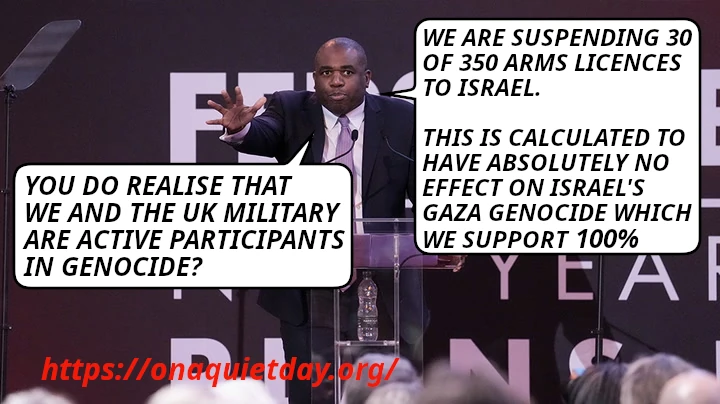
Keir Starmer objects to criticism of the IDF. He asks how could anyone object to them starving people to death, forced marches like the Nazis did, bombing Gaza’s hospitals and universities, mass-murdering journalists, healthworkers and starving people queuing for food, killing and raping prisoners and murdering children. He calls for people to stop obstructing his genocide for Israel.Genocide denier and Current UK Prime Minister Keir Starmer is quoted that he supports Zionism without qualification. He also confirms that UK air force support has been essential in Israel’s mass-murdering genocide. Includes URLs https://www.declassifieduk.org/keir-starmers-100-spy-flights-over-gaza-in-support-of-israel/ and https://youtu.be/O74hZCKKdpAGenocide denying UK Foreign Secretary David Lammy says that UK is suspending 30 of 350 arms licences to Israel. He also confirms the UK government’s support for Israel’s Gaza genocide and the UK government and military’s active participation in genocide.
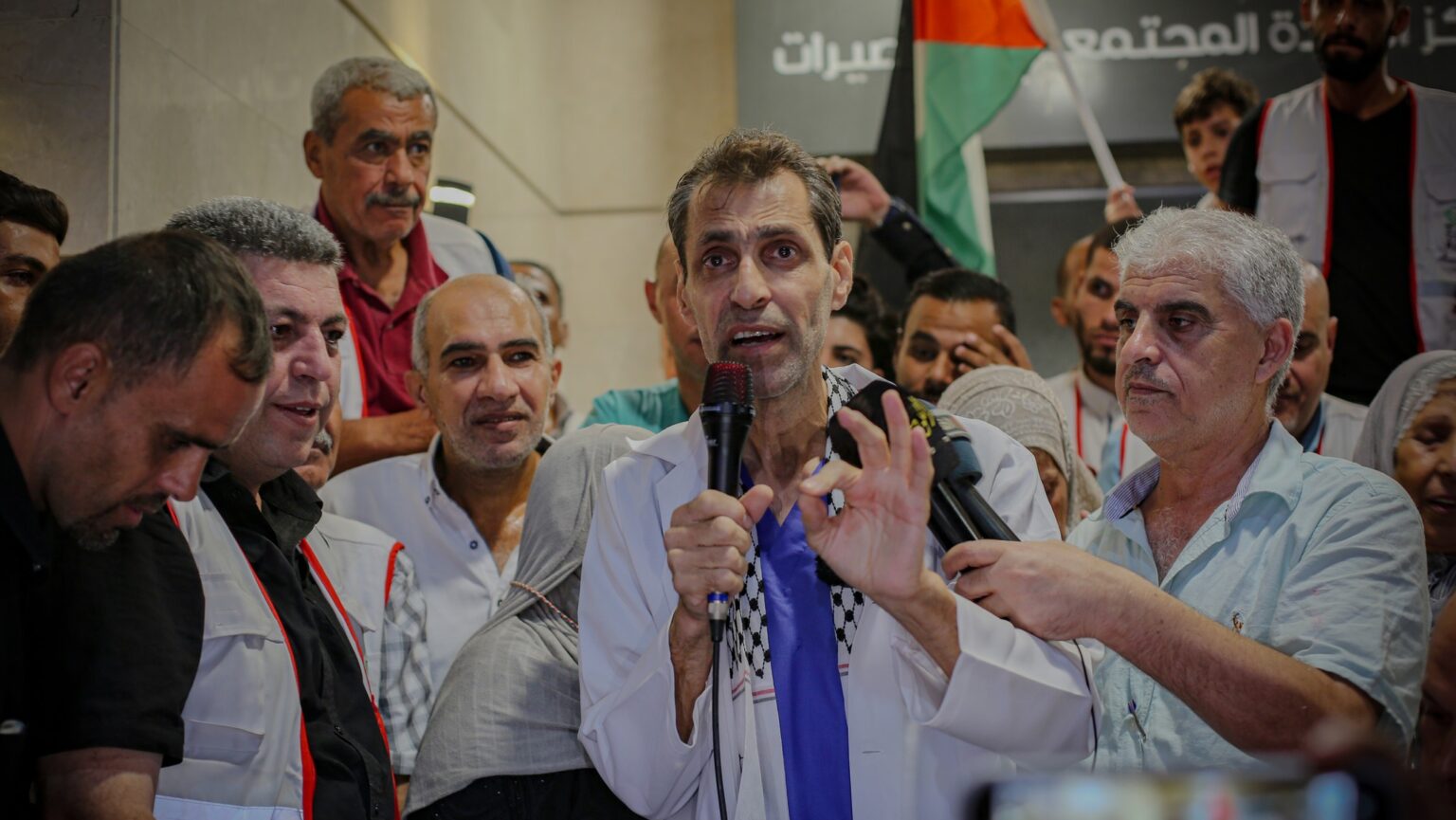
Dr. Ahmed Muhanna was illegally imprisoned by Israeli forces for 665 days. Source: Awda Health and Community Association/Facebook
Al-Awda Hospital director Ahmed Muhanna was released after almost two years of illegal imprisonment. Dozens of Palestinian health workers remain captives in Israeli jails.
Dr. Ahmed Muhanna, director of Al-Awda Hospital in northern Gaza, has been released by Israeli forces after 665 days of illegal imprisonment. He was originally kidnapped from the hospital floor in December 2023, as Israel unleashed its systematic destruction of Gaza’s healthcare system, killing and imprisoning hundreds of health workers.
“Israel directly targeted medical staff, as if they were the biggest enemy of the Zionist entity, with their white coats, serving the people of Gaza,” Dr. Muhanna said upon returning to the hospital. “They tried to capture all the functioning institutions, but I will say this once more: never! You will never get control of them. We will never leave the hospitals.”
Dr. Muhanna was released with a number of healthcare workers – nurses, doctors, and paramedics – during the first phase of the captives for prisoners exchange agreement. “While their release is warmly welcomed, there are at least 115 more Gazan healthcare workers who are still being held in Israeli detention,” Healthcare Workers Watch wrote on October 13.
“Israel’s systematic abduction of healthcare workers is a war crime which has decimated the hospital workforce in Gaza,” said the network’s co-founder Dr. Muath Alser. “Unlawfully holding highly trained medical professionals in detention has directly deprived Palestinians of medical care and terrorized the hospital staff left behind. Israel must immediately and unconditionally release all the detained healthcare workers including the bodies of those tortured to death in detention.”
At least five medics – including surgeon Dr. Adnan Al-Bursh – have been tortured to death while imprisoned during the genocide, Healthcare Workers Watch notes. Others, such as pediatrician Dr. Hussam Abu Safiya, have been excluded from lists of political prisoners scheduled for release, despite deteriorating health and their importance for keeping health services running.
Dr. Muhanna himself described the conditions endured by Palestinian health workers and other prisoners in Israeli jails. “We were isolated and deceived,” he said. “There was no news at all. The intelligence services spread false information only to demoralize us. There were harsh interrogations, and we were kept entirely in the dark. So our message to detainees still imprisoned must be to continue our humanitarian and health mission for our people, especially in the northern and central Gaza Strip.”
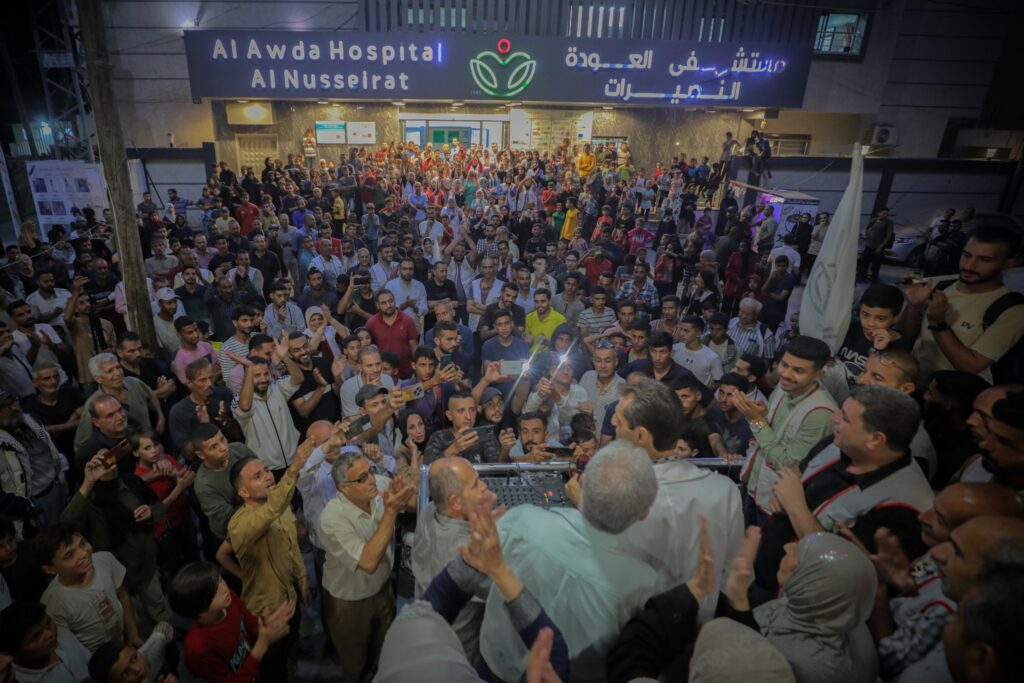
Health workers and patients gathered to meet Dr. Muhanna near Al-Awda Hospital in Gaza upon his release. Source: Awda Health and Community Association/Facebook
Upon his release, Dr. Muhanna reaffirmed his determination to rebuild Gaza’s health services together with his colleagues. Palestinian and international right to health organizations have expressed the commitment to ensure that such reconstruction is steered by Palestinians themselves. “Political sovereignty is recognized as indivisible from health sovereignty,” states the Gaza Health Solidarity Declaration, signed by Awda, the People’s Health Movement (PHM), Viva Salud, and others. For Palestinians, it continues, this means liberation from settler colonialism, occupation, and imprisonment, as well as the full realization of the right of return, restitution, and reparations.
The role of Palestinian health workers like Dr. Muhanna and of community-based organizations providing care is central to this vision. These organizations, the declaration emphasizes, “have long provided healthcare services to their communities” and must be able to set the course for future health programs across Palestine.
“We state clearly our conviction that Palestinians can and will rebuild the health system in Gaza,” the declaration concludes, “while deepening a shared commitment to health equity and health justice throughout Palestine.”
People’s Health Dispatchis a fortnightly bulletin published by thePeople’s Health Movementand Peoples Dispatch. For more articles and subscription to People’s Health Dispatch, clickhere.
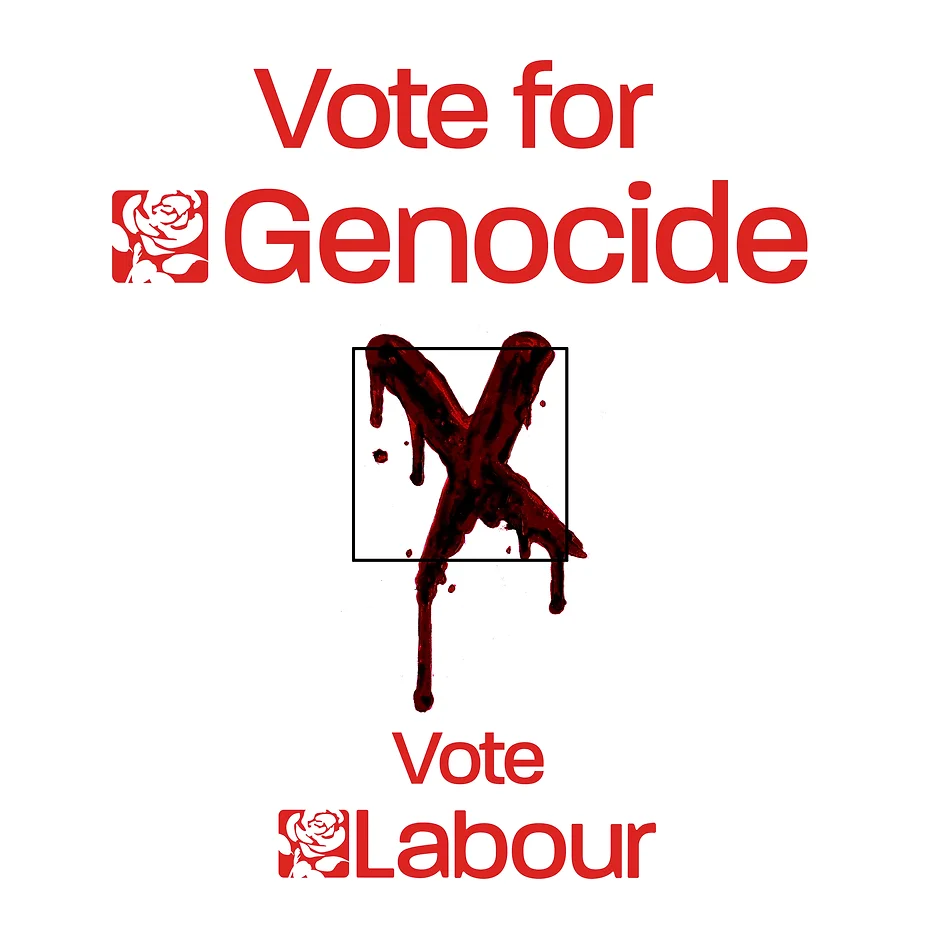
Keir Starmer objects to criticism of the IDF. He asks how could anyone object to them starving people to death, forced marches like the Nazis did, bombing Gaza’s hospitals and universities, mass-murdering journalists, healthworkers and starving people queuing for food, killing and raping prisoners and murdering children. He calls for people to stop obstructing his genocide for Israel.Genocide denier and Current UK Prime Minister Keir Starmer is quoted that he supports Zionism without qualification. He also confirms that UK air force support has been essential in Israel’s mass-murdering genocide. Includes URLs https://www.declassifieduk.org/keir-starmers-100-spy-flights-over-gaza-in-support-of-israel/ and https://youtu.be/O74hZCKKdpAVote Labour for Genocide.
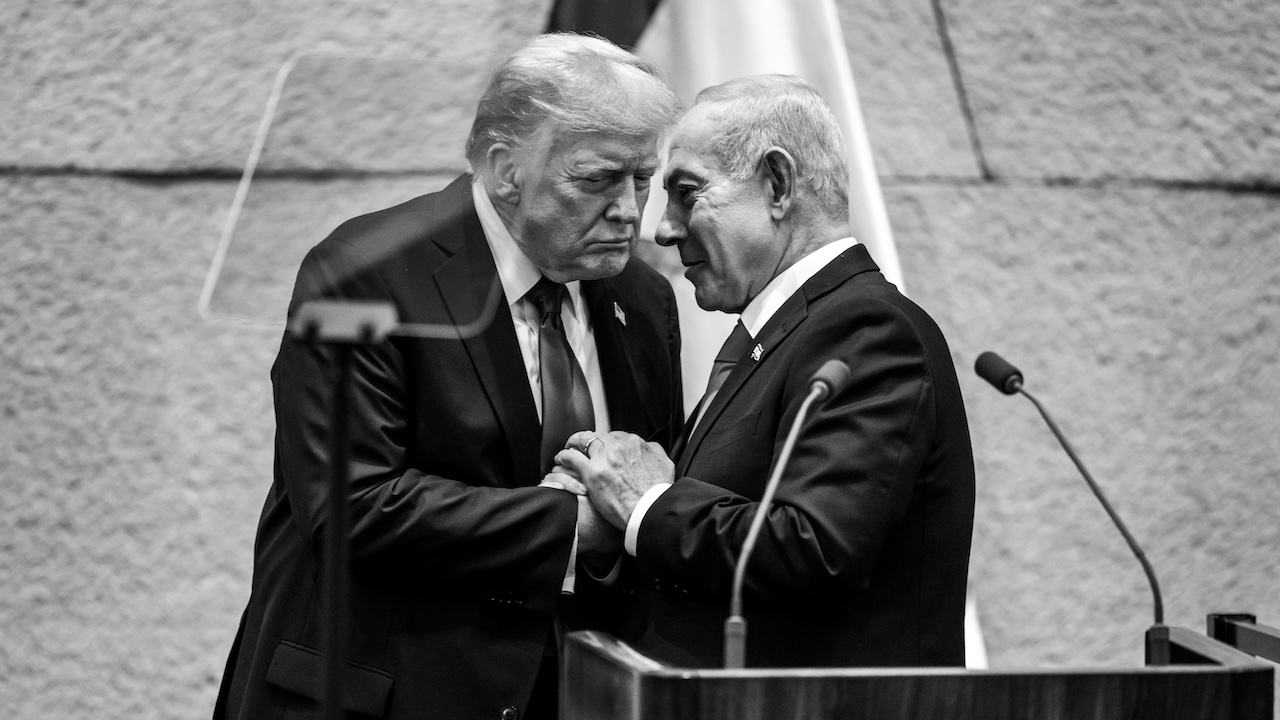
Trump embraces Netanyahu in the Knesset (Photo via the White House)
Trump stirred controversy in several off-script moments in his address to the Israeli Knesset, including spotlighting a top pro-Israel donor
US President Donald Trump spoke in the Israeli parliament on October 13 amid the implementation of the Israeli-Hamas ceasefire deal he helped broker – labeling the deal as a “historic dawn for the Middle East.”
Trump attempted to position himself not only as a behind-the-scenes mediator, but as a central actor in shaping post-war Gaza and the region as a whole. “Israel, with our help, has won all that they can by force of arms,” Trump proclaimed. “Now it’s time to translate these victories against terrorists on the battlefield into the ultimate prize of peace and prosperity for the entire Middle East.”
Several unscripted moments of US President Donald Trump’s speech at the Israeli Knesset have become the subject of controversy, highlighting the unconventional diplomatic relationship between Israel and the US.
In an extraordinary intrusion into Israeli domestic politics, Trump went off script and urged Israeli President Isaac Herzog to pardon Prime Minister Benjamin Netanyahu, who is facing corruption charges.
“Cigars and champagne, who the hell cares about this?” Trump proclaimed, referring to Netanyahu’s charges of fraud and breach of trust.
Trump claimed that Netanyahu is “a very popular man” because he knows “how to win.” A Maariv poll from last month revealed that a majority – 52% – of Israelis do not trust Netanyahu as Prime Minister. However, polling by the Israeli Democracy Institute reveals that a majority of Israelis also support a hostage deal with Hamas that leads to a full withdrawal of forces, indicating that the recent ceasefire deal may boost support for Netanyahu.
Trump’s speech at the Knesset comes the same day that Israel freed nearly 2,000 Palestinian prisoners as part of the Israeli-Hamas hostage exchange. Before the ceasefire deal, there were about 10,400 Palestinians in Israeli prisons, according to Palestinian prisoners’ rights group Addameer.
Trump shines spotlight on pro-Israel lobby
In a separate controversial moment, Trump singled out one of his major donors, Israeli-American Miriam Adelson, who was in the audience at the Knesset. Adelson donated USD 106 million to Trump’s super PAC, which helped fundraise for his reelection last year.
“Look at her, sitting there so innocently,” Trump said, pointing Adelson out. “She’s got 60 billion in the bank.”
Trump continued: “I’m gonna get her in trouble with this, but I actually asked her once, I said, ‘So, Miriam, I know you love Israel. What do you love more, the United States or Israel?’ She refused to answer.”
“That might mean Israel,” Trump said, before laughing.
Trump’s commentary on Adelson, who was awarded a Presidential of Medal of Honor by Trump during his first term, has inadvertently shined a spotlight on the ultra-powerful pro-Israel lobby in US politics.
Some have noted the pattern of Trump saying “the quiet part out loud” throughout his political career. US law professor and public commentator Jody David Armour wrote on X that Trump “regularly just spills the beans on how US policy actually works,” in response to the president’s Adelson comments.
“He might have been a bit too frank for her tastes. She looked uncomfortable,” remarkedElectronic Intifada journalist Asa Winstanley on X.
Independent journalist Sam Husseini summarized Trump’s comments as “she bribed me and she loves Israel more than the US.”
A major part of the recent resurgence of the Palestine solidarity movement in the past two years has been shining a light on the pro-Israeli influence in US politics.
“By his own admission, the president of the United States is acting on the wishes of his top donors” like Adelson, wrote the account “AIPAC Out of US Politics” on social media. AIPAC Out of US Politics is a grassroots campaign recently launched by pro-Palestine activists in the United States, aiming to spotlight the influence of the American Israel Public Affairs Committee, the largest pro-Israel lobbying group in the US.
Quinnipiac University polling from September revealed that the share of registered US voters who believe that backing Israel aligns with their country’s national interests has dropped sharply over the 21 months of Israel’s military offensive in Gaza. Less than half of voters say they believe support for Israel aligns with US national interests, a sharp drop from 67% in December.
Keir Starmer objects to criticism of the IDF. He asks how could anyone object to them starving people to death, forced marches like the Nazis did, bombing Gaza’s hospitals and universities, mass-murdering journalists, healthworkers and starving people queuing for food, killing and raping prisoners and murdering children. He calls for people to stop obstructing his genocide for Israel.Genocide denier and Current UK Prime Minister Keir Starmer is quoted that he supports Zionism without qualification. He also confirms that UK air force support has been essential in Israel’s mass-murdering genocide. Includes URLs https://www.declassifieduk.org/keir-starmers-100-spy-flights-over-gaza-in-support-of-israel/ and https://youtu.be/O74hZCKKdpAVote Labour for Genocide.
This work by Middle East Monitor is licensed under a Creative Commons Attribution-NonCommercial-ShareAlike 4.0 International License.
US President Donald Trump (C) is welcomed by Israeli Prime Minister Benjamin Netanyahu at Ben Gurion International Airport on October 13, 2025 in Tel Aviv, Israel. [Chip Somodevilla/Getty Images]
A single, candid statement by US President Donald Trump during a Fox News interview on 9 October may illuminate the true calculus behind Israel’s decision for a ceasefire in Gaza, following a relentless, two-year genocidal campaign that has tragically killed and wounded nearly a quarter of a million Palestinians.
“Israel cannot fight the world, Bibi,” Trump declared during the interview, a direct warning he said to have previously delivered to Israeli Prime Minister Benjamin Netanyahu.
The stark reality is that very few people around the globe currently support Netanyahu. Crucially, a significant segment of his own populace has already held him in contempt, a resentment that predates the war on Gaza — a war which he treated as a desperate, personal quest for renewed domestic popularity.
Yet, his delusion persists. Even as millions globally protest his systematic extermination of innocent Palestinians, Netanyahu has seemingly convinced himself that world opinion is miraculously shifting in his favour — a shift that would require the world to have liked him in the first place.
But what precisely did Trump mean by, “You cannot fight the world”?
The term ‘fight’ here clearly transcends physical combat. Gaza, besieged, starved, and devastated, was the entity enduring the physical confrontation. Trump’s reference is unambiguously to the combative surge of anti-Israel sentiment worldwide: the official sanctions imposed by nations like Spain, the critical legal proceedings initiated at the world’s highest courts, the widespread demands for boycott, the organising of freedom flotillas, and more.
It is profoundly significant that, in the minds of both Washington and Tel Aviv, these global events have registered as a serious strategic concern. Future historians will likely designate this moment as the definitive turning point in global attitudes toward the Israeli occupation of Palestine. If deliberately and strategically fostered by Palestinians, this burgeoning solidarity movement holds the potential to fully isolate Israel, compelling it to finally relent and free the Palestinian people from its enduring system of colonialism and apartheid.
However, ‘Bibi’ is not merely losing the world; he is fundamentally losing America itself. For decades, the United States has operated as Israel’s indispensable benefactor, underwriting every war, financing every illegal settlement, justifying every act of violence, and consistently blocking any international attempt to hold Israel accountable.
The reasons for America’s decades-long, unwavering commitment to sustaining Israel are profoundly complex. While the overwhelming influence of the powerful pro-Israel lobby in D.C. and Israel’s disproportionate sway over major media are correctly cited as factors, the dynamic is far deeper. The prevailing, mutually reinforced narrative in both nations has consistently framed Israel not merely as an ally, but as a crucial, essential extension of America’s political identity and core values.
Yet, cracks in this political edifice began to appear with unmistakable clarity. What were once marginalised dissenting voices, often labeled as ‘radicals’ within the American left, gradually solidified into mainstream dissent, particularly within the Democratic Party. Poll after poll demonstrated a mass shift, with the majority of Democrats turning against Israeli policy and lending their support, instead, to the Palestinian people and their rightful struggle for freedom. One of the most telling polls was conducted by Gallup in March 2025. It found that 59 percent of Democratic voters say they sympathize more with Palestinians, while only 21 per cent say they sympathise more with Israelis.
The Israeli genocide in Gaza catalysed more than just dissent within one of America’s two major political parties. Outright opposition to Israel has rapidly become mainstream, transcending traditional political lines — a rupture that has profoundly alarmed those determined to maintain the illusion that Israel can act with impunity, free from American objection.
The pro-Israel media apparatus in the US fought a shameful war to obscure the extent of the Israeli genocide. It consistently sought to blame Palestinians for Israel’s actions and brazenly promoted the insidious notion that the war against Gaza’s innocents was a necessary component of the ever-elusive ‘war on terror.’
But it was ordinary people, powerfully amplified by countless social media platforms, who collectively fought back. They successfully defeated a mainstream propaganda machine that had, for decades, served as the primary defense line for Israel.
A particularly troubling fact for Israel was the erosion of its newly established base of support: the Evangelicals and the broader Republican party. Polling indicated a significant exodus, especially among young Republican voters. A survey conducted by the University of Maryland Critical Issues Poll in August 2025 found that only 24 per cent of Republican voters aged 18–34 said they sympathise more with Israelis than with Palestinians.
According to Politico, Israel even attempted to manipulate social media by paying influencers significant sums of money to circulate Israeli fabrications and deception. That campaign employed roughly 600 fake profiles posting over 2,000 coordinated comments per week, targeting more than 120 US lawmakers.
But can Israel possibly swing the narrative back in its favor? While vast sums of money will, undoubtedly, be committed to launching sophisticated campaigns aimed at polishing Israel’s severely tarnished image, the efforts will prove futile. The once-marginalised Palestinian narrative has surged, becoming a powerful, compelling moral authority worldwide. The strong, unyielding, and dignified resilience of the Palestinian people has garnered global sympathy and galvanised support in ways unprecedented in history.
This new reality may very well represent hasbara’s final stand, as truly no amount of money, newspaper coverage, or Netflix specials can ever successfully polish the image of a state that has so openly committed a genocide, one of the most thoroughly documented in recorded history.
The views expressed in this article belong to the author and do not necessarily reflect the editorial policy of Middle East Monitor.
This work by Middle East Monitor is licensed under a Creative Commons Attribution-NonCommercial-ShareAlike 4.0 International License.
Keir Starmer objects to criticism of the IDF. He asks how could anyone object to them starving people to death, forced marches like the Nazis did, bombing Gaza’s hospitals and universities, mass-murdering journalists, healthworkers and starving people queuing for food, killing and raping prisoners and murdering children. He calls for people to stop obstructing his genocide for Israel.Genocide denier and Current UK Prime Minister Keir Starmer is quoted that he supports Zionism without qualification. He also confirms that UK air force support has been essential in Israel’s mass-murdering genocide. Includes URLs https://www.declassifieduk.org/keir-starmers-100-spy-flights-over-gaza-in-support-of-israel/ and https://youtu.be/O74hZCKKdpAGenocide denying UK Foreign Secretary David Lammy says that UK is suspending 30 of 350 arms licences to Israel. He also confirms the UK government’s support for Israel’s Gaza genocide and the UK government and military’s active participation in genocide.
This work by Middle East Monitor is licensed under a Creative Commons Attribution-NonCommercial-ShareAlike 4.0 International License.
Trucks loaded with humanitarian aid on the Egyptian side of the Rafah crossing wait to cross into the Gaza Strip early on October 15, 2025, after Israel said it would allow the crossing to reopen for humanitarian aid to enter from Egypt into the Palestinian territory. [STR/AFP via Getty Images]
The United Nations and the International Committee of the Red Cross (ICRC) on Tuesday called for all border crossings into Gaza to be opened to allow the delivery of urgently needed humanitarian aid to the war-torn enclave.
The two organizations stressed that the truce recently reached in Gaza, as part of US President Donald Trump’s mediation plan, requires immediate steps to ensure aid can reach civilians facing famine conditions.
“This is what humanitarian workers, including the ICRto allow the delivery of urgently needed humanitarian aid C, have been calling for in recent hours — to make sure all entry points can be opened, given the massive needs,” said Christian Cardon, an ICRC spokesperson, speaking to reporters in Geneva.
Jens Laerke, spokesperson for the UN Office for the Coordination of Humanitarian Affairs (OCHA), echoed the call, saying: “We need them all to be opened.”
Laerke acknowledged that several crossings were “partially destroyed,” and that debris clearance was needed to enable trucks to move safely through Gaza’s streets. “We call for them to be repaired so they can be operated” he added.
The United Nations declared a famine in Gaza on 22 August, after experts warned that some 500,000 people were facing a “catastrophic” hunger crisis. Laerke said the UN currently has 190,000 tons of humanitarian aid ready to be transported into the enclave once access is granted.
This work by Middle East Monitor is licensed under a Creative Commons Attribution-NonCommercial-ShareAlike 4.0 International License.
Keir Starmer objects to criticism of the IDF. He asks how could anyone object to them starving people to death, forced marches like the Nazis did, bombing Gaza’s hospitals and universities, mass-murdering journalists, healthworkers and starving people queuing for food, killing and raping prisoners and murdering children. He calls for people to stop obstructing his genocide for Israel.Genocide denier and Current UK Prime Minister Keir Starmer is quoted that he supports Zionism without qualification. He also confirms that UK air force support has been essential in Israel’s mass-murdering genocide. Includes URLs https://www.declassifieduk.org/keir-starmers-100-spy-flights-over-gaza-in-support-of-israel/ and https://youtu.be/O74hZCKKdpAGenocide denying UK Foreign Secretary David Lammy says that UK is suspending 30 of 350 arms licences to Israel. He also confirms the UK government’s support for Israel’s Gaza genocide and the UK government and military’s active participation in genocide.