Oxfam placed a replica Mark 84 2,000-pound bomb, used by the Israeli military in Gaza to devastating effect, opposite Parliament, July 30, 2024Photo: Andy Aitchison / Oxfam
Oxfam warns that 7,000 people are estimated to be killed or injured in Gaza by Israeli military during Parliament recess
AS BRITAIN remains complicit in Israel’s war crimes by refusing an arms embargo, a replica of a 2,000-pound bomb was placed outside of Parliament today, serving as a stark reminder of the innocent lives that will be claimed while the government breaks up for summer.
The 16-foot replica was placed by Oxfam after it released a new analysis estimating that around 7,000 people in Gaza will be killed or injured over the next 33 days.
A carpet of flowers around the bomb symbolised those who are likely to be killed by the Israeli military, as well as the Israeli hostages still in captivity.
Using UN cumulative impact reports, Oxfam estimated that Israel will likely murder more than 1,800 people — a third of them children — if its military offensive continues at its current level.
The analysis comes as Britain refuses to commit to an arms embargo, despite warnings that exports are likely being used to commit war crimes.
This includes components for F-35 Israeli fighter jets, which carry out devastating strikes.
According to Action on Armed Violence, air-strikes were responsible for more than 45 per cent of recent fatalities.
Oxfam GB chief executive Halima Begum said: “By selling F-35 components to Israel, the UK government is effectively facilitating many of the Israeli air strikes and the decimation of Gaza.
“The government is fully aware of the risk that arms exported from the UK are likely being used to commit war crimes in Gaza.
“It is critical that the UK government immediately suspend both existing and new licences for all arms sales, whether direct to Israel or via third parties.”
Britain is legally obliged to halt arms exports if there is a clear risk they might be used to commit or facilitate a serious violation of international humanitarian law.
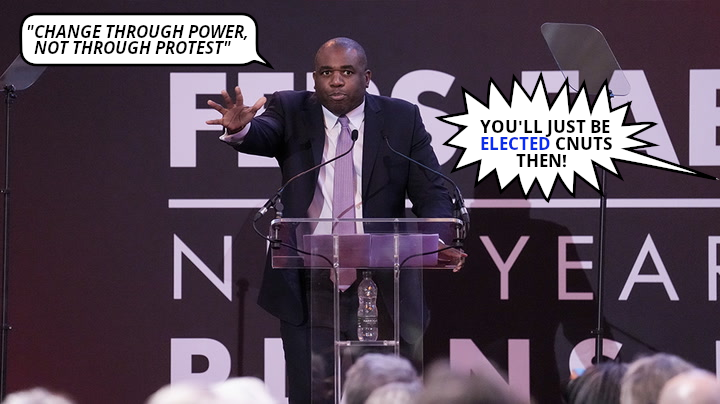
Zionist Keir Starmer is quoted “I support Zionism without qualification.” He’s asked whether that means that he supports Zionism under all circumstances, whatever Zionists do.Vote For Genocide Vote Labour.UK Labour Party Shadow Foreign Secretary repeatedly heckled at a speech to the Fabian Society over his and the Labour Party’s support for and complicity in Israel’s genocide of Gaza.
Israel’s prime minister, Benjamin Netanyahu, has threatened a harsh response to a rocket attack that on July 27 struck the Israeli-occupied Syrian Golan Heights, killing 12 children and injuring about 30 more.
Visiting the small town of Majdal Shams, where the children had been playing football when the strike occurred, Netanyahu blamed Hezbollah for the attack and said it would pay a “hefty price”. He said: “Our response will come, and it will be harsh.”
While Israel is claiming the attack targeted their citizens, all the victims of the strike were members of the Druze religious minority group located across Israel, Lebanon and Syria. Hezbollah has denied responsibility for the attack, but without an independent investigation, it remains unclear who fired the rocket.
The Golan Heights, a rocky 1,000 square kilometre region south-west of Damascus, was occupied by Israel after the 1967 Arab-Israeli war in a move that, half a century on, is often referred to as the “forgotten occupation”.
After defeating Egypt, Jordan, and Syria in the short conflict, Israel occupied the West Bank, Gaza and East Jerusalem as well as the Sinai desert and two-thirds of the Syrian Golan. Around 127,000 indigenous Syrians (95% of the population) – including Christians, Muslims and Druze – fled or were forcibly displaced. Depopulated villages were razed to the ground.
Later in 1981, Israel illegally annexed the territory, passing the Golan Heights Law. The UN security council immediately condemned this as illegal and passed resolution 497 (1981) calling on Israel to rescind its action, which would have “serious consequences for peace and security in the Middle East”.
Israel’s annexation of the Golan Heights was not recognised internationally until 2019 when the then US president Donald Trump released a “Proclamation on Recognizing the Golan Heights as Part of the State of Israel”.
Israel views its control over the Golan Heights as crucial to its security, as the region shares a border with Israel, Jordan and Lebanon. There is a buffer zone between the Israeli-occupied area of the Golan Heights and Syria, which is administered by the United Nations Disengagement Observer Force (Undof). The Golan gives whoever controls the land a vantage point overlooking Syria, which has never given up on its claim over the land.
Forgotten people
But what of the indigenous people of the Golan? Roughly 20,000 Druze people now remain, members of an Arab sect which is an offshoot of Islam that allows no intermarriage or joining from outside the religion. There are about 150,000 Druze in Israel and about 1 million across the Middle East. Druze men with Israeli citizenship are subject to military service.
Historically, Golanis have resisted the occupation via non-violent means, drawing on Druze religious beliefs, secular political ideas and the continuing assertion of their Syrian identity. The main industry in the region is agriculture and the area is known for its production of apples, cherries and olive oil.
Golanis in Majdal Shams participating in peaceful demonstration in solidarity with Palestinians. Al-Marsad
Resistance
In the years before annexation of the Golan, Israel attempted to introduce Israeli identity cards for the population. But this was rejected by Syrian communities in the Golan, who issued a wathiqa wataniya (Syrian national document), which asserted their Syrian-Arab national identity and connection to the land and opposed the annexation of the Golan.
The annexation also triggered what became known as the aldrab alkabir (great strike) that began in the February of 1982 and lasted almost six months. All segments of Golani society took part in demonstrations, discarded their Israeli ID cards and refused to pay taxes or participate in Israeli land surveys. The aim was to resist the imposition of Israeli citizenship and assert their Syrian identity.
Israel responded by placing curfews on the Druze villages, setting up blockades and restricting goods from entering, including milk and baby food. Some residents were arrested, including women who played a central role in the strike.
The Golani community responded to these restrictions by sharing resources and offering free services to one another. Palestinians also mobilised in support of Golanis by taking part in demonstrations and solidarity visits to the Golan.
This non-violent action was successful in achieving its primary aim and to this day around 80% of Golani Druze have rejected citizenship. They identify as Syrian and, unlike the Druze living in Israel, do not serve in the Israeli military.
This does mean that they are “stateless” (though not landless like many stateless people) and instead of passports they hold “laissez passer” travel documents that state their nationality is “undefined”. Without Israeli citizenship they are not allowed to vote, though they can attend Israeli educational institutions.
Meanwhile there are also an estimated 25,000 Jewish-Israelis living in the Golan Heights, across more than 30 settlements, considered illegal under international law. They are supported by the Israeli military and now together control 95% of the Golan, including much of its agriculture and industries.
Fear of escalation
There are now fears in the region that an Israeli retaliation against Hezbollah could significantly escalate the conflict. I’ve been working with local partners in the Golan Heights on a research project about Golani youth and human rights.
I spoke with a colleague in Majdal Shams this week. She told me that the people of the Golan “don’t want any other mother to scream and cry”. She said: “The Golani people are and have always been a peaceful people. Our message would be, ‘Stop the killing.’”
The 12 children were killed while playing football. Let that sink in. Then remember that it should not take their deaths to bring this forgotten occupation and these people who are forced to live under a foreign power to the world’s attention.
Israeli soldiers and police clash with a far-right mob that invaded the Beit Lid army base in Kfar Yona on July 29, 2024. (Photo: Oren Ziv/AFP via Getty Images)
Several Israeli lawmakers and one minister took part in the attempt to free the nine reservists, who were hailed as heroes by multiple Cabinet members.
Far-right Israelis including government officials stormed two military bases late on Monday, sparking clashes with troops and police over the arrest of Israel Defense Forces reservists who allegedly gang-raped a Palestinian prisoner.
Hundreds of protesters broke into the notorious Sde Teiman base in the Negev Desert in an attempt to stop the detention of nine reserve troops accused of sodomizing a Palestinian jailed there. According to the Israeli newspaper Haaretz, the victim is hospitalized with severe injuries and is unable to walk.
The nine suspects were then taken to the Beit Lid army base, which was also mobbed by at least dozens of demonstrators.
Supporters of president-elect Nicolas Maduro celebrate his proclamation as president-elect in the vicinity of the CNE headquarters during the ceremony to deliver the majority of the vote Certificate at CNE Headquarters on July 29, 2024 in Caracas, Venezuela. (Photo by Jesus Vargas/Getty Images)
Shortly before midnight on 28 July, Venezuela’s National Electoral Council (CNE) announced that — with 80 percent of the over 20 million votes counted — the trend was irreversible: Nicolás Maduro had been re-elected president of Venezuela.
According to the CNE, Maduro received 51.2 percent of the vote, while his primary opponent, the little-known Edmundo Gonzales, received 44.02 percent. With that result, it was clear that the Venezuelan majority chose to continue the project of Bolivarian socialism introduced by Hugo Chavez at the end of the nineties. Recognizing the economic turn-around of the last two years and proud of their achievements in building 5.1 million housing units, securing food sovereignty, and deepening communal democracy, Venezuelans re-elected Maduro for a third six-year term.
A former ambassador to Argentina, the opposition candidate Gonzales replaced far-right leader Maria Corina Machado as the candidate of the Unity Platform after Machado was disqualified from running. Machado has long been an outspoken critic of Chavismo, supporting US sanctions and advocating foreign intervention in the country. In 2018, she asked Benjamin Netanyahu for military assistance in dismantling the Maduro government. Machado has close ties in the United States. In 2009, she was a Yale World Fellow. On June 23, 2024 she spoke at a National Endowment for Democracy awards ceremony in Washington, DC. She has been nicknamed the new “iron lady” after her idol Margaret Thatcher. In contrast, Maduro supports the Palestinian liberation struggle, linking it to the struggle of the indigenous peoples of Venezuela against colonial genocide.
Venezuela’s far-right opposition is doubling down on its refusal to accept defeat in the country’s presidential election amid simmering unrest and violence in the streets of Caracas, sparking warnings of another coup attempt in a nation that has long faced interference from the United States and other Western powers.
Led by María Corina Machado, who was disqualified from running in Sunday’s election, Venezuela’s opposition claimed that its candidate—ex-diplomat Edmundo González—defeated President Nicolás Maduro with over 70% of the vote, contradicting the official results announced by the Consejo Nacional Electoral (CNE).
Machado, who once urged Israeli Prime Minister Benjamin Netanyahu to back an effort to topple Maduro’s elected government, pointed Venezuelans to a website the opposition is using to assemble its own vote counts.
“So far, she hasn’t presented any evidence [of fraud],” Caracas-based reporter Andreína Chávez Alava said in an appearance on Democracy Now! Tuesday morning. “In past elections they have also said they have evidence that they won and they never actually showed any proof.”
Republican vice presidential nominee U.S. Sen. J.D. Vance (R-OH) arrives to speak during a rally with running mate U.S. Republican Presidential nominee former President Donald Trump at Herb Brooks National Hockey Center on July 27, 2024 in St Cloud, Minnesota. (Photo by Stephen Maturen/Getty Images)
The former Republican president, despite all his allegedly populist rhetoric, has a deeply anti-worker record from his first term. Vance’s record is no different and he’s no better.
“These attempts to create the appearance of distance between Trump and Project 2025 are happening because Americans are starting to learn about this extreme takeover plan,” said one Democratic congressman.
At least 140 people who worked in the Trump administration—including six former Cabinet secretaries—have been involved with Project 2025, according to a CNN analysis published earlier this month. Among them is the outgoing director, Paul Dans.
“Dans served in the Trump administration as chief of staff at the U.S. Office of Personnel Management where he managed the federal agency in charge of human resources policy for the more than 2 million federal workers,” according to his profile on the Heritage website.
Smoke billows following an Israeli airstrike in the southern Lebanese border village of Chihine on July 28, 2024. (Photo by Kawnat Haju/AFP via Getty Images)
A barrage of Israeli strikes across Gaza killed many dozen Palestinians over the weekend, while a strike attributed to Hezbollah killed 12 children in Israeli-controlled territory.
Israel’s war in Gaza continued in full force on Saturday and Sunday, with at least 66 Palestinians killed in roughly the last 24 hours, as international attention shifted to concern about an all-out war with Lebanon following an attack on Israeli-controlled territory that killed 12 children, with international diplomats pushing for deescalation.
At least 66 people were killed in Israeli strikes across Gaza in a 24-hour period, and another 241 were injured, the enclave’s health ministry reported Sunday. Fifteen were also killed in strikes on Khan Younis that apparently weren’t included in the 24-hour count, including a four-month-old girl, Al Jazeera reported.
The strikes in Gaza came as the conflict between Israel and Hezbollah, a heavily armed militia and political party in Lebanon, intensified. A rocket attack on a soccer field in the town of Majdal Shams in the Golan Heights, an Israeli-controlled territory, killed 12 children—the most deadly attack on Israeli-controlled land since October. The victims were Druze Arab; it’s not clear from media reports if they were Israeli citizens.
Israel blamed Hezbollah for the attack, and U.S. Secretary of State Antony Blinken said there was “every indication” that the group was behind it, though Hezbollah denied responsibility, which it hasn’t done for previous strikes.
“Hezbollah will pay a heavy price, which it has not paid up to now,” Israel Prime Minister Benjamin Netanyahu’s office said in an overnight statement.
The Israel-Hezbollah conflict, featuring cross-border strikes, has killed more than 500 since October, including more than 100 civilians, but has thus far remained relatively contained, with both sides saying that they are willing to engage in full-scale war but want to avoid it. About 100,000 people in Lebanon and 60,000 in Israel have been already displaced due to the strikes.
Hezbollah is seen as far stronger and better equipped than Hamas, the Palestinian militant and political group which Israel is seeking to eliminate, following the group’s massacre of more than 1,100 Israelis on October 7. Both groups are classified by the U.S. State Department as foreign terrorist organizations.
Israel’s conflicts with the two groups are related and ending one could help end the other. Hezbollah has said it would stop its attacks if a cease-fire in Gaza is reached.
Experts are calling on U.S. diplomats not just to diffuse Israel-Hezbollah tensions but also to use its leverage, as the main arms supplier and backer of Israel, to bring an end to the assault on Gaza.
“The U.S. administration has not done enough to [reach a ceasefire] in Gaza,” Heiko Wimmen, an analyst at the International Crisis Group, told Al Jazeera on Sunday. “The incident in Majdal Shams is a potent reminder of why it is necessary to bring this unending conflict to an end.”
For now, the violence continues on multiple fronts. An Israeli drone strike killed two Palestinians in the West Bank on Saturday and injured 28, according to Al Jazeera.
A Palestinian boy walks past the rubble of a school destroyed in an Israeli airstrike on Deir al-Balah, central Gaza Strip, July 27, 2024
ISRAELI air strikes destroyed a school used by displaced Palestinians in central Gaza on Saturday, killing at least 30 people, including several children.
Seven children and seven women were reportedly among the dead taken from the girls’ school in Deir al-Balah to al-Aqsa Hospital.
Israel’s military said that the air raid was targeted at a Hamas command centre used to direct attacks against Israeli troops and store “large quantities of weapons.”
Hamas slammed the Israeli claim as false.
Civil defence workers in Gaza said thousands had been sheltering in the school, which also contained a medical site.
Gaza’s Health Ministry said at least another 12 people were killed in other strikes on Saturday.