Zionist Keir Starmes is quoted “I support Zionism without qualification.” He’s asked whether that means that he supports Zionism under all circumstances, whatever Zionists do.
SHIFTY Sir Keir Starmer was left squirming today as he dodged election questions about his past conduct and present and future plans.
The lacklustre Labour leader failed to come clean on Gaza, Jeremy Corbyn or his volte-face on public ownership.
Speaking in a radio phone-in, Sir Keir also repeated shadow health secretary Wes Streeting’s controversial call for junior doctors to call off their strike action.
“Don’t strike during the election campaign because we’re very close now to the opportunity for a different approach with a Labour government if we get over the line,” he said.
“So don’t strike because that causes all sorts of issues.”
On the Gaza crisis Sir Keir waffled when asked whether a Labour government would stop arms sales to Israel.
The lawyer said that he would have to “look at the legal advice” and hold “a review.”
He also refused to agree that what is happening in Gaza is a genocide.
“You need the evidence in front of you to make a decision,” he slithered, as if the whole world has not seen an amplitude of such evidence over the last nine months.
The Labour leader was also uncomfortable when he was put on the spot as to whether he would have served in a Corbyn-led cabinet had Labour won the 2017 or 2019 general elections.
He repeated his argument that he “did not think Labour would win” and insisted that the question was “hypothetical,” a silly answer because it was evident to everyone at the time that he would have done.
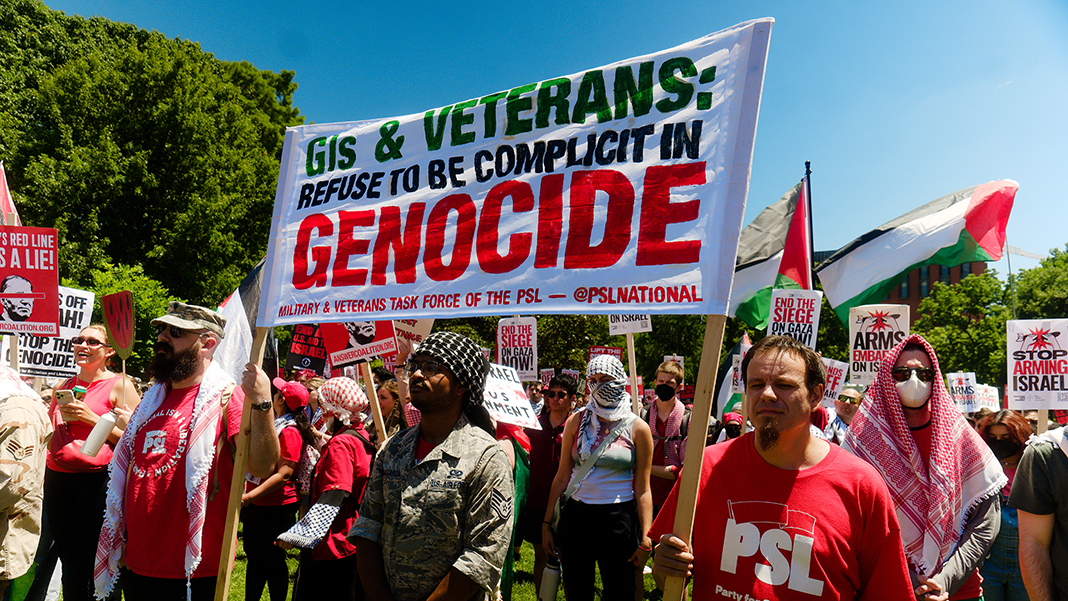
Veterans mobilize in front of the White House on June 8. (Photo: Mandy Wilkens)
Peoples Dispatch speaks to US veterans who are standing against their government’s complicity in genocide and organizing more to do the same
On February 25, US Air Force member Aaron Bushnell became the first active duty US soldier to earn the title of “martyr” among oppressed people worldwide. The 25-year-old set himself on fire in front of the Israeli embassy in Washington DC in protest of the US government’s complicity in the genocide in Gaza, declaring, “this is what our ruling class has decided will be normal,” before self-immolating.
Bushnell’s sacrifice was the most high-profile action by member of the US army in solidarity with Palestine and signaled an enormous sea change among active duty military as well as veterans—who are increasingly taking a bold step to denounce their government’s involvement in genocide.
According to Mike Prysner, who was an active duty soldier during the Iraq War and has been organizing veterans and active duty military ever since, the momentum among current and former members of the US military “hasn’t been this high since the Bush era.”
“The sector of service members who have turned against the US/Israeli policy in a profound way is undoubtedly much bigger than we can see at the moment—one the Pentagon is no doubt aware of as well,” Prysner wrote.
As Prysner told Peoples Dispatch, although the anti-war veterans movement is not as big as it was during the Iraq invasions, it is significant that veterans are organizing at such a high level today because unlike Iraq, the genocide in Palestine is “not a direct US war.”
“Most service members haven’t had direct experience with supporting Israel,” Prysner said. “They’re just disgusted by the fact that the military they served in and are serving in is playing a support and a propaganda role.”
However, Prysner notices significant anti-war momentum in the US Air Force in particular, which “does have more of a direct role in the other branches” in Gaza, in terms of “all the logistics that Israel needs” to carry out genocide. “I have noticed the active duty of the Air Force becoming more engaged because of their direct role,” Prysner says, including Bushnell.
“The potential for there to be unrest within the military is historically something that plays a major impact in adding to the pressure on Washington to end the war,” Prysner told Peoples Dispatch.
Shortly after Bushnell’s self-immolation, Prysner worked with other veterans of the Vietnam, Iraq, and Afghanistan wars to organize an action in Portland in which former US military members burned their uniforms collectively in protest. This type of action was later repeated throughout the country as other veterans and active duty military drew inspiration from the momentum.
Veterans in Portland, Oregan also recently organized a massive projection of anti-war imagery on a US Navy warship docked for “Fleet Week”. The images had slogans such as “Stop the US war machine” and “Blood is on your hands”.
Not only do veterans organizing within the anti-war movement inspire active duty military to take further action as well, but they also galvanize the entire anti-imperialist movement, says Prysner. He references the contingent of veterans who attended the recent 100,000-strong protest in front of the White House on June 8. Prysner noticed “a lot of excitement among the attendees” of the protest that veterans had mobilized.
On June 8, Peoples Dispatch spoke to two of the veterans who attended the mass mobilization in front of the White House to declare a “people’s red line” against genocide. Adrian served in the Air Force from 2002 to 2009, and went to Iraq. He now openly identifies as both an anti-imperialist and Marxist, organizing with the Party for Socialism and Liberation, and credits his time in the military as contributing to his shift in consciousness.
“War is a profit-making business,” US vet declares
“As a person who served in the United States Air Force, I’m very familiar with how the imperialist war machine works. Naturally, this isn’t something that one joins the military knowing. It was part of the whole radicalization process for me, being in the military, realizing that it functions very much like a corporate entity, and that war is a profit-making business,” Adrian told Peoples Dispatch.
“It was part of my being a working class person in the military, coming from the background that I came from, going to a foreign country to fight other poor and oppressed people, that created such a cognitive dissonance in me, that I had to address it in some sort of way.”
Adrian continued, “there are many things that active duty people, reservists and guardsmen can do. They can conscientiously object and thus separate from the military, but they can also organize outside of the military. They can attend rallies. They can organize with professional revolutionary organizations such as our own. They can do many other things to raise consciousness and awareness among their fellow servicemen.”
Chris Stevens, who was an infantryman in the US Army from 2007 and 2013, told Peoples Dispatch what his message is to prospective, current, and former service members who are disgusted by US complicity in genocide.
“Don’t be seduced in the first place. If you’ve yet to sign a contract, you should turn the other way. Your recruiter’s lying to you about everything, whether it be the job that you can have or the life that you’ll lead, the benefits that they promise you are not cast in stone and they will take anything they can from you,” Stevens said, referencing the predatory US military recruitment process.
Military recruiters in the US notoriously prey on working class and oppressed youth to lead them into military careers, luring them with promises of free college education. This phenomenon is part of what anti-war activists dub the “poverty draft,” in which poor young people have few opportunities apart from joining the US military, risking life and limb, and participating in the imperialist machine.
“For those who are already involved, my message is that you don’t have to listen to what they tell you to do,” Stevens continued. “There are significant historical examples from the Vietnam and Iraq wars, where entire units have decided to say no to their orders. As long as it’s not you alone resisting, if you can get a squad or a company together to say, we will not participate in this, there’s not much that the army can do.”
“So if you’re in a position where you are actively supporting this genocide that’s happening in Israel, you don’t have to,” Stevens said.
The issue of Palestine was particularly galvanizing, as Adrian mentioned: “I don’t want to see children murdered anymore. This is beyond the pale of what can be justified in the name of nationalism, in the name of anything that would be any semblance of what one would call the sovereignty of a so-called nation. The self-determination of the Palestinian people is paramount to humanity. And their fight is our fight.”
dizzy: It’s difficult to argue that they are not Fascists when they commit the very crimes created immediately after WWII to address Fascism, to ensure “never again” and quote Fascist Adolf Hitler. It’s difficult to see that supporting countries are not aiding and abetting and complicit in genocide and war crimes when such blatant calls for such crimes are and have been made.
Israeli far-right Zehout (identity) political party chairman Moshe Feiglin gives a joint press statement with Prime Minister and Likud Chairman Benjamin Netanyahu (unseen) in Ramat Gan, near the Israeli coastal city of Tel Aviv on August 29, 2019. (Photo: Jack Guez/AFP via Getty Images)
“In what kind of society can one openly advocate policies modeled on Hitler’s conduct? In a society that feels complete impunity due to America’s protection,” one foreign policy expert said.
Former Israeli Knesset member Moshe Feiglin quoted Adolf Hitler as he called for Israel to resettle the Gaza Strip and create a “Hebrew Gaza.”
Feiglin, who quit Prime Minister Benjamin Netanyahu’s Likud Party to found the right-wing Zehut Party and plans to challenge Likud in Israel’s next elections, made the comments during a panel discussion on Israel’s Channel 12 that was shared on social media on Sunday, as Middle East Eye reported.
“We are not guests in our country, this is our country, all of it…” Feiglin said, adding, “As Hitler said, ‘I cannot live if one Jew is left.’ We can’t live here if one ‘Islamo-Nazi’ remains in Gaza.”
On @N12News Israel's most watched news show, former Likud MP Moshe Feiglin invokes ***Hitler*** to justify Gaza resettlement:
"As Hitler said, 'I cannot live if one Jew is left,' we can't live here if one 'Islamo-nazi' remains in Gaza."
Feiglin’s remarks earned widespread condemnation on social media.
“In what kind of society can one openly advocate policies modeled on Hitler’s conduct?” asked Trita Parsi, the executive vice president of the Quincy Institute for Responsible Statecraft. “In a society that feels complete impunity due to America’s protection.”
Former Greek Finance Minister and leader of the pan-European leftist political party DiEM25 Yanis Varoufakiswrote that “the evidence of genocidal intentions is mounting” and asked, “When will the ICC [International Criminal Court] act?”
Israel has killed at least 37,337 people and injured 85,299 in its war on Gaza since October 7, when Hamas carried out a lethal attack against southern Israel, killing around 1,100 people and taking more than 240 hostage. Prior to the attack, Israel had maintained a 16-year blockade of the narrow enclave.
South Africa brought a case before the International Court of Justice accusing Israel of genocide in Gaza, citing the vast destruction of its bombing campaign as well as statements made by high-level Israeli politicians, including Netanyahu, that portray all Gazans as complicit in the October 7 attacks. Several human rights experts and scholars have also concluded that Israel is committing genocide.
This is not the first time that Feiglin, who served in the Knesset from 2013 to 2015, has called for the expulsion of Palestinians from Gaza.
“We need a different prime minister who is willing to stick his neck out to win. Zehut will provide, whenever elections happen, such a candidate,” he told supporters in January, according to Middle East Eye. “For us, the war in Gaza is not merely a defensive war. It’s a war of liberation, the liberation of the land from its occupiers.”
In an October 2023 interview with Al Jazeera, he also advocated for the “complete destruction of Gaza, before invading it… Destruction like Dresden and Hiroshima, without a nuclear weapon.”
Zehut’s 2019 platform included the cancellation of the Oslo Accords with the Palestinians, according to Haaretz.
“Don’t talk to me about international law, because there is not such a thing. You know, the minute you use the word ‘Palestinian,’ you stop saying the truth. Because there is no Palestinian nation, and they know it,” Feiglin said that same year.
Other currently governing Israeli politicians have also called for the expulsion of Palestinians from Gaza.
Israeli National Security Minister Itamar Ben-Gvir said in January that the Israeli government should “encourage the migration” of Palestinians out of Gaza.
Later the same month, Ben-Gvir and Finance Minister Bezalel Smotrich attended a right-wing conference calling for the “resettlement” of Gaza.
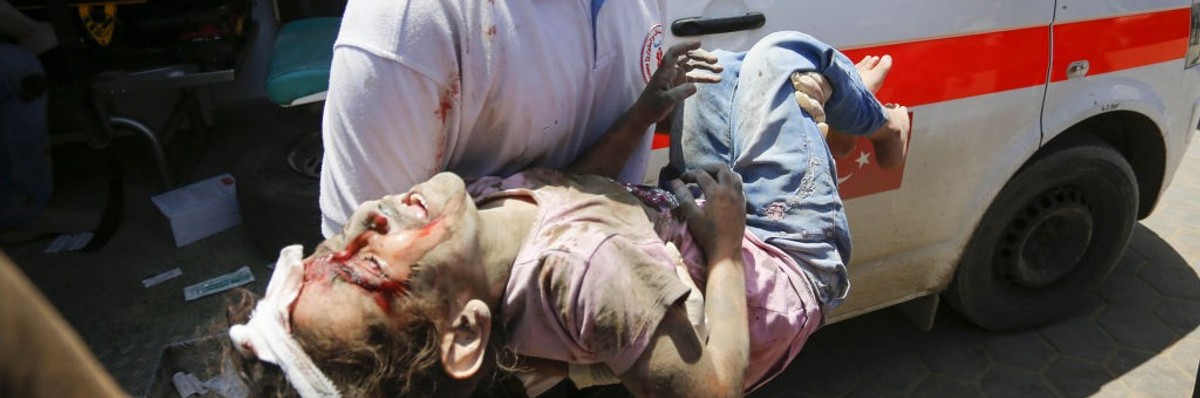
Palestinian child, injured in the Israeli attack on Abu Aisha family house is taken to Al-Aqsa Martyrs Hospital in Deir al-Balah, Gaza on June 14, 2024. (Photo by Ashraf Amra/Anadolu via Getty Images)
A joint statement calls on “all States to ensure full co-operation with the Court for it to carry out its important mandate of ensuring equal justice for all victims of genocide, war crimes, [and] crimes against humanity.”
Ninety-three nations on Friday, all them state parties to the Rome Statute that created the International Criminal Court, reiterated their support for the ICC as it assesses an application for arrest warrants of high level Israeli government officials accused of perpetrating war crimes in Gaza.
The 93 countries—including Canada, Bangladesh, Belgium, Ireland, Afghanistan, Costa Rica, Chile, Germany, France, Mongolia, Mexico, New Zealand, and scores of other—cited separate ICC statements defending its mandate for independence and upheld in their joint statement “that the Court, its officials and staff shall carry out their professional duties as international civil servants without intimidation.”
Though neither nation is named in the joint statement, both the United States and Israel have publicly condemned ICC chief prosecutor Karim Khan for his May 20 arrest warrant applications for Israeli Prime Minister Benjamin Netanyahu and Defense Minister Yoav Gallant over alleged “war crimes” and “crimes against humanity” in the Gaza Strip.
Khan also submitted arrest warrants for Hamas leaders Yahya Sinwar, Mohammed Diab Ibrahim Al-Masri, and Ismail Haniyeh for their alleged roles in the October 7 attack on southern Israel. Following Khan’s announcement in May, U.S. President Joe Biden said, “Whatever this prosecutor might imply, there is no equivalence—none—between Israel and Hamas. We will always stand with Israel against threats to its security.”
In April it was reported that the U.S. government was working behind the scenes to block the ICC from issuing any arrest warrants targeting Israel officials. Neither Israel nor the U.S. is party to the Rome Statute, though the United Nations has recognized the ICC’s jurisdiction over the Occupied Palestinian Territories (OPT), where the alleged war crimes by the occupying power, Israel, took place.
After Khan made his application for warrants, White House spokesperson Karine Jean-Pierre said, “We’ve been really clear about the ICC investigation. We do not support it.” On June 4, Republicans in the U.S. House of Representatives, along with 42 Democrats, passed a measure that would sanction ICC officials if the arrest warrants for any Israeli officials were approved or carried out.
Balakrishnan Rajagopal, the United Nations Special Rapporteur on the right to adequate housing, was among those who applauded Friday’s public statement.
Rajagapol thanked the signatory nations “for defending the ICC and standing up against the bullies, including the relics from the U.S. Senate whose idea of engaging with the world is to use threats,” a possible reference to Sen. Lindsay Graham (R-S.C.) who denounced Khan’s applications as “outrageous,” applauded the House approval of sanctions, and vowed further punishment for the ICC.
Such punitive measures and high-profile threats directed at the ICC appeared to be the exact kind of intimidation Friday’s joint pledge of support is responding to.
93 governments sign this statement of support for the International Criminal Court after others criticized the prosecutor's request for arrest warrants for senior Israeli officials and it emerges that the Israeli government had threatened the prosecutor to avoid investigation. pic.twitter.com/4BwBUsOOzR
“The ICC, as the world’s first and only permanent international criminal court, is an essential component of the international peace and security architecture,” the statement reads. “We therefore call on all States to ensure full co-operation with the Court for it to carry out its important mandate of ensuring equal justice for all victims of genocide, war crimes, crimes against humanity and the crime of aggression, grave crimes that threaten the peace, security and well-being of the world.”
With their show of unified support for the ICC and its mandate, the countries said they aim to “contribute to ending impunity for such crimes and preventing their recurrence while defending the progress we have made together to guarantee lasting respect for international humanitarian law, human rights, the of law and the enforcement of international criminal justice.”
Internally displaced Palestinians walk in the courtyard of a destroyed UNRWA school [File: Mohammed Saber/EPA-EFE]
UNRWA warns people in Gaza face ‘catastrophic’ levels of hunger because of Israeli restrictions on humanitarian aid.
The UN agency for Palestinian refugees (UNRWA) says more than 50,000 children in the Gaza Strip require immediate medical treatment for acute malnutrition.
In a statement on Saturday, the agency noted “with continued restrictions to humanitarian access, people in Gaza continue to face desperate levels of hunger. UNRWA teams work tirelessly to reach families with aid, but the situation is catastrophic”.
With continued restrictions to humanitarian access, people in #Gaza continue to face desperate levels of hunger. Over 50,000 children require treatment for acute malnutrition@UNRWA teams work tirelessly to reach families with aid but the situation is catastrophic. #CeasefireNowpic.twitter.com/FwmsjrqmRW
UNICEF spokesperson James Elder also described how difficult it is to not only get aid into Gaza, but also to distribute it across the war-battered coastal enclave.
“More aid workers have been killed in this war than any war since the advent of the UN,” he told Al Jazeera.
On Wednesday, UNICEF had a mission to drive a truck full of nutritional and medical supplies for 10,000 children, Elder said. Their task was to deliver the aid, which was pre-approved by Israeli authorities, from Deir el-Balah to Gaza City, a 40km (25 miles) round trip.
“It took 13 hours and we spent eight of those around checkpoints, arguing around paperwork – ‘was it a truck or a van’,” he said.
“The reality is this truck was denied access. Those 10,000 children did not get that aid … Israel as the occupying power has the legal responsibility to facilitate that aid.”