This work by Middle East Monitor is licensed under a Creative Commons Attribution-NonCommercial-ShareAlike 4.0 International License.
Secretary of State for Defence John Healey arrives at Downing Street to attend the weekly cabinet meeting in London, United Kingdom, on March 24, 2026. [Raşid Necati Aslım – Anadolu Agency]
The UK will deploy more troops and air defense systems to the Middle East to help the allies against Iranian attacks, the country’s defense secretary said Tuesday, Anadolu reports.
On a trip to the Gulf nations, John Healey said extra air defense teams and systems would be deployed to Saudi Arabia, Bahrain, and Kuwait, along with an extension of the use of Typhoon jets in Qatar, the Defense Ministry said in a statement.
It noted that as part of the UK’s action in the “collective defense of allies,” without getting drawn into the wider war, the Healey is visiting Saudi Arabia, Qatar, and Bahrain.
“Defence Secretary John Healey MP held detailed discussions on the conflict, the Strait of Hormuz, and further UK-Gulf cooperation on regional security as the war enters its second month,” said the statement.
During his visit to the UK Armed Forces at the Dukhan base in Qatar, Healey confirmed that the UK has extended the deployment of UK Typhoon jets to Qatar.
“My message to Gulf partners is: Britain’s best will help you defend your skies,” said the defense secretary.
In Saudi Arabia, he also confirmed to his Saudi counterpart Prince Khalid bin Salman Al Saud his decision to deploy Sky Sabre there.
The statement noted that the UK’s Lightweight Multirole Launcher is now in Bahrain, as the defense secretary also announced earlier Tuesday, supported by a team of UK experts who will help integrate the short-range air defense system into Bahraini defenses.
Healey has been visiting Saudi Arabia, Qatar, and Bahrain as the government announced the deployment of further systems, and associated teams, for each of the three nations, as well as for Kuwait.
Separately, the Defense Ministry said in its daily update that Britain’s Royal Air Force jets operating in a high-threat area successfully downed multiple Iranian drones overnight.
The region has been on alert since the US and Israel launched an air offensive on Iran on Feb. 28, killing more than 1,340 people, including then-Supreme Leader Ayatollah Ali Khamenei.
Tehran has retaliated with drone and missile strikes targeting Israel, Jordan, Iraq, and Gulf countries hosting US military assets, causing casualties and infrastructure damage while disrupting global markets and aviation.
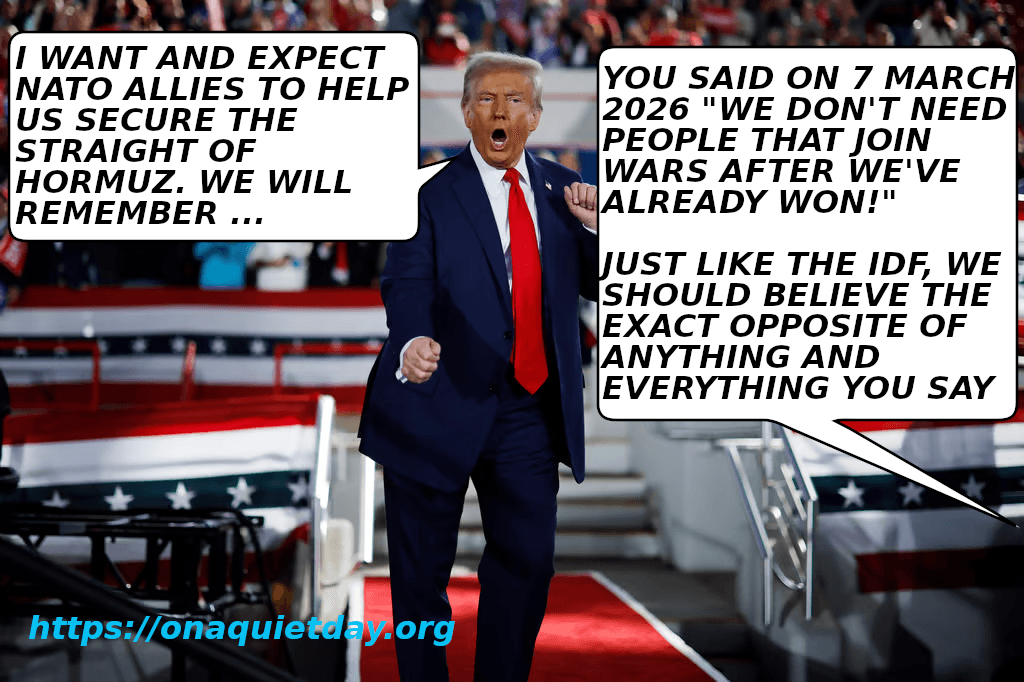
Donald Trump calls for help from NATO allies in securing the Straight of Hormuz despite saying on 7 March 2026 that they don’t need people to join wars after they’ve already won. He’s challenged with the claim that he lies as much as the IDF.Keir Starmer explains that UK is actively supporting Israel’s genocidal expansion and repeats his previous quotation that he supports Zionism “without qualification”. Keir Starmer said “I said it loud and clear – and meant it – that I support Zionism without qualification.” here: https://www.jewishnews.co.uk/keir-starmer-interview-i-will-work-to-eradicate-antisemitism-from-day-one/
Donald Trump warns against following the https://onaquietday.org blog, says that it’s easy atm, she only needs to report war crimes supporting Israel’s genocidal expansion.
This work by Middle East Monitor is licensed under a Creative Commons Attribution-NonCommercial-ShareAlike 4.0 International License.
Smoke rises after Iranian-sourced unmanned aerial vehicle (UAV) carried out an attack on a fuel depot at Kuwait International Airport in Kuwait City, Kuwait on March 25, 2026. [Stringer – Anadolu Agency]
The Gulf countries and Jordan on Wednesday strongly denounced Iranian attacks as a “flagrant violation” of their sovereignty and territorial integrity, affirming their full right to self-defense, Anadolu reports.
In a joint statement, Kuwait, the United Arab Emirates, Bahrain, Saudi Arabia, Qatar and Jordan said attacks carried out by Iran or its proxies constitute “a violation of international law, international humanitarian law, and the United Nations Charter.”
They particularly cited attacks launched by Iran-backed armed groups in Iraq as “a breach of international laws and conventions,” and “a blatant violation” of UN Security Council 2817, which demands Iran cease all assaults and threats against neighboring countries.
The statement called on the Iraqi government to take “the necessary measures” to halt attacks by armed groups against neighbors “in order to preserve fraternal relations and prevent further escalation.”
Signatories reaffirmed their full right to self-defense “against these criminal attacks,” and to take all necessary measures “to preserve their sovereignty, security, and stability.”
They also condemned acts and activities “that undermine the security and stability of the region’s countries, planned by sleeper cells loyal to Iran and terrorist organizations linked to Hezbollah.”
Regional escalation has continued to flare since the US and Israel launched a joint offensive on Iran on Feb. 28, killing so far over 1,340 people, including then-Supreme Leader Ali Khamenei.
Tehran has retaliated with drone and missile strikes targeting Israel, along with Jordan, Iraq, and Gulf countries hosting US military assets, causing casualties and damage to infrastructure while disrupting global markets and aviation.
This work by Middle East Monitor is licensed under a Creative Commons Attribution-NonCommercial-ShareAlike 4.0 International License.
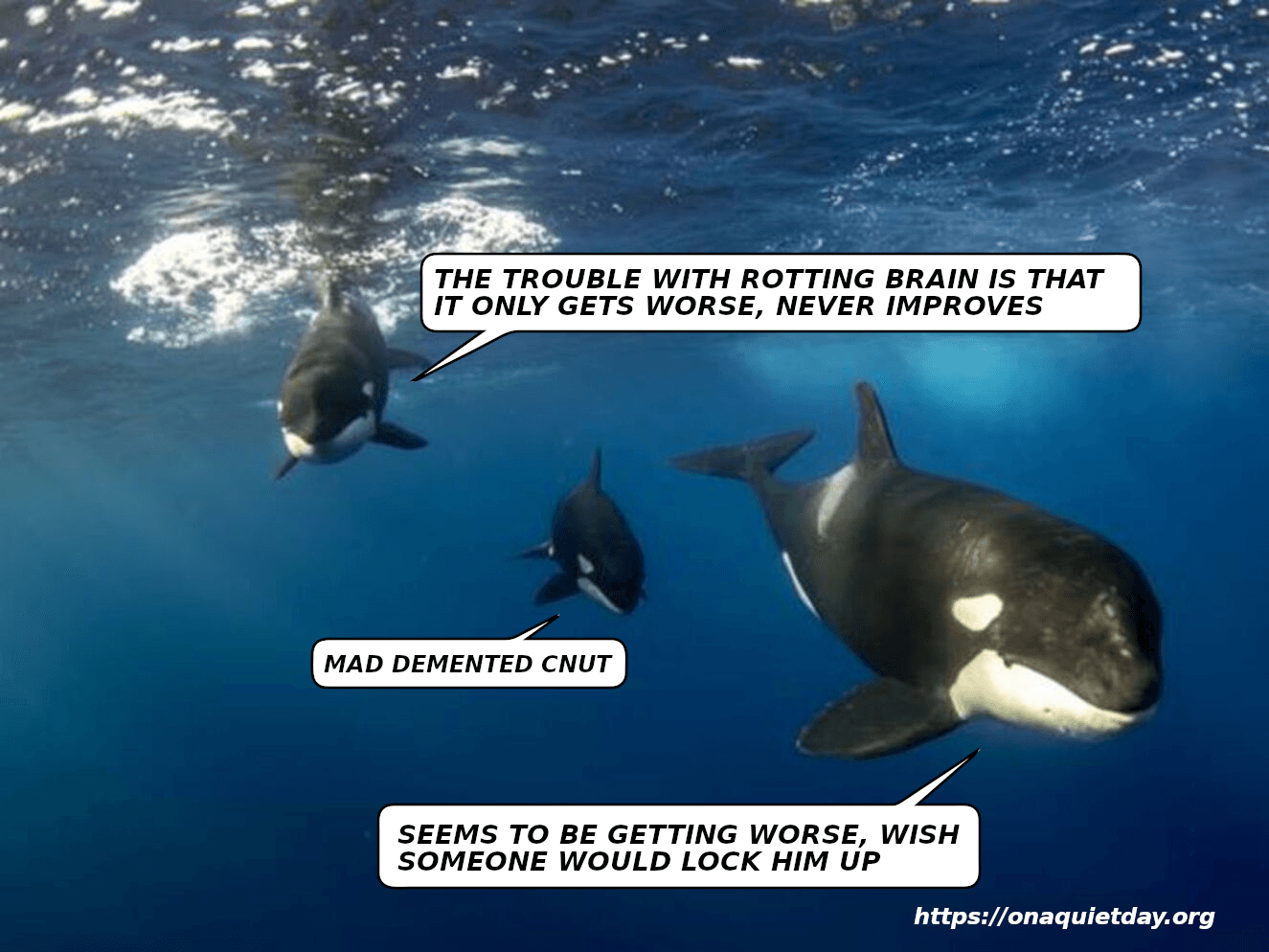
Orcas discuss rotting brain. Front Orca says “Wish someone would lock him up”.Donald Trump warns against following the https://onaquietday.org blog, says that it’s easy atm, she only needs to report war crimes supporting Israel’s genocidal expansion.Keir Starmer explains that UK is participating defensively in Trump and Israel’s criminal war for Israel’s genocidal expansion in Iran and states that he supports Zionism “without qualification”. Keir Starmer said “I said it loud and clear – and meant it – that I support Zionism without qualification.” here: https://www.jewishnews.co.uk/keir-starmer-interview-i-will-work-to-eradicate-antisemitism-from-day-one/
Mike Waltz, US ambassador to the United Nations, raises his hand during a UN Security Council meeting in New York on March 11, 2026. (Photo by Selcuk Acar /Anadolu via Getty Images)
“The very purpose of this biased and politically motivated text, which was pushed by the Israeli regime and the United States, is clear: to reverse the roles of victim and aggressor,” said Iran’s ambassador to the UN.
The United Nations Security Council on Wednesday adopted a resolution condemning Iran’s retaliatory attacks on Gulf nations without denouncing—or even mentioning—the illegal US and Israeli bombing campaign that started the war, which has hurled the region into conflict and destabilized the global economy.
The resolution, sponsored by council member and US ally Bahrain, “condemns in the strongest terms the egregious attacks by the Islamic Republic of Iran against the territories of Bahrain, Kuwait, Oman, Qatar, Saudi Arabia, the United Arab Emirates, and Jordan,” nations that host US military bases. The text calls Iranian strikes “a breach of international law and a serious threat to international peace and security,” but contains no mention of the US or Israel, nations that have been accused of grave war crimes.
The council adopted Bahrain’s measure by a vote of 13-0, with two abstentions—China and Russia. Both nations have veto power but declined to use it. Neither Iran nor Israel is currently a member of the Security Council.
The UN body also voted on a competing resolution, sponsored by Russia, that would have implored “all parties”—without naming any of them—to stop their military operations and avoid escalating the conflict. The resolution did not receive the nine votes necessary for adoption, with the US and Latvia voting against it and Bahrain, Colombia, the Democratic Republic of the Congo, Denmark, France, Greece, Liberia, Panama, and the United Kingdom abstaining.
Amir Saeid Iravani, Iran’s ambassador to the UN, said the body’s adoption of Bahrain’s resolution marks “a serious setback to the council’s credibility and leaves a lasting stain on its record.”
“Today’s action represents a blatant misuse of the Security Council’s mandate in pursuit of the political agendas of certain members,” said Iravani. “The very state responsible for this brutal war of aggression against my country—the regime of the United States—sits on the other side of this chamber as president of the council, abusing its position while obstructing every effort to bring an end to this barbaric war against the Iranian people and preventing the Council from fulfilling its Charter-based responsibilities.”
“This resolution is a manifest injustice against my country, the main victim of a clear act of aggression. It distorts the realities on the ground and deliberately ignores the root causes of the current crisis,” he continued. “The very purpose of this biased and politically motivated text, which was pushed by the Israeli regime and the United States, is clear: to reverse the roles of victim and aggressor. It rewards the regimes of the United States and Israel, which have violated the UN Charter and committed acts of aggression. In doing so, it establishes impunity and sends a wrong message to the international community—emboldening the aggressors to commit further crimes.”
“The UN and International Criminal Court were created for moments like this, when the most powerful decide the rules do not apply to them.”
Ahead of the vote on Bahrain’s resolution, which accuses Iran of “deliberate targeting of civilians and civilian objects,” Iravani said US-Israeli bombing has killed more than 1,300 civilians in Iran and destroyed nearly 10,000 civilian structures across the country, including around 8,000 homes and dozens of schools and healthcare facilities.
Earlier on Wednesday, the New York Times reported that the Pentagon has reached the preliminary conclusion that US forces were responsible for the February 28 bombing of an Iranian elementary school, an attack that killed around 175 people—mostly young children.
DAWN, a nonprofit that supports human rights and democracy in the Middle East, said Wednesday that “mounting evidence” shows US and Israeli forces “have committed multiple war crimes” in Iran and Lebanon—which is facing a rapidly worsening humanitarian disaster due to Israeli attacks.
“In mere days, US and Israel forces have launched a war of choice, killed hundreds of civilians, displaced hundreds of thousands, bombed scores of schools, health facilities, and fuel depots, and dropped white phosphorus on civilian communities,” Omar Shakir, DAWN’s executive director, said in a statement. “The international community’s failure to act when the most fundamental norms of international law are being challenged risks plunging the world further into a lawless era in which civilians across the globe are at risk.”
“The UN and International Criminal Court were created for moments like this, when the most powerful decide the rules do not apply to them,” said Shakir. “Governments unwilling to invoke international law when their allies commit crimes have no credibility when they invoke it against rivals.”
Keir Starmer explains that UK is participating defensively in Trump and Israel’s criminal war for Israel’s genocidal expansion in Iran and states that he supports Zionism “without qualification”. Starmer said it here: https://www.jewishnews.co.uk/keir-starmer-interview-i-will-work-to-eradicate-antisemitism-from-day-one/Keir Starmer objects to criticism of the IDF. He asks how could anyone object to them starving people to death, forced marches like the Nazis did, bombing Gaza’s hospitals and universities, mass-murdering journalists, healthworkers and starving people queuing for food, killing and raping prisoners and murdering children. He calls for people to stop obstructing his genocide for Israel.Orcas discuss Genocide-supporting and complicit Zionists. Donald Trump, Keith Starmer, David Lammy, Rachel Reeves, Angela Rayner and Wes Streeting are acknowledged as evil genocide-complicit and supporting cnuts.
Two women from the Iranian Red Crescent Society stand as a thick plume of smoke from a U.S.-Israeli strike on an oil storage facility late Saturday rises in the sky in Tehran, Iran, March 8, 2026
IRAN launched fresh waves of strikes at Israel and US and energy assets in the Gulf states today as it continued to retaliate against devastating US and Israeli air raids.
Sirens warned of incoming missiles in Dubai and in Bahrain, authorities said an Iranian attack hit a residential building in the capital, killing a woman and wounding eight others.
Saudi Arabia said it destroyed two drones over its oil-rich eastern region and Kuwait’s National Guard said it shot down six drones.
Later in the morning sounds of explosions could be heard in Tel Aviv.
“We are definitely not looking for a ceasefire,” Iran’s parliament speaker Mohammad Bagher Qalibaf wrote on X.
“We believe that the aggressor should be punched in the mouth so that he learns a lesson so that he will never think of attacking our beloved Iran again.”
Keir Starmer explains that UK is participating defensively in Trump and Israel’s criminal war for Israel’s genocidal expansion in Iran and states that he supports Zionism “without qualification”. Starmer said it here: https://www.jewishnews.co.uk/keir-starmer-interview-i-will-work-to-eradicate-antisemitism-from-day-one/Donald Trump warns against following the https://onaquietday.org blog, says that it’s easy atm, she only needs to report war crimes supporting Israel’s genocidal expansion.Orcas discuss how Trump was re-elected and him being an obviously insane, xenophobic Fascist.
A yacht sails past a plume of smoke rising from the port of Jebel Ali following a reported Iranian strike in Dubai on March 1, 2026. Fadel Senna/AFP via Getty Images
Military facilities in Bahrain, Kuwait, Oman, Qatar, Saudi Arabia and the United Arab Emirates have all been hit. But the missiles and drones from Iran have been aimed at civilian infrastructure, too, including airport, ports and hotels in the opening days of U.S. and Israeli operations against Iran.
In scale and scope, the barrage marks a major departure from Iran’s previous response to being attacked by U.S. and Israeli airstrikes. In contrast, during a 12-day war in June 2025, Tehran only attacked one base in Qatar, and even then forewarned authorities in Doha.
Instead, what is occurring in the region is a scenario that planners in Persian Gulf capitals have long warned about: a deliberate attempt by Tehran to widen conflict and hit nations it sees as allied to the West.
As an expert on Gulf dynamics, I see the unfurling events as undoing years of work to de-risk the region and placing in jeopardy the unique selling point and business models that have underpinned the Gulf states’ global rise.
An intercepted projectile falls into the sea near Dubai’s Palm Jumeirah archipelago on March 1, 2026. Fadel Senna/AFP via Getty Images
A cornered regime fighting for survival
Ever since the Oct. 7, 2023, attacks by Hamas and other Palestinian militants on Israel, policymakers in the Gulf nations have sought to avoid the regionalization of conflict.
Each of the successive escalations between Israel and Iran – in April and October 2024 and then in June 2025, with the joint U.S.-Israeli strikes – brought the region closer to, without tipping over into, all-out war.
But Iran’s actions in the opening days following what Washington has named “Operation Epic Fury” have signaled that the comparative restraint it showed during the 12-day war is firmly off the table.
The Islamic Republic is now a cornered regime fighting for its survival. As such, it is lashing out and seeking to spread the pain to regional neighbors. The logic in this approach is that Gulf nations could put pressure on the U.S., which may fear the cascading costs of a prolonged regional conflict.
Gulf nations are also obvious targets for Iran. With Iran lacking the capability to hit the U.S. mainland through conventional weapons, the American military bases that dot the Gulf region are within the reach of Tehran’s ballistic arsenal.
Psychological impact on Gulf nations
The scale of the Iranian attacks on targets in the Gulf nations in the opening two days of the current conflict underscores the extent to which Iran’s response now differs from that of June 2025: In the first two days of the conflict, Iran had fired at least 390 ballistic missiles and 830 drones at the Gulf states. By comparison, the Iranian strike on the Al-Udeid air base in Qatar last year involved 14 ballistic missiles and was a one-off attack on a single target.
Air defense systems in Gulf nations have neutralized most of the incoming Iranian missiles, to date, and actual damage and casualties have been limited to a handful of deaths and injuries in the dozens.
But it is the intangible and psychological impact on Gulf cities under attack that threatens to inflict profound damage on the reputation and image of cities such as Dubai, Abu Dhabi and Doha. In recent years, Gulf Cooperation Council nations have presented the Gulf as an oasis of stability and havens to live and work.
This is especially the case for Dubai, which has marketed itself strongly as a hub for business and tourism. But it is also applicable to other Gulf nations as well, such as Qatar, which relies heavily on a steady stream of large-scale meetings and events.
Iran’s attacks on civilian infrastructure and soft targets – airports in Bahrain, Dubai, Abu Dhabi and Kuwait, and hotels in Bahrain and Dubai – serve to puncture this image of safe and secure Gulf capitals.
This choice of targets by Iran likely reflects a calculation that leaders in the Gulf countries would immediately feel the full impact of the war and push Washington hard to find a resolution and quick.
The subsequent targeting by Tehran on oil and gas facilities, including Ras Laffan in Qatar and Ras Tanura in Saudi Arabia, serves as a further and highly consequential step. It has already triggered a forceful response from Qatar, which shot down two Iranian jets on March 2.
There is concern among Gulf nations that the next step in the ladder of escalation could involve targeting the desalination plants that are so vital to overcoming water scarcity in the region.
As critical hubs in the global economy by virtue of their reserves of oil and gas and centrality to international shipping and aviation, the Gulf nations are uniquely vulnerable to further escalation by Iran.
Dubai, Abu Dhabi and Doha have invested heavily in creating airlines that function as “super-connectors” capable of linking any two destinations worldwide with a stop in the Gulf. A Feb. 28 drone strike on Dubai International Airport, the world’s busiest for international travel, illustrated the impact that Iran’s asymmetric responses could have on the global hub model that has come to dominate world air travel.
Already, closure of airspaces over Qatar and the UAE, as well as in Bahrain and Kuwait, has stranded tens of thousands of passengers and created the biggest disruption to global travel since the COVID-19 pandemic.
In addition, cargo operations essential to local supply chains have been heavily impacted, at the same time that seaborne trade through the Strait of Hormuz has been similarly interrupted.
Whereas initial spikes in oil prices and insurance premiums at the start of the 12-day war last year fell away as it became clear that energy infrastructure was not significantly targeted, the opposite has happened this time.
Peril and uncertainty
But the short-term shock to the global economy is not what will be of primary concern to the Gulf Cooperation Council members. Not since the Gulf crisis of 1990-91, with the Iraqi invasion of Kuwait and subsequent Gulf War, has the region faced so much peril and uncertainty.
And that is what Iran’s leaders are banking on. The attacks across the Gulf by Tehran are not, after all, without strategy. The intent is to expand the conflict, thereby significantly raising costs to the U.S. and its partners in the Gulf.
Tehran’s hope is that the economic impact will encourage Gulf leaders to press Trump for an endgame. But in attacking capitals across the region, Iran risks perhaps doing the opposite: rupturing any chance of bettering ties with rivals in the region and instead pushing them further back into Washington’s orbit after a period of drift.
Orcas discuss rotting brain. Front Orca says “Wish someone would lock him up”.Donald Fuhrump says that Amerikkka doesn’t bother with crimes or charges anymore, not being 100% Amerikkkan and opposing his real estate intentions is enough.Elon Musk urges you to be a Fascist like him, says that you can ignore facts and reality then.