‘What’s happening in the West Bank just as in Gaza are war crimes’
Labour MP John McDonnell has questioned the UK government’s record on sanctioning Israeli settlers in the occupied West Bank, as violence in the region escalates.
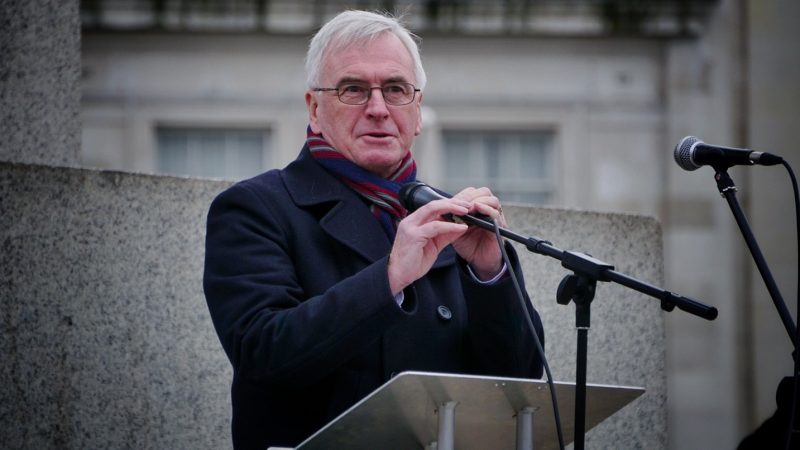
Speaking in Parliament on Wednesday, McDonnell called on the UK government to publish a detailed report into the sanctions imposed by the government on Israeli settlers in the West Bank.
It comes after the UN human rights office has demanded that Israeli security forces immediately stop participating in and enabling attacks by Jewish settlers in the region, stating the, “escalating violence over the past few days is also a matter of grave concern”.
This followed the killing of a 14 year-old Israeli from a settler family, which sparked the biggest settler rampage since the war in Gaza began, with seven Palestinians reported murdered and many others wounded.
Speaking on Wednesday in Parliament McDonnell said: “At a meeting with Israeli colleagues this morning we heard that the Israeli government is arresting legal and peaceful observers in the West Bank.
“Could the government now make it very clear to the Israeli government that observers should be allowed to operate within the West Bank, to ensure that peace is maintained, but also could we have a report in detail on the sanctions that the government is applying to Israeli settlements and Israeli settlers.”
Robert A. Wood, deputy permanent representative of the United States to the United Nations, vetoes Palestine’s U.N. membership during the Security Council meeting on April 18, 2024. (Photo: Manuel Elías/United Nations)
Palestine’s permanent observer at the United Nations said the resolution’s failure “will not break our will, and it will not defeat our determination.”
U.S. President Joe Biden’s administration on Thursday used the country’s veto power at the United Nations Security Council to block Palestine’s bid to become a full member of the U.N.
While 12 nations voted in favor of Palestinian membership and two abstained, the United States is one of five countries—along with China, France, Russia, and the United Kingdom—who have veto authority at the Security Council.
Since Israel launched what the International Court of Justice has said is a “plausibly” genocidal assault of the Gaza Strip in response to a Hamas-led October attack, the Biden administration has blocked three cease-fire resolutions at the Security Council. Under mounting global pressure, the U.S. finally abstained last month, allowing a cease-fire measure to pass.
In the lead-up to Thursday’s vote, the Biden administration was pressuring other countries to oppose the Palestinian Authority’s renewed membership effort so it could possibly avoid a veto, according to leaked cables obtained by The Intercept.
“Take a moment to ponder how isolated Biden has made the U.S.,” said Trita Parsi, executive vice president of the Quincy Institute for Responsible Statecraft, after the veto. “Biden lobbied Japan, South Korea, and Ecuador HARD to oppose the Palestine resolution so that the U.S. wouldn’t have to veto. They refused. So Biden cast his fourth veto in seven months (!!) This is the opposite of leadership.”
In addition to the nations Parsi highlighted, Algeria, China, France, Guyana, Malta, Mozambique, Russia, Sierra Leone, and Slovenia voted for giving Palestine full U.N. membership while Switzerland and the United Kingdom abstained.
After the vote, U.N. News reported on remarks from Riyad Mansour, a U.N. permanent observer for the state of Palestine:
“We came to the Security Council today as an important historic moment, regionally and internationally, so that we could salvage what can be saved. We place you before a historic responsibility to establish the foundations of a just and comprehensive peace in our region.”
Council members were given the opportunity “to revive the hope that has been lost among our people” and to translate their commitment towards a two-state solution into firm action “that cannot be maneuvered or retracted,” and the majority of council members “have risen to the level of this historic moment, and they have stood on the side of justice and freedom and hope, in line with the ethical and humanitarian and legal principles that must govern our world and in line with simple logic.”
“The fact that this resolution did not pass will not break our will, and it will not defeat our determination,” Mansour added. “We will not stop in our effort. The state of Palestine is inevitable. It is real. Perhaps they see it as far away, but we see it as near, and we are the faithful.”
Parsi said that “a Western-friendly senior Global South diplomat” told him of Biden’s veto: “Whatever agonizing claim the U.S. had to lead a self-appointed free world has died a very loud public death on the Security Council horseshoe tonight. YOU CAN’T LEAD IF YOU CAN’T LISTEN.”
Biden, a Democrat seeking reelection in November, has faced fierce criticism in the United States and around the world for U.S. complicity in Israel’s war on Gaza—which Hamas, not the Palestinian Authority, has controlled for nearly two decades. In under seven months, Israeli forces have killed 33,970 Palestinians, injured another 76,770, displaced most of the besieged enclave’s 2.3 million population, devastated civilian infrastructure, and severely limited the flow of lifesaving humanitarian assistance.
Israel—which already got $3.8 billion in annual U.S. military aid before October 7—continues to receive weapons support from the Biden administration, even as a growing chorus of critics, including some Democrats in Congress, argues that the arms transfers violate U.S. and international law.
Google employees demand the company terminate its contract with the Israeli government at a protest on April 16, 2024. (Photo: No Tech for Apartheid/Medium)
“These mass, illegal firings will not stop us,” said organizers. “Make no mistake, we will continue organizing until the company drops Project Nimbus and stops powering this genocide.”
The peace coalition No Tech for Apartheid accused Google of a “flagrant act of retaliation” late Wednesday night as the Silicon Valley giant announced it had fired 28 workers over protests against its cloud services contract with the Israeli government.
The firings came after Google organizers held two 10-hour sit-ins at the company’s offices in Sunnyvale, California and New York City, demanding the termination of Project Nimbus, a $1.2 billion contract under which Google and Amazon provide cloud infrastructure and data services for Israel—without any oversight regarding whether the Israel Defense Forces uses the services in its occupation of Palestinian territories and bombardment of Gaza.
No Tech for Apartheid said in a statement that Google officials called the police to both offices to arrest nine protesters—dubbed the Nimbus Nine—on Tuesday morning, before utilizing “a dragnet of in-office surveillance” to fire nearly two dozen other employees on Wednesday.
“They punished all of the workers they could associate with this action in wholesale firings,” said the coalition, which includes Jewish Voice for Peace and MPower Change, a Muslim-led anti-war group.
Google accused the workers of “bullying,” “harassment,” defacing property, and physically impeding other employees—allegations No Tech for Apartheid rejected as it noted organizers “have yet to hear from a single executive about” their concerns over Google’s collaboration with Israel.
“This excuse to avoid confronting us and our concerns directly, and attempt to justify its illegal, retaliatory firings, is a lie,” said the workers. “Even the workers who were participating in a peaceful sit-in and refusing to leave did not damage property or threaten other workers. Instead they received an overwhelmingly positive response and shows of support.”
The organizers staged the sit-ins on the heels of reporting in Time magazine about new negotiations between Google and the Israeli government regarding further potential tech contracts.
Kate J. Sim, a child safety policy adviser at Google who said she was among those fired this week, said the terminations show “how terrified [executives] are of worker power.”
Terminated worker here. Listen when employers tell you exactly who they are
McCarthyism is alive and well. Look how terrified they are of worker power 🔥
Google employees have a history of harnessing worker power to change policies at the company. In 2018, Google terminated a deal with the U.S. Defense Department to develop drone and artificial intelligence (AI) technology through a contract called Project Maven. The decision followed the resignations of several employees and the condemnation of thousands of workers.
Calling Google CEO Sundar Pichai and Google Cloud CEO Thomas Kurian “genocide profiteers,” No Tech for Apartheid said Wednesday that they will not stop demonstrating against Project Nimbus until they get a similar result.
“The truth is clear: Google is terrified of us,” said the group. “They are terrified of workers coming together and calling for accountability and transparency from our bosses… The corporation is trying to downplay and discredit our power.
“These mass, illegal firings will not stop us,” No Tech for Apartheid added. “On the contrary, they only serve as further fuel for the growth of this movement. Make no mistake, we will continue organizing until the company drops Project Nimbus and stops powering this genocide.”
THE United Nations has appealed for $2.8 billion (£2.2bn) to provide desperately needed aid to three million Palestinians, stressing that tackling looming famine in the devastated Gaza Strip requires not only food but sanitation, water and health facilities.
Andrea De Domenico, the head of the UN humanitarian office for Gaza and the West Bank, told reporters on Tuesday night that massive operations are required to restore those services and meet minimum standards — and this can’t be done during military operations.
He pointed to the destruction of hospitals, water and sanitation facilities, homes, roads and schools by Israeli forces, adding that “there is not a single university that is standing in Gaza.”
Mr De Domenico said Israel’s recently ended so-called military operation at Shifa Hospital, Gaza’s largest medical facility, was so destructive the facility has been forced to shut down.
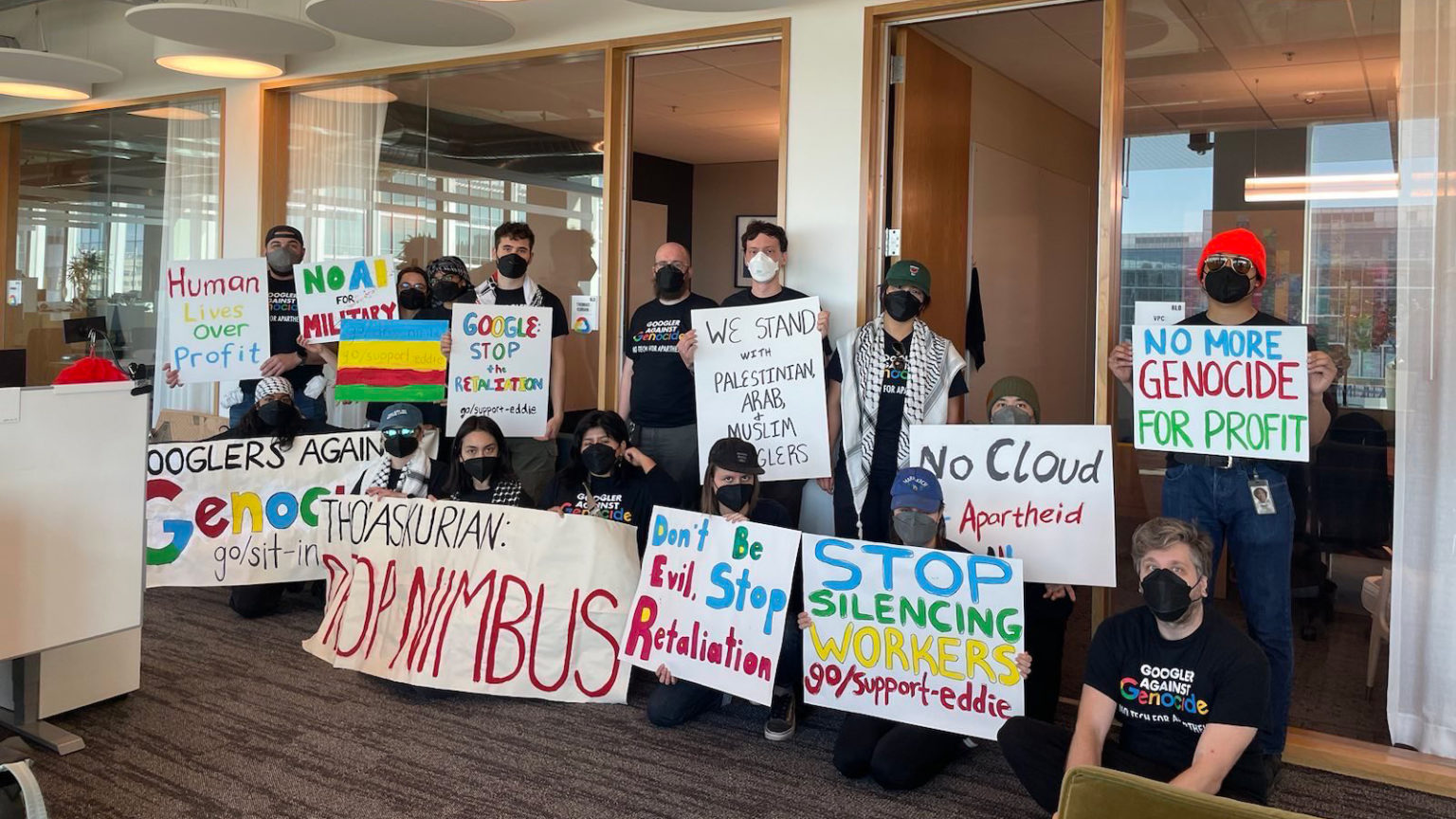
Google workers stage sit-in to end Project Nimbus (Photo: No Tech for Apartheid)
Tech workers are joining the Palestine solidarity movement in leading coast-to-coast sit ins at Google offices across the country
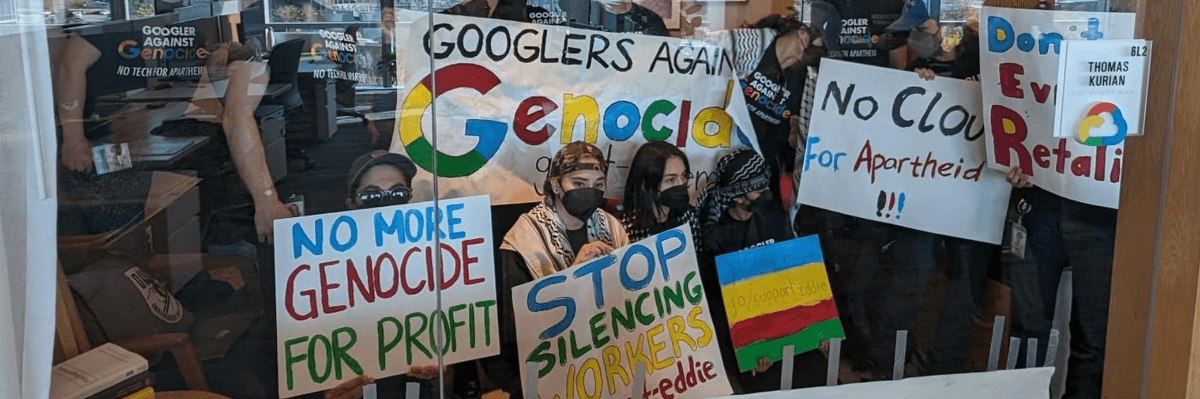
On April 16, Google workers led sit-ins at the office of Google Cloud CEO Thomas Kurian in Sunnyvale, California, and Google’s New York City headquarters in protest against Google’s complicity in the Israeli genocide of the Gaza Strip, through Project Nimbus, the tech giant’s contract with the Israeli government and military.
BREAKING—DOZENS OF @GOOGLE WORKERS LEAD HISTORIC COAST TO COAST-INS AT @GOOGLECLOUD CEO THOMAS KURIAN’S OFFICE IN SUNNYVALE & @GOOGLE’s NYC 10TH FLOOR COMMONS. They refuse to leave until @google stops powering the genocide in Gaza
— No Tech For Apartheid (@NoTechApartheid) April 16, 2024
Tech workers at both Amazon and Google have been organizing for years to end Project Nimbus, which is Google and Amazon’s USD 1.2 million contract with the Israeli government and military. Despite retaliation from Google including the firing of workers, the movement against Project Nimbus has only grown.
“Google is enabling and profiting from Israel’s AI-powered genocide through Project Nimbus, their USD 1 billion cloud contract with Israel. The Israeli military is also using Google Photos as part of a facial recognition dragnet across Gaza, which has led to the arrest, imprisonment, and torture of thousands of Palestinians with little to no evidence. It’s clear that the Israeli military will use any technology available to them for genocidal means,” say the Amazon and Google workers, organized in the group No Tech for Apartheid, in a recent statement. “Google workers do not want their labor to power Israel’s genocide of Palestinians in Gaza.”
This action comes days after Time Magazine reporting confirmed that Google is providing direct cloud computing services to the Israeli occupation forces, despite the company stating the contrary.
“We have been very clear that the Nimbus contract is for workloads running on our commercial platform by Israeli government ministries such as finance, healthcare, transportation, and education,” a Google spokesperson previously toldTime Magazine. “Our work is not directed at highly sensitive or classified military workloads relevant to weapons or intelligence services.” Time reporting revealed that the Israeli Ministry of Defense has its own secure entry point into the Google Cloud.
Tech workers staging the sit-ins in California and New York are demanding that the company end Project Nimbus, stop “the harassment, intimidation, bullying, silencing, and censorship of Palestinian, Arab, and Muslim Googlers,” and address health and safety issues in the workplace, which arise from the “mental health consequences of working at a company that is using their labor to enable a genocide,” workers say.