‘Crucial’ UN Report on Gaza Genocide Must Spur Global Action, Says Amnesty

Spread the love

Original article by JULIA CONLEY republished from Common Dreams under Creative Commons (CC BY-NC-ND 3.0). 

A wounded person receives treatment at a local hospital in the southern Gaza Strip city of Rafah on March 24, 2024.
 (Photo: Khaled Omar/Xinhua via Getty Images

U.N. member states must “use their influence” to push Israel to halt its bombardment of Gaza and blocking of humanitarian aid, said the group’s secretary general.

“The time to act to prevent genocide is now,” Amnesty International’s secretary general said Tuesday, a day after the United Nations Human Rights Council released a draft report detailing how the panel found that there are “reasonable grounds to believe” that Israel is already committing genocidal violence in Gaza.

Amnesty’s Agnes Callamard called the 25-page report a “crucial body of work that must serve as a vital call to action to states,” many of which have called for a cease-fire in Gaza for several months.

After the U.N. report found that “the overwhelming nature and scale of Israel’s assault on Gaza… reveal an intent to physically destroy Palestinians as a group,” Callamard said “states must now focus their efforts on making these calls a reality.”

“Third states must apply political pressure on the warring parties to implement the U.N. Security Council resolution adopted yesterday demanding an immediate cease-fire, use their influence to insist that Israel abides by the resolution, including by stopping the shelling and lifting restrictions on humanitarian aid,” said Callamard. “They must impose a comprehensive arms embargo against all parties to the conflict. They must also pressure Hamas and other armed groups to free all civilian hostages.”

The U.N. report was released the same day that the U.N Security Council adopted a resolution demanding an immediate, temporary cease-fire for the remainder of the month of Ramadan—the first cease-fire resolution to pass at the council following three that failed due to the U.S. vetoing the measures.

The U.S., which gives Israel $3.8 billion in annual military aid and has continued to provide support throughout the bombardment, abstained from voting on Monday’s resolution and infuriated human rights experts by baselessly claiming the vote was “nonbinding.”

The U.N. report, titled Anatomy of a Genocide, detailed actions Israel has taken since beginning its bombardment of Gaza in October that could violate Article II of the Genocide Convention, including killing members of the group, causing serious bodily or mental harm to members of the group, deliberately inflicting conditions of life calculated to bring about its physical destruction, and imposing measures intended to prevent births.

Along with killing at least 32,414 Palestinians in Gaza—73% of whom have been women and children, and the remaining 27% were not proven to have been Hamas members—Israel has also imposed mass starvation on the population, killing “10 children daily,” according to the report. Israel has detained thousands of Palestinian men and boys in undisclosed locations; injured 70,000 people; forced medical personnel to perform “hazardous health procedures, such as amputations without anesthetics, including on children”; and “destroyed or severely damaged most life-sustaining infrastructure.”

Callamard noted on Tuesday that the report came two months after the International Court of Justice (ICJ) announced an interim ruling that Israel is “plausibly” committing a genocide in Gaza and ordered the country to take action to prevent genocidal violence by its forces.

“In that time, the situation in Gaza has grown exponentially worse, with thousands more Palestinians killed and Israel continuing to refuse to comply with the ICJ ruling to ensure provision of sufficient humanitarian aid to Palestinians as human-made famine edges closer each day and more people starve to death,” said Callamard.

The secretary general echoed a call in the report, which was compiled by Francesca Albanese, special rapporteur on human rights in the occupied Palestinian territories, for the full funding of the U.N. Relief and Works Agency for Palestine Refugees in the Near East (UNRWA).

Israel said Sunday it will no longer permit UNRWA aid trucks to deliver humanitarian relief in northern Gaza, where one-third of children under age 2 are now suffering from acute malnutrition. The U.S. officially suspended UNRWA funding through March 2025 on Monday after President Joe Biden signed a new spending package into law.

The U.S. led several countries in cutting funding to the agency in January after Israel claimed 12 of UNRWA’s 13,000 employees in Gaza had been involved in the Hamas-led attack on southern Israel in October. Countries including Finland, Canada, and Australia have since reinstated funding.

Callamard also called on all states, particularly powerful Western countries that are allied with Israel, including the U.S., to support international authorities as they try to hold Israeli officials to account for the mass killing and starving of civilians in Gaza. Israel has refused to allow U.N. experts and other independent human rights monitors access to Gaza.

“Helping to prevent genocide also means supporting accountability efforts including the ongoing investigation by the Office of the Prosecutor of the International Criminal Court and exercising universal jurisdiction to bring those suspected of crimes under international law to justice,” said Callamard.

The secretary general noted that momentum has grown in recent days around international calls for a cease-fire, but said a desperately needed halt in fighting requires a concerted push by influential states to become a reality.

“An enduring cease-fire,” said Callamard, “remains the best way to enforce the ICJ’s provisional measures to prevent genocide and further crimes and civilian suffering.”

Original article by JULIA CONLEY republished from Common Dreams under Creative Commons (CC BY-NC-ND 3.0). 

Continue Reading‘Crucial’ UN Report on Gaza Genocide Must Spur Global Action, Says Amnesty

US Under Fire for Downplaying Security Council Resolution as ‘Nonbinding’

Spread the love

Oriignal article by JAKE JOHNSON republished from Common Dreams under Creative Commons (CC BY-NC-ND 3.0). 

U.S. State Department spokesperson Matthew Miller speaks to reporters during a press briefing on March 25, 2024. 
(Photo: Mostafa Bassim/Anadolu via Getty Images)

One expert accused the U.S. of working to “undermine and sabotage the U.N. Security Council, the ‘rules-based order,’ and international law.”

Biden administration officials attempted Monday to downplay the significance of a newly passed United Nations Security Council resolution, drawing ire from human rights advocates who said the U.S. is undercutting international law and stonewalling attempts to bring Israel’s devastating military assault on Gaza to an end.

The resolution “demands an immediate cease-fire for the month of Ramadan respected by all parties, leading to a lasting sustainable cease-fire.” The U.S., which previously vetoed several cease-fire resolutions, opted to abstain on Monday, allowing the measure to pass.

Shortly after the resolution’s approval, several administration officials—including State Department spokesman Matthew Miller, White House National Security Council spokesman John Kirby, and U.S. Ambassador to the U.N. Linda Thomas-Greenfield—falsely characterized the measure as “nonbinding.”

“It’s a nonbinding resolution,” Kirby told reporters. “So, there’s no impact at all on Israel and Israel’s ability to continue to go after Hamas.”

Josh Ruebner, an adjunct lecturer at Georgetown University and former policy director of the U.S. Campaign for Palestinian Rights, wrote in response that “there is no such thing as a ‘nonbinding’ Security Council resolution.”

“Israel’s failure to abide by this resolution must open the door to the immediate imposition of Chapter VII sanctions,” Ruebner wrote.

Beatrice Fihn, the director of Lex International and former executive director of the International Campaign to Abolish Nuclear Weapons, condemned what she called the Biden administration’s “appalling behavior” in the wake of the resolution’s passage. Fihn said the administration’s downplaying of the resolution shows how the U.S. works to “openly undermine and sabotage the U.N. Security Council, the ‘rules-based order,’ and international law.”

In a Monday op-ed for Common Dreams, Phyllis Bennis, a senior fellow at the Institute for Policy Studies, warned that administration officials’ claim that the resolution was “nonbinding” should be seen as “setting the stage for the U.S. government to violate the U.N. Charter by refusing to be bound by the resolution’s terms.”

While all U.N. Security Council resolutions are legally binding, they’re difficult to enforce and regularly ignored by the Israeli government, which responded with outrage to the latest resolution and canceled an Israeli delegation’s planned visit to the U.S.

Israel Katz, Israel’s foreign minister, wrote on social media Monday that “Israel will not cease fire.”

The resolution passed amid growing global alarm over the humanitarian crisis that Israel has inflicted on the Gaza Strip, where most of the population of around 2.2 million is displaced and at increasingly dire risk of starvation.

Amnesty International secretary-general Agnes Callamard said Monday that it was “just plain irresponsible” of U.S. officials to “suggest that a resolution meant to save lives and address massive devastation and suffering can be disregarded.”

In addition to demanding an immediate cease-fire, the Security Council resolution calls for the unconditional release of all remaining hostages and “emphasizes the urgent need to expand the flow of humanitarian assistance.”

Israel has systematically obstructed aid deliveries to Gaza, including U.S.-funded flour shipments.

Farhan Haq, deputy spokesman for the U.N. secretary-general, stressed during a briefing Monday that “all the resolutions of the Security Council are international law.”

“They are as binding as international laws,” Haq said.

Oriignal article by JAKE JOHNSON republished from Common Dreams under Creative Commons (CC BY-NC-ND 3.0). 

12 Palestinians Drown Trying to Retrieve Airdropped Gaza Aid From Sea

‘Crucial’ UN Report on Gaza Genocide Must Spur Global Action, Says Amnesty

Sanders Rips ‘Absurd’ US Claim That Israel Is Not Violating International Law

Continue ReadingUS Under Fire for Downplaying Security Council Resolution as ‘Nonbinding’

Sanders Rips ‘Absurd’ US Claim That Israel Is Not Violating International Law

Spread the love

Original article by JAKE JOHNSON republished from Common Dreams under Creative Commons (CC BY-NC-ND 3.0).

Children in Rafah, Gaza gather to receive food distributed by aid organizations on March 15, 2024.
 (Photo: Jehad Alshrafi/Anadolu via Getty Images

“The State Department’s position makes a mockery of U.S. law and assurances provided to Congress,” said Sen. Bernie Sanders.

Sen. Bernie Sanders on Monday said the U.S. State Department’s determination that Israel is not violating international law with its assault on the Gaza Strip is “absurd on its face,” pointing to the mass death, destruction, and starvation that Israeli forces have inflicted on the territory’s population over the past six months.

“Thirty-two thousand Palestinians in Gaza have been killed and almost 75,000 injured, two-thirds of whom are women and children,” Sanders (I-Vt.) said in a statement. “Some 60% of the housing units have been damaged or destroyed, and almost all medical facilities have been made inoperable. Today, hundreds of thousands of Palestinian children are facing starvation because [Israeli Prime Minister Benjamin] Netanyahu won’t let in sufficient humanitarian aid, while thousands of trucks are waiting to get into Gaza.”

“The State Department’s position,” said Sanders, “makes a mockery of U.S. law and assurances provided to Congress.”

The senator’s statement came after State Department spokesperson Matthew Miller told reporters during a press briefing earlier Monday that the Biden administration has not found Israel “to be in violation of international humanitarian law, either when it comes to the conduct of the war or when it comes to the provision of humanitarian assistance.”

Miller was responding to a question about assurances the administration has received from the Israeli government that its use of American weaponry has complied with international law and that it has permitted U.S. humanitarian aid to enter Gaza, where the entire population is facing acute hunger.

Under a new Biden administration policy known as NSM-20, recipients of American military aid are required to provide the U.S. government with “credible and reliable” written assurances that they are using such assistance “in a manner consistent with all applicable international and domestic law and policy.”

Late last week, a group of U.S. senators—including Sanders—warned the Biden administration that deeming Israeli assurances credible would “be inconsistent with the letter and spirit of NSM-20” and “establish an unacceptable precedent” for the application of the policy “in other situations around the world.”

“Until Biden is ready to impose real policy consequences on Netanyahu’s government, the famine will continue.”

It is a violation of U.S. law to continue sending military assistance to a country that is obstructing the delivery of American humanitarian aid. Last month, far-right Israeli Finance Minister Bezalel Smotrich blocked a U.S.-funded flour shipment from entering the Gaza Strip, and Israeli forces have repeatedly fired on convoys attempting to deliver aid to desperate Gazans.

Prominent human rights groups have been calling on the U.S. to impose an arms embargo on Israel for months, pointing to documented examples of the Israeli military using American weaponry to commit atrocities in Gaza.

But the Biden administration has refused to even apply concrete restrictions on American military aid. Over the weekend, U.S. President Joe Biden signed into law a measure that approves $3.8 billion in unconditional military assistance for the Israeli government and imposes a one-year ban on funding for the primary humanitarian aid organization in Gaza.

Jeremy Konyndyk, the president of Refugees International and a former USAID official, said Monday that Israel’s assurances to the U.S. are “not remotely credible” and argued the Biden administration is undermining efforts to combat the worsening humanitarian crisis in Gaza by accepting the Israeli government’s claims.

The U.S., he said, is “talking a big game about fighting the famine that its bombs and diplomatic cover have helped create.” Resorting to “gimmicky” efforts such as airdrops and temporary ports while a U.S. ally obstructs humanitarian aid “is not how you fight a famine,” Konyndyk argued.

“Fundamentally Biden must choose: between continuing to enable Netanyahu, or ending the famine. There’s no way to split the difference,” said Konyndyk. “Until Biden is ready to impose real policy consequences on Netanyahu’s government, the famine will continue.”

Original article by JAKE JOHNSON republished from Common Dreams under Creative Commons (CC BY-NC-ND 3.0).

‘Crucial’ UN Report on Gaza Genocide Must Spur Global Action, Says Amnesty

US Under Fire for Downplaying Security Council Resolution as ‘Nonbinding’

‘Outrageous’: US Accepts Israeli Assurances on Legal Use of Weapons in Gaza

Draft UN Report Finds Israel Has Met Threshold for Genocide

Continue ReadingSanders Rips ‘Absurd’ US Claim That Israel Is Not Violating International Law

Protesters across Arab countries call for immediate ceasefire in Gaza

Spread the love

Original article by Peoples Dispatch republished from peoples dispatch under a Creative Commons Attribution-ShareAlike 4.0 (CC BY-SA) license.

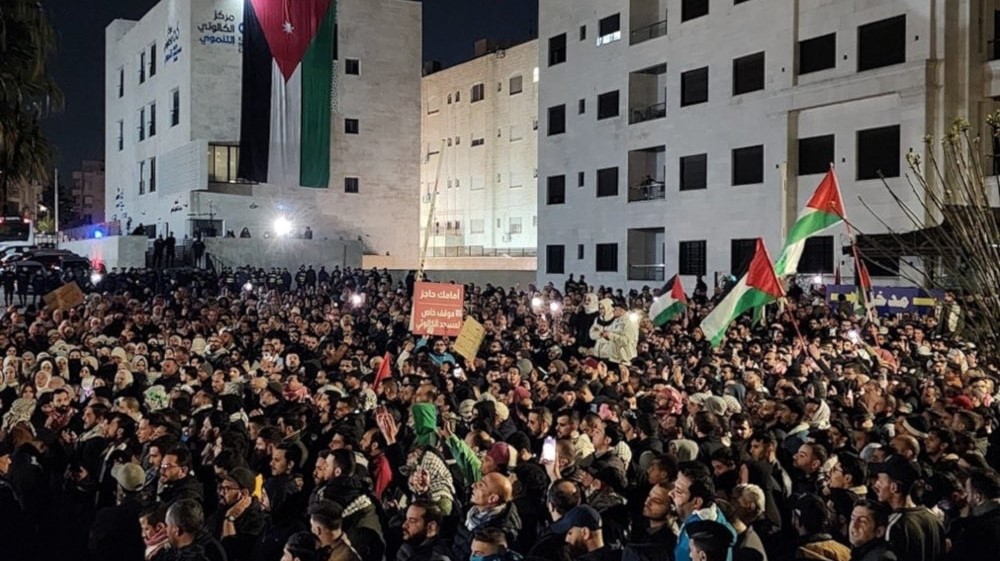
Protesters gather in Amman in Jordan demanding an immediate ceasefire in Gaza. Photo: Al Mayadeen

People took to the streets in a number of countries across West Asia and North Africa after the UN Security Council resolution calling for a ceasefire. However, Israel refused to heed the call and continued its attacks on Gaza on Tuesday

Large-scale protests broke out in different parts of West Asia and North Africa on Monday, March 25 in support of Palestine with people chanting slogans against the Israeli war in Gaza and demanding an immediate ceasefire. People took to the streets in a number of countries in the aftermath of the UN Security Council resolution that called for a ceasefire.

Jordanian security forces fired tear gas shells to disperse protesters who tried to storm the Israeli embassy in Amman. Thousands of these protestors chanted slogans in solidarity with the people in Gaza and in support of the Al-Aqsa mosque. Many of them carried Palestinian flags which they hoisted in nearby buildings.

Similar protests took place in other parts of the country. A day before, Jordanian forces had prevented a large group of people from marching to the Israeli embassy.

Protests were also organized in the Iraqi capital Baghdad and Cairo in Egypt as well on Monday where hundreds gathered to chant slogans in support of Palestine and demand an immediate ceasefire.

Hundreds also gathered in Tangiers in Morocco to demonstrate against the continued Israeli genocide of Palestinians in Gaza.

Protests were also organized in the Nur Shams refugee camp in Tulkarem and in Ramallah in the occupied West Bank on Tuesday. Hundreds of Palestinians, defying Israeli dictates and ongoing attacks, took to the streets in the morning to call for a ceasefire.

The protests followed the UNSC resolution demanding an immediate ceasefire. The resolution was adopted after the US, which had blocked three similar previous resolutions, decided to abstain. All the other members of the Security Council supported the resolution.

The resolution called for an immediate ceasefire during the month of Ramadan and for working towards a permanent cessation of hostilities and the release of all hostages. It was welcomed by the Palestinian resistance group Hamas and most of the countries in the region.

Hamas reiterated its demand for a permanent ceasefire that would lead to the complete withdrawal of all Israeli forces from Gaza and the return of all Palestinians displaced due to the war over five months.

Nearly the entire population of Gaza, around 2.3 million, has been displaced due to the Israeli war which has killed more than 32,000 and wounded close to 74,000 Palestinians.

The Iranian foreign ministry welcomed the UNSC resolution, calling it a positive step and demanded its immediate implementation. It also demanded the lifting of all blockades on the supply of aid to Gaza and the opening of all border crossings to the besieged territory and immediate resumption of reconstruction.

Israel has however rejected the resolution. It carried out fresh attacks on Gaza on Tuesday, killing dozens of Palestinians.

The resolution accepted by the Security Council is binding on all members of the UN. However, only a fresh vote in the Security Council can decide the future course of action in case one particular party chooses not to implement it.

Original article by Peoples Dispatch republished from peoples dispatch under a Creative Commons Attribution-ShareAlike 4.0 (CC BY-SA) license.

Continue ReadingProtesters across Arab countries call for immediate ceasefire in Gaza

UN Security Council’s Gaza Cease-Fire Resolution Is Not Enough—But It’s a Start

Spread the love

Original article by PHYLLIS BENNIS republished from Common Dreams under Creative Commons (CC BY-NC-ND 3.0). 

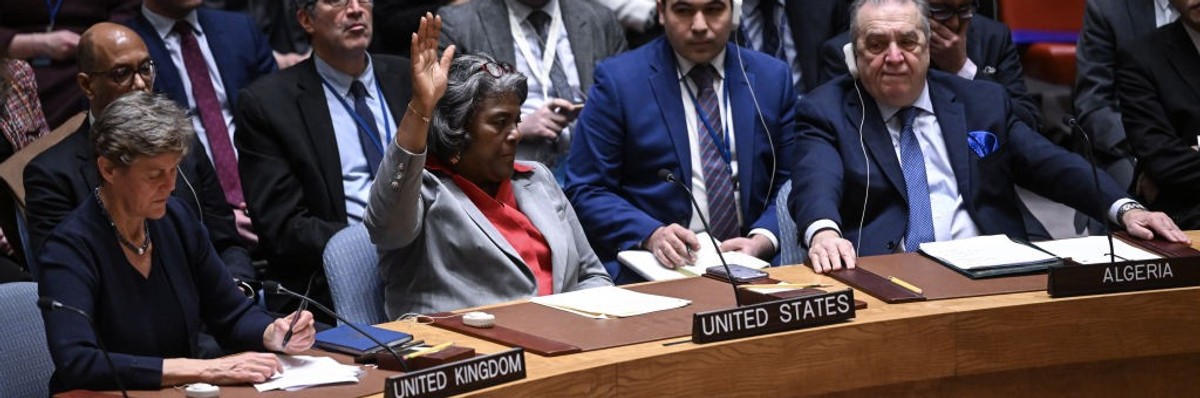
US Ambassador to the United Nations Linda Thomas-Greenfield raises her hand during the UN Security Council meeting which adopted a resolution demanding an immediate cease-fire in Gaza Strip for the month of Ramada on March 25, 2024. As many as 14 countries voted in favor of the resolution, presented by 10 elected members of the Council, while the US abstained from voting.  (Photo by Fatih Aktas/Anadolu via Getty Images

Despite weaknesses and false U.S. claims that the resolution is nonbinding, it demands an end to the bombing and a massive influx of humanitarian aid. And that means the possibility of saving lives.

Five and half months into Israel’s genocidal assault on Gaza with more than 32,000 Palestinians already killed, six weeks after the International Court of Justice found Israel plausibly committing genocide and ordered it to stop, and after four earlier tries, the UN Security Council on Monday finally passed a resolution submitted by all ten elected members aiming to stop the slaughter. The resolution has lots of weaknesses and shows the effects of U.S. pressure—but it demands an end to the bombing and a massive influx of food and medicine. And that means the possibility of saving lives.

The resolution demanded an immediate ceasefire leading to a lasting and sustainable ceasefire, the release of all hostages, and compliance with international law in treatment of all those detained. The Council also demanded “the lifting of all barriers to the provision of humanitarian assistance at scale,” reminding the world of the need for massive expansion of that aid and for protection of Palestinian civilians across the entire Gaza Strip.

The resolution’s passage was uncertain until the very last moment. An hour before the vote, U.S. diplomats won a final concession—replacing the original demand for a “permanent” ceasefire” to the squishier, less clear “lasting.” And there are significant other weaknesses in the resolution.

When U.S. Ambassador Linda Thomas-Greenfield claimed that the Council vote was “nonbinding,” she was setting the stage for the U.S. government to violate the UN Charter by refusing to be bound by the resolution’s terms.

The most important flaw in the Council’s text is that it calls for a ceasefire only “for the month of Ramadan.” This most important of Muslim holidays began on March 11, so the demand for a ceasefire is only for about two weeks. And while it does demand that the immediate halt lead to a lasting ceasefire, two weeks is still a much too-short time.

Other problems reflect deliberate obfuscation of language. The demand that all parties treat “all persons they detain” in compliance with international law clearly refers to the thousands of Palestinian detainees Israel is holding, many in administration detention without even the pretense of legitimate legal procedures, whom international law requires to be immediately released. Their detention violates a host of those laws, but by not naming them directly, diplomatic wrangling always threatens to deny them their rights.

And in the paragraph focusing on the catastrophic humanitarian situation across Gaza, the Council’s demand for “lifting all barriers to provision of humanitarian aid at scale” should be a clear and straightforward message to Israel that it must open the gates, end its rejection of goods on the spurious grounds of potential “dual use,” replace its deliberately complex and time-consuming inspection processes and more. But that reference to “lifting all barriers” is hidden in a long sentence within a reference to an earlier resolution. The first part of the sentence merely “emphasizes” the need for more humanitarian aid and protection for Palestinian civilians. And in UN diplo-speak, especially in the Security Council that actually has the right to enforce its resolutions, “emphasizing” something ain’t even close to “demanding” that it happen.

Israel was still not pleased, of course. Prime Minister Benjamin Netanyahu immediately announced his delegation, expected in Washington tomorrow to discuss Tel Aviv’s planned escalation against Rafah, will stay home instead.

But even if the resolution is not all it should be, its passage (14 in favor, the U.S. abstained) still represents a powerful global rejection of the U.S.-backed Israeli assault against Palestinians in Gaza, and an important expression of support for the South African-led intervention at the International Court of Justice designed to prevent or stop Israeli genocide and to hold Israel accountable for its crimes. Importantly, and despite U.S. Ambassador Linda Thomas-Greenfield’s false claim following the vote, all decisions of the Council, as stated in Article 25 of the UN Charter, are binding on Member States.

That puts a big obligation on the U.S. and global movements for ceasefire, massive escalation of humanitarian aid, and resumption of funding UNRWA. Left to its own devices, the Council will almost never move to enforce its own decisions. That responsibility, that obligation, lies with our movements—and, in the UN context, with the General Assembly. The legacy of the South Africa anti-apartheid movement, especially through the 1970s and 80s, and into the early 1990s, shows that model. The U.S. and Britain over and over again vetoed resolutions in the Security Council for sanctions against apartheid South Africa. Over and over again the General Assembly passed the resolutions—for banking, trade, and other sanctions, for arms embargoes and much more. Eventually, public pressure against Washington and London forced a pull-back, and eventually, reluctantly and grudgingly, those governments gave in, stopped vetoing the Council resolutions and started abiding by the calls of the Assembly. It all played a huge role in ending South African apartheid.

Left to its own devices, the Council will almost never move to enforce its own decisions. That responsibility, that obligation, lies with our movements—and, in the UN context, with the General Assembly.

When U.S. Ambassador Linda Thomas-Greenfield claimed that the Council vote was “nonbinding,” she was setting the stage for the U.S. government to violate the UN Charter by refusing to be bound by the resolution’s terms. But enforcement of Council decisions can take shape in many forms—protest movements around the world can demand their governments move to pressure Israel to abide by the Council’s demands. The General Assembly can urge Member States to impose some of those same sanctions it used so successfully against apartheid South Africa. Maybe the Assembly and global movements together can escalate the call urging boycotts of Israeli products, divestment from companies profiting from Israel’s occupation or apartheid, and sanctions on banking transactions or trade, and the imposition of arms embargoes.

First things, of course, an immediate ceasefire, release of hostages and Palestinian detainees, and a flood of emergency humanitarian aid. Then maybe, just maybe, we’ll see this Security Council resolution lead to the United Nations joining the global BDS movement. It’s never too late.


Phyllis Bennis

Phyllis Bennis is a fellow of the Institute for Policy Studies and serves on the national board of Jewish Voice for Peace. Her most recent book is the 7th updated edition of “Understanding the Palestinian-Israeli Conflict: A Primer” (2018). Her other books include: “Understanding the US-Iran Crisis: A Primer” (2008) and “Challenging Empire: How People, Governments, and the UN Defy US Power” (2005).

Original article by PHYLLIS BENNIS republished from Common Dreams under Creative Commons (CC BY-NC-ND 3.0). 

Continue ReadingUN Security Council’s Gaza Cease-Fire Resolution Is Not Enough—But It’s a Start