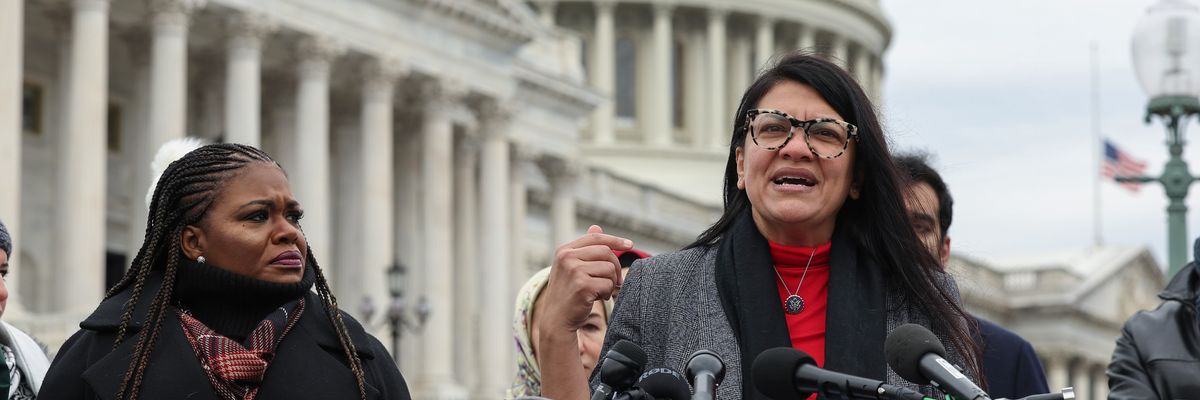
U.S. Rep. Rashida Tlaib (D-Mich.) speaks alongside Rep. Cori Bush (D-Mo.) at a press conference on December 7, 2023 in Washington, D.C. (Photo: Kevin Dietsch/Getty Images)
“We will not be complicit in Israel’s grave violation of international law,” reads a statement backed by more than 200 legislators from 13 countries.
More than 200 lawmakers from 13 countries issued a joint statement Friday expressing opposition to their nations’ weapons exports to Israel and pledging to do everything in their power to halt the flow of arms that are being used to massacre Palestinians in Gaza.
“We, the undersigned parliamentarians, declare our commitment to end our nations’ arms sales to the state of Israel,” reads the statement, which was coordinated by Progressive International. “Our bombs and bullets must not be used to kill, maim, and dispossess Palestinians. But they are: We know that lethal weapons and their parts, made or shipped through our countries, currently aid the Israeli assault on Palestine that has claimed over 30,000 lives across Gaza and the West Bank.”
The statement’s signatories include legislators from Israel’s top allies and weapons suppliers, including the United States, Germany, the United Kingdom, France, and Canada. Just two U.S. lawmakers—Reps. Rashida Tlaib (D-Mich.) and Cori Bush (D-Mo.)—backed the statement.
The statement includes six signatories from Germany, which is facing an International Court of Justice (ICJ) case alleging complicity in genocide against Palestinians.
The lawmakers argued that an arms embargo on Israel is both “a moral necessity” and “a legal requirement,” given the ICJ’s interim ruling in late January.
“We will not be complicit in Israel’s grave violation of international law,” the statement reads. “The ICJ ordered Israel not to kill, harm or ‘deliberately [inflict] on the [Palestinians] conditions of life calculated to bring about… physical destruction.’ They have refused. Instead, they press on with a planned assault on Rafah that the secretary-general of the United Nations has warned will ‘exponentially increase what is already a humanitarian nightmare.'”
“Today, we take a stand,” the statement continues. “We will take immediate and coordinated action in our respective legislatures to stop our countries from arming Israel.”
Niki Ashton, a member of Canada’s Parliament and a statement signatory, noted on social media that the Canadian government has approved $28 million worth of weapons exports to Israel since its latest assault on Gaza began in October.
“That is horrifying,” Ashton wrote. “Which is why I along with Jeremy Corbyn and 200+ parliamentarians across the world are backing [Progressive International’s] call for a ban on arms exports to Israel.”
“Make no mistake. These weapons are directly used to kill and maim starving Palestinians,” she added. “As Canadians, we can no longer claim to respect international law while sending arms to a country involved in genocidal acts. Enough is enough.”
Canada sent $28 million worth of weaponry to Israel amid its ongoing massacre of Palestinians in Gaza.
The statement was released amid global outrage over what’s been dubbed the “flour massacre.” On early Thursday morning, Israeli forces opened fire on a crowd of Gazans that surrounded an aid convoy in the northern part of the territory, which has been largely cut off from humanitarian assistance.
Israel’s military claimed dozens were killed and injured in a stampede, but witness accounts and video footage show that Israeli forces fired on Gazans as they desperately tried to get their hands on sacks of flour. One Gaza doctor said that 80% of the patients treated at his hospital in the wake of the attack had gunshot wounds, an account corroborated by United Nations teams and rights groups on the ground.
“Witness testimonies obtained by our field researchers and videos shared on social media documenting the events, clearly and unequivocally demonstrate that the crowd was hit by bullets coming from Israeli tanks and snipers,” Palestinian human rights organizations said in a statement Thursday.
A day after the deadly attack, U.S. President Joe Biden announced plans to airdrop humanitarian aid into Gaza as ground deliveries plummet.
The U.S. president said he would “insist that Israel facilitate more trucks and more routes” for ground shipments, but he didn’t promise to impose consequences if the Israeli government continues obstructing humanitarian assistance.
“Unbelievable,” Agnes Callamard, secretary-general of Amnesty International, wrote following Biden’s announcement. “There is a serious risk of genocide and in response the U.S. is proposing to airdrop supplies, while continuing to arm the perpetrator.”
Late last month, dozens of U.N. experts called for an immediate arms embargo on Israel, warning that “any transfer of weapons or ammunition to Israel that would be used in Gaza is likely to violate international humanitarian law and must cease immediately.”
“State officials involved in arms exports may be individually criminally liable for aiding and abetting any war crimes, crimes against humanity, or acts of genocide,” the experts said.
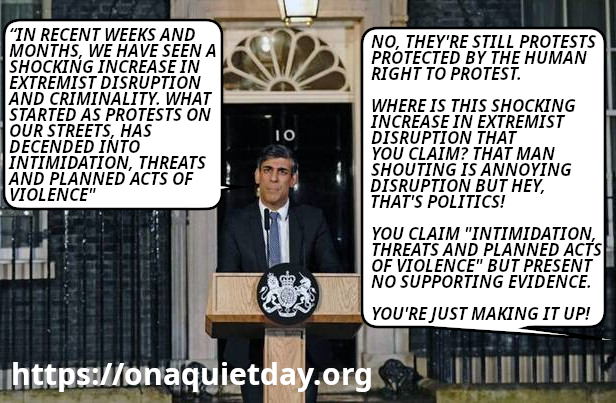
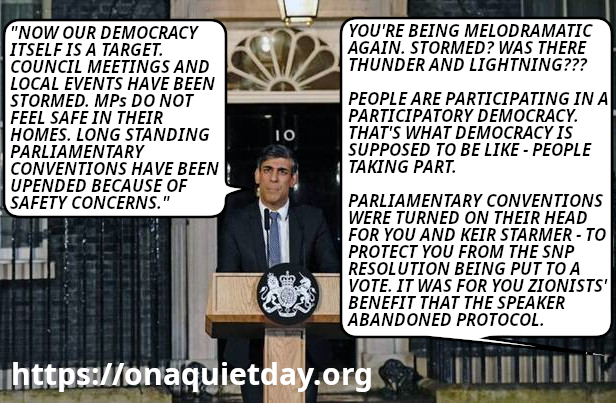
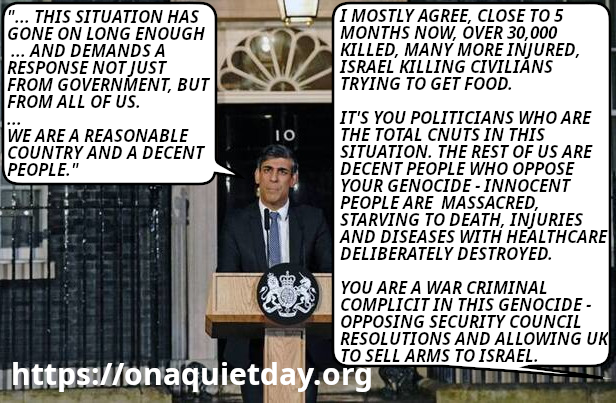
Not decided if I’ll do more (but I probably will because I enjoy telling him how it is ;).
Response to Rishi Sunak’s extremism speech at Downing Street 1 March 2024.Response to Rishi Sunak’s extremism speech at Downing Street 1 March 2024.Response to Rishi Sunak’s extremism speech at Downing Street 1 March 2024.Response to Rishi Sunak’s extremism speech at Downing Street 1 March 2024.Response to Rishi Sunak’s extremism speech at Downing Street 1 March 2024. Second version of this image with text slightly altered.
Screenshot from Israeli drone footage of the flour massacre.
Israeli forces killed at least 112 Palestinians after opening fire on a crowd awaiting a food aid truck in northern Gaza on February 29. The massacre took place as one quarter of Gaza’s population is at imminent risk of famine while Israel continues to blockade aid to the besieged strip.
Israeli forces massacred at least 112 people and injured more than 750 when they opened fire on starving Palestinians in the south west of Gaza City on February 29. The “Flour Massacre”, as it is now being called, took place in the early hours of Thursday morning, when people had gathered at the Harun al-Rashid Street awaiting a convoy of aid trucks carrying flour believed to be en route.
Manufactured famine
Israel has decimated northern Gaza in its ongoing, five-month long bombardment of the besieged Strip, and has virtually cut off humanitarian aid, pushing 576,000 people— or one quarter of Gaza’s population— “one step away from famine”.
One in six children under the age of two in Gaza are suffering from acute malnutrition and wasting, with the United Nations Office for the Coordination of Humanitarian Affairs (OCHA) warning of a “complete agricultural collapse” in northern Gaza by May.
On February 25, the head of the UN Relief and Works Agency (UNRWA) had stated that the last time aid had entered northern Gaza was January 23, stating that calls to send food aid had “been denied and have fallen on deaf ears”.
On February 20, the UN World Food Program had announced that it was pausing the delivery of “life saving food aid” to northern Gaza. This was despite the fact that aid deliveries had resumed just two days prior after a three-week suspension after an attack on a UNRWA truck.
“In these past two days our teams witnessed unprecedented levels of desperation,” the WFP said, as starving people tried to climb onto trucks to access food. Meanwhile, the agency stated that its trucks had faced gunfire upon entering Gaza City and had distributed only a small quantity of food.
Thursday’s aid convoy was not organized by the UN, but had been coordinated by the Israeli forces.
At least 10 children have died from malnutrition and dehydration in hospitals in northern Gaza, the Palestinian Ministry of Health announced on Thursday, including four children at the Kamal Adwan Hospital and two at Al-Shifa.
It is under these horrific circumstances, with families consuming animal feed to survive, that the first aid trucks in nearly a month entered northern Gaza this week. The Israeli Coordinator of Government Activities in the Territories (COGAT) had claimed that 31 trucks had entered northern Gaza on February 28. It stated that 20 other trucks had entered on Monday and Tuesday.
Starving Palestinians shot and ran over
“At about 4:30 in the early morning, trucks started to trickle in. The Israelis just opened random fire on us as if it was a trap. Once we approached the aid trucks, the Israeli tanks and warplanes started firing on us,” a witness had also told Al Jazeera, describing Thursday’s massacre.
After the shooting, Israeli tanks ran over the bodies of those who had been killed and others who lay injured, Al Jazeera’s journalist, Ismail Al-Ghoul had reported. He added that the injured had been rushed to the Al Ahli and Jordanian hospitals, however, “hospitals are no longer able to accommodate the huge number of patients because they lack fuel, let alone medicine”.
Gaza-based human rights organization, Al Mezan, also stated that the intense shooting by the IOF had gone on for an hour and a half.
Videos showed the dead and injured being escorted to the hospitals on donkey-drawn carts.
After releasing a doctored aerial drone footage clip, the Israeli occupation forces claimed that “dozens” of people had been killed and injured resulting from a stampede and that some people had been run over by the trucks. It went on to claim that it had not fired directly at the people around the trucks, and that instead, “armed men” had reportedly fired at the convoy and looted it.
While the Israeli military claimed that the shots had been aimed at the legs of the crowd, the head of the Kamal Adwan Hospital stated that the bullets had been concentrated in the head and upper parts of the bodies. The acting director of the Al-Awda hospital, which had been forced to suspend services earlier this week due to a lack of supplies, also told the Associated Press that of the 176 wounded people brought to the hospital, 80% had gunshot injuries.
The Israeli military later went on to alter its initial claims, saying that a small group of people had moved towards an Israeli tank and soldiers “in a way that endangered” them, after which its forces opened fire. It has claimed responsibility for “fewer than 10 of the casualties”, as reported by the Times of Israel.
In a video statement on Thursday night, military spokesperson Daniel Hagari claimed that there had been no Israeli military strike on the aid convoy and repeated the Occupation’s claim that “Israel puts no limits on the amount of aid that can go into Gaza”. This is demonstrably false as has been made clear by the images, testimonies and reports of starvation that are coming out of Gaza. According to the Euro-Med Monitor, aid deliveries to Gaza in February fell by 50% as compared to January.
Residents from northern Gaza told the organization that they had received calls from the Israeli military ordering them to move towards central and southern Gaza to access food and water. Meanwhile, not only has Israel restricted the entry of trucks into the Strip, it has continued to carry out military operations, targeting civilian police officers tasked with guarding the convoys, and shelling and shooting at people waiting to receive aid, the organization noted.
“Intentionally depriving people of food is clearly a war crime. Israel has announced its intention to destroy the Palestinian people, in whole or in part, simply for being Palestinian. In my view as a UN human rights expert, this is now a situation of genocide,” UN Special Rapporteur on the right to food, Michael Fakhri, stated in an interview with the Guardian, earlier this week.
“This means the state of Israel in its entirety is culpable and should be held accountable – not just individuals or this government or that person.”
Israeli impunity and concerns surrounding aid airdrops
While Hagari had tried to bolster Israel’s “humanitarian” credentials, Israel’s Minister of National Security, Itamar Ben-Gvir released a statement on X saying that “total support” must be given to Israeli forces in Gaza “who acted excellently against a Gazan mob that tried to harm them.”
“Today it was proven that the transfer of humanitarian aid to Gaza is not only madness while our abductees are being held in the Strip under substandard conditions, but also endangers the IDF soldiers. This is another clear reason why we must stop transferring this aid, which is in fact aid to harm the IDF soldiers and oxygen to Hamas.”
However, the Israeli narrative was seemingly unconvincing for most. Thursday’s massacre has drawn sharp international condemnation, including by the United Nations, China, Turkey, Qatar, Lebanon, Jordan, Australia, Italy, Brazil, France, and others. While condemning the “bread massacre”, Colombian president Gustavo Petro also announced that the country would be suspending weapons purchases from Israel, adding that the “whole world must blockade [Israeli PM] Netanyahu”.
Meanwhile, an emergency session of the UN Security Council was convened on Thursday to discuss the massacre. However, a draft declaration prepared by Algeria expressing “deep concern” over the killings and noting that they had been caused by Israeli forces opening fire, was ultimately blocked by the US. “The parties are working on some language to see if we can get to a statement”, US deputy ambassador Robert Wood said, adding that “the problem is that we don’t have all the facts”.
Speaking ahead of Thursday’s meeting, Palestinian Ambassador Riyad Mansour had stated that Thursday’s massacre “is a testimony to the fact that as long as the Security Council is paralyzed and vetoes casted, then it is costing the Palestinian people their lives”.
“[T]he Security Council should say enough is enough and if they have a spine and determination to put an end to these massacres from happening, all over again, what we need is a ceasefire”.
US and Western powers scramble to construct “the other side” of the massacre
During a US State Department press briefing on Thursday, spokesperson Matthew Miller was asked by veteran journalist Said Arikat whether anyone but Israel was holding aid from going into Gaza. Miller responded saying that there was solely a “distribution problem” “because there are police officers, some of whom are members of Hamas, who have been providing the security for that distribution and what Israel says is that they have a legitimate right to go after members of Hamas”.
When asked to confirm that “you don’t have any doubt that only one side did the shooting and the killing and the shelling of these people”, Miller said he had seen “different reports” that “other people were shooting” and that they were waiting for an investigation.
Israel’s allies in the west, including Germany and European Commission President Ursula Von Der Leyen have similarly sought “explanations” and investigations instead of explicitly condemning Thursday’s killings. Even when condemnations have been made, the language remains evasive and the perpetrator unnamed, with the killings called a “carnage among civilians”.
While consistently obstructing any kind of international intervention against Israel’s ongoing genocide in Gaza, all while handing the Occupation the tools to carry out the massacres, the US is now reportedly considering air-dropping aid to Gaza.
As Israel has continued to impede air delivery through land routes, Jordan and Egypt have airdropped small amounts of aid into Gaza in recent days, with harrowing visuals emerging of Gazans wading into the sea as some of the packages fell into the water. Belgium also announced on Friday that it would airdrop aid.
While a necessary measure under the circumstances, those working in humanitarian and aid agencies, such as Refugees International head and former USAID official, Jeremy Konyndyk have stated that aid airdrops must be recognized “as a form of bureaucratic obstruction by Israel”.
“Facilitating airdrops – and driving media coverage around them – gives the public appearance that Israel is cooperating with humanitarian efforts. But ensures that the amounts of aid getting in are negligible enough to still perpetuate the overall blockade strategy.”
The fact that the US is now considering airdrops can be seen as yet another attempt for it to whitewash Israel’s crimes and its own complicity in them— including the 17 year long brutal siege of Gaza, giving Israel the power to engineer hunger in the besieged strip, a power the Zionist entity has also used in the past.
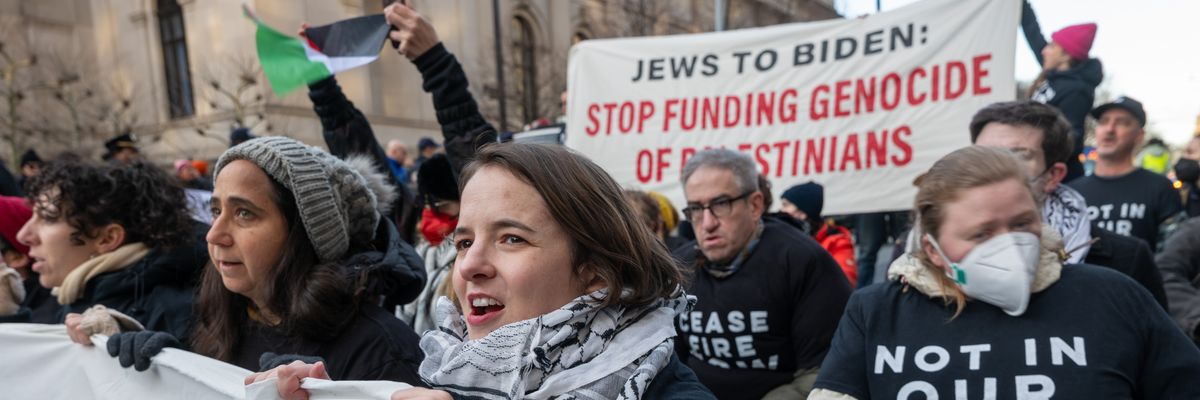
Members of the activist group Jewish Voice for Peace join others in protesting President Joe Biden’s visit to New York due to his continued support for Israel on February 7, 2024. (Photo: Spencer Platt/Getty Images)
“A Democratic campaign that is scared of college campuses is not a campaign that can win given today’s coalitions,” said one journalist.
Public opposition to U.S. President Joe Biden’s support for Israel pushed more than 100,000 primary voters in the key state of Michigan this week to vote “uncommitted” instead of backing him, but while the Biden campaign brushed the protest votes off with promises to “listen to what folks’ concerns are,” the president is reportedly intent on avoiding contact with pro-Palestinian constituents as much as possible.
As NBC News reported Friday, Biden’s campaign is considering hiring a private firm to vet attendees of a major upcoming fundraiser in New York in order to “weed out potential protesters.”
The fundraiser is one of several campaign events that the Biden team has planned with a new level of secrecy following protests that disrupted speeches he gave earlier this year.
According to NBC, the event will likely be held at Radio City Music Hall, but the campaign hasn’t confirmed the location and has only publicized the date—March 28.
The campaign also kept the location of Biden’s recent event in Culver City, California under wraps beforehand, and Biden opted to announced a $1.2 billion student loan forgiveness program in front of a small group at a public library there instead of speaking about the issue at a college campus.
Campuses are among the places that have become hotbeds of pro-Palestinian activism in recent months, but Intercept journalist Ryan Grim said that avoiding the youngest voters—who helped secure Biden’s victory in 2020—is no way for the president to win in November.
A Democratic campaign that is scared of college campuses is not a campaign that can win given today’s coalitions https://t.co/GAhhZsiQwR
“To avoid protests against Biden’s support for Israel’s carnage in Gaza, the Biden campaign is among other things avoiding college campuses. Yes, you read that right: HE’S AVOIDING YOUNG PEOPLE. He is literally hiding from his base,” said Trita Parsi, executive vice president of the Quincy Institute for Responsible Statecraft.
The campaign told NBC News that “larger-scale events” are planned in the coming weeks, “including on college campuses,” but critics on social media said the report raises larger concerns about the president’s ability to gather the support he needs as the U.S. continues to shield Israel from accountability for its indiscriminate killing of more than 30,000 people in Gaza in less than five months.
“Having a foreign policy so unpopular that you must avoid large crowds is definitely totally fine and not a problem for a presidential candidate,” Beth Miller, political director for Jewish Voice for Peace, said sarcastically.
the biden campaign is literally looking at a huge swath of dem voters and instead of reaching out to them or listening to their positions they're shielding biden from all contact with those voters https://t.co/xJ5TAIsLT4
While Biden has faced fewer protests at events in the past five weeks, since the campaign implemented the new strategy after demonstrators disrupted a speech he gave on abortion rights in Virginia several times, one ally of the president told NBC that the secrecy and smaller events are a risk he is taking.
“The downside is that means he doesn’t reach as many voters,” the person told NBC. “The point is to reach as many voters as you can, and those small events don’t.”
The campaign’s strategy is the latest sign that Biden’s “Israel stubbornness continues to trump even his seeming top goal: reelection,” said HuffPost senior diplomatic correspondent Akbar Shahid Ahmed.
The report came a day after journalist Mehdi Hasan appeared on CNN and expressed shock that Biden has continued to support Israel despite mounting evidence not only that the country is targeting civilians instead of Hamas, but also that the issue is increasingly a political liability for him, with more than three-quarters of Democrats calling for a permanent cease-fire.
“Joe Biden has rightly said for the last few years that [former President] Donald Trump poses an existential threat to our democracy,” said Hasan. “The idea that he would risk not only his own presidency, but the future of American democracy for the sake of [Israeli Prime Minister] Benjamin Netanyahu and [National Security Minister] Itamar Ben-Gvir and [Finance Minister] Bezalel Smotrich and the rest of the fascists in Israel is bizarre and inexplicable to me.”
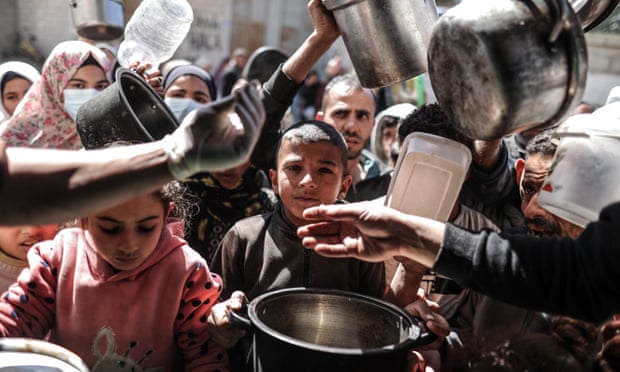
Palestinian people queue for food distributed by a charity in Deir al Balah, central Gaza. Allegations against 12 employees led major donors to suspend funding to UNRWA. Photograph: Anadolu/Getty Images
Allegations against 12 employees led major donors to suspend funding to UN Palestinian agency despite hunger crisis in Gaza
A month after Israeli allegations that a dozen United Nations staff were involved in the 7 October Hamas attack, UN investigators have yet to receive any evidence from Israel to support the claims though they expect some material to be forthcoming “shortly”.
The allegations against the 12 employees of the UN Relief and Works Agency for Palestine (UNRWA) led 16 major donors to suspend contributions totalling $450m at a time when more than two million Gazans are facing famine. UNRWA says it is approaching “breaking point” and only has sufficient funds to continue functioning for the next month at most.
The UN Office of Internal Oversight Services (OIOS) launched an investigation on 29 January in the wake of the Israeli allegations initially presented to UNRWA in January, and delivered an update on its work to the UN secretary general, António Guterres, on Wednesday.
Diplomats who saw the OIOS preliminary report said it contained no new evidence from Israel since the initial presentation of the claims in January – which were not backed by any proof. In summarising the findings, the UN spokesperson, Stéphane Dujarric, confirmed that the investigation had yet to receive corroborating material from Israel.