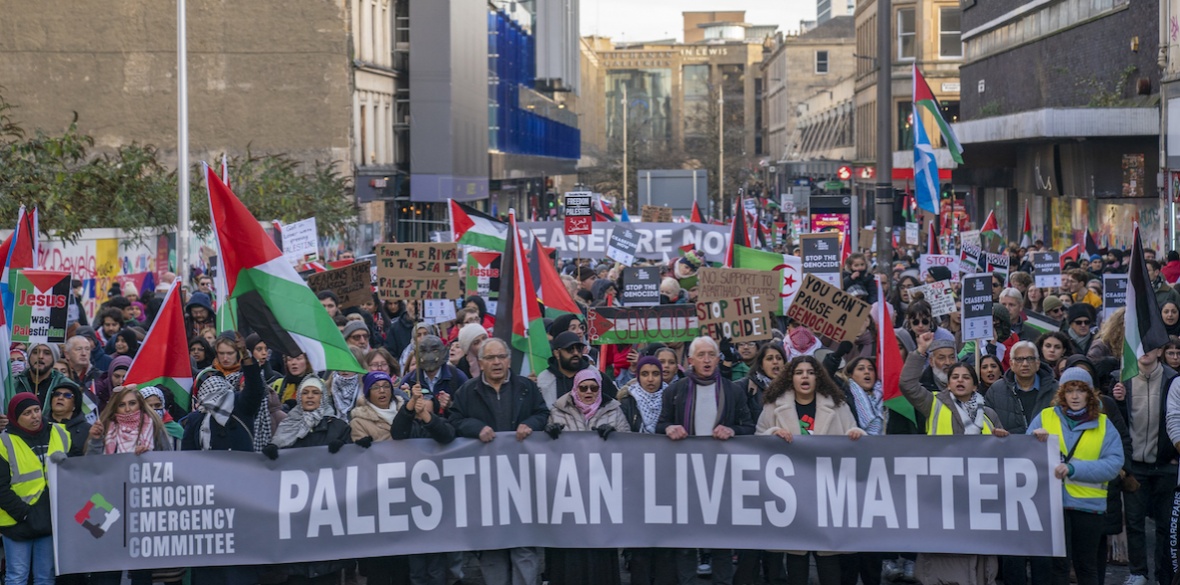
People take part in a Scottish Palestine Solidarity Campaign demonstration in Glasgow. Picture date: Saturday November 25, 2023.
HUNDREDS of thousands of protesters again took to the streets of London and major cities across Britain on Saturday as public anger over Israel’s slaughter in Gaza showed no signs of abating.
Demands for a ceasefire echoed in and other centres on the second day of the four-day “pause” in Israel’s attack for the release of Israeli hostages held in Gaza in exchange for Palestinians in Israeli prisons.
In London, police arrested 18 protesters and police were accused of using catch-all Section 12 regulations to make arrests in response to political pressure.
Palestine Solidarity Campaign (PSC) director Ben Jamal said: “There has been a major political effort by pro-Israel voices, including in government, to defame the protests as hate marches.
“In response the police today imposed a ludicrous Section 12 that gave them power to arrest anyone arriving early or leaving late no matter what they were doing.”
Stop the War Coalition national officer John Rees said: “This is political policing and it’s pretty certain none of this will be applied to tomorrow’s march for Israel,” referring to today’s demonstration called by the Campaign Against Anti-semitism.
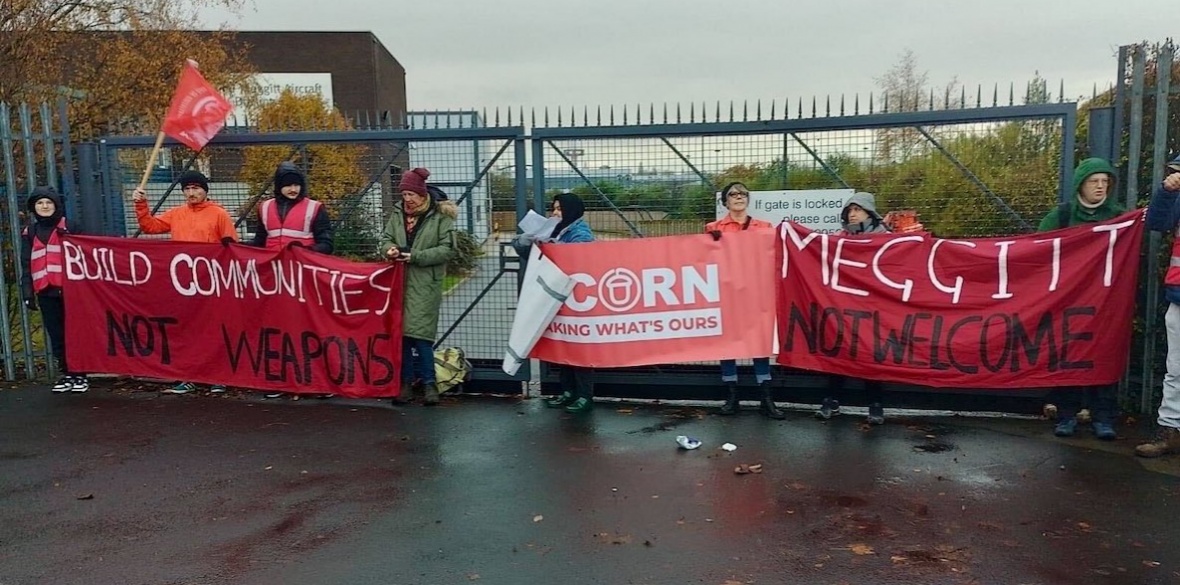
Acorn activists outside the entrance of aerospace and defence manufacturer Meggitt in Birmingham
THREE British arms firms supplying Israel with weapons were blockaded today when activists, local community members and tenants’ union Acorn went into action in defence of Gaza.
Acorn is active in towns and cities across Britain fighting on issues such as tenants’ rights, public transport and the cost-of-profits crisis.
Activists targeted weapons manufacturers in Birmingham, Bristol and Leeds today.
In Birmingham, the entrances to aerospace and defence manufacturer Meggitt were blocked; in Bristol, protesters turned away workers at defence and security manufacturer Leonardo; and in Leeds, the offices of BAE System were blockaded.
All three firms manufacture or provide components and systems for military aircraft being used in the bombardment of Gaza.
Acorn chairwoman Chelsea Phillips said: “Acorn will not stand by while entire communities are obliterated while ordinary people just like us are murdered in their tens of thousands by the Israeli government with the support of our government and using horrific weapons of war built by British companies.
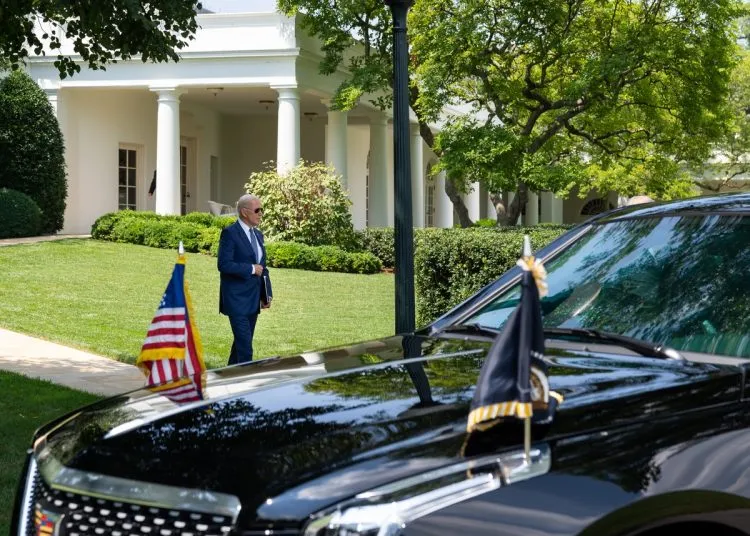
Zionist president Joe Biden. 27 July 2021 image by Official White House Photo by Adam Schultz. Original public domain image from Flickr
The request would remove most conditions on Israel’s use of a U.S. weapons stash, including a requirement that it only use surplus or obsolete weapons and a cap on how much the U.S. can spend resupplying the stash.
President Joe Biden has requested that Congress to lift most of the restrictions on Israel’s access to a U.S. stockpile of weapons in the country, The Intercept reported Saturday.
The request came in the administration’s supplemental budget request to the U.S. Senate, sent October 20. It concerns the War Reserve Stockpile Allies-Israel (WRSA-I) that the U.S. has stored in Israel since the 1980s for its own use in a potential conflict in the region. The U.S. allows Israel to access the stockpile under certain conditions, but Biden’s request would remove most of these conditions, including a requirement that Israel only use surplus or obsolete weapons and a cap on how much the U.S. can spend resupplying the stash.
“The President’s emergency supplemental funding request would essentially create a free-flowing pipeline to provide any defense articles to Israel by the simple act of placing them in the WRSA-I stockpile, or other stockpiles intended for Israel,” Josh Paul, a former State Department official who resigned over U.S. arm transfers to Israel in the midst of its bombardment of Gaza, told The Intercept.
“The Biden administration’s supplemental budget request would further undermine oversight and accountability even as U.S. support enables an Israeli campaign that has killed thousands of children.”
The news comes in the midst of a four-day cease-fire between Israel and Hamas, which has given journalists and humanitarian organizations a moment to assess the extent of the death and destruction unleashed by Israel in Gaza since October 7, when Hamas attacked Israel, killing 1,200 and taking around 240 hostages. In retaliation, the Israeli military has killed more than 14,800 people in Gaza, around 10,000 of them women and children. That means the number of women and children killed in Gaza in less than two months is more than double the number confirmed killed in Ukraine in two years of fighting with Russia, The New York Times concluded Saturday. One of the reasons for the high civilian toll, the Times said, is Israel’s use of 2,000-pound, U.S.-made bombs in a densely populated Gaza Strip.
Despite this, Biden’s request would allow Israel to access all weapons from the WRSA-I, not just excess or obsolete ones, something that could hurt U.S. preparedness, Paul told The Intercept. The request would also remove a requirement that Israel provide concessions to the U.S. in exchange for accessing the weapons, lift the $200 million per year restocking cap, and shorten a requirement that the government inform Congress 30 days ahead of a weapons transfer under “extraordinary” circumstances.
“The Biden administration’s supplemental budget request would further undermine oversight and accountability even as U.S. support enables an Israeli campaign that has killed thousands of children,” John Ramming Chappell, a legal fellow with the Center for Civilians in Conflict, told The Intercept.
The U.S. typically provides Israel with $3.8 billion in military aid every year, more than it sends to any other nation, according to Al Jazeera. The House has already approved additional aid this year to the tune of $14.3 billion.
The Intercept story came the day after Biden seemed open to the idea of putting conditions on military aid to Israel while answering questions from reporters in Nantucket.
“I think that’s a worthwhile thought, but I don’t think if I started off with that we would have gotten where we are today,” Biden said, as HuffPost reported. “We have to take this a piece at a time.”
A reporter asked Biden his thoughts on calls to condition U.S. aid to Israel as a way to halt Israel's invasion of Gaza.
"I think that's a worthwhile thought, but I don't think if I started off with that we would have gotten where we are today." pic.twitter.com/Ur8pwN0qjX
On the campaign trail in 2020, Biden said the idea of putting conditions on aid to Israel was “absolutely outrageous.” But the administration’s seemingly unconditional support for Israel as it carried out its siege, bombardment, and invasion of Gaza has led to backlash among progressives, who have marched for a cease-fire and carried out direct actions in several major cities. A Reuters/Ipsos poll released on November 15 found that 68% of the U.S. public backed a cease-fire.
In an appearance on NBC’s Meet the Press on Sunday, National Security Adviser Jake Sullivan did not rule out the idea that Biden would sign legislation putting conditions on military aid to Israel, though he said currently what was proving effective was behind-doors diplomacy with Israel and Arab nations.
“He is going to continue to focus on what is going to generate results,” Sullivan said.
“Oxfam is urgently calling for a full cease-fire and unimpeded humanitarian access,” said the group, explaining that a four-day pause in fighting is not sufficient.
Humanitarian workers in Gaza on Thursday said their daily experiences struggling to take care of pregnant people and babies demonstrate why a four-day pause in fighting is far from sufficient to save the lives of the blockaded enclave’s most vulnerable residents, including newborns who have begun to die from preventable causes.
As Israel’s blockade continues to keep Gaza authorities from providing clean water, food, sanitation, and heat to homes and hospitals, babies aged three months and younger “are dying of diarrhea, hypothermia, dehydration, and infection,” said Oxfam International.
Juzoor, an organization partnering with Oxfam in northern Gaza, said premature births have increased by 25-30% since October 7 when Israel began its bombardment of Gaza in retaliation for an attack by Hamas.
More premature babies born in #Gaza due to stress, trauma.
Some displaced mothers have had to give birth without basic hygiene.
The group has been supporting about 500 pregnant women in 13 shelters—where a total of 35,000 people are living—and many have gone into labor prematurely as they have the ongoing trauma of “walking long distances in search of safety, running away from bombs, and being crowded into shelters with squalid conditions.”
Humanitarian workers are struggling to adequately care for thousands of people who have taken refuge in shelters, with waste piling up due to a lack of sanitation services and up to 600 people sharing one toilet.
Sally Abi Khalil, Middle East regional director for Oxfam, said the fact that the crisis has reached a stage where babies are dying of preventable illnesses is “abhorrent.”
“Last month we lost at least one baby in every shelter, it’s heartbreaking,” said Umaiyeh Khammash, director of Juzoor. “Access to hospitals is extremely dangerous and virtually impossible, so many women are having to give birth with little or no maternity support in shelters.”
As Common Dreams has reported, more than 50,000 Gaza residents are facing Israel’s onslaught while pregnant, and more than 5,500 are expected to give birth within a month. Juzoor estimates that 30% of women will face pregnancy complications that require extra medical attention, putting their babies at greater risk—particularly in the first 28 days of life, when newborns are most vulnerable.
Khammash expressed fear that the group will soon be entirely out of food for residents.
“The absence of fuel has affected hospitals in the north and the shelters where we operate,” he said. “There is no light, there is no heat. Now winter is coming and it’s cold. It is really a disaster for everyone, but especially for expectant mothers.”
Some women have given birth in recent weeks in repurposed classrooms surrounded by dozens of refugees, without qualified medical personnel present or any capacity for providing “basic hygiene,” Khalil said.
“I don’t think there is anyone anywhere in the world that would disagree that is simply inhumane,” she added.
Oxfam is working to provide the Juzoor shelters with hygiene kits and food, while 60 health professionals have been mobilized to work with thousands of displaced people.
“But the ongoing violence, siege, and acute shortages of fuel and clean water severely hinder these efforts,” said Oxfam as it called on officials to go further than negotiating only a four-day “humanitarian pause.”
“Oxfam is urgently calling for a full cease-fire and unimpeded humanitarian access in order to restore vital services and provide desperately needed medical support particularly to pregnant women and newborn babies,” said the group.
Palestine solidarity and anti-imperialist organizations raise demands following the announcement of a 4-day pause in aggression in Gaza
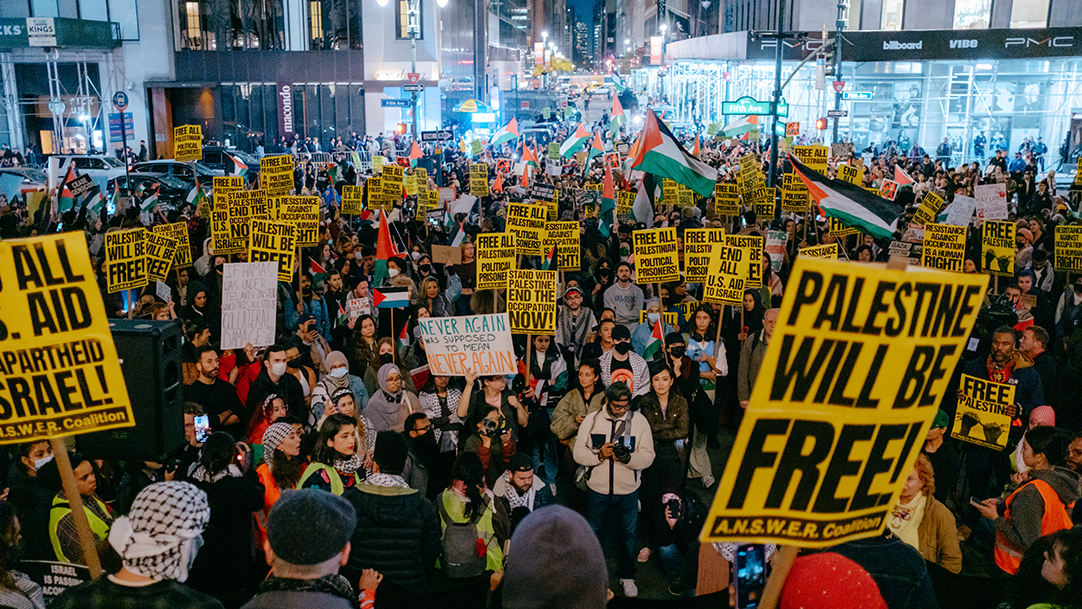
Thousands gather outside of the Pennsylvania Station in New York City on November 17 (Photo: Wyatt Souers/ANSWER Coalition)
In the early hours of November 22, Israeli and Hamas officials announced that they accepted the agreement brokered by Qatar, Egypt, and the United States for a 4-day pause in aggression in the Gaza Strip, which includes the exchange of 150 Palestinian political prisoners for 50 non-military Israeli hostages, as well as the entry of 300 trucks of humanitarian aid into the besieged Gaza Strip.
This temporary pause comes after Israel has slaughtered over 14,500 Palestinians in Gaza, with 7,000 still trapped under the rubble and over 35,000 wounded. Israel’s airstrikes on hospitals and civilian infrastructure as well as the complete blockade on the enclave means that the thousands of injured have limited access to care and the population overall has restricted access to medicine, water, food, fuel, and electricity. The Government Media Office in Gaza reports that 1.5 million Palestinians have been displaced, with 233,000 homes partially damaged and 45,000 completely damaged. 266 schools have been damaged, and 67 are now out of service. Israel has completely destroyed 85 mosques, and significantly damaged three churches.
“The steadfast resilience and resistance of the Palestinian people has delivered a 4-day pause in the ongoing genocide while securing the imminent release of 150 Palestinian political prisoners,” read a statement signed by the Palestinian Youth Movement, National Students for Justice in Palestine, The People’s Forum, ANSWER Coalition, and the International Peoples’ Assembly.
The groups have called on people to remain in the streets around the world, to ensure that a permanent ceasefire is reached: “We must intensify our commitment and efforts until every single one of our demands is fulfilled: a permanent ceasefire, an end to the siege on Gaza, and an end to all US, Canadian, and European aid to Israel.”
“We call on people of conscience everywhere to Shut it Down on November 24th and to continue protesting, planning and implementing direct actions, and drive campaigns focused on our primary demands,” the statement read, referring to the 3rd announced day of “shut downs” for strategic actions for Palestine.
International NGOs are also pushing for a more permanent ceasefire. In a press briefing on “Ceasefire, Pauses and Safe Corridors” held on November 22, hours after the deal was reached, Joel Weiler, executive director of Médecins du Monde, said “for a medical organization, four days of pause is….band aid, not health care,” arguing it would be insufficient time for treatment of serious injuries. Danila Zizi, Handicap International director for Palestine, said “it’s a kind of drop in the ocean if we don’t have fuel and we don’t have access,” complaining about the lack of clarity around the agreement.
“The only way to meet all these needs,” or respect for human rights and access to healthcare, “is a permanent, sustained cessation of humanitarian law violations and a cease fire long enough to restore human rights to millions of people,” said Paul O’Brien, Executive Director of Amnesty International USA. “That’s why we’re joining this call for an immediate and sustained ceasefire.”
Regarding the announcement of the agreement, Hamas stated, “The terms of this agreement were formulated according to the vision of the resistance and its determinants, which aim to serve our people and enhance their steadfastness in the face of aggression, constantly mindful of their sacrifices, suffering, concerns, and managing these negotiations from a position of steadfastness and strength in the field, despite the occupation’s attempts to prolong and procrastinate the negotiations.”
Israeli newspaper Haaretz reported that this exact same deal was put forward to Prime Minister Benjamin Netanyahu previously, but was rejected. According to an analysis piece in the Israeli paper of record, Netanyahu caved under pressure from the families of Israelis held hostage in Gaza as well as the IDF, Shin Bet, and the Mossad. Multiplereports indicate that Israeli airstrikes in Gaza have killed many of their own hostages.
On Wednesday, Lieutenant Colonel Richard Hecht, the IDF’s international spokesperson, said in a press briefing that, “our terminology is not ceasefire, our terminology is an operational pause,” implying that Israel could resume violence once the hostage exchange is complete. Hecht also suggests that the pause might not begin in over 24 hours.
Wounded and hospitalized Gazans continue to be targeted by the IOF, with convoys evacuating the wounded obstructed by Israeli forces at checkpoints or Israelis launching further airstrikes near hospitals, such as the Al-Aqsa Martyrs Hospital and the Al-Yemen Al-Saeed Hospital.
“As medical humanitarians, we reassert that hospitals should never, under any circumstances be a target,” asserted Avril Benoît, Executive Director of Doctors Without Borders/Médecins Sans Frontières in the United States, in Wednesday’s press briefing. She added, “It’s dangerous and terrifying to think what is happening to the norms, to the laws of war. It’s like this dystopian reality now where all the normal scaffolding of what is the conduct of responsible parties in a conflict are being completely perverted.”