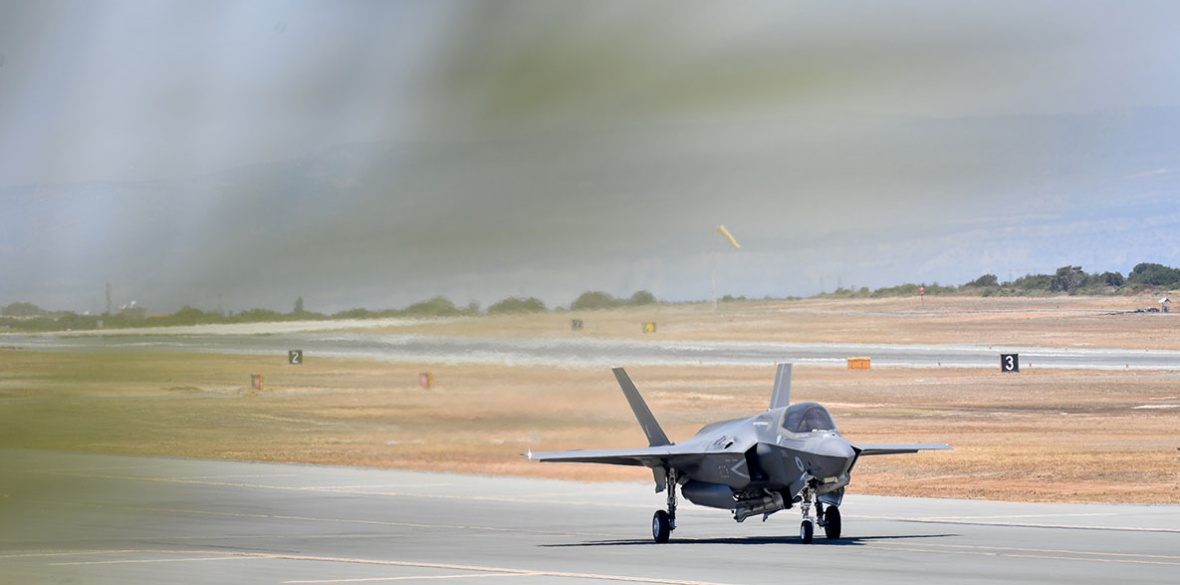
An F-35 arriving back at RAF Akrotiri in Cyprus, June 24, 2019
LABOUR remains complicit in Israel’s war crimes despite imposing a partial arms suspension, a briefing from the Campaign Against Arms Trade (CAAT) has revealed.
The government suspended 30 export licences to Israel out of about 350 last month.
But the briefing by CAAT highlights that crucial elements have been excluded, including components for F-35 combat aircraft.
F-35 components are exempt if not sent directly to Israel, despite evidence that they have been used in violations of International Humanitarian Law (IHL).
On the same day the suspension was announced, Danish NGO Danwatch revealed that an F-35 was used to drop bombs in an attack on a “safe zone” on Al-Mawasi in Khan Younis, killing 90 people.
CAAT warns this attack likely violated IHL.
Britain makes 15 per cent of all F-35s, with CAAT estimating the value of British components in the 39 planes delivered to Israel since 2016 at about £360 million — almost three times the value of other aircraft-related licences to Israel in the same period.
The F-35 is the largest and most important part of Britain’s arms trade with Israel and exports are made through an open licence, often excluded from media reporting as its financial value isn’t attached.
Freedom of information requests by CAAT revealed that the use of the Open General Export Licence for F-35 spare parts to Israel nearly tripled in 2023.
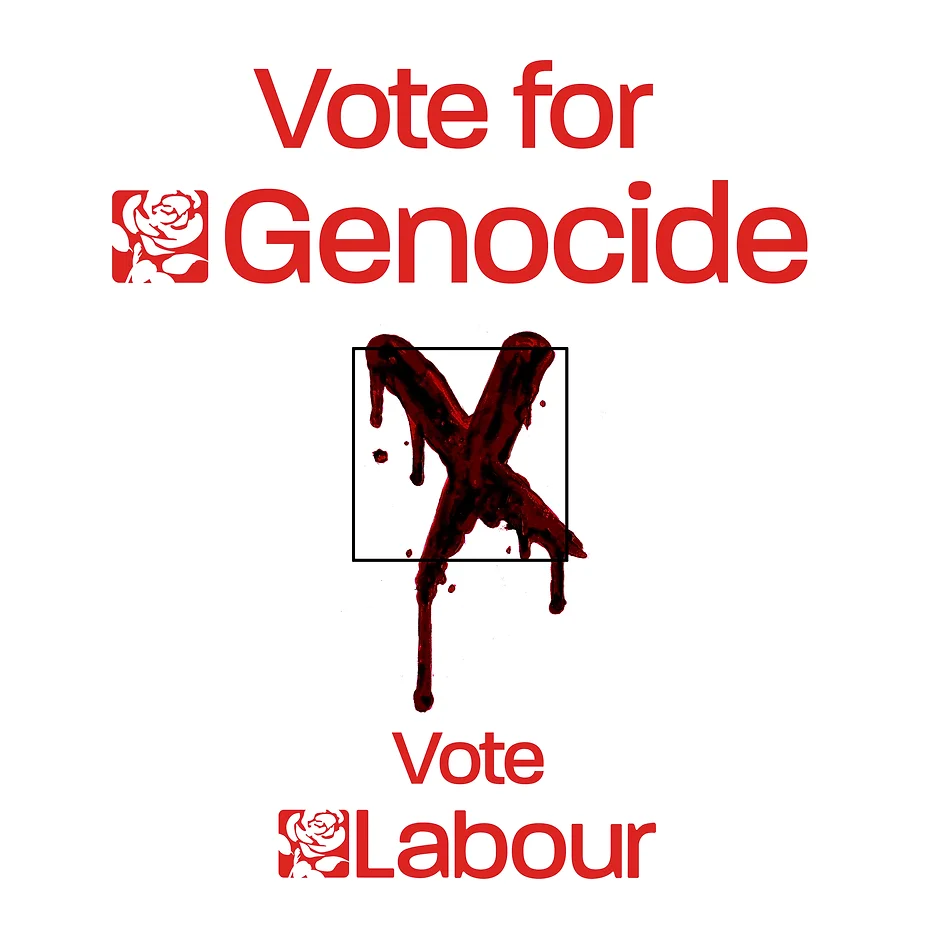
Zionist Keir Starmer is quoted “I support Zionism without qualification.” He’s asked whether that means that he supports Zionism under all circumstances, whatever Zionists do.UK Foreign Secretary David Lammy says that UK is suspeding 30 of 350 arms licences to Israel. He also confirms the UK government’s support for Israel’s Gaza genocide.Vote For Genocide Vote Labour.
… [C]ounterterrorism forces raided Winstanley’s home in London, seizing electronic devices used in his work. Although Winstanley was not arrested, the equipment was confiscated by the police. …
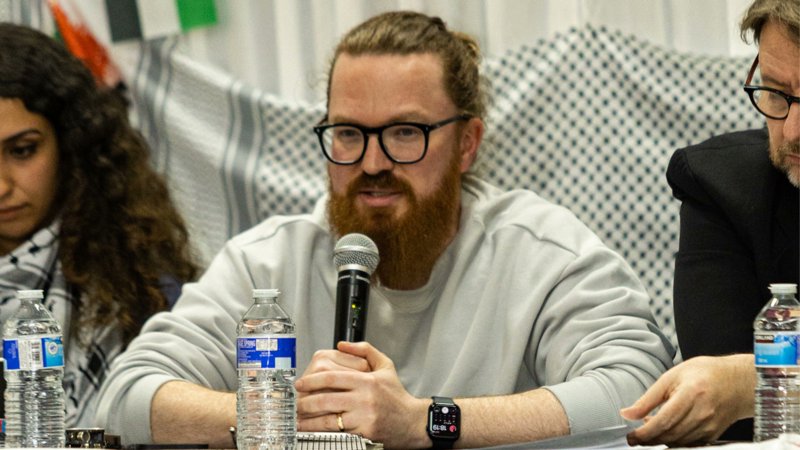
Asa Winstanley. Photo: R Witts Photography: Electronic Intifada
British authorities targeted journalist Asa Winstanley in a counterterrorism raid, marking the latest crackdown on journalists opposing Israel’s occupation of Palestine and its ongoing genocide in Gaza
Journalist with the Electronic Intifada Asa Winstanley is one of the latest targets of British authorities cracking down on activists and journalists opposing Israel’s genocide in Gaza. On Thursday, October 17, counterterrorism forces raided Winstanley’s home in London, seizing electronic devices used in his work. Although Winstanley was not arrested, the equipment was confiscated by the police.
The operation was based on the heavily criticized 2006 Terrorism Act, whose broad provisions can be easily misused to stifle discussion on controversial topics, the editors of The Electronic Intifada said in a statement. Media workers’ trade unions have already warned that applying the law to journalists will have a chilling effect on press freedom and free speech.
Winstanley was told he was being investigated for “encouragement of terrorism,” a charge human rights associations have previously criticized for being too vague and opening the door to the suppression of free speech. The police informed Winstanley that the raid was triggered by material he shared on social media.
Editors of the renowned pro-Palestine outlet described the action against Winstanley as the “latest use by British authorities of repressive ‘counterterrorism’ legislation to crack down on journalists and activists involved in reporting on or protesting Israel’s crimes.” Previously, journalists like Richard Medhurst and Palestine solidarity activists Mick Napier, Tony Greenstein, and Sarah Wilkinson, among others, were targeted by the authorities over speeches made at rallies and opinions expressed on social media.
Several activists from Palestine Action involved in direct action against companies complicit in Israel’s crimes, including Elbit Systems, have also been detained by British police on alleged terrorism charges over recent months. Like in Winstanley’s case, “counterterrorism powers are being used to raid, arrest, and imprison pro-Palestine activists and journalists,” according to Palestine Action.
Winstanley has been a vocal critic of Britain’s complicity in the occupation of Palestine, with his investigations covering the Labour Party’s links with the Israel lobby. As a result, he has faced legal threats from the party, which is currently in power in the UK and has promoted the criminalization of solidarity with Palestine since winning the election.
“The raid on Winstanley’s home is clearly intended to intimidate and silence him, as well as other journalists and activists,” concluded The Electronic Intifada.
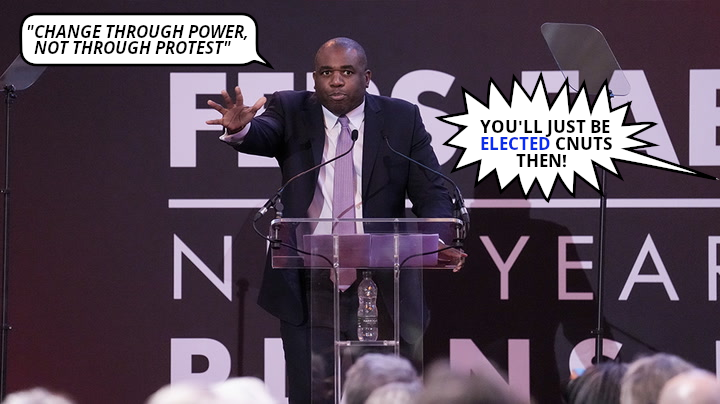
UK Foreign Secretary David Lammy says that UK is suspeding 30 of 350 arms licences to Israel. He also confirms the UK government’s support for Israel’s Gaza genocide.Vote For Genocide Vote Labour.Zionist Keir Starmer is quoted “I support Zionism without qualification.” He’s asked whether that means that he supports Zionism under all circumstances, whatever Zionists do.UK Labour Party Shadow Foreign Secretary repeatedly heckled at a speech to the Fabian Society over his and the Labour Party’s support for and complicity in Israel’s genocide of Gaza.
U.S. Rep. Alexandria Ocasio Cortez (D-N.Y.) speaks during a press conference to call for a cease-fire between Israel and Hamas in front of the U.S. Capitol in Washington, D.C. on November 13, 2023. (Photo: Mandel Ngan/AFP via Getty Images)
“I care about human rights,” said the New York congresswoman in response to her Democratic colleague in the Senate. “I care that billions of U.S. tax dollars’ worth of weapons are carrying out unspeakable atrocities.”
New York Rep. Alexandria Ocasio-Cortez criticized fellow Democrat and Pennsylvania Sen. John Fetterman on Wednesday for failing to hold the U.S.-armed Israeli military accountable for killing and harming civilians in the Gaza Strip.
Ocasio-Cortez’s remarks came in response to Fetterman’s dismissal of her earlier call for an arms embargo on Israel, which has received billions of dollars worth of weapons and other military aid since the Hamas-led October 7 attack.
“The tragedy in Gaza is 100% on Hamas,” Fetterman wrote on social media with a screengrab of a Hill headline outlining Ocasio-Cortez’s remarks. “Stop using civilians and hospitals as shields, surrender, and release all remaining hostages—and this ends.”
Ocasio-Cortez then retweeted Fetterman’s words with her own rebuttal.
“I dunno man. I care about little kids dying,” the New York lawmaker replied. “I care about human rights. I care that billions of U.S. tax dollars’ worth of weapons are carrying out unspeakable atrocities. I care enough for us to do better.”
“Hope this bleak dunk attempt gets you whatever it is you’re going for,” she concluded.
I dunno man. I care about little kids dying. I care about human rights. I care that billions of US tax dollars’ worth of weapons are carrying out unspeakable atrocities.
I care enough for us to do better.
Hope this bleak dunk attempt gets you whatever it is you’re going for. https://t.co/aGSDfSdrUI
The exchange comes as Israel has intensified its assault on northern Gaza in recent days, bombing homes and schools-turned-shelters in the Jabalia refugee camp and issuing new evacuation orders for the beleaguered region yet placing snipers on roofs and shooting people who try to flee. On Saturday, the Palestinian Deputy Observer to the United Nations Majed Bamya called Israel’s escalation in the north a “genocide within the genocide” and the World Food Program said that no food had been able to reach the area since October 1, warning that the ramped up attacks were having “a disastrous impact on food security for thousands of Palestinian families.” However, 50 trucks carrying aid including food were allowed to enter the north on Wednesday.
Ocasio-Cortez’s remarks that prompted Fetterman’s rejoinder came in response to the weekend’s atrocities.
“The horrors unfolding in northern Gaza are the result of a completely unrestrained Netanyahu gov, fully armed by the Biden admin while food aid is blocked and patients are bombed in hospitals,” she wrote on social media on Monday. “This is a genocide of Palestinians. The U.S. must stop enabling it. Arms embargo now.”
Ocasio-Cortez has been an outspoken critic of Israel’s assault on Gaza and the U.S. response. She backed a House resolution calling for a cease-fire weeks into the war, and demanded an end to the flow of weapons from the House floor in March, when she described Israel’s actions in Gaza as an “unfolding genocide.”
Fetterman, meanwhile, has faced protests from some of his more progressive constituents over his hardline pro-Israel stance.
On Tuesday, news broke that the Biden administration had reportedly written a letter to the Israeli government threatening to cut off the flow of weapons to the country unless it took “urgent and sustained actions” to improve the humanitarian situation in Gaza within 30 days.
A Palestinian man mourns after an Israeli attack killed members of this family on October 12, 2024. (Photo: Omar al-Qattaa/AFP via Getty Images)
Israeli Prime Minister Benjamin Netanyahu is reportedly “examining a plan to seal off humanitarian aid to northern Gaza,” which could starve hundreds of thousands of Palestinians.
Palestine’s deputy permanent observer to the United Nations said Saturday that “what is happening in northern Gaza now is a genocide within the genocide” as Israeli forces continued to bombard the region and terrorize the hundreds of thousands of people who remain trapped there, in increasingly desperate need of food and other necessities.
Palestinian Ambassador Majed Bamya’s message came after the World Food Program (WFP) warned that Israel’s latest offensive in northern Gaza “is having a disastrous impact on food security for thousands of Palestinian families.”
“Food distribution points, as well as kitchens and bakeries in North Gaza, have been forced to shut down due to airstrikes, military ground operations, and evacuation orders,” the U.N. body said in a statement. “The only functioning bakery in North Gaza, supported by WFP, caught fire after being hit by an explosive munition.”
Antoine Renard, WFP’s country director for Palestine, said that the northern part of the enclave “is basically cut off and we’re not able to operate there.”
“WFP has been on the ground since the onset of the crisis,” said Renard. “We are committed to delivering lifesaving food every day despite the mounting challenges, but without safe and sustained access, it is virtually impossible to reach the people in need.”
What is happening in northern Gaza now is a genocide within the genocide
No shipments of food, water, or medicine have been able to enter northern Gaza in at least two weeks due to Israel’s assault, which has trapped around 400,000 people and killed dozens. Residents have reported witnessing Israeli drones and quadcopters fire on people attempting to flee the famine-stricken area.
Israel’s military said Saturday that even shelters for displaced people in northern Gaza are considered part of a “dangerous combat zone,” further underscoring that there is no safe place in the besieged enclave.
” Israel is exterminating northern Gaza right now,” said Middle East historian and analyst Assal Rad. “There are 400,000 Palestinians there being deliberately starved, with nowhere to go, trapped inside a killing field. There’s no outrage or wall-to-wall media coverage because Israel is the one doing it and the victims are Arab.”
On Sunday, The Associated Press reported that Israeli Prime Minister Benjamin Netanyahu is “examining a plan to seal off humanitarian aid to northern Gaza in an attempt to starve out Hamas militants, a plan that, if implemented, could trap without food or water hundreds of thousands of Palestinians unwilling or unable to leave their homes.”
According to AP, the plan was proposed to Netanyahu and the Israeli parliament by “a group of retired generals.” It would give the hundreds of thousands of Palestinians who remain in the northern third of Gaza a week to leave before the area is declared a “closed military zone.”
“Those who remain would be considered combatants—meaning military regulations would allow troops to kill them—and denied food, water, medicine, and fuel,” AP added. “The plan calls for Israel to maintain control over the north for an indefinite period to attempt to create a new administration without Hamas, splitting the Gaza Strip in two.”
While the Netanyahu government has not yet decided whether to “fully carry out” the plan, the outlet observed, “one official with knowledge of the matter said parts of the plan are already being implemented, without specifying which parts.”
Citing senior defense officials, the Israeli newspaper Haaretz reported Sunday that the Netanyahu government “is not seeking to revive hostage talks and the political leadership is pushing for the gradual annexation of large parts of the Gaza Strip.”
“Army commanders in the field who spoke with Haaretz say the recent decision to launch operations in northern Gaza was taken without any in-depth discussion. They said it appeared that the operations were aimed principally at pressuring local residents, who were again told to evacuate the area for the coast as winter is approaching,” the newspaper continued. “It is possible that the operation is laying the groundwork for a decision by the government to put into effect the so-called surrender or starve plan of Maj. Gen. (ret.) Giora Eiland.”
Much recent media focus has rightly been on the anniversary of the October 7 attacks, where Hamas assailants murdered nearly 1,200 Israelis and foreign nationals and abducted a further 251.
Coverage has also centred on Israel’s expanding ground operation in Lebanon, which follows an intensive bombing campaign of the country’s south, east and capital, Beirut.
But meanwhile, the Israeli military has been continuing its operations in Gaza, where the death toll has risen to 42,000, according to the Hamas-run health ministry. Yet another instance of renewed Hamas paramilitary activity has emerged in Jabalia near Gaza City, an area that had reportedly been brought under the firm control of the Israel Defense Forces (IDF).
The Palestinian suffering has been massive and sustained, and Hamas has been severely damaged. But, in reality, the war in Gaza has become a violent stalemate with neither party able to win, yet neither likely to lose.
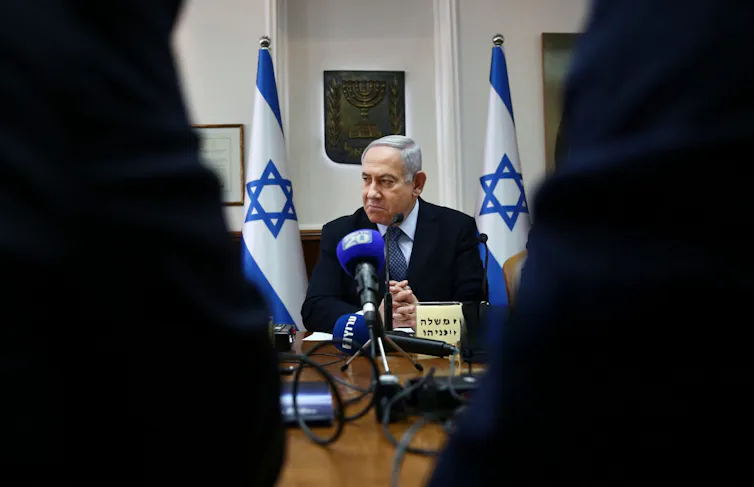
Israeli prime minister Benjamin Netanyahu, though, is determined to press on in Gaza while extending the war to Lebanon.
Netanyahu’s main problem has been the depth of opposition facing him in Israel over the fate of the hostages. This was exemplified by a general strike in support of a hostage deal in early September and the sheer size of some of the demonstrations against his government in recent months.
However, that has changed with the start of Israel’s military actions in Lebanon, and has given Netanyahu breathing space. At the end of September, polling indicated that Netanyahu’s rightwing Likud party would now win more seats than any other if a general election was held.
That popularity may persist for now, depending partly on what the IDF does next. But the longer-term course of the war is probably contingent on the far-right components of Netanyahu’s governing coalition, and especially the rise of messianic Judaism.
Messianic Judaism is best seen as an amalgam of ultra-orthodox Judaism and religious nationalism. The movement, which has grown in Israel in recent years, seeks a pure Jewish state. This includes the rebuilding of the Temple of Solomon on the site of Islam’s third-most holy site, the Al-Aqsa Mosque, in the Old City of Jerusalem.
It has also become increasingly significant in the military. This is partly because many soldiers have been educated in religious military schools, and a high proportion of young army recruits come from religious families.
Indeed, some of the most active Israeli military units in the Gaza war are drawn specifically from such cohorts, an example being the Netzah Yehuda (Judah Forever) battalion.
Messianic Judaism is an element in Israeli politics that is underestimated in political analysis. This is despite the especially hard line it takes in terms of what is acceptable in ending the war, offering support to Netanyahu’s government on its own terms.
A state built out of conflict
In three distinct periods, the Israeli state has moved markedly to the right. The first followed the Yom Kippur war in 1973. The second occurred after the influx of hundreds of thousands of immigrants from the old Soviet bloc in the 1990s. And the third was a reaction to the second intifada (or uprising) in the early 2000s.
The latest move to the right was reflected by a growth in support for the Likud party, as well as smaller parties that were strongly Zionist and deeply opposed to any Palestinian influence on Israeli politics.
From 2010 onwards, there appeared to be a more stable period. The IDF maintained rigorous control over Gaza and the occupied West Bank, and there was a stalemate in Lebanon. Hezbollah’s rocket attacks into northern Israel were rare and Israeli troops stayed mainly south of the border.
However, the loss of life and the capture of hostages on October 7 was a massive and visceral shock. It was clear from the start that the government’s response would be overwhelming and focused on the destruction of Hamas.
A year later and that possibility seems diminished. But if there is ever to be a more peaceful coexistence between Israel and Palestine then the position of hardline Israelis has to be recognised, especially given their strong role in the current Netanyahu government.
To put it bluntly, in their view something has to be done about the Palestinians. As the Economist newspaper put it on August 29, the hardliners “want to annex the West Bank, topple the Palestinian Authority, permanently reoccupy and resettle Gaza, and push Palestinians abroad”.
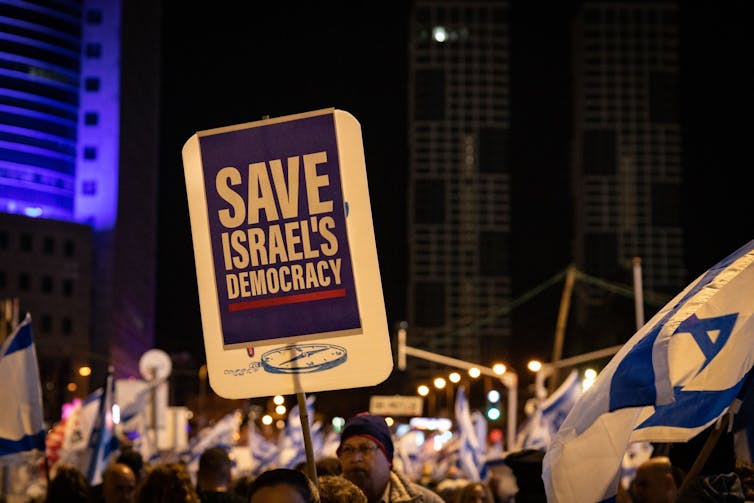
They also want Israel to move away from secularism. According to the same article, Netanyahu’s aborted plan to curb judicial power in the early months of this government was only the first step to achieving this.
The government’s push for a wide-ranging judicial reform in 2023 sparked massive protests. Noa Ratinsky / Shutterstock
His government’s aim, the article argues, is to eradicate the secular “deep state” and seize control of the army, security agencies and courts. Their problem is that such an aim, if ever a possibility, is hugely constrained by the near-global perception of Israel as close to a rogue state.
What is already clear, though, is that Israeli society is becoming more hawkish. This is probably aided by substantial recent emigration, including a “brain drain” from the secular elite.
For now, the Netanyahu government may seem secure. But political stability is hard won and all too easily lost, especially at a time of accelerated war-making.