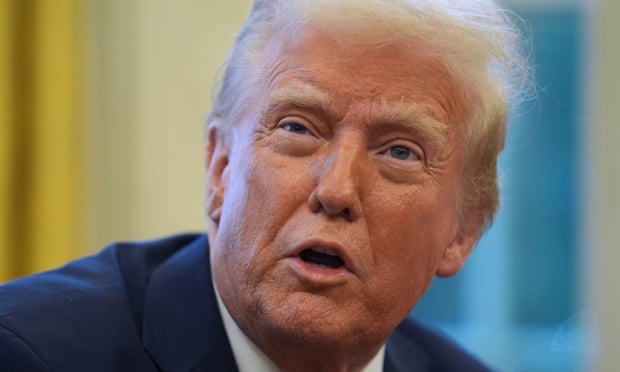
Donald Trump signs executive orders at the White House on Thursday. Photograph: Evan Vucci/AP
Justin Trudeau, Canada’s prime minister, announces tit-for-tat 25% tariffs and warns of impeded access to ‘vital goods critical to US security’
The leaders of Canada and Mexico have hit back after Donald Trump signed an order authorizing drastic tariffs of up to 25% on their exports to the US, while China said it would complain to the World Trade Organization after it was also targeted by the president.
Canada’s prime minister, Justin Trudeau, on Saturday night made a televised address announcing concrete measures including a tit-for-tat 25% tariff phased in across C$155bn ($107bn) worth of American products. Trudeau said Trump had put at risk US consumers’ and industries’ access to much-needed Canadian critical minerals and resources including oil, energy and timber. The prime minister promised to work with Canada’s provinces to review dealings with the United States.
Addressing Americans, Trudeau said: “Tariffs against Canada will put your jobs at risk, potentially shutting down American auto assembly plants and other manufacturing facilities. They will raise costs for you including food at the grocery store and gas at the pump. They will impede your access to an affordable supply of vital goods crucial for US security such as nickel, potash, uranium, steel and aluminum.”
Trudeau added: “They will violate the free trade agreement that the president and I along with our Mexican partner negotiated and signed a few years ago” – referring to the United States Mexico Canada agreement (USMCA) that was drawn up largely at Trump’s behest after he tore up the previous North America free trade agreement (Nafta) during his first term as US president.
…
Elon Musk urges you to be a Fascist like him, says that you can ignore facts and reality then.Climate Science Denier Donald Trump says Burn, Baby, Burn.
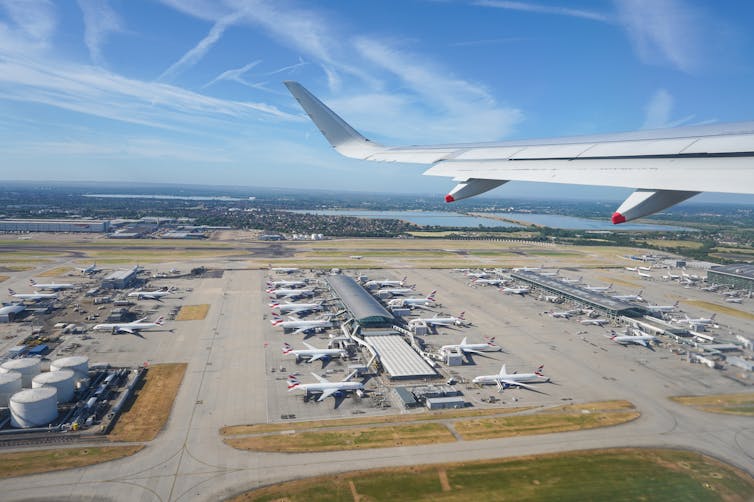
Environmentalists and locals have resisted a third runway at London’s Heathrow, Europe’s busiest airport, for more than two decades. Today, their efforts took a major setback.
The UK government has announced it will give the green light to airport expansion. This is not guaranteed to increase growth in the national economy as Chancellor Rachel Reeves hopes. More flights and more emissions are certain, however, at a time when experts are practically screaming at governments to rein them in.
“No airport expansions should proceed” without a UK-wide plan to annually assess and control the sector’s climate impact said the government’s watchdog, the Climate Change Committee, in 2023. Aeroplanes are 8% of UK emissions and 2% of the world’s, but they also release gases that seed heat-trapping clouds in the upper atmosphere, which triples air travel’s greenhouse effect.
While the government’s own advisers have effectively ruled out new runways for the sake of net zero, airport and airline bosses play a different tune. So what does the sector propose to manage its own pollution?
Not enough cooking oil to save us
Aviation is a notoriously difficult sector to decarbonise says Richard Sulley, a senior research fellow in sustainability policy at the University of Sheffield: “If electric or hydrogen-powered planes are possible, it won’t be for many years yet.”
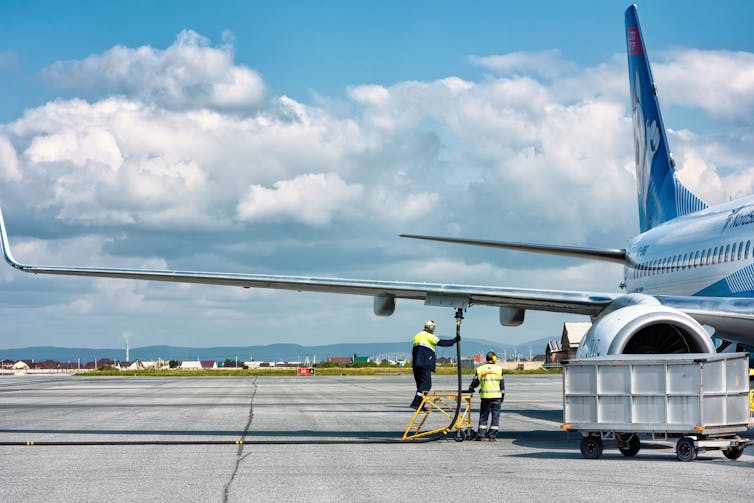
To justify air travel emissions ballooning in the meantime, the aviation sector has promised a mix of “supply-side” measures, like replacing kerosene with so-called “sustainable aviation fuel” (SAF), which Reeves described as “a game changer”, and making planes lighter and more fuel-efficient.
Efficiency, in this context, is a slippery path to decarbonisation. When a high-emitting activity is reformed so that it consumes less energy, the efficiency savings are generally eclipsed by the increasing demand it drives.
“Indeed, the sector’s own plans for growth will outstrip efforts to decarbonise through synthetic fuel, delivering a neutral effect at best,” Sulley says.
“Demand-side” measures like fewer flights, taxes on frequent flying and domestic flight bans (see France) could cut emissions, he notes, but are seldom mentioned.
The UK has set a target for airline fuel to be 10% SAF by 2030. So far we’re at 1.2% – and Sulley reports that the industry has not said how it will scale up in time.
Even if airlines start taking their commitment to SAF seriously very soon, it’s a dubious solution to aviation’s climate impact according to political economists Gareth Dale (Brunel University) and Josh Moos (Leeds Beckett University).
Earlier SAF test flights burned coconut oil – 3 million coconuts to power a journey from London to Amsterdam, as Dale and Moos calculate it. At that rate, they argue Heathrow would exhaust the world’s entire crop in a few weeks (there are 18,000 commercial airports worldwide).
Modern SAF is blended with waste products from farms and kitchens. But the pair argue that the market for used cooking oil is “notoriously unregulated”. SAF may in fact be relabelled palm oil from plantations that are erasing orangutan habitat in the tropics. Again, Dale and Moos argue there is not enough used cooking oil to meet existing, let alone future, demand.
Transport for the rich, by the rich
At least the hype around SAF addresses the main problem, albeit misleadingly. Policy experts David Howarth (University of Essex) and Steven Griggs (De Montfort University) marvel at how often “carbon-neutral airports” in aviation sustainability strategies simply mean terminals powered by renewable energy.
“A terminal’s heating or lighting is, of course, largely irrelevant when its core business is as emissions-intensive as flying,” says Sulley.
Unfortunately for Rachel Reeves, a 2023 report by the New Economics Foundation found that any economic benefits of airport expansion will be largely confined to the airports themselves. Meanwhile, a wealthy subset of UK society can be expected to capture the biggest share of any new flight capacity. Each year, around half of British residents do not fly at all, Sulley points out.
At the stratospheric heights of that subset are the private jet passengers who are served by “more or less dedicated airports” that are more obscure to the general public, says Raymond Woessner, a geographer at Sorbonne Université. A study published in November found that emissions from these flights rose by 46% between 2019 and 2023. The lead author described wealthy passengers using jets “like taxis”.
“Discretion and anonymity” is what one airport nestled in the Oxfordshire countryside promises for “routine celebrity, head of state and royal visits”. Without state direction or regulation, it is these people who are setting the agenda for air travel.
Woessner notes that the world’s richest man, Elon Musk, successfully lobbied to derail a high-speed rail project in California in 2013. Instead of an option that has shown its ability to cut flight demand, the US will be offered intercontinental rocket travel.
Musk’s company SpaceX says that rockets could ferry passengers between New York and Shanghai in under an hour. Rockets would burn “vastly more fuel per trip than conventional aircraft”, says aerospace engineer Angadh Nanjangud of Queen Mary University of London, but this might “drive critical research into carbon-neutral” methane-based rocket fuel.
It would not be the first time an industry seeking to grow has used an as yet fantastical fuel to justify more carbon in Earth’s atmosphere.
“There is the potential to create a good life for all within planetary boundaries,” say Dale and Moos.
“But getting there requires clipping the wings of the aviation industry.”
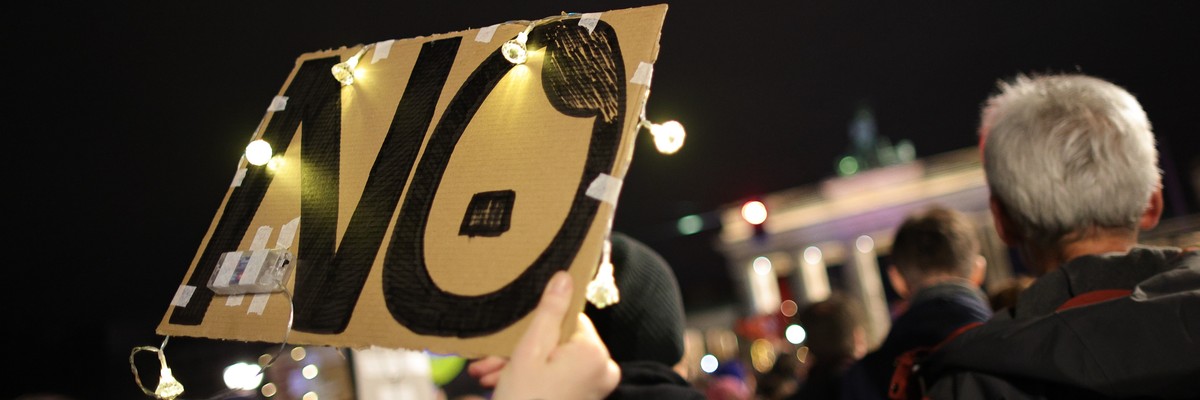
Protesters hold up a banner reading “NO” with the O shaped like an Adolf Hitler caricature during a demonstration against right-wing extremism, U.S. President Donald Trump, and right-wing billionaire Elon Musk on January 25, 2025 in Berlin, Germany. (Photo: Omer Messinger/Getty Images)
“We must not forget the tragic lesson of our past,” said Polish Prime Minister Donald Tusk. “Evil, violence and contempt cannot triumph anew.”
Billionaire enterpreneur Elon Muskinsisted at a far-right rally in Germany over the weekend that the European country must move “beyond the past” and leave behind the memory of one of the deadliest genocides in history—but as leaders on the continent marked the 80th anniversary of the Auschwitz concentration camp liberation on Monday, several made clear that Musk’s advice was not welcome.
Musk’s comments on “‘the need to forget German guilt for Nazi crimes’ sounded all too familiar and ominous,” said Polish Prime Minister Donald Tusk on Sunday. “Especially only hours before the anniversary of the liberation of Auschwitz.”
German Chancellor Olaf Scholz said on the social media platform X, “I couldn’t agree more.”
The country’s ambassador to Israel said that while Musk claimed German children are treated as “guilty of the sins” of the Nazis during World War II, the government simply wants “them to grow up informed and responsible and to apply the lessons of Germany’s past.”
As Common Dreams reported, the Tesla CEO and key adviser to U.S. President Donald Trump made the remarks at a rally for Alternative for Germany (AfD) on Saturday, five weeks before Germans are set to vote in federal elections.
AfD is currently polling at 19%, trailing the center-right Christian Democratic Union (CDU), which is in first place at 28%. But leaders across Europe, including Spanish Prime Minister Pedro Sánchez, French President Emmanuel Macron, and Scholz have warned that Musk appears to be angling for the spread of far-right ideologies—including neo-Nazism—in European countries.
The AfD has been designated a “suspected extremist” group by Germany’s domestic intelligence agency, and one of its candidates for public office last year said that “not all” Nazis who worked for Adolf Hitler’s government were criminals.
The party has been ostracized in Germany, with other political groups including the CDU ruling out the formation of a coalition government with the AfD, but last week CDU leader Friedrich Merz said he would push for tougher anti-immigration proposals even if they were submitted by the AfD.
Scholz, who represents the Social Democrats, toldStuttgarter Zeitung in response to Merz’s comments that “the firewall to the AfD must not crumble.”
As Tusk oversaw the liberation of Auschwitz anniversary on Monday, International Holocaust Remembrance Day, he alluded to Musk’s comments at the AfD rally.
“We must not forget the tragic lesson of our past,” he said on X, which is owned by Musk. “Evil, violence, and contempt cannot triumph anew.”
Musk’s comments came days after he appeared to flash a Nazi salute twice at an event for Trump’s inauguration.
In the U.S. on Sunday, Illinois Gov. JB Pritzker addressed Musk’s remarks at the AfD rally on CNN, asking why Trump hadn’t spoken out against them.
“President Trump ought to be calling that out,” said the Democratic governor. “If he doesn’t agree with Elon Musk, if he doesn’t agree with two Sieg Heils at his own rally, and backing a party that backs Nazis, then he ought to say so. Why isn’t Donald Trump speaking out?”
Tech billionaire Elon Musk speaks live via a video transmission during the election campaign launch rally of the far-right Alternative for Germany (AfD) political party as AfD supporters wave German flags on January 25, 2025 in Halle, Germany. (Photo by Sean Gallup/Getty Images)
“All the people who were shrugging and equivocating over Elon and whether he was aligning with Nazi, far-right forces should be launched into the sun,” wrote one observer.
Billionaire Elon Musk made virtual appearance at a Saturday campaign event for the far-right Alternative for Germany party—known by the initials AfD—ahead of a snap federal election in Germany next month. The campaign appearance comes less than a week after Musk was accused of performing a Nazi salute twice on stage at a post-inauguration celebration for U.S. President Donal Trump.
“A nazi speaking at a nazi rally. It’s really not deeper than that,” wrote the independent journalist Marisa Kabas on Saturday.
Musk has endorsed the AfD, known for it’s strong anti-immigrant stance, and earlier this month hosted AfD co-leader Alice Weidel—who was also at Saturday’s campaign event—for an interview on his platform X. Members of the AfD have been accused of downplaying the crimes of Nazi Germany and using Nazi slogans.
Musk told onlookers at the event, which took place in Halle, that he thinks AfD is the best hope for Germany and said that it’s good to be proud of German culture, according to Reuters andThe Guardian.
“It’s good to be proud of German culture, German values, and not to lose that in some sort of multiculturalism that dilutes everything,” Musk said, according to Reuters, addressing the crowd via a live video.
“Children should not be guilty of the sins of their parents, let alone their great grandparents,” Musk also said, which, per Reuters, apparently referred to Germany’s Nazi past.
Musk’s “Nazi-like salutes” earlier this week drew sharp rebuke from some, but not all. The Anti-Defamation League, an organization whose mission is to combat antisemitism, called the move “an awkward gesture” and “not a Nazi salute.”
For his part, Musk wrote on X that the reaction was an example of Democratic “dirty tricks.” He also said that “the ‘everyone is Hitler’ attack is sooo tired.”
Washington Post columnist Karen Attiah, reacting to the news of Musk’s appearance at the rally, wrote that “all the people who were shrugging and equivocating over Elon and whether he was aligning with Nazi, far-right forces should be launched into the sun. May they never be taken seriously again.”
Climate scientists are probably among those most aggrieved by Donald Trump’s return as US president.
Trump has scoffed at the increasingly dire warnings of these scientists and declared his enthusiasm for digging up and burning the coal, oil and gas that is overheating Earth. His empowerment of the far right dims prospects for collective solutions to collective problems, but what is he likely to change about US climate policy?
Trump has not published a climate agenda. To discern his impact on domestic and international policy, we have to sift through statements, appointments to political positions and the record of his first term.
Here, our academics glean grim portents for the years ahead – and some continuities with supposedly pro-climate presidents of the past.
1. It’s still ‘drill, baby, drill’
Trump’s three-word campaign slogan, “drill, baby, drill”, is intended to sum up his plans for the US oil and gas industry. It’s also an apt summary of existing US energy policy.
Since 2008, when Democrat Barack Obama was elected, oil production has soared from a 50-year low of 6.8 billion barrels a day to 19.4 billion in 2023.
“The United States is already producing more crude oil than any country ever,” says Gautam Jain, an energy and finance expert at Columbia University.
“Oil and gas companies are buying back stocks and paying dividends to shareholders at a record pace, which they wouldn’t do if they saw better investment opportunities.”
2. We won’t always have Paris (or even Rio)
Trump withdrew the US from the 2015 Paris agreement on the first day of his second term (it took him six months to do it last time).
Jain frets that he may go further and exit international negotiations entirely, by rescinding his country’s membership of the UN Framework Convention on Climate Change, which was adopted in Rio de Janeiro in 1992.
Rejoining would be “nearly impossible”, Jain says, as a future president would need the consent of two-thirds of the Senate.
The US risks dropping the mantle of climate leadership on China, he adds. A recent analysis by Oxford economists Matthew Carl Ives and Natalie Sum Yue Chung suggests that that ship may have sailed years ago.
“China already processes most of the clean energy supply materials and has an advanced manufacturing base that is more capable of scaling up production to meet the rising demand,” they say.
3. The bucks stop here?
A US retreat from international climate diplomacy would afflict people who are particularly vulnerable to the mounting crisis in Earth’s atmosphere. Jain highlights how Trump’s predecessor Joe Biden donated several billions of dollars more towards renewable energy and adaptation in the developing world, compared with Trump in his first term.
However, a 2023 study that estimated each country’s “fair share” of this climate finance pot according to income, population size and historical emissions, issued this withering assessment while Biden was president:
“Based on these metrics, we found that the US is overwhelmingly responsible for the climate finance shortfall,” says environmental economist Sarah Colenbrander (University of Oxford).
“The world’s largest economy should be providing US$43.5 billion of climate finance a year. In 2021, it gave just US$9.3 billion – a meagre 21% of its fair share.”
4. Biden’s green tax credits may endure…
Trump could keep some Biden-era investments in clean energy (tax breaks for investors in renewables, for example) as the benefits are accruing in Republican states, Jain says.
He may still cut tax credits for people buying electric vehicles, though. This would slow the transition from combustion-engine transport by making it harder for people to afford an EV. (Biden’s 100% tariff on Chinese-made EVs hasn’t help either).
5. … but his methane tax probably won’t
Jain predicts that the greatest damage inflicted by Trump will be to the regulation of fossil fuels and emissions. In his crosshairs is a federal charge for the release of methane from oil and gas wells and pipelines.
Biden identified cutting methane emissions as a potential brake on the accelerating pace of global heating. That’s because methane is a greenhouse gas that lingers in our atmosphere for decades instead of centuries like CO₂ and is far more potent in trapping heat during that time.
Reducing methane emissions could reduce climate change quickly – a climate action lifeline we will be sorry to see thrown away.
6. The nuclear option
Trump seems to have a soft spot for one low-carbon energy source: nuclear power. Perhaps because civil nuclear maintains the skills and supply chains needed for its military applications?
7. Up is down, left is right
Democrats may regret making “trust the science” their dividing line against Trump.
Eric Nast, an environmental governance expert at the University of Guelph, tracked how the first Trump administration altered language on US government websites.
He expects Trump to disguise his regulation bonfire as “strengthening transparency” (blocking air pollution standards that rely on private health data) and championing “citizen science” (dismissing academics from advisory boards for private citizens rich in time and money, who might benefit from scrapping rules and limiting scrutiny).
8. Fighting fire with money
Tesla’s Elon Musk, Amazon’s Jeff Bezos and Meta’s Mark Zuckerberg attended Trump’s second inauguration. Their presence – plus a pointed farewell speech by Biden – has provoked murmurs of “oligarchy”: rule by people whose immense wealth and influence has utterly captured ostensibly democratic societies.
“As public firefighters struggle to cope, affluent residents and businesses have turned to private firefighting services to protect their properties,” says Doug Specht, a University of Westminster geographer.
9. Arctic relations
What explains Trump’s sudden interest in the Arctic? Oil, gas and critical minerals newly liberated by thawing ice in a region warming four times faster than the global average says engineer Tricia Stadnyk at the University of Calgary.
“The second Trump administration is aware of both the new opportunities and risks as global temperatures shatter new records and thresholds, and an ice-free Arctic becomes a possibility,” she says.