This work by Middle East Monitor is licensed under a Creative Commons Attribution-NonCommercial-ShareAlike 4.0 International License.
President Donald Trump gives opening remarks during a press conference with Israeli Prime Minister Benjamin Netanyahu in the State Dining Room of the White House in Washington, DC on September 29, 2025. [Stringer – Anadolu Agency]
US President Donald Trump said on Sunday that he was unsure whether former British Prime Minister Tony Blair would join the new “Peace Council” planned to oversee the governance of the Gaza Strip, amid ongoing criticism of Blair’s role in the Iraq war.
“I’ve always liked Tony, but I want to find out that he’s an acceptable choice to everybody,” Trump told reporters, without naming specific leaders who might have a say in Blair’s appointment.
The Gaza peace plan, announced by the White House last month, listed Blair as a proposed member of the new council.
Trump made his remarks to journalists aboard Air Force One during his flight to Israel, where he is scheduled to deliver a speech to the Knesset on Monday.
He also plans to attend a world leaders’ summit in Egypt aimed at formally ending the war in Gaza, as the ceasefire enters its fourth day.
Orcas discuss Genocide-supporting and complicit Zionists. Donald Trump, Keith Starmer, David Lammy, Rachel Reeves, Angela Rayner and Wes Streeting are acknowledged as evil genocide-complicit and supporting cnuts.Keir Starmer objects to criticism of the IDF. He asks how could anyone object to them starving people to death, forced marches like the Nazis did, bombing Gaza’s hospitals and universities, mass-murdering journalists, healthworkers and starving people queuing for food, killing and raping prisoners and murdering children. He calls for people to stop obstructing his genocide for Israel.Genocide denier and Current UK Prime Minister Keir Starmer is quoted that he supports Zionism without qualification. He also confirms that UK air force support has been essential in Israel’s mass-murdering genocide. Includes URLs https://www.declassifieduk.org/keir-starmers-100-spy-flights-over-gaza-in-support-of-israel/ and https://youtu.be/O74hZCKKdpA
This work by Middle East Monitor is licensed under a Creative Commons Attribution-NonCommercial-ShareAlike 4.0 International License.
US President Donald Trump disembarks from Air Force One upon arrival at Ben Gurion Airport on the outskirts of Lod near Tel Aviv on October 13, 2025, as he travels to Israel and Egypt. [Jack GUEZ / AFP/ Getty Images]
In a move dense with symbolism and political calculation, President Donald Trump is in Egypt to celebrate the handover of Israeli hostages by Hamas. What is cast as a diplomatic triumph is, in reality, a performance piece designed to salvage reputations rather than achieve peace.
For two brutal years, Israel—with full US backing—pounded Gaza. Despite superior firepower, advanced surveillance, and staunch diplomatic protection, it failed to crush Hamas. The war left thousands dead and Gaza flattened. The final bargain: not conquest, but concession. Hamas is still upright and resilient.
Trump was never a neutral mediator. From weapons to intelligence-sharing to U.N. veto cover, his administration served as Israel’s war partner. His “peace rhetoric” often concealed complicity in Netanyahu’s war logic. He wasn’t brokering peace; he was underwriting Israel’s campaign.
Rebranding defeat as victory
With global attention focused on him, Trump makes his entrance to recast the story. He wants to turn an inconclusive war into a story of triumph. But battlefield assessments suggest otherwise: Hamas, while wounded, remains a wild card.
“Israel misjudged the resilience of the resistance,” recounts Israeli historian Ilan Pappé, noting how the campaign strengthened Hamas’s political identity even as it devastated Gaza. In Israel itself, Haaretz lambastes what it calls Netanyahu’s “strategic blindness,” warning that his military-first obsession has isolated Israel and left it less secure. The critique is no longer fringe; it’s becoming mainstream in Israeli discourse. Netanyahu’s boastful and unachievable goals may ultimately lead to his downfall. He never listened to Machiavelli: “The tongue has destroyed more men than the sword, for words once released can never be recalled”.
A Washington Post analysis frames Trump’s Gaza gambit as risk-laden: he may have coerced a settlement, but sustaining it demands pressure he may lack. The war may be paused, but the contradictions are unresolved.
Trump’s optics of redemption
This Egyptian excursion is more about spectacle than diplomacy. The stage is set; hostages are reunited, arms clasped, a president framed as a peacemaker. Yet touch the surface and you find the fissures.
An article by David Ignatius in The Washington Post praises Trump’s coalition-building but also notes his modus operandi: declare victory first, work out the details later. The inversion of selling the banner of peace before securing the foundation is the key to understanding this visit.
Former CIA analyst Graham E. Fuller warns: “Washington has burned moral capital defending Israel’s conduct—only to offer a ceasefire that everyone expects will collapse.” The optics may dazzle. The substance, however, is brittle.
For Netanyahu, Trump’s arrival is a lifeline. His coalition teeters, public weariness grows, and international patience wanes. With Trump’s arrival, a deadlocked war becomes a shared pageant. A faltering gambit can be reframed as a shared triumph. If loyalty turns to envy, friends can become rivals.
But elites in Israel are whispering about failure. In TheTimes of Israel, a civil commission’s scathing report laments Netanyahu’s “arrogance and inherent blindness” in failing to prepare the country for the 7 October assault. He’s accused of undermining decision-making, sidelining security organs, and overcentralizing power. If very senior officials were barred from dissent, the political house was built on fear, not strategy.
Netanyahu needs Trump to save his skin and help reignite the narrative from gridlock to breakthrough, from defeat to deliverance. However, the miracle is contingent upon the illusions remaining solid. Netanyahu kept Trump in the dark during the war. He knows knowledge is a blade, and when you hand it freely, you place the weapon in your enemy’s hand.
Trump and Netanyahu are inevitably poised to exchange barbed accusations over Gaza’s unresolved chaos. That verbal exchange of blaming each other for Hamas’s survival, strategic missteps, and ignored counsel is looming on the horizon. Beneath the rhetoric simmers a quiet charge of betrayal, as both leaders subtly imply perfidy and failed promises, their alliance fraying under the weight of unmet expectations and diverging ambitions. Throughout the war, Netanyahu underestimated Presidents Biden and Trump, believing he could manipulate them as well as the US. Now he discovers that being underestimated is far safer than being fully known.
The pivot to Iran
The Gaza theatre will soon be over, and both men will pretend it never happened the way it did. Both men share the instinct to pivot—and nothing is more convenient than Iran. With Gaza’s devastation already disputed, Netanyahu is already telegraphing a shift to Tehran as the new existential rival. The script is familiar: rally behind a new threat, reset internal consensus.
Within US defense circles, pressure is mounting for a tougher stance on Iran. Israeli officials reportedly press Trump to re-impose sanctions, reassert deterrence, and prepare renewed confrontation. “Gaza needs to be forgotten. Iran must be next,” said an anonymous defense analyst quoted in strategic coverage. This is not a war of necessity, but a war of distraction: personal survival masquerading as a national imperative. Trump, ever the opportunist, may again be lured into conflict he helped mismanage, chasing legacy on borrowed time.
Conclusion: The mirage of victory
No statue in Cairo will change Gaza’s rubble. No press conference will erase the war’s toll. History judges more slowly than headlines. It is Trump’s turn to quote the author of The Prince: “Power does not belong to the one who speaks loudly, but to the one who withholds”.
Trump may strut down a tarmac, declare peace, and bask in the global applause. However, the pieces left behind—displacement, devastation, silent tunnels, and the political phoenix of resistance—testify to a war that remains unresolved. Until genuine leadership replaces spectacle, peace will remain a prop rather than a policy.
The views expressed in this article belong to the author and do not necessarily reflect the editorial policy of Middle East Monitor.
This work by Middle East Monitor is licensed under a Creative Commons Attribution-NonCommercial-ShareAlike 4.0 International License.
Orcas discuss Genocide-supporting and complicit Zionists. Donald Trump, Keith Starmer, David Lammy, Rachel Reeves, Angela Rayner and Wes Streeting are acknowledged as evil genocide-complicit and supporting cnuts.Keir Starmer objects to criticism of the IDF. He asks how could anyone object to them starving people to death, forced marches like the Nazis did, bombing Gaza’s hospitals and universities, mass-murdering journalists, healthworkers and starving people queuing for food, killing and raping prisoners and murdering children. He calls for people to stop obstructing his genocide for Israel.Genocide denier and Current UK Prime Minister Keir Starmer is quoted that he supports Zionism without qualification. He also confirms that UK air force support has been essential in Israel’s mass-murdering genocide. Includes URLs https://www.declassifieduk.org/keir-starmers-100-spy-flights-over-gaza-in-support-of-israel/ and https://youtu.be/O74hZCKKdpA
Palestinians follow the news about the ceasefire agreement in Khan Yunis, Gaza, on 9 October 2025 | Abdallah F.s. Alattar/Anadolu via Getty Images)
For two years, our lives have been on hold amid constant air strikes and fighting. Now, we finally have reason to hope
Growing up in Gaza, my friends and I often heard older relatives’ stories of the Nakba; learning about the homes that Israeli troops forced them out of in 1948, and the keys they forever carried with them in hopes of returning. We never imagined that we would one day carry this pain ourselves.
For the last two years, history has repeated itself before the eyes of the world. Those of us in Gaza who have survived the Israeli genocide have lived a new Nakba, not knowing where to go or if we will ever return home.
This has not been one war, but multiple wars happening at once. It is the war of relentless bombing that destroyed homes and neighbourhoods, the war of forced displacement that has pushed hundreds of thousands into the unknown at a moment’s notice, and the war of tents that offer no protection from the scorching summer heat or the cold and rain of winter.
Today, as we hear news of a ceasefire, we’re caught between feeling joy and fear – between believing and doubting.
I was in my hometown of Rafah in May last year when the Israeli occupation launched its invasion of the city. In a single day, Rafah was transformed from an overcrowded city sheltering more than 1.5 million people – both its own residents and those who’d sought refuge there after being displaced from elsewhere in Gaza – to an empty wasteland.
Within hours, the roads filled with overloaded cars and carts as hundreds of thousands of people, my family included, abandoned their homes and most of their belongings, fleeing towards the unknown. There was no time to think or to salvage what remained; fearing what would happen to those trapped, we all chose survival over everything else.
A few days later, the evacuation operation expanded further, forcing tens of thousands of us to move to the Mawasi area in Khan Younis. I’d never been to Mawasi before, but I had heard about it from friends online: a barren land with sand dunes unlike anything we’d seen before. When we arrived, we found dilapidated plastic tents, extreme overcrowding, no sewage or basic services.
The tents’ flimsy fabric roofs offered no protection from the summer heat or the winter cold. Our daily life turned into a continuous struggle of finding water, trying to charge our phones, and dealing with internet cuts, with scorching days and freezing nights. Even sleeping and talking became difficult amid the complete lack of privacy.
Life in the camps offered no safety at all. One evening, my cousin Ali was returning from the sea at sunset when he was chased by a quadcopter – a small, remote-controlled drone that Israel has used to surveil, intimidate and even kill civilians in Gaza. Ali froze in place for minutes that he said felt like hours before the drone disappeared, and he ran away, terrified. After that, we no longer dared to leave the area once darkness fell.
Every night, we would lay awake listening to stray bullets from occupation snipers piercing the air, planting terror in our hearts. We would lie on the ground instinctively, fearing any bullet that might pierce the tent, and sometimes six of us would gather in a small stone room at my aunt’s place, seeking a sliver of safety. After a neighbour’s child was paralysed by a stray bullet that pierced their tent, some of my relatives dug small trenches inside theirs to hide in.
On 10 September 2024, we lived through a night we will never forget. The evening began like any other; my family was in the tent and I was laying out front, trying to escape the heat, reading Letter from Gaza, a short story about a young man who returns home to Gaza to find his neighbourhood destroyed. It could have been penned any day over the past two years, but was written nearly 70 years ago by Palestinian author and militant Ghassan Kanafani.
I was interrupted by the sound of a military helicopter, followed by five consecutive airstrikes that destroyed much of the camp. My family managed to escape unharmed, which was a miracle, but in an instant, we lost everything we owned for a second time: our tent, our few belongings, my university certificates, and the computer that I used for my studies.
I remember screams, blood, and mothers searching for their children in the smoke. The Palestinian Civil Defence Agency later reported that 40 people had died that night, and 60 others were injured. But we had nowhere else to go, so my mother and sisters moved briefly into a friend’s tent, and within a week my father and I had rebuilt a shelter for us.
Then came the ceasefire on 18 January 2025, bringing a ray of hope. I returned to my home in Rafah, clutching the key as if it were all I had left. But my joy did not last long. When I reached the neighbourhood, I found nothing but rubble. My house, the homes of my relatives and friends, even my grandmother’s house, the place I most loved spending time – they were all gone.
The key I had believed would take me back home became merely a symbol of a Nakba that my ancestors had already endured, a memory of a home that no longer exists. Still, we stayed in Rafah, staying with a relative and trying to rebuild our lives.
My family is far from alone. Since the start of the invasion, 1.9 million people, nearly 90% of Gaza’s population, have been internally displaced – many of them forced to move over and over again as Israel expands its war into areas it told us would be safe. The occupation now controls large parts of the Strip, leaving less than 30% of Gaza’s original area habitable and making freedom of movement impossible.
In mid-March, two months after it started, the ceasefire ended abruptly and the war’s devastation resumed overnight. The bombardment intensified worse than ever, and by the morning, Rafah was surrounded by Israeli tanks. We were forced to evacuate for a fifth time, returning to a tent in Mawasi without any of the belongings I had managed to salvage from our shelled home.
On that day, I realised my old life would never return. For me, it was a new phase of the war, a new chapter of terror. I had to face that the relentless and violent bombing was not just a passing event, but our everyday reality – everything I knew from before the war was gone, just memories.
For more than a year, Rafah has been entirely under occupation, with no news of when we might be able to go home. The city is no longer as I knew it growing up. There is no safety, and freedom of movement is impossible.
Despite all the loss and suffering tied into displacement, it has reunited me with friends whom war stopped me from seeing for over a year. Hamdan, my friend from Khan Younis, Mahmoud from Gaza City, and Ramez from East Khan Younis; we all found ourselves in the same area, a small solace in all the devastation.
My friends and I began sharing our stories and sorrows every day. Mahmoud, with whom I went to university before its buildings were destroyed and our dreams were shattered, told us of how his family spent most of the past two years refusing to leave Gaza City, in the north of the Gaza Strip, choosing to endure the war in their home.
Then, last month, Binyamin Netanyahu’s occupation announced its plan to fully occupy the city. The shelling intensified, and every time Mahmoud looked out of his window, he would see the trucks that were carrying more than half a million people and their belongings south.
Over 200,000 families remained in the city, though. Some had nowhere else to go, some could not afford the up to $5,000 it can cost to transport belongings and purchase tents, and some, like Mahmoud’s family, simply did not want to leave.
Eventually, the shelling hit the neighbourhood where Mahmoud and his family lived, and became a daily occurrence. Several nearby tower blocks were destroyed. All services in the area collapsed; there was no potable water, or even dirty water, and no people on the streets or in the markets. Life became impossible. Mahmoud’s family was finally forced to evacuate.
Mahmoud and I are no longer who we once were. We used to have breakfast together in the university cafeteria, walk through the lecture halls together to attend our daily classes, and go together to Gaza City’s central library to borrow a book or one of the English novels. Now, we still see each other most days – living as we do in nearby camps – but our lives are so different now; we are unrecognisable from who we once were.
Two years have passed in which life has been on hold. Every day we have asked ourselves the same question: will this nightmare ever end? Then, last night, we finally heard the news that we have all been waiting for: Israel and Hamas appear ready to reach a peace deal.
The camp instantly came alive. Women began to ululate and children laughed, it felt as though everyone had been waiting for just one moment to breathe, a brief pause from this long fear. No one knows if this is truly the end or just another pause in the war, but today, we all need to believe that peace – even for a moment – is still possible.
Hassan Herzallah is a Palestinian translator and writer based in Gaza.
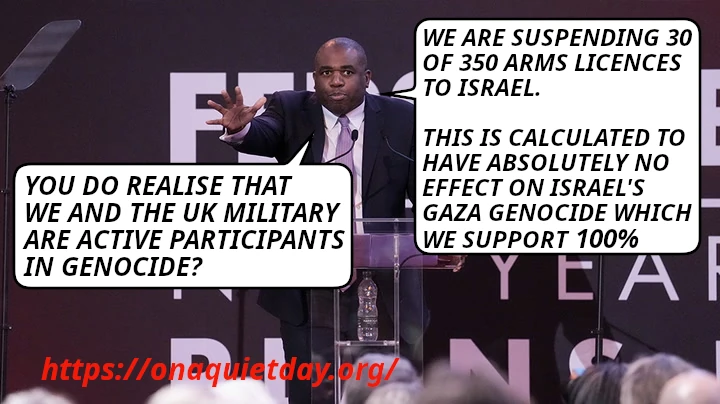
Keir Starmer objects to criticism of the IDF. He asks how could anyone object to them starving people to death, forced marches like the Nazis did, bombing Gaza’s hospitals and universities, mass-murdering journalists, healthworkers and starving people queuing for food, killing and raping prisoners and murdering children. He calls for people to stop obstructing his genocide for Israel.Genocide denier and Current UK Prime Minister Keir Starmer is quoted that he supports Zionism without qualification. He also confirms that UK air force support has been essential in Israel’s mass-murdering genocide. Includes URLs https://www.declassifieduk.org/keir-starmers-100-spy-flights-over-gaza-in-support-of-israel/ and https://youtu.be/O74hZCKKdpAGenocide denying UK Foreign Secretary David Lammy says that UK is suspending 30 of 350 arms licences to Israel. He also confirms the UK government’s support for Israel’s Gaza genocide and the UK government and military’s active participation in genocide.
This work by Middle East Monitor is licensed under a Creative Commons Attribution-NonCommercial-ShareAlike 4.0 International License.
USA Flag in San Diego. [Mario Tama/Getty Images]
US troops began arriving in Israel on Saturday to take part in a joint task force to monitor the implementation of the Gaza ceasefire agreement, according to media reports, Anadolu reports.
Citing two US officials, ABC News reported that 200 troops will arrive in Israel “to set up a coordination center that will oversee implementation of the ceasefire agreement in Gaza” and operate in different fields, including transportation, planning, logistics, security, and engineering.
US troops will not enter the Gaza Strip; they will carry out their activities in Israel under the command of US Central Command (CENTCOM) Commander Adm. Bradley Cooper, alongside different units and contingents sent from countries in the region, according to the report.
On Wednesday, US President Donald Trump announced that Israel and Hamas agreed to the first phase of a 20-point plan he laid out on Sept. 29 to bring a ceasefire to Gaza, release all Israeli captives being held there in exchange for around 2,000 Palestinian prisoners, and a gradual withdrawal of Israeli forces from the entire Gaza Strip.
A second phase of the plan calls for the establishment of a new governing mechanism in Gaza without Hamas’ participation, the formation of a security force comprising Palestinians and troops from Arab and Islamic countries, and the disarmament of Hamas.
Since October 2023, Israeli attacks have killed nearly 67,200 Palestinians in the enclave, most of them women and children, and rendered it uninhabitable.
This work by Middle East Monitor is licensed under a Creative Commons Attribution-NonCommercial-ShareAlike 4.0 International License.
Hundreds of Palestinians continued returning from the south to the north, carrying their belongings along Rashid Street that connects the two parts of the enclave on the second day of the ceasefire in the Gaza Strip on October 11, 2025. [Stringer – Anadolu Agency]
Tens of thousands of Palestinians set off toward areas vacated by Israeli forces after a ceasefire took effect on Friday, according to an Anadolu correspondent, Anadolu reports.
Thousands of displaced civilians departed from southern Gaza to their homes northward, the majority on foot. Some made the hours-long journey using the few vehicles still running amid fuel shortages, along with animal-drawn carts, bicycles, and motorcycles.
Simultaneously, thousands returned to their homes in the central Gaza Strip and some eastern parts of Khan Younis in the south, following the withdrawal of Israeli forces.
The transfers from the south to the north were carried out via the coastal Al-Rashid Street in the west and Salah al-Din Road in the east.
Hundreds of displaced civilians had to set up tents on the rubble of their homes upon returning.
A gradual withdrawal of Israeli forces toward the yellow line was completed on Friday in accordance with US President Donald Trump’s plan.
The army forces withdrew from Gaza City in the north, excluding the Shejaiya neighborhood and some parts of the Al-Tuffah and Zeitoun neighborhoods; and the central and eastern parts of Khan Younis in the south. Palestinians were prevented from entering Beit Hanoun and Beit Lahia in northern Gaza.
The Gaza Government Media Office said on Saturday that more than 5,000 missions, including humanitarian, health, rescue, and relief operations, were carried out in the past 24 hours across Gaza governorates.
Trump announced Wednesday that Israel and Hamas agreed to the first phase of a 20-point plan he laid out on Sept. 29 to bring a ceasefire to Gaza, release all Israeli captives being held there in exchange for around 2,000 Palestinian prisoners, and a gradual withdrawal of Israeli forces from the entire Gaza Strip.
The first phase of the deal came into force at 12 noon local time Friday (0900 GMT).
A second phase of the plan calls for the establishment of a new governing mechanism in Gaza without Hamas’ participation, the formation of a security force comprising Palestinians and troops from Arab and Islamic countries, and the disarmament of Hamas.
Since October 2023, Israeli attacks have killed nearly 67,200 Palestinians in the enclave, most of them women and children, and rendered it uninhabitable.
This work by Middle East Monitor is licensed under a Creative Commons Attribution-NonCommercial-ShareAlike 4.0 International License.