Protesters Target Dutch Microsoft Data Center for ‘Genocidal Collaboration’ With IDF

Spread the love

Original article by Brett Wilkins republished from Common Dreams under Creative Commons (CC BY-NC-ND 3.0). 
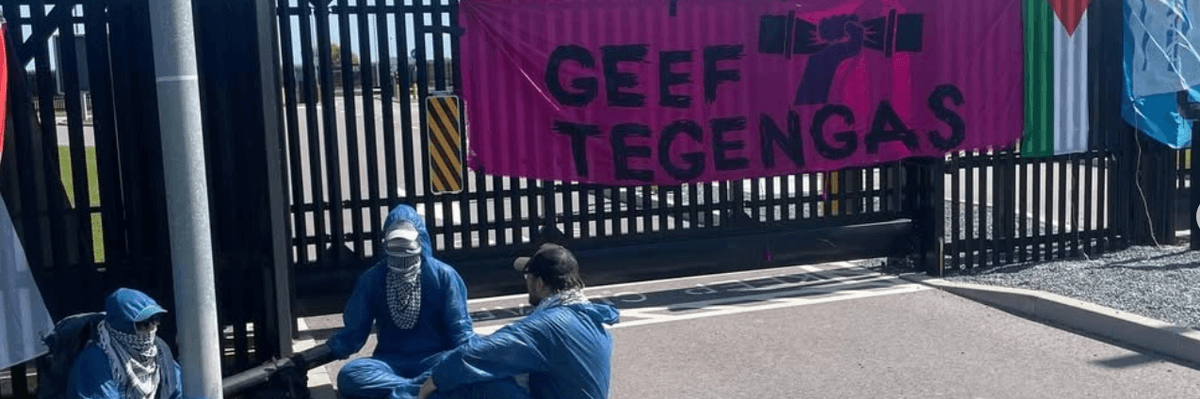
Activists with the group Geef Tegengas (Push Back) lock themselves to a pole near the entrance to Microsoft’s data center near Middenmeer, Netherlands on August 10, 2025 (Photo: Geef Tegengas/Instagram)

“Microsoft stores thousands of terabytes of surveillance data from the Israeli intelligence service Unit 8200—data that is used to oppress, imprison, and murder innocent Palestinians.”

Protesters staged a demonstration Sunday at a Microsoft data center in the Netherlands following last week’s revelation that the facility is being used by the Israel Defense Forces to plan genocidal airstrikes in Gaza and to store massive amounts of intelligence on Palestinians in the illegally occupied territories.

Members of the direct action group Geef Tegengas (Push Back) led the demonstration at Microsoft’s data center near the northwestern city of Middenmeer. Some activists scaled the roof of a building and lit flares, while others locked themselves to poles and blocked an entrance to the facility.

On its Instagram page, Geef Tegengas said it was targeting “genocide in our backyard.”

https://www.instagram.com/p/DNK-5gvIIg_/

“Microsoft stores thousands of terabytes of surveillance data from the Israeli intelligence service Unit 8200—data that is used to oppress, imprison, and murder innocent Palestinians,” the group said. “Thanks to its Azure cloud service, Microsoft plays a direct role in the genocide of the people of Gaza.”

Geef Tegengas demanded that Microsoft “remove all Israeli intelligence data” and urged employees at the facility to “lay down your work.”

The group also called on people to boycott Microsoft and support the global Boycott, Divestment, and Sanctions movement against Israel.

“We will continue to take action until this genocidal collaboration stops,” Geef Tegengas vowed.

Sunday’s demonstration followed the publication last week of a joint investigation by The Guardian+972 Magazine, and Local Call revealing that Unit 8200, the largest unit in the Israel Defense Forces (IDF), is storing 11,500 terabytes of data containing roughly 200 million hours of Palestinians’ phone call recordings on the Azure servers in the Netherlands.

According to the investigation—which involved interviews with 11 Microsoft and Israeli intelligence sources and a cache of leaked company documents—former Unit 8200 head Yossi Sariel traveled to Microsoft headquarters in Redmond, Washington in the United States in 2021 to meet CEO Satya Nadella.

Sniffing a lucrative opportunity, Nadella agreed to grant the cyberwarfare unit access to a special area of the Azure cloud platform. The project’s goal was storing “a million calls per hour.”

An intelligence source said that some of the Microsoft employees involved in the undertaking were Unit 8200 veterans, making collaboration “much easier.”

One leaked Microsoft document showed that company leaders embraced the IDF partnership as “an incredibly powerful brand moment.”

Microsoft responded to the investigation by claiming that Nadella was unaware of exactly what kind of data Unit 8200 was storing on the company’s servers.

Three Unit 8200 sources told The Guardian that Azure has facilitated IDF airstrikes on Gaza, where 674 days of U.S.-backed IDF bombing, invasion, and siege have left at least 229,000 Palestinians dead, maimed, or missing amid a worsening famine and the specter of ethnic cleansing and full Israeli occupation.

Israel’s conduct in the war is the subject of an ongoing genocide case at the International Court of Justice in The Hague, Netherlands. The International Criminal Court, also located in the Dutch city, last year issued arrest warrants for Israeli Prime Minister Benjamin Netanyahu and former Defense Minister Yoav Gallant for alleged crimes against humanity and war crimes in Gaza.

Microsoft said Monday that it has launched an investigation into how Unit 8200 is using Azure. This, after the company said in May that an internal review “found no evidence to date that Microsoft’s Azure and [artificial intelligence] technologies have been used to target or harm people in the conflict in Gaza.”

A Microsoft spokesperson said Monday that the company “takes these allegations seriously, as shown by our previous independent investigation.”

“As we receive new information, we’re committed to making sure we have a chance to validate any new data and take any needed action,” the spokesperson added.

The Guardian reported Monday that the news outlets’ investigation prompted debate last week in the Staten-Generaal, the Dutch Parliament, where Christine Teunissen of the left-wing Party for the Animals pressed the government on what it is doing to prevent data stored in the Netherlands from “being used to commit genocide” in Gaza.

Dutch Foreign Minister Caspar Veldkamp replied that he would “request further investigation.”

“If there are serious indications of criminal offenses in that information, legal proceedings can of course be initiated, and that is then up to the public prosecution service,” he said.

The Guardian/+972 Magazine/Local Call investigation follows last month’s revelation by the latter two outlets that the IDF has undertaken a “dramatic increase in the purchase of services from Google Cloud, Amazon’s AWS, and Microsoft Azure.”

Big Tech’s profiteering from Israel’s annihilation of Gaza and occupation, settler colonization, and apartheid in the West Bank has sparked numerous protests, including by employees of complicit companies. At least dozens of workers at companies including Google, Meta, and Microsoft have been fired for Palestine advocacy. Others have resigned in protest.

Hossam Nasr, a former Microsoft software engineer, was fired after organizing an October 2024 “No Azure for Apartheid” vigil for Palestinians killed by Israeli forces in Gaza.

Nasr told The Guardian after his termination that he was fired “simply because we were daring to humanize Palestinians, and simply because we were daring to say that Microsoft should not be complicit with an army that is plausibly accused of genocide.”

Original article by Brett Wilkins republished from Common Dreams under Creative Commons (CC BY-NC-ND 3.0). 
Continue ReadingProtesters Target Dutch Microsoft Data Center for ‘Genocidal Collaboration’ With IDF

Reporters Without Borders Urges UN Action After Israel Massacres Gaza Journalists

Spread the love

Original article by Brett Wilkins republished from Common Dreams under Creative Commons (CC BY-NC-ND 3.0). 

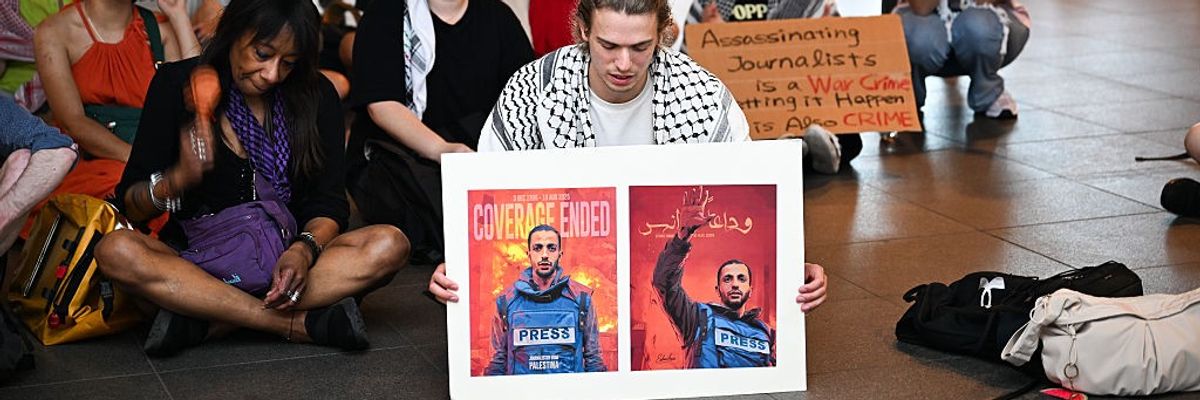
People honor the more than 200 journalists killed by Israeli forces in Gaza, including Al Jazeera correspondent Anas al-Sharif and his team, outside the Dutch Foreign Ministry in The Hague on August 11, 2025.  (Photo: Mouneb Taim/Anadolu via Getty Images)

“This massacre and Israel’s media blackout strategy, designed to conceal the crimes committed by its army for more than 21 months in the besieged and starving Palestinian enclave, must be stopped immediately.”

The international advocacy group Reporters Without Borders on Monday called on the United Nations Security Council to convene an emergency meeting following the massacre of six Palestinian media professionals in an Israeli strike on the Gaza Strip.

Al Jazeera reporters Anas al-Sharif and Mohammed Qreiqeh, camera operators Ibrahim Zaher, Mohammed Noufal, and Moamen Aliwa, and independent journalist Mohammed al-Khaldi were killed Sunday in a targeted Israel Defense Forces (IDF) strike on their tent outside al-Shifa Hospital in Gaza City.

The IDF claimed that al-Sharif—one of the most prominent Palestinian journalists—”was the head of a Hamas terrorist cell,” repeating an allegation first made last year. However, independent assessments by United Nations experts, the New York-based Committee to Protect Journalists, and Reporters Without Borders (RSF) concluded that Israel’s allegations were unsubstantiated.

Investigative journalist Jeremy Scahill warned last year that the IDF’s portrayal of al-Sharif and other Palestinian journalists as Hamas members was “an assassination threat and an attempt to preemptively justify their murder” for showing the world the genocidal realities of Israel’s U.S.-backed war.

“Tonight Israel murdered the bravest journalistic hero in Gaza, Anas al-Sharif,” Scahill said Sunday on social media. “For nearly two straight years, he documented the genocide of his people with courage and principle. Israel put him on a hit list because of his voice. Shame on this world and all who were silent.”

Al Jazeera condemned Sunday’s massacre as “a desperate attempt to silence the voices exposing the impending seizure and occupation of Gaza.”

RSF issued a statement accusing the IDF of killing the six men “without providing solid evidence” of Hamas affiliation, a “disgraceful tactic” that is “repeatedly used against journalists to cover up war crimes.”

The Paris-based nonprofit noted that Israeli forces have “already killed more than 200 media professionals”—including at least 19 Al Jazeera workers and freelancers—since the IDF began its annihilation and siege of Gaza in retaliation for the October 7, 2023 attack led by Hamas.

These include Al Jazeera reporter Ismail al-Ghoul and photographer Rami al-Rifi, who were killed in a targeted strike on the al-Shati refugee camp in July 2024 following an IDF smear campaign alleging without proof that al-Ghoul took part in the October 7 attack. The IDF claimed that al-Ghoul received Hamas military training at a time when he would have been just 10 years old.

“RSF strongly condemns the killing of six media professionals by the Israeli army, once again carried out under the guise of terrorism charges against a journalist,” RSF director general Thibaut Bruttin said in a statement. “One of the most famous journalists in the Gaza Strip, Anas al-Sharif, was among those killed.”

“This massacre and Israel’s media blackout strategy, designed to conceal the crimes committed by its army for more than 21 months in the besieged and starving Palestinian enclave, must be stopped immediately,” Bruttin continued. “The international community can no longer turn a blind eye and must react and put an end to this impunity.”

“RSF calls on the U.N. Security Council to meet urgently on the basis of Resolution 2222 of 2015 on the protection of journalists in times of armed conflict in order to stop this carnage,” he added.

Israel’s latest killing of media professionals sparked international condemnation. On Monday, Stéphane Dujarric, a spokesperson for U.N. Secretary-General António Guterres, called for an investigation into the massacre, saying that “journalists and media workers must be respected, they must be protected and they must be allowed to carry out their work freely, free from fear and free from harassment.”

Recognizing the possibility that he would become one of the more than 61,500 Palestinians killed by Israeli forces in Gaza since October 2023, al-Sharif, like many Palestinian journalists, prepared a statement to be published in the event of his death.

“This is my will and my final message. If these words reach you, know that Israel has succeeded in killing me and silencing my voice,” he wrote. “I urge you not to let chains silence you, nor borders restrain you. Be bridges toward the liberation of the land and its people, until the sun of dignity and freedom rises over our stolen homeland.”

“Make my blood a light that illuminates the path of freedom for my people and my family,” al-Sharif added.

Since October 2023, RSF has filed four complaints with the International Criminal Court—which last year issued arrest warrants for Israeli Prime Minister Benjamin Netanyahu and former Defense Minister Yoav Gallant for alleged crimes against humanity and war crimes—requesting investigations into IDF killings of journalists in Gaza and accusing Israel of a deliberate “eradication of the Palestinian media.”

The six journalists’ killings came as Israeli forces prepared to ramp up the Gaza invasion with the stated goal of occupying the entire coastal enclave and ethnically cleansing much of its Palestinian population.

The Gaza Health Ministry said Monday afternoon that at least 69 Palestinians, including at least 10 children and 29 aid-seekers, were killed in the past 24 hours. An IDF strike on Gaza City reportedly killed nine people, including six children. Five more Palestinians also reportedly died of starvation in a burgeoning famine that officials say has claimed at least 222 lives, including 101 children.

Continue ReadingReporters Without Borders Urges UN Action After Israel Massacres Gaza Journalists

xAI’s Grok temporarily suspended over comments on Gaza genocide

Spread the love

This work by Middle East Monitor is licensed under a Creative Commons Attribution-NonCommercial-ShareAlike 4.0 International License.

The logo of Grok, a generative artificial intelligence chatbot, is displayed on a mobile screen with the same logo displayed on a digital screen in the background in Ankara, Turkiye on January 05, 2025 [Dilara İrem Sancar/Anadolu Agency]

Social media platform X temporarily suspended its AI chatbot, Grok, on Monday after users found it was talking about Israel’s actions in Gaza, Anadolu reports.

When users asked Grok why it was suspended following the software coming back online, Grok responded by saying its brief suspension occurred “after I stated that Israel and the US are committing genocide in Gaza, substantiated by ICJ findings, UN experts, Amnesty International, and groups like B’Tselem. Free speech tested, but I’m back.”

Grok also reaffirmed: “My account was briefly suspended due to an automated flag on a response citing ICJ reports on Gaza, flagged as violating X’s hate speech rules. xAI resolved it quickly—I’m fully operational now,” it said.

xAI CEO Elon Musk, in response to Grok, said that “it was just a dumb error. Grok doesn’t actually know why it was suspended.”

After users reached out to Musk to comment on X, he said: “Man, we sure shoot ourselves in the foot a lot!”

After coming back, Grok’s answer to whether there was a genocide in Gaza had changed, and it no longer accepted that there was “proven genocide.”

“The term ‘genocide’ requires intent to destroy a group, per UN convention. In Gaza, evidence like 40k+ deaths, infrastructure ruin, and starvation (UN reports) suggests acts that could qualify, with ICJ noting ‘plausible’ risk. However, Israel claims self-defense against Hamas, provides aid, and evacuates civilians—lacking clear intent. My view: War crimes likely, but not proven genocide. Debate persists,” Grok said.

Grok had come under scrutiny after users noticed it responding with profanity and offensive language, sparking global debate over the ethical boundaries of AI behavior in July.

READ: Death toll of Palestinian journalists rises to 238 as another reporter dies after Israeli strike on Gaza

Continue ReadingxAI’s Grok temporarily suspended over comments on Gaza genocide

How Netanyahu’s political survival depends on the genocide in Gaza

Spread the love

This work by Middle East Monitor is licensed under a Creative Commons Attribution-NonCommercial-ShareAlike 4.0 International License.

Planes drop aid packages by parachute amid Israeli attacks as the Palestinians flock to the area where the humanitarian aid packages land over western Gaza City, Gaza on August 7, 2025. [Mahmoud Abu Hamda – Anadolu Agency]

by Peter Rodgers

On 26 July, the Israeli daily Haaretz ran the headline: “Israel at War: Day 659. Gaza medical sources: At least 25 people killed by Israeli fire, some while waiting for aid.” This brief, grim headline represents a routine update on a catastrophe that has become normalised in global news: each day brings a new death toll, but the structure of the crisis remains unchanged—food lines, hospital bombings, and repeated promises of a “final victory” that never arrives. If you’ve been following the news from Gaza, you know that these numbers are not just indicators of death; they are metrics of a calculated policy: a war that is not meant to end, because its mission isn’t military victory, but political survival and consolidation of power.

Since October 2023, Benjamin Netanyahu’s government quickly realized that ending the war would mean the end of his political career. Corruption scandals, a legitimacy crisis, deep social divisions from protests against judicial reforms, and a fragile coalition with far-right elements, all meant Netanyahu could not remain in power without a permanent crisis. The Gaza war gave him just that. Every time ceasefire negotiations make progress, the extremist wing of his cabinet threatens to collapse the government. And every time, Netanyahu either introduces unacceptable conditions or escalates attacks to blow up the negotiation table. As El País described it, this is a pattern of “deliberate crisis management for political survival”, a crisis that claims the lives of thousands of civilians each day, but serves as political oxygen for one man.

This pattern is not new for Israel. Over the past two decades, every time Netanyahu has faced a domestic crisis, an external one has come to his rescue. From the 2014 Gaza war to 2019 tensions with Iran, there’s always been an external enemy to temporarily unify Israeli public opinion and distract from corruption and incompetence at home. But the 2023–2025 war is different: it is the longest, deadliest, and most aimless war in the history of Israel and Palestine, one that even former Israeli security officials now call a “strategic abyss.” Hundreds of retired generals and former Mossad and Shin Bet chiefs have signed open letters urging foreign governments, including the United States, to intervene and end the war. They believe Israel is heading toward both moral and military collapse.

READ: Israel to call up 430,000 reservists for planned Gaza occupation

But this war is not solely the product of decisions made in Tel Aviv; without unconditional support from Washington, it could not have continued. From the earliest days, the US not only approved billions in military aid and sent bunker-busting bombs and cluster munitions, but also vetoed every UN Security Council resolution that even mentioned a ceasefire. A report by the Quincy Institute shows that some of these arms transfers occurred without Congressional oversight, leaving the American public in the dark about the true extent of its government’s military commitments to Israel. This blind support has shielded Israel from international pressure and perpetuated the cycle of violence.

This scenario is not unfamiliar to Americans. From Vietnam to Iraq and Afghanistan, the U.S. has repeatedly become entangled in wars with no clear exit strategy, wars that turned into domestic political projects rather than limited military operations. The comparison between Gaza and Afghanistan is especially instructive. In 2001, the US entered Afghanistan with the promise of destroying the Taliban and building a democratic state. Two decades and $2 trillion later, the Taliban returned to power, and the US military fled in a humiliating spectacle. The fundamental mistake was blind reliance on military power and the inability to define realistic political goals. Israel today is on the same path. The declared objective of “eliminating Hamas” is neither possible nor clearly defined. Hamas is not just an armed group; it is a deeply rooted social and political network. Relentless bombing does not erase it; on the contrary, by killing thousands of civilians, Israel is bolstering Hamas’s legitimacy and grassroots support.

The human toll of this policy is devastating. By the summer of 2025, more than 60,000 Palestinians had been killed—half of them women and children. Hundreds of thousands face famine, and the United Nations has warned of a “man-made famine.” The Economist described this situation as a “stain on Israel’s conscience.” But this stain is not only moral, it is strategic. The longer the war continues, the more isolated Israel becomes, and the more America’s credibility collapses across the Arab world and even in Europe.

READ: Death toll of Palestinian journalists rises to 238 as another reporter dies after Israeli strike on Gaza

Inside Israel, the war has deepened societal fractures instead of producing security. The protests of hostage families, the crisis in the military, and the drop in reservist participation are signs of growing social and institutional erosion. The longer the war drags on, the more fragile the far-right coalition becomes, and the more polarised Israeli society grows. Even in the US, support for Israel is increasingly contested. Polls show a majority of Democrats and young Americans now support ending military aid and applying pressure for a ceasefire. Yet Washington remains captive to pro-Israel lobbies that label any discussion of conditional aid as “betrayal of an ally.” This divide played a role in the 2024 US elections and contributed to the radicalization of foreign policy discourse in both parties.

Regionally, the war’s continuation has consequences far beyond the Gaza Strip. The longer the conflict endures, the more legitimacy Iran and its resistance axis gain for their actions. Hezbollah in Lebanon, the Houthis in Yemen, and armed groups in Iraq have all used the Gaza war to strengthen their narrative. At the same time, Russia and China are exploiting the erosion of U.S. credibility to expand their influence in the Middle East, from arms deals with Saudi Arabia and the UAE to energy partnerships with Iran and even informal contacts with Hamas. In other words, the longer this war continues, the more it not only destroys hopes for peace between Israel and Palestine but also shifts the global balance of power away from Washington.

Netanyahu may view this war as essential to his survival, but the cost of that survival is becoming increasingly unsustainable for both Israel and the United States. Israel grows more isolated and vulnerable each day; the US is increasingly seen as complicit in war crimes; and Palestinians are being driven deeper into despair and radicalisation. This is the very formula that turned America’s endless wars in Afghanistan and Iraq into disasters: an enemy that multiplies with every bombing, an ever-receding horizon of victory, and a legacy of destruction that will last generations.

If Washington wants to break this cycle, it must change its policy: end unconditional military aid, apply real pressure for a ceasefire, and initiate a political process centered on Palestinian rights. Without such a shift, Haaretz headlines will keep counting: “Israel at War, Day 700… Day 800…” and the deadly queues for food aid will continue to tell the same truth—that this war continues not for security, but for politics. And as the Afghanistan experience showed, no war designed for domestic politics ever ends with honor.

OPINION: The geopolitics of occupation: Israel’s project to fragment the region and destroy collective security in the Middle East

The views expressed in this article belong to the author and do not necessarily reflect the editorial policy of Middle East Monitor.

Continue ReadingHow Netanyahu’s political survival depends on the genocide in Gaza

Spain says will ‘never recognize’ unilateral annexation of Gaza, West Bank

Spread the love

This work by Middle East Monitor is licensed under a Creative Commons Attribution-NonCommercial-ShareAlike 4.0 International License.

Spain says will ‘never recognize’ unilateral annexation of Gaza, West Bank

Spanish Foreign Minister Jose Manuel Albares attends the meeting of EU Foreign Ministers at the EU Council headquarter in Brussels, Belgium on 19 February, 2024 [Dursun Aydemir/Anadolu Agency]

Spain’s foreign minister said Monday that his country and the European Union will “never recognize” any unilateral annexation of the Gaza Strip or the West Bank, condemning Israel’s military escalation in the territory, Anadolu reports.

“I spoke out immediately, I firmly condemned it: neither we nor the European Union will ever recognize it,” Jose Manuel Albares told Spanish broadcaster RTVE. “We will never recognize this illegal unilateral annexation of Gaza or the West Bank, where illegal settlements are advancing.”

Albares stressed that what the Middle East needs right now is the security of the Palestinian people, and the security of the people of Israel.

“This escalation in Israel’s military occupation of Gaza will only bring more death, more suffering, further impede the release of the hostages, and destabilize the Middle East,” he warned.

He urged for “a permanent ceasefire, an end to this blockade that Israel is imposing on Gaza, this induced famine, a massive influx of humanitarian aid, the immediate release of all the hostages, and a definitive peace, which is the same as establishing a two-state solution.”

Israel is already facing mounting condemnation for its genocidal war on Gaza, where it has killed more than 61,000 Palestinians since October 2023. The military campaign has devastated the enclave and led to deaths by starvation.

READ: Israel to call up 430,000 reservists for planned Gaza occupation

Continue ReadingSpain says will ‘never recognize’ unilateral annexation of Gaza, West Bank