Analysis: The climate papers most featured in the media in 2025

Spread the love

Original article republished from Carbon Brief under a CC license

The year 2025 saw the return to power of Donald Trump, a jewellery heist at the Louvre museum in Paris and an engagement that “broke the internet”.

Amid the biggest stories of the year, climate change research continued to feature prominently in news and social media feeds.

Using data from Altmetric, which scores research papers according to the attention they receive online, Carbon Brief has compiled its annual list of the 25 most talked-about climate-related studies of the past year. 

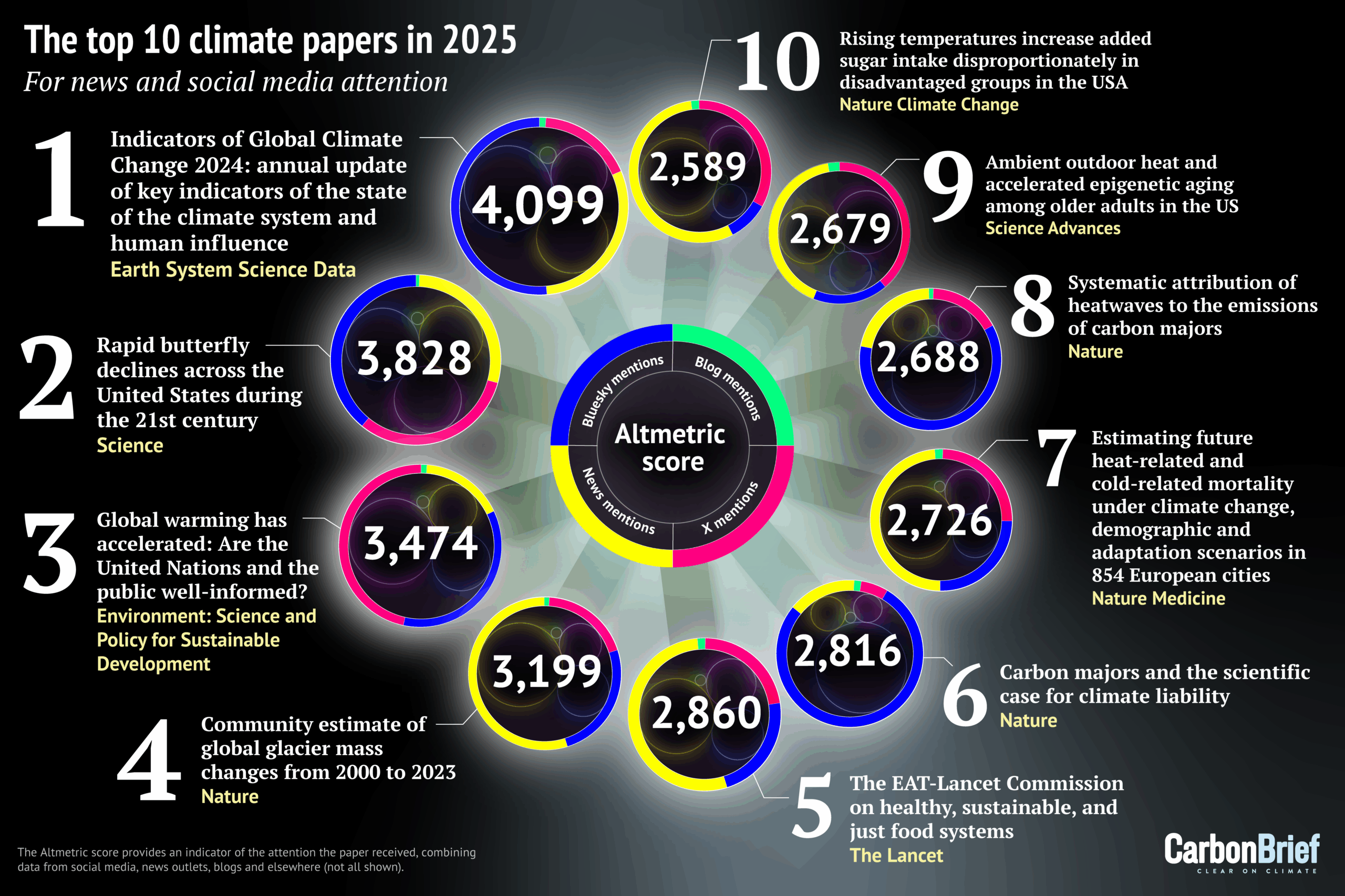
The top 10 – shown in the infographic above and list below – include research into declining butterflies, heat-related deaths, sugar intake and the massive loss of ice from the world’s glaciers:

  1. Indicators of Global Climate Change 2024: annual update of key indicators of the state of the climate system and human influence
  2. Rapid butterfly declines across the US during the 21st century
  3. Global warming has accelerated: Are the UN and the public well informed?
  4. Community estimate of global glacier mass changes from 2000 to 2023 
  5. The EAT-Lancet Commission on healthy, sustainable and just food systems 
  6. Carbon majors and the scientific case for climate liability 
  7. Estimating future heat-related and cold-related mortality under climate change, demographic and adaptation scenarios in 854 European cities 
  8. Systematic attribution of heatwaves to the emissions of carbon majors 
  9. Ambient outdoor heat and accelerated epigenetic aging among older adults in the US 
  10. Rising temperatures increase added sugar intake disproportionately in disadvantaged groups in the US

Later in this article, Carbon Brief looks at the rest of the top 25 and provides analysis of the most featured journals, as well as the gender diversity and country of origin of authors.

New for this year is the inclusion of Altmetric’s new “sentiment analysis”, which scores how positive or negative a paper’s social media attention has been.

(For Carbon Brief’s previous Altmetric articles, see the links for 202420232022202120202019201820172016 and 2015.) 

Global indicators

The top-scoring climate paper of 2025, ranking 24th of any research paper on any topic, is the annual update of the “Indicators of Global Climate Change” (IGCC) report.

The report was established in 2023 to help fill the gap in climate information between assessments of the Intergovernmental Panel on Climate Change (IPCC), which can take up to seven years to complete. It includes the latest data on global temperatures, the remaining carbon budget, greenhouse gas emissions and – for the first time – sea level rise. 
Ragout: Indicators of Global Climate Change 2024: annual update of key indicators of the state of the climate system and human influence

The paper, published in Earth System Science Data, has an Altmetric score of 4,099. This makes it the lowest top-scoring climate paper in Carbon Brief’s list since 2017.

(An Altmetric score combines the mentions that published peer-reviewed research has received from online news articles, blogs, Wikipedia and on social media platforms such as Facebook, Reddit, Twitter and Bluesky. See an earlier Carbon Brief article for more on how Altmetric’s scoring system works.)

Previous editions of the IGCC have also appeared in Carbon Brief’s list – the 2024 and 2023 iterations ranked 17th and 18th, respectively.

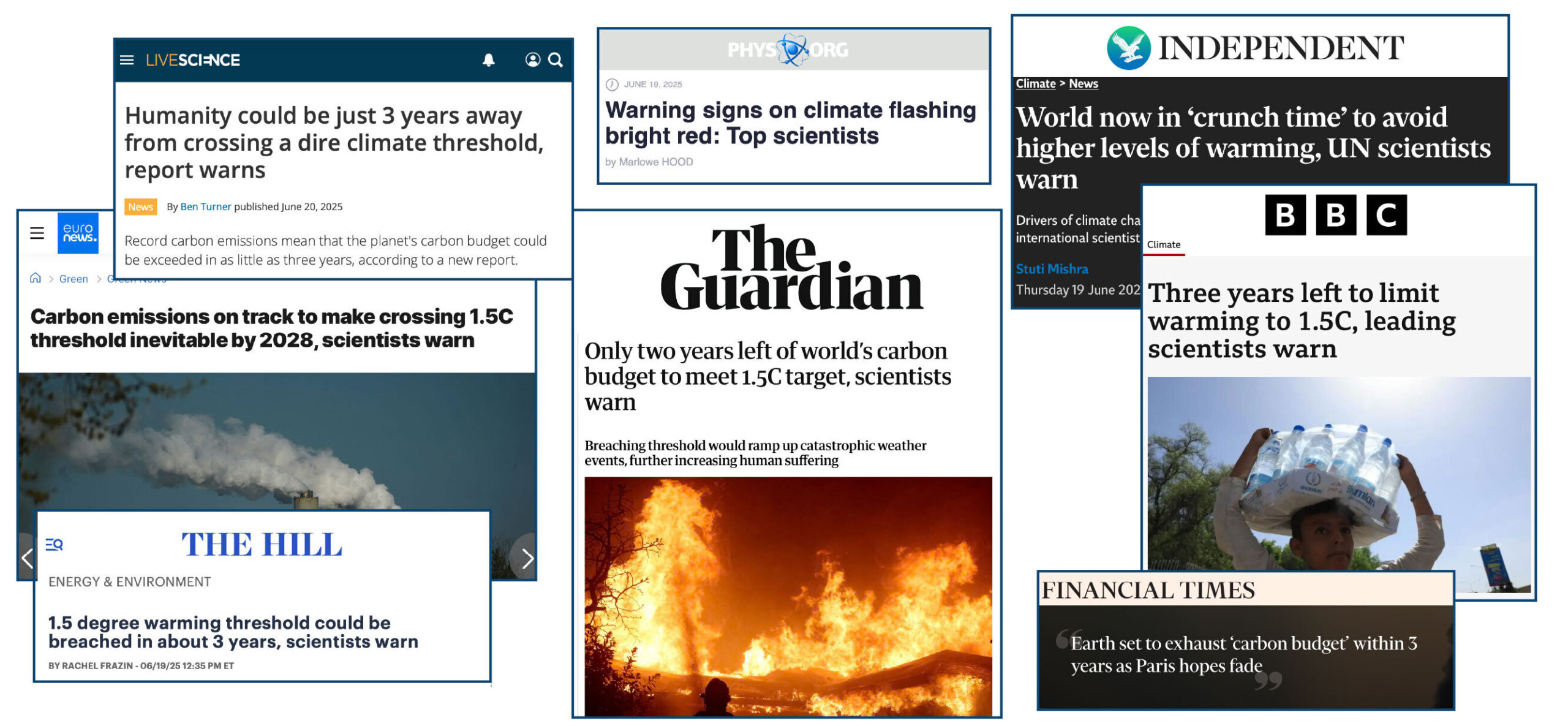
This year’s paper was mentioned 556 times in online news stories, including in the Associated PressGuardianIndependentHill and BBC News

Many outlets led their coverage with the study’s findings on the global “carbon budget”. This warned that the remaining carbon budget to limit warming to 1.5C will be exhausted in just three years if global emissions continue at their current rate.
Headline_Montage

In a Carbon Brief guest post about the study, authors Prof Piers Forster and Dr Debbie Rosen from the University of Leeds wrote:

“It is also now inevitable that global temperatures will reach 1.5C of long-term warming in the next few years unless society takes drastic, transformative action…Every year of delay brings reaching 1.5C – or even higher temperatures – closer.”

Forster, who was awarded a CBE in the 2026 new year honours list, tells Carbon Brief that media coverage of the study was “great” at “putting recent extreme weather in the context of rapid long-term rates of global warming”. 

However, he adds:

“Climate stories are not getting the coverage they deserve or need at the moment so the community needs to get all the help we can for getting clear consistent messages out there.”

The paper was tweeted more than 300 times and posted on Bluesky more than 950 times. It also appeared in 22 blogs. 

Using AI, Altmetric now analyses the “sentiment” of this social media attention. As the summary figure below shows, the posts about this paper were largely positive, with an approximate 3:1 split of positive and negative attention.

Altmetric’s AI-generated summary of the sentiment of social media posts regarding the Forster et al.
Altmetric’s AI-generated summary of the sentiment of social media posts regarding the Forster et al. (2025) paper. Totals may add up to more than 100% because of rounding. Source: Altmetric

Butterfly decline

With an Altmetric score of 3,828, the second-highest scoring climate paper warns of “widespread” declines in butterfly numbers across the US since the turn of the century.

The paper, titled “Rapid butterfly declines across the US during the 21st century” and published in Science, identifies a 22% fall in butterfly numbers across more than 500 species between 2000 and 2020.

(There is a higher-scoring paper, “The 2025 state of the climate report: a planet on the brink”, in the journal BioScience, but it is a “special report” and was not formally peer reviewed.)
Ragout: Rapid butterfly declines across the United States during the 21st
century

The scale of the decline suggests “multiple and broadly acting threats, including habitat loss, climate change and pesticide use”, the paper says. The authors find that “species generally had stronger declines in more southerly parts of their ranges”, with some of the most negative trends in the driest and “most rapidly warming” US states.

The research was covered in 560 news articles, including the New York TimesGuardianAssociated PressNPREl País and BBC News. Much of the news coverage led with the 22% decline figure.

The paper was also mentioned in 13 blogs, more than 750 Bluesky posts and more than 600 tweets.

The sentiment analysis reveals that social media posts about the paper were largely negative. However, closer inspection reveals that this negativity is predominantly towards the findings of the paper, not the research itself. 

For example, a Bluesky post on the “distressing” findings by one of the study’s authors is designated as “neutral negative” by Altmetric’s AI analysis.

In a response to a query from Carbon Brief, Altmetric explains that the “goal is to measure how people feel about the research paper itself, not the topic it discusses”. However, in some cases the line can be “blurred” as the AI “sometimes struggles to separate the subject matter from the critique”. The organisation adds that it is “continuously working on improving our models to better distinguish between the post’s content and the research output”. 

Altmetric’s AI-generated summary of the sentiment of social media posts regarding the Forster et al.
Altmetric’s AI-generated summary of the sentiment of social media posts regarding the Forster et al. (2025) paper. Totals may add up to more than 100% because of rounding. Source: Altmetric

On the attention that the paper received, lead author Dr Collin Edwards of the Washington Department of Fish & Wildlife says that “first and foremost, people care about butterflies and our results are broad-reaching, unequivocal and, unfortunately, very concerning”. 

Edwards tells Carbon Brief he hopes the clarity of the writing made the paper accessible to readers, noting that he and his co-authors “sweat[ed] over every word”. 

The resulting news coverage “accurately captured the science”, Edwards says: 

“Much as I wish our results were less consistently grim, the consistency and simplicity of our findings mean that even if a news story only provides the highest level summary, it isn’t misleading readers by skipping some key caveat or nuance that changes the interpretation.”

Warming ‘acceleration’

In third place in Carbon Brief’s list for 2025 is the latest scientific paper from veteran climatologist Dr James Hansen, former director of the NASA Goddard Institute for Space Studies and now adjunct professor at Columbia University’s Earth Institute.

The paper, titled “Global warming has accelerated: Are the UN and the public well-informed?” was published in the journal Environment: Science and Policy for Sustainable Development. It generated an Altmetric score of 3,474.

Ragout: Global Warming Has Accelerated: Are the United Nations and the Public Well-Informed

The study estimates that the record-high global temperatures in the last few years were caused by a combination of El Niño and a reduction in air pollution from international shipping

The findings suggest that the cooling effect of aerosols – tiny, light‑scattering particles produced mainly by burning fossil fuels – has masked more of the warming driven by greenhouse gases than previously estimated by the IPCC.

As efforts to tackle air pollution continue to reduce aerosol emissions, warming will accelerate further – reaching 2C by 2045, according to the research.

The paper was covered by almost 400 news stories – driven, in part, by Hansen’s comments in a press briefing that the Paris Agreement’s 2C warming limit was already “dead”. 

Hansen’s analysis received a sceptical response from some scientists. For example, Dr Valerie Masson-Delmotte, an IPCC co-chair for its most recent assessment report on climate science, told Agence France-Presse the research “is not published in a climate science journal and it formulates a certain number of hypotheses that are not consistent with all the available observations”.

In addition, other estimates, including by Carbon Brief, suggest new shipping regulations have made a smaller contribution to warming than estimated by Hansen.

Hansen tells Carbon Brief that the paper “did ok” in terms of media coverage, although notes “it’s on [scientists] to do a better job of making clear what the core issues are in the physics of climate change”.

With more than 1,000 tweets, the paper scored highest in the top 25 for posts on Twitter. It was also mentioned in more than 800 Bluesky posts and on 27 blogs. 

The sentiment analysis suggests that these posts were largely positive, with just a small percentage of negative comments.

Altmetric’s AI-generated summary of the sentiment of social media posts regarding the Hansen et al.
Altmetric’s AI-generated summary of the sentiment of social media posts regarding the Hansen et al. (2025) paper. Totals may add up to more than 100% because of rounding. Source: Altmetric

Making the top 10

Ranking fourth in Carbon Brief’s analysis is a Nature paper calculating changes in global glacier mass over 2000-23. The study finds glaciers worldwide lost 273bn tonnes of ice annually over that time – with losses increasing by 36% between 2000-11 and 2012-23.

The study has an Altmetric score of 3,199. It received more news coverage than any other paper in this year’s top 25, amassing 1,187 mentions. with outlets including the GuardianAssociated Press and Economic Times

At number five, with an Altmetric score of 2,860, is the EAT-Lancet Commission on healthy, sustainable and just food systems.

Carbon Brief’s coverage of the report highlights that “a global shift towards ‘healthier’ diets could cut non-CO2 greenhouse gas emissions, such as methane, from agriculture by 15% by 2050”. It adds:

“The findings build on the widely cited 2019 report from the EAT-Lancet Commission – a group of leading experts in nutrition, climate, economics, health, social sciences and agriculture from around the world.”

Also making the top 10 – ranking sixth and eighth – are a pair of papers published in Nature, which both link extreme heat to the emissions of specific “carbon majors” – large producers of fossil fuels, such as ExxonMobil, Shell and Saudi Aramco,.

The first is a perspective, titled “Carbon majors and the scientific case for climate liability”, published in April. It begins:

“Will it ever be possible to sue anyone for damaging the climate? Twenty years after this question was first posed, we argue that the scientific case for climate liability is closed. Here we detail the scientific and legal implications of an ‘end-to-end’ attribution that links fossil fuel producers to specific damages from warming.”

The authors find “trillions (of US$) in economic losses attributable to the extreme heat caused by emissions from individual companies”.

The paper was mentioned 1,329 times on Bluesky – the highest in this year’s top 25. It was also mentioned in around 270 news stories.

Published four months later, the second paper uses extreme event attribution to assess the impact of climate change on more than 200 heatwaves recorded since the year 2000.

The authors find one-quarter of the heatwaves would have been “virtually impossible” without human-caused global warming. They add that the heatwaves were, on average, 1.7C hotter due to climate change, with half of this increase due to emissions stemming from the operations and production of carbon majors. 

This study was mentioned in almost 300 news stories – including by Carbon Brief – as well as 222 tweets and 823 posts on Bluesky.

In seventh place is a Nature Medicine study, which quantifies how heat-related and cold-related deaths will change over the coming century as the climate warms. 

A related research briefing explains the main findings of the paper:

“Heat-related deaths are estimated to increase more rapidly than cold-related deaths are estimated to decrease under future climate change scenarios across European cities. An unrealistic degree of adaptation to heat would be required to revert this trend, indicating the need for strong policies to reduce greenhouse gases emissions.”

The paper was mentioned 345 times in the news, including in the Financial TimesNew ScientistGuardian and Bloomberg.

The paper in ninth place also analyses the health impacts of extreme heat. The study, published in Science Advances, finds that extreme heat can speed up biological ageing in older people. 

Rounding out the top 10 is a Nature Climate Change study, titled “Rising temperatures increase added sugar intake disproportionately in disadvantaged groups in the US”. 

The study finds that at higher temperatures, people in the US consume more sugar – mainly due to “higher consumption of sugar-sweetened beverages and frozen desserts”. The authors project that warming of 5C would drive additional sugar consumption of around 3 grams per day, “with vulnerable groups at an even higher risk”.

Elsewhere in the top 25

The rest of the top 25 includes a wide range of research, from “glacier extinction” and wildfires to Amazon drought and penguin guano.

In 13th place is a Nature Climate Change study that finds the wealthiest 10% of people – defined as those who earn at least €42,980 (£36,605) per year – contributed seven times more to the rise in monthly heat extremes around the world than the global average.

The authors also explore country-level emissions, finding that the wealthiest 10% in the US produced the emissions that caused a doubling in heat extremes across “vulnerable regions” globally. 

(See Carbon Brief’s coverage of the paper for more details.)

In 15th place is the annual Lancet Countdown on health and climate change – a lengthy report with more than 120 authors.

The study warns that “climate change is increasingly destabilising the planetary systems and environmental conditions on which human life depends”.

This annual analysis from the Lancet often features in Carbon Brief’s top 25 analysis. After three years in the Carbon Brief’s top 10 over 2020-23, the report landed in 20th place in 2023 and missed out on a spot in the top 25 altogether in 2024. 

In 16th place is a Science Advances study, titled “Increasing rat numbers in cities are linked to climate warming, urbanisation and human population”. The study uses public complaint and inspection data from 16 cities around the world to estimate changes in rat populations.

It finds that “warming temperatures and more people living in cities may be expanding the seasonal activity periods and food availability for urban rats”.

The study received 320 new mentions, including in the Washington PostNew Scientist and National Geographic.

In 21st place is a Nature Climate Change paper, titled “Peak glacier extinction in the mid-21st century”. The study authors “project a sharp rise in the number of glaciers disappearing worldwide, peaking between 2041 and 2055 with up to ~4,000 glaciers vanishing annually”.

Completing the top 25 is a Nature study on the “prudent planetary limit for geological carbon storage” – where captured CO2 is injected deep underground, where it can stay trapped for thousands of years. 

In a Carbon Brief guest post, study authors Dr Matthew Gidden and Prof Joeri Rogelj explain that carbon dioxide removal will only be effective at limiting global temperature rise if captured CO2 is injected “deep underground, where it can stay trapped for thousands of years”. 

The guest post warns that “geological carbon storage is not limitless”. It states that “if all available safe carbon storage capacity were used for CO2 removal, this would contribute to only a 0.7C reduction in global warming”. 

Top journals

The journal Nature dominates Carbon Brief’s top 25, with seven papers featured.

Many other journals in the Springer Nature stable also feature, including Nature Climate Change (three), Communications Earth & Environment (two), as well as Nature Ecology & Evolution, Nature Medicine and Nature Reviews Earth & Environment (one each).

Also appearing more than once in the top 25 are Science Advances (three), Science (two) and the Lancet (two). 

This is shown in the graphic below.
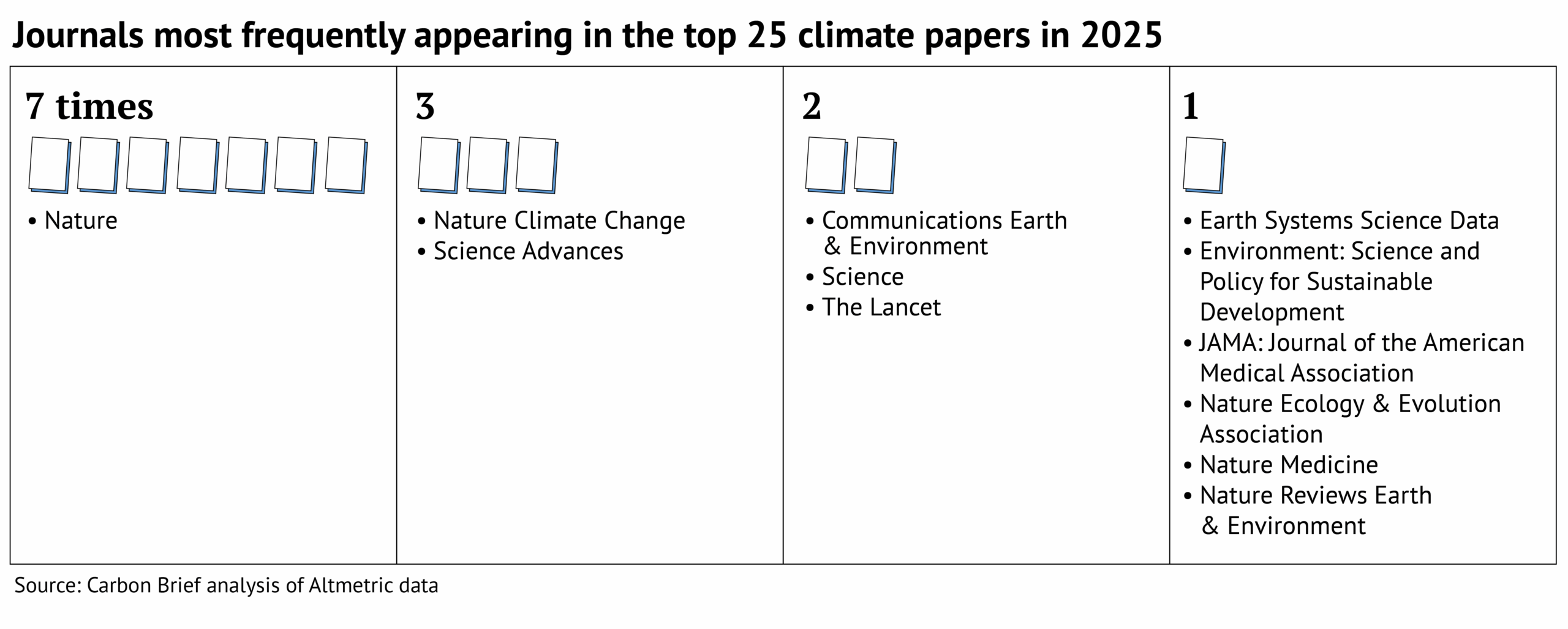
Graphic: Journals most frequently appearing in the top 25 climate papers in 2025

All the final scores for 2025 can be found in this spreadsheet.

Diversity in the top 25

The top 25 climate papers of 2025 cover a huge range of topics and scope. However, analysis of their authors reveals a distinct lack of diversity.

In total, the top 25 includes more than 650 authors – the highest number since Carbon Brief began this analysis in 2022.

This is largely due to a few publications with an exceptionally high number of authors. For example, the 2025 report of the Lancet Countdown on health and climate change has almost 130 authors alone, accounting for almost one-fifth of authors in this analysis. 

Carbon Brief recorded the gender and country of affiliation for each of these authors. (The methodology used was developed by Carbon Brief for analysis presented in a special 2021 series on climate justice.)

The analysis reveals that 88% of the authors of the climate papers most featured in the media in 2025 are from institutions in the global north. 

Global South: The “global south” is a term used to broadly describe lower-income countries in regions such as Africa, Asia and Latin America. It is often used to denote nations that are either in… Read More

Carbon Brief defines the global north as North America, Europe, Japan, Australia and New Zealand. It defines the global south as Asia (excluding Japan), Africa, Oceania (excluding Australia and New Zealand), Latin America and the Caribbean.

The analysis shows that 53% of authors are from European institutions, while only 1% of authors are from institutions in Africa.

Further data analysis shows that there are also inequalities within continents. The map below shows the percentage of authors from each country, where dark blue indicates a higher percentage. Countries that are not represented by any authors in the analysis are shown in grey.
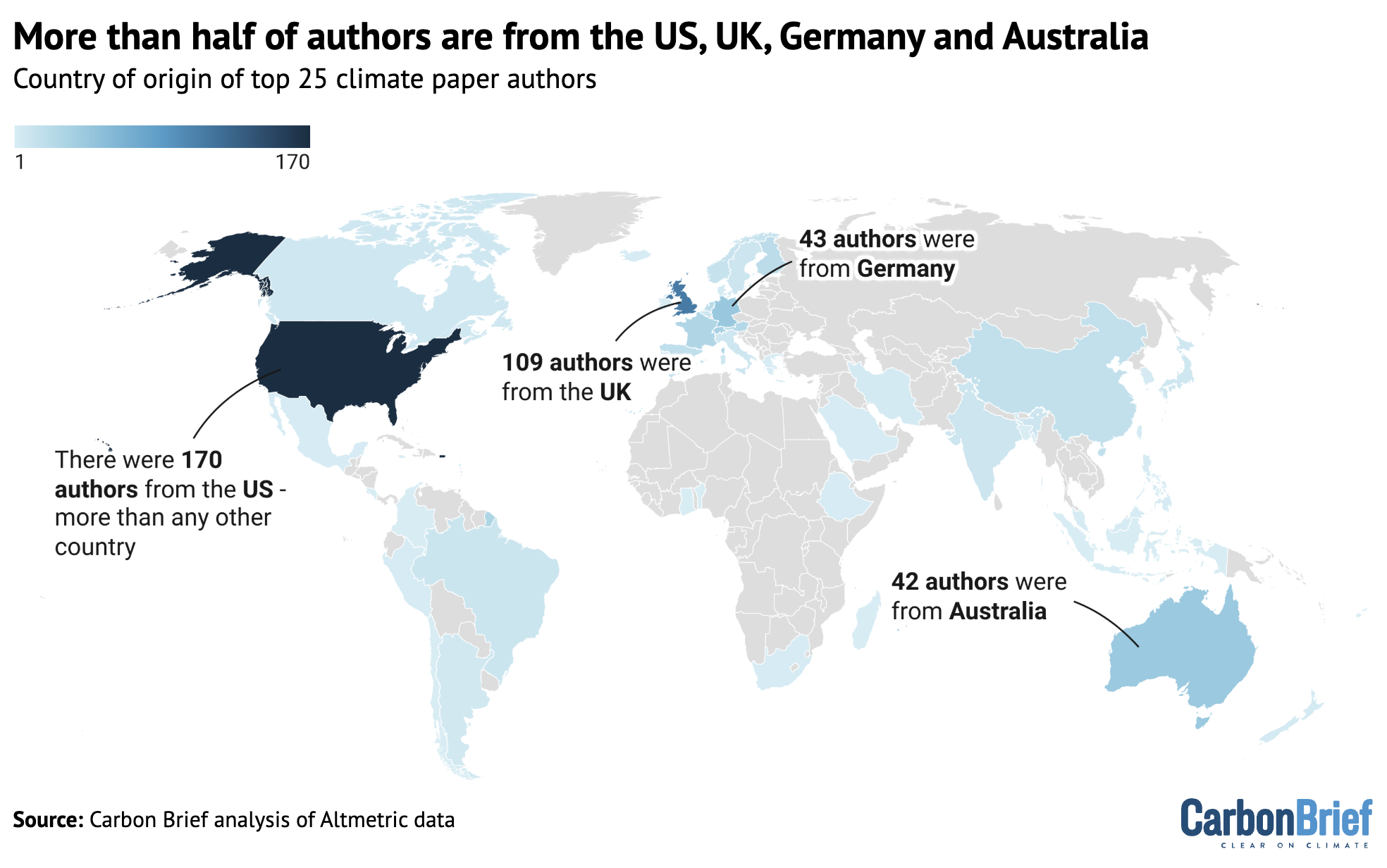
The number of all authors from the climate papers most featured in the media in 2025.
The number of all authors from the climate papers most featured in the media in 2025. The designations employed and the presentation of the material on this map do not imply the expression of any opinion whatsoever on the part of Carbon Brief concerning the legal status of any country, territory, city or area or of its authorities, or concerning the delimitation of its frontiers or boundaries. Map by Carbon Brief using Datawrapper.

The top-ranking countries on this map are the US and the UK, which account for 26% and 16% of the authors, respectively.

Carbon Brief also analysed the gender of the authors. 

Only one-third of authors from the top 25 climate papers of 2025 are women and only five of the 25 papers list a woman as lead author.

The plot below shows the number of authors from each continent, separated into men (dark blue) and women (light blue).
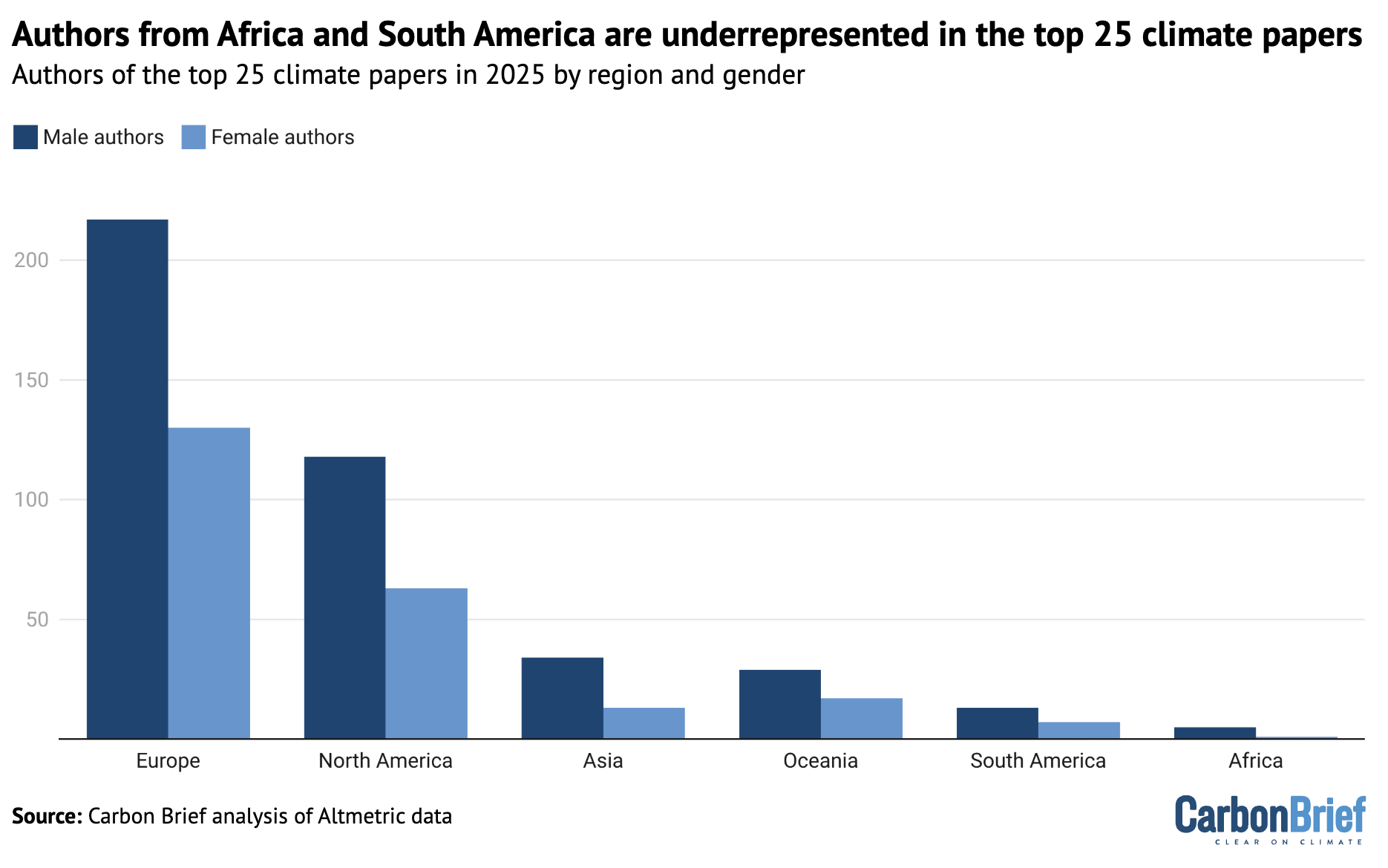
The number of men (dark blue) and women (light blue) listed as authors in the climate papers most featured in the media in 2025, shown by continent.
The number of men (dark blue) and women (light blue) listed as authors in the climate papers most featured in the media in 2025, shown by continent. Chart by Carbon Brief using Datawrapper.

The full spreadsheet showing the results of this data analysis can be found here. For more on the biases in climate publishing, see Carbon Brief’s article on the lack of diversity in climate-science research.

Elon Musk urges you to be a Fascist like him, says that you can ignore facts and reality then.
Donald Trump urges you to be a Climate Science denier like him. He says that he makes millions and millions for destroying the planet, Burn, Baby, Burn and Flood, Baby, Flood.
Orcas discuss Donald Trump and the killer apes' concept of democracy. Front Orca warns that Trump is crashing his country's economy and that everything he does he does for the fantastically wealthy.
Orcas discuss Donald Trump and the killer apes’ concept of democracy. Front Orca warns that Trump is crashing his country’s economy and that everything he does he does for the fantastically wealthy.

Original article republished from Carbon Brief under a CC license

Continue ReadingAnalysis: The climate papers most featured in the media in 2025

Global use of coal hit record high in 2024

Spread the love

https://www.theguardian.com/environment/2025/oct/22/global-use-of-coal-hit-record-high-in-2024

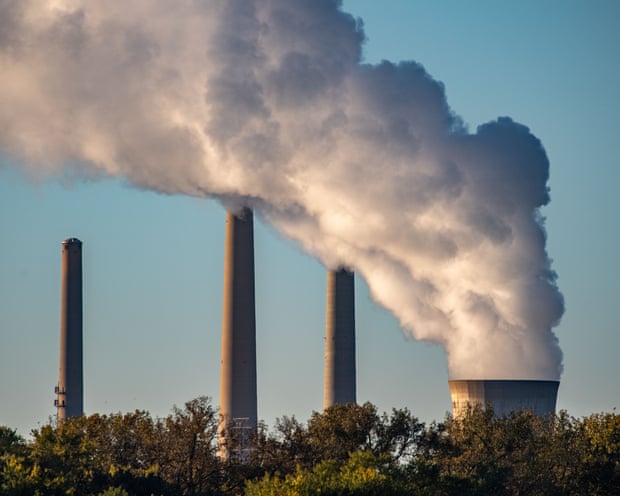
A coal power station in Ohio, US. Donald Trump has declared his support for coal and other fossil fuels. Photograph: Jason Whitman/NurPhoto/Shutterstock

Bleak report finds greenhouse gas emissions are still rising despite ‘exponential’ growth of renewables

Coal use hit a record high around the world last year despite efforts to switch to clean energy, imperilling the world’s attempts to rein in global heating.

The share of coal in electricity generation dropped as renewable energy surged ahead. But the general increase in power demand meant that more coal was used overall, according to the annual State of Climate Action report, published on Wednesday.

The report painted a grim picture of the world’s chances of avoiding increasingly severe impacts from the climate crisis. Countries are falling behind the targets they have set for reducing greenhouse gas emissions, which have continued to rise, albeit at a lower rate than before.

Clea Schumer, a research associate at the World Resources Institute thinktank, which led the report, said: “There’s no doubt that we are largely doing the right things. We are just not moving fast enough. One of the most concerning findings from our assessment is that for the fifth report in our series in a row, efforts to phase out coal are well off track.”

Article continues at https://www.theguardian.com/environment/2025/oct/22/global-use-of-coal-hit-record-high-in-2024

Orcas comment on killer apes destroying the planet by continuing to burn fossil fuels.
Donald Trump urges you to be a Climate Science denier like him. He says that he makes millions and millions for destroying the planet, Burn, Baby, Burn and Flood, Baby, Flood.
Nigel Farage urges you to ignore facts and reality and be a climate science denier like him and his Deputy Richard Tice. He says that Reform UK has received £Millions and £Millions from the fossil fuel industry to promote climate denial and destroy the planet.
Continue ReadingGlobal use of coal hit record high in 2024

Revealed: Forecasts of greenhouse gas emissions from fossil fuels soar in Trump’s first 100 days

Spread the love

https://www.theguardian.com/us-news/2025/may/02/trump-drill-baby-drill-tariffs

Expected greenhouse gas emissions from US oil and gas fields has jumped under Trump, after previously dropping under Biden, forecasts show. Photograph: Bloomberg/Getty Images

Tariff chaos hampers Trump’s pledge to ‘drill, baby, drill’, but analysis still shows surge in planet-heating emissions

Donald Trump’s ambitions for the US to “drill, baby, drill” for more fossil fuels have ironically been hampered by the economic chaos unleashed by his own tariffs, but the US is still on track to increase oil and gas extraction, causing a surge in planet-heating emissions, a new analysis shows.

The US was already the world’s leading oil and gas power, producing more of the fossil fuels than any country in history during Joe Biden’s administration. But Trump has sought to escalate this further, declaring an “energy emergency” to open up more land and ocean for drilling and launching an unprecedented assault on environmental regulations in his first 100 days back in the White House.

This new political climate means that the expected amount of greenhouse gas emissions from active and planned projects in US oil and gas fields has jumped under Trump, after previously dropping under Biden, forecasts shared with the Guardian show.

Despite awarding more drilling leases than Trump in his first 100 days, Biden also pursued policies to combat the climate crisis that saw oil and gas companies revise down their production estimates. That situation has now reversed, threatening a pulse of new pollution that will further add to the fever of a planet already suffering from heatwaves, floods, droughts and other disasters accelerated by global heating.

“The uptick in embodied emissions from forecast US oil and gas production is worrying,” said Olivier Bois von Kursk, policy adviser at the International Institute for Sustainable Development, which tracks emissions projections from the lifetime of projects, based on data from research consultancy Rystad Energy. “The world can’t afford more climate chaos.”

The International Energy Agency, which has forecast that global oil and gas demand will peak by 2030, has said that no new major fossil fuel projects can occur if the world is to stay within agreed temperature limits and avoid catastrophic climate impacts. Last year was the hottest, worldwide, ever recorded and governments are collectively failing to meet targets to avert escalating disasters.

Tariffs on solar panels from Vietnam, Cambodia and Malaysia have been ratcheted up to as much as 3,521%. “We don’t want windmills in this country,” the president said shortly after his inauguration in January. “We don’t want windmills. You know what else people don’t like? Those massive solar fields.”

https://www.theguardian.com/us-news/2025/may/02/trump-drill-baby-drill-tariffs

Neo-Fascist Climate Science Denier Donald Trump says Burn, Baby, Burn.
Elon Musk urges you to be a Fascist like him, says that you can ignore facts and reality then.
Orcas discuss Donald Trump and the killer apes' concept of democracy. Front Orca warns that Trump is crashing his country's economy and that everything he does he does for the fantastically wealthy.
Orcas discuss Donald Trump and the killer apes’ concept of democracy. Front Orca warns that Trump is crashing his country’s economy and that everything he does he does for the fantastically wealthy.

‘A ruthless agenda’: charting 100 days of Trump’s onslaught on the environment

Continue ReadingRevealed: Forecasts of greenhouse gas emissions from fossil fuels soar in Trump’s first 100 days

Fossil fuel industry accused of seeking special treatment over oilfield emissions

Spread the love

https://www.theguardian.com/environment/2025/feb/18/fossil-fuel-industry-accused-of-seeking-special-treatment-over-oilfield-emissions

Protests against the Rosebank oilfield in Edinburgh in 2024. Labour pledged in its manifesto to halt new North Sea licensing, but Rosebank was awaiting final approval when the party won the general election. Photograph: Murdo MacLeod/The Guardian

Lobbyists argued it was unfair for their industry to be treated the same as others as end product – oil and gas – inevitably produced emissions

Experts have accused the fossil fuel industry of seeking special treatment after lobbyists argued greenhouse gas emissions from oilfields should be treated differently to those from other industries.

The government is embroiled in a row over whether to allow a massive new oilfield, Rosebank, to go ahead, with some cabinet members arguing it could boost growth and others concerned it could make the goal of reaching net zero emissions by 2050 impossible to reach. Labour made a manifesto commitment to halt new North Sea licensing, but Rosebank and some other projects had already been licensed and were awaiting final approval when the party won the general election.

Documents seen by the Guardian show the industry group Offshore Energies UK (OEUK) asking for Rosebank and other oilfields’ “scope three emissions” – those caused by the burning of extracted oil and gas – to be treated differently because that was the point of their business.

A court case recently found the licence granted to Rosebank by the previous government was unlawful as it failed to take these emissions into account.

I am only able to quote a small section of this copyrighted article. See the original article at https://www.theguardian.com/environment/2025/feb/18/fossil-fuel-industry-accused-of-seeking-special-treatment-over-oilfield-emissions

Orcas are pleased that Rosebank and Jackdaw oil fields are blocked.

Continue ReadingFossil fuel industry accused of seeking special treatment over oilfield emissions

The overshoot myth: you can’t keep burning fossil fuels and expect scientists of the future to get us back to 1.5°C

Spread the love
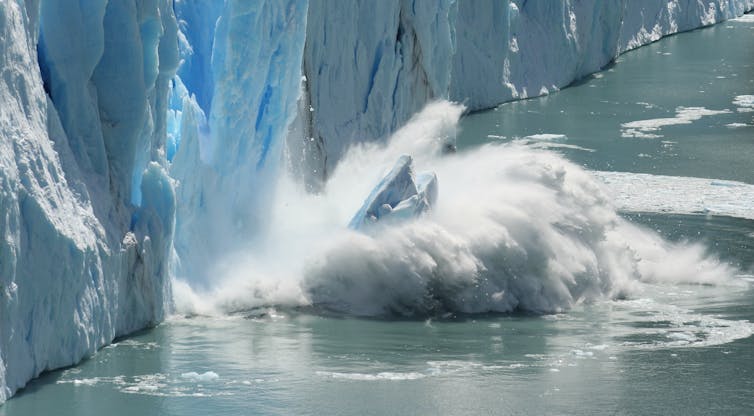
Melting Antarctic glacier. Shutterstock/Bernhard Staehli

James Dyke, University of Exeter; Robert Watson, University of East Anglia, and Wolfgang Knorr, Lund University

Record breaking fossil fuel production, all time high greenhouse gas emissions and extreme temperatures. Like the proverbial frog in the heating pan of water, we refuse to respond to the climate and ecological crisis with any sense of urgency. Under such circumstances, claims from some that global warming can still be limited to no more than 1.5°C take on a surreal quality.

For example, at the start of 2023’s international climate negotiations in Dubai, conference president, Sultan Al Jaber, boldly stated that 1.5°C was his goal and that his presidency would be guided by a “deep sense of urgency” to limit global temperatures to 1.5°C. He made such lofty promises while planning a massive increase in oil and gas production as CEO of the Abu Dhabi National Oil Company.

We should not be surprised to see such behaviour from the head of a fossil fuel company. But Al Jaber is not an outlier. Scratch at the surface of almost any net zero pledge or policy that claims to be aligned with the 1.5°C goal of the landmark 2015 Paris agreement and you will reveal the same sort of reasoning: we can avoid dangerous climate change without actually doing what this demands – which is to rapidly reduce greenhouse gas emissions from industry, transport, energy (70% of total) and food systems (30% of total), while ramping up energy efficiency.

A particularly instructive example is Amazon. In 2019 the company established a 2040 net zero target which was then verified by the UN Science Based Targets initiative (SBTi) which has been leading the charge in getting companies to establish climate targets compatible with the Paris agreement. But over the next four years Amazon’s emissions went up by 40%. Given this dismal performance, the SBTi was forced to act and removed Amazon and over 200 companies from its Corporate Net Zero Standard.

This is also not surprising given that net zero and even the Paris agreement have been built around the perceived need to keep burning fossil fuels, at least in the short term. Not do so would threaten economic growth, given that fossil fuels still supply over 80% of total global energy. The trillions of dollars of fossil fuel assets at risk with rapid decarbonisation have also served as powerful brakes on climate action.

Overshoot

The way to understand this doublethink: that we can avoid dangerous climate change while continuing to burn fossil fuels – is that it relies on the concept of overshoot. The promise is that we can overshoot past any amount of warming, with the deployment of planetary-scale carbon dioxide removal dragging temperatures back down by the end of the century.

This not only cripples any attempt to limit warming to 1.5°C, but risks catastrophic levels of climate change as it locks us in to energy and material-intensive solutions which for the most part exist only on paper.

To argue that we can safely overshoot 1.5°C, or any amount of warming, is saying the quiet bit out loud: we simply don’t care about the increasing amount of suffering and deaths that will be caused while the recovery is worked on.


This article is part of Conversation Insights.
Our co-editors commission long-form journalism, working with academics from many different backgrounds who are engaged in projects aimed at tackling societal and scientific challenges.


A key element of overshoot is carbon dioxide removal. This is essentially a time machine – we are told we can turn back the clock of decades of delay by sucking carbon dioxide directly out of the atmosphere. We don’t need rapid decarbonisation now, because in the future we will be able to take back those carbon emissions. If or when that doesn’t work, we are led to believe that even more outlandish geoengineering approaches such as spraying sulphurous compounds into the high atmosphere in an attempt to block out sunlight – which amounts to planetary refrigeration – will save us.

The 2015 Paris agreement was an astonishing accomplishment. The establishment of 1.5°C as being the internationally agreed ceiling for warming was a success for those people and nations most exposed to climate change hazards. We know that every fraction of a degree matters. But at the time, believing warming could really be limited to well below 2°C required a leap of faith when it came to nations and companies putting their shoulder to the wheel of decarbonisation. What has happened instead is that the net zero approach of Paris is becoming detached from reality as it is increasingly relying on science fiction levels of speculative technology.

There is arguably an even bigger problem with the Paris agreement. By framing climate change in terms of temperature, it focuses on the symptoms, not the cause. 1.5°C or any amount of warming is the result of humans changing the energy balance of the climate by increasing the amount of carbon dioxide in the atmosphere. This traps more heat. Changes in the global average temperature is the established way of measuring this increase in heat, but no one experiences this average.

Climate change is dangerous because of weather that affects particular places at particular times. Simply put, this extra heat is making weather more unstable. Unfortunately, having temperature targets makes solar geoengineering seem like a sensible approach because it may lower temperatures. But it does this by not reducing, but increasing our interference in the climate system. Trying to block out the sun in response to increasing carbon emissions is like turning on the air conditioning in response to a house fire.

In 2021 we argued that net zero was a dangerous trap. Three years on and we can see the jaws of this trap beginning to close, with climate policy being increasingly framed in terms of overshoot. The resulting impacts on food and water security, poverty, human health, the destruction of biodiversity and ecosystems will produce intolerable suffering.

The situation demands honesty, and a change of course. If this does not materialise then things are likely to deteriorate, potentially rapidly and in ways that may be impossible to control.

Au revoir Paris

The time has come to accept that climate policy has failed, and that the 2015 landmark Paris agreement is dead. We let it die by pretending that we could both continue to burn fossil fuels and avoid dangerous climate change at the same time. Rather than demand the immediate phase out of fossil fuels, the Paris agreement proposed 22nd-century temperature targets which could be met by balancing the sources and sinks of carbon. Within that ambiguity net zero flourished. And yet apart from the COVID economic shock in 2020, emissions have increased every year since 2015, reaching an all time high in 2023.

Despite there being abundant evidence that climate action makes good economic sense (the cost of inaction vastly exceeds the cost of action), no country strengthened their pledges at the last three COPs (the annual UN international meetings) even though it was clear that the world was on course to sail past 2°C, let alone 1.5°C. The Paris agreement should be producing a 50% reduction in greenhouse gas emissions by 2030, but current policies mean that they are on track to be higher than they are today.

Greenhouse gas emissions continue to rise. Catazul/Pixabay, CC BY

We do not deny that significant progress has been made with renewable technologies. Rates of deployment of wind and solar have increased each year for the past 22 years and carbon emissions are going down in some of the richest nations, including the UK and the US. But this is not happening fast enough. A central element of the Paris agreement is that richer nations need to lead decarbonisation efforts to give lower income nations more time to transition away from fossil fuels. Despite some claims to the contrary, the global energy transition is not in full swing. In fact, it hasn’t actually begun because the transition demands a reduction in fossil fuel use. Instead it continues to increase year-on-year.

And so policymakers are turning to overshoot in an attempt to claim that they have a plan to avoid dangerous climate change. A central plank of this approach is that the climate system in the future will continue to function as it does today. This is a reckless assumption.

2023’s warning signs

At the start of 2023, Berkeley Earth, NASA, the UK Met Office, and Carbon Brief predicted that 2023 would be slightly warmer than the previous year but unlikely to set any records. Twelve months later and all four organisations concluded that 2023 was by some distance the warmest year ever recorded. In fact, between February 2023 and February 2024 the global average temperature warming exceeded the Paris target of 1.5°C.

The extreme weather events of 2023 give us a glimpse of the suffering that further global warming will produce. A 2024 report from the World Economic Forum concluded that by 2050 climate change may have caused over 14 million deaths and US$12.5 trillion in loss and damages.

Currently we cannot fully explain why global temperatures have been so high for the past 18 months. Changes in dust, soot and other aerosols are important, and there are natural processes such as El Niño that will be having an effect.

But it appears that there is still something missing in our current understanding of how the climate is responding to human impacts. This includes changes in the Earth’s vital natural carbon cycle.

Around half of all the carbon dioxide humans have put into the atmosphere over the whole of human history has gone into “carbon sinks” on land and the oceans. We get this carbon removal “for free”, and without it, warming would be much higher. Carbon dioxide from the air dissolves in the oceans (making them more acidic which threatens marine ecosystems). At the same time, increasing carbon dioxide promotes the growth of plants and trees which locks up carbon in their leaves, roots, trunks.

All climate policies and scenarios assume that these natural carbon sinks will continue to remove tens of billions of tons of carbon from the atmosphere each year. There is evidence that land-based carbon sinks, such as forests, removed significantly less carbon in 2023. If natural sinks begin to fail – something they may well do in a warmer world – then the task of lowering global temperatures becomes even harder. The only credible way of limiting warming to any amount, is to stop putting greenhouse gasses into the atmosphere in the first place.

Science fiction solutions

It’s clear that the commitments countries have made to date as part of the Paris agreement will not keep humanity safe while carbon emissions and temperatures continue to break records. Indeed, proposing to spend trillions of dollars over this century to suck carbon dioxide out of the air, or the myriad other ways to hack the climate is an acknowledgement that the world’s largest polluters are not going to curb the burning of fossil fuels.

Direct Air Capture (DAC), Bio Energy Carbon Capture and Storage (BECCS), enhanced ocean alkalinity, biochar, sulphate aerosol injection, cirrus cloud thinning – the entire wacky races of carbon dioxide removal and geoengineering only makes sense in a world of failed climate policy.

Clouds in the sky.
Is ‘cloud thinning’ really a possibility? HarmonyCenter/Pixabay, CC BY

Over the following years we are going to see climate impacts increase. Lethal heatwaves are going to become more common. Storms and floods are going to become increasingly destructive. More people are going to be displaced from their homes. National and regional harvests will fail. Vast sums of money will need to be spent on efforts to adapt to climate change, and perhaps even more compensating those who are most affected. We are expected to believe that while all this and more unfolds, new technologies that will directly modify the Earth’s atmosphere and energy balance will be successfully deployed.

What’s more, some of these technologies may need to operate for three hundred years in order for the consequences of overshoot to be avoided. Rather than quickly slow down carbon polluting activities and increasing the chances that the Earth system will recover, we are instead going all in on net zero and overshoot in an increasingly desperate hope that untested science fiction solutions will save us from climate breakdown.

We can see the cliff edge rapidly approaching. Rather than slam on the brakes, some people are instead pushing their foot down harder on the accelerator. Their justification for this insanity is that we need to go faster in order to be able to make the jump and land safely on the other side.

We believe that many who advocate for carbon dioxide removal and geoengineering do so in good faith. But they include proposals to refreeze the Arctic by pumping up sea water onto ice sheets to form new layers of ice and snow. These are interesting ideas to research, but there is very little evidence this will have any effect on the Arctic let alone global climate. These are the sorts of knots that people tie themselves up in when they acknowledge the failure of climate policy, but refuse to challenge the fundamental forces behind such failure. They are unwittingly slowing down the only effective action of rapidly phasing out fossil fuels.

That’s because proposals to remove carbon dioxide from the air or geoengineer the climate promise a recovery from overshoot, a recovery that will be delivered by innovation, driven by growth. That this growth is powered by the same fossil fuels that are causing the problem in the first place doesn’t feature in their analysis.

The bottom line here is that the climate system is utterly indifferent to our pledges and promises. It doesn’t care about economic growth. And if we carry on burning fossil fuels then it will not stop changing until the energy balance is restored. By which time millions of people could be dead, with many more facing intolerable suffering.

Major climate tipping points

Even if we assume that carbon removal and even geoengineering technologies can be deployed in time, there is a very large problem with the plan to overshoot 1.5°C and then lower temperatures later: tipping points.

The science of tipping points is rapidly advancing. Late last year one of us (James Dyke) along with over 200 academics from around the world was involved in the production of the Global Tipping Points Report. This was a review of the latest science about where tipping points in the climate system may be, as well as exploring how social systems can undertake rapid change (in the direction that we want) thereby producing positive tipping points. Within the report’s 350 pages is abundant evidence that the overshoot approach is an extraordinarily dangerous gamble with the future of humanity. Some tipping points have the potential to cause global havoc.

The melt of permafrost could release billions of tons of greenhouse gasses into the atmosphere and supercharge human-caused climate change. Fortunately, this seems unlikely under the current warming. Unfortunately, the chance that ocean currents in the North Atlantic could collapse may be much higher than previously thought. If that were to materialise, weather systems across the world, but in particular in Europe and North America, would be thrown into chaos. Beyond 1.5°C, warm water coral reefs are heading towards annihilation. The latest science concludes that by 2°C global reefs would be reduced by 99%. The devastating bleaching event unfolding across the Great Barrier Reef follows multiple mass mortality events. To say we are witnessing one of the world’s greatest biological wonders die is insufficient. We are knowingly killing it.

We may have even already passed some major climate tipping points. The Earth has two great ice sheets, Antarctica, and Greenland. Both are disappearing as a consequence of climate change. Between 2016 and 2020, the Greenland ice sheet lost on average 372 billion tons of ice a year. The current best assessment of when a tipping point could be reached for the Greenland ice sheet is around 1.5°C.

This does not mean that the Greenland ice sheet will suddenly collapse if warming exceeds that level. There is so much ice (some 2,800 trillion tons) that it would take centuries for all of it to melt over which time sea levels would rise seven metres. If global temperatures could be brought back down after a tipping point, then maybe the ice sheet could be stabilised. We just cannot say with any certainty that such a recovery would be possible. While we struggle with the science, 30 million tons of ice is melting across Greenland every hour on average.

Melting ice flows.
Ice sheets in Greenland and Antarctica are being affected by global warming. Pexels from Pixabay, CC BY

The take home message from research on these and other tipping points is that further warming accelerates us towards catastrophe. Important science, but is anyone listening?

It’s five minutes to midnight…again

We know we must urgently act on climate change because we are repeatedly told that time is running out. In 2015, Professor Jeffrey Sachs, the UN special adviser and director of The Earth Institute, declared:

The time has finally arrived – we’ve been talking about these six months for many years but we’re now here. This is certainly our generation’s best chance to get on track.

In 2019 (then) Prince Charles gave a speech in which he said: “I am firmly of the view that the next 18 months will decide our ability to keep climate change to survivable levels and to restore nature to the equilibrium we need for our survival.”

“We have six months to save the planet,” exhorted International Energy Agency head Fatih Birol – one year later in 2020. In April 2024, Simon Stiell, executive secretary of the United Nations Framework Convention on Climate Change said the next two years are “essential in saving our planet”.

Either the climate crisis has a very fortunate feature that allows the countdown to catastrophe to be continually reset, or we are deluding ourselves with endless declarations that time has not quite run out. If you can repeatedly hit snooze on your alarm clock and roll over back to sleep, then your alarm clock is not working.

Or there is another possibility. Stressing that we have very little time to act is intended to focus attention on climate negotiations. It’s part of a wider attempt to not just wake people up to the impending crisis, but generate effective action. This is sometimes used to explain how the 1.5°C threshold of warming came to be agreed. Rather than a specific target, it should be understood as a stretch goal. We may very well fail, but in reaching for it we move much faster than we would have done with a higher target, such as 2°C. For example, consider this statement made in 2018:

Stretching the goal to 1.5 degrees celsius isn’t simply about speeding up. Rather, something else must happen and society needs to find another lever to pull on a global scale.

What could this lever be? New thinking about economics that goes beyond GDP? Serious consideration of how rich industrialised nations could financially and materially help poorer nations to leapfrog fossil fuel infrastructure? Participatory democracy approaches that could help birth the radical new politics needed for the restructuring of our fossil fuel powered societies? None of these.

The lever in question is Carbon Capture and Storage (CCS) because the above quote comes from an article written by Shell in 2018. In this advertorial Shell argues that we will need fossil fuels for many decades to come. CCS allows the promise that we can continue to burn fossil fuels and avoid carbon dioxide pollution by trapping the gas before it leaves the chimney. Back in 2018, Shell was promoting its carbon removal and offsets heavy Sky Scenario, an approach described as “a dangerous fantasy” by leading climate change academics as it assumed massive carbon emissions could be offset by tree planting.

Since then Shell has further funded carbon removal research within UK universities presumably in efforts to burnish its arguments that it must be able to continue to extract vast amounts of oil and gas.

Shell is far from alone in waving carbon capture magic wands. Exxon is making great claims for CCS as a way to produce net zero hydrogen from fossil gas – claims that have been subject to pointed criticism from academics with recent reporting exposing industry wide greenwashing around CCS.

But the rot goes much deeper. All climate policy scenarios that propose to limit warming to near 1.5°C rely on the largely unproven technologies of CCS and BECCS. BECCS sounds like a good idea in theory. Rather than burn coal in a power station, burn biomass such as wood chips. This would initially be a carbon neutral way of generating electricity if you grew as many trees as you cut down and burnt. If you then add scrubbers to the power station chimneys to capture the carbon dioxide, and then bury that carbon deep underground, then you would be able to generate power at the same time as reducing concentrations of carbon dioxide in the atmosphere.

Unfortunately, there is now clear evidence that in practice, large-scale BECCS would have very adverse effects on biodiversity, and food and water security given the large amounts of land that would be given over to fast growing monoculture tree plantations. The burning of biomass may even be increasing carbon dioxide emissions. Drax, the UK’s largest biomass power station now produces four times as much carbon dioxide as the UK’s largest coal-fired power station.

Five minutes to midnight messages may be motivated to try to galvanise action, to stress the urgency of the situation and that we still (just) have time. But time for what? Climate policy only ever offers gradual change, certainly nothing that would threaten economic growth, or the redistribution of wealth and resources.

Despite the mounting evidence that globalised, industrialised capitalism is propelling humanity towards disaster, five minutes to midnight does not allow time and space to seriously consider alternatives. Instead, the solutions on offer are techno fixes that prop up the status quo and insists that fossil fuel companies such as Shell must be part of the solution.

That is not to say there are no good faith arguments for 1.5°C. But being well motivated does not alter reality. And the reality is that warming will soon pass 1.5°C, and that the Paris agreement has failed. In the light of that, repeatedly asking people to not give up hope, that we can avoid a now unavoidable outcome risks becoming counterproductive. Because if you insist on the impossible (burning fossil fuels and avoiding dangerous climate change), then you must invoke miracles. And there is an entire fossil fuel industry quite desperate to sell such miracles in the form of CCS.

Four suggestions

Humanity has enough problems right now, what we need are solutions. This is the response we sometimes get when we argue that there are fundamental problems with the net zero concept and the Paris agreement. It can be summed up with the simple question: so what’s your suggestion? Below we offer four.

1. Leave fossil fuels in the ground

The unavoidable reality is that we need to rapidly stop burning fossil fuels. The only way we can be sure of that is by leaving them in the ground. We have to stop exploring for new fossil fuel reserves and the exploitation of existing ones. That could be done by stopping fossil fuel financing.

At the same time we must transform the food system, especially the livestock sector, given that it is responsible for nearly two thirds of agricultural emissions. Start there and then work out how best the goods and services of economies can be distributed. Let’s have arguments about that based on reality not wishful thinking.

2. Ditch net zero crystal ball gazing targets

The entire framing of mid and end-century net zero targets should be binned. We are already in the danger zone. The situation demands immediate action, not promises of balancing carbon budgets decades into the future. The SBTi should focus on near-term emissions reductions. By 2030, global emissions need to be half of what they are today for any chance of limiting warming to no more than 2°C.

It is the responsibility of those who hold most power – politicians and business leaders – to act now. To that end we must demand twin targets – all net zero plans should include a separate target for actual reductions in greenhouse gas emissions. We must stop hiding inaction behind promises of future removals. It’s our children and future generations that will need to pay back the overshoot debt.

3. Base policy on credible science and engineering

All climate policies must be based on what can be done in the real world now, or in the very near future. If it is established that a credible amount of carbon can be removed by a proposed approach – which includes capture and its safe permanent storage – then and only then can this be included in net zero plans. The same applies to solar geoengineering.

Speculative technologies must be removed from all policies, pledges and scenarios until we are sure of how they will work, how they will be monitored, reported and validated, and what they will do to not just the climate but the Earth system as a whole. This would probably require a very large increase in research. As academics we like doing research. But academics need to be wary that concluding “needs more research” is not interpreted as “with a bit more funding this could work”.

4. Get real

Finally, around the world there are thousands of groups, projects, initiatives, and collectives that are working towards climate justice. But while there is a Climate Majority Project, and a Climate Reality Project, there is no Climate Honesty Project (although People Get Real does come close). In 2018 Extinction Rebellion was formed and demanded that governments tell the truth about the climate crisis and act accordingly. We can now see that when politicians were making their net zero promises they were also crossing their fingers behind their backs.

We need to acknowledge that net zero and now overshoot are becoming used to argue that nothing fundamental needs to change in our energy intensive societies. We must be honest about our current situation, and where we are heading. Difficult truths need to be told. This includes highlighting the vast inequalities of wealth, carbon emissions, and vulnerability to climate change.

The time for action is now

We rightly blame politicians for failing to act. But in some respects we get the politicians we deserve. Most people, even those that care about climate change, continue to demand cheap energy and food, and a constant supply of consumer products. Reducing demand by just making things more expensive risks plunging people into food and energy poverty and so policies to reduce emissions from consumption need to go beyond market-based approaches. The cost of living crisis is not separate from the climate and ecological crisis. They demand that we radically rethink how our economies and societies function, and whose interests they serve.

To return to the boiling frog predicament at the start, it’s high time for us to jump out of the pot. You have to wonder why we did not start decades ago. It’s here that the analogy offers valuable insights into net zero and the Paris agreement. Because the boiling frog story as typically told misses out a crucial fact. Regular frogs are not stupid. While they will happily sit in slowly warming water, they will attempt to escape once it becomes uncomfortable. The parable as told today is based on experiments at the end of the 19th century that involved frogs that had been “pithed” – a metal rod had been inserted into their skulls that destroyed their higher brain functioning. These radically lobotomised frogs would indeed float inert in water that was cooking them alive.

Promises of net zero and recovery from overshoot are keeping us from struggling to safety. They assure us nothing too drastic needs to happen just yet. Be patient, relax. Meanwhile the planet burns and we see any sort of sustainable future go up in smoke.

Owning up to the failures of climate change policy doesn’t mean giving up. It means accepting the consequences of getting things wrong, and not making the same mistakes. We must plan routes to safe and just futures from where we are, rather where we would wish to be. The time has come to leap.


For you: more from our Insights series:

To hear about new Insights articles, join the hundreds of thousands of people who value The Conversation’s evidence-based news. Subscribe to our newsletter.

James Dyke, Associate Professor in Earth System Science, University of Exeter; Robert Watson, Emeritus Professor in Environmental Sciences, University of East Anglia, and Wolfgang Knorr, Senior Research Scientist, Physical Geography and Ecosystem Science, Lund University

This article is republished from The Conversation under a Creative Commons license. Read the original article.

Continue ReadingThe overshoot myth: you can’t keep burning fossil fuels and expect scientists of the future to get us back to 1.5°C