Look at Labour’s acts of environmental vandalism and ask: did I vote for this?

Spread the love

I am only able to quote small sections of this copyrighted article by George Monbiot published in the Guardian. The whole article is here.

A plane comes into land at Heathrow airport, London. Photograph: Avpics/Alamy

Our rivers, our wildlife, the air we breathe: the government is sacrificing all to the insatiable god of GDP – and mocking our objections

I can scarcely believe I’m writing this, but it’s hard to dodge the conclusion. After 14 years of environmental vandalism, it might have seemed impossible for Labour to offer anything but improvement. But on green issues, this government is worse than the Tories.

The last prime minister to insist that growth should override every other consideration, and to fling insults at anyone who disagreed, was Liz Truss. She called those of us seeking to defend the living world an “anti-growth coalition”, “voices of decline” and “enemies of enterprise” who “don’t understand aspiration”.

Now Keir Starmer has picked up her theme and run with it. Those who challenge government policies that might promote GDP growth, however destructive and irrational, such as the planned expansion of Heathrow, Gatwick, Luton and Doncaster Sheffield airports, are “time-wasting nimbys”, “zealots” and “blockers”, engaged in “self-righteous virtue-signalling”.

After all, these are the kind of people who might send “congratulations to the climate campaigners” whose legal challenge stopped plans to build a third Heathrow runway at the court of appeal. Or who insist that Heathrow expansion should be blocked because “there is no more important challenge than the climate emergency”. Oh, hang on, that was Starmer, writing in 2020. You know, the one you voted for, not the new model, channelling the worst Tory prime minister of modern times.

Now his chancellor, Rachel Reeves, insists that growth “trumps other things”, including the government’s environmental commitments. The verb is unfortunate. The government’s new rhetoric is horribly reminiscent of the convicted felon: monomania, slogans and insults take the place of nuanced and complex policy.

I am only able to quote small sections of this copyrighted article by George Monbiot published in the Guardian. The whole article is here.

Orcas comment on killer apes destroying the planet by continuing to burn fossil fuels.
Continue ReadingLook at Labour’s acts of environmental vandalism and ask: did I vote for this?

Reports on Heat Waves and Flooding Usually Neglect to Explain Why They’re Happening: Study

Spread the love

Original article by OLIVIA RIGGIO republished from FAIR under a Creative Commons Attribution-NonCommercial-NoDerivs 3.0 Unported License.

This month brought yet another record-breaking spate of flash floods and deadly heatwaves across the US. Yet, as a new study by Heated (6/27/24) reveals, despite ample reporting on these events, a majority of news outlets still did not link these events to their cause: climate change.

Emily Atkin and Arielle Samuelson, writers for the climate-focused, Substack-based outlet, analyzed 133 digital breaking news articles from national, international and regional outlets reporting on this month’s extreme weather. Just 44% mentioned the climate crisis or global warming. Broken down by weather event: 52% of stories that covered heatwaves, and only 25% of stories that covered extreme rainfall, mentioned climate change.

As Atkin and Samuelson write, by now we know that climate change is the main cause of both extreme heat and extreme flooding. And we know the biggest contributor of climate-disrupting greenhouse gasses: fossil fuels, which account for about 75% of global emissions annually.

Still, the study’s authors found, only 11% of the articles they studied mentioned fossil fuels. Only one piece (BBC6/24/24) mentioned deforestation, which scientists say contributes about 20% of annual greenhouse gas emissions. None mentioned animal agriculture, which the FAO estimates contributes about 12% of global emissions.

Stark omissions

The omissions were laughably stark: A New York Post piece (6/21/24) ended with a New Yorker and former Marine who said he’d been in “way hotter conditions”—in Kuwait and Iraq. An AP article (6/4/24) quoted the “explanation” offered by a spokesperson for the Arizona Department of Forestry and Fire Management: “It does seem like Mother Nature is turning up the heat on us a little sooner than usual.”

Heated recognized some outlets that consistently mentioned climate change in their breaking coverage of heat and floods this month. That list included NPRVoxAxiosBBC and Agence France-Presse (AFP).

Then there were the outlets whose breaking coverage never mentioned it: ABC NewsUSA TodayThe Hill, the New York Post and Fox Weather. When questioned, many of these outlets pointed the study’s authors to other climate coverage they had done, but this study’s focus on breaking news stories  was deliberate:

Our analysis focused only on breaking stories because climate change is not a follow-up story; it is the story of the lethal and economically devastating extreme weather playing out across the country. To not mention climate change in a breaking news story about record heat in June 2024 is like not mentioning Covid-19 in a breaking news article about record hospitalizations in March 2020. It’s an abdication of journalistic responsibility to inform.

Explaining isn’t hard

A crucial takeaway for journalists and editors in this piece is that explaining the cause of these weather events isn’t hard. It’s often a matter of adding a sentence at most, Atkin and Samuelson write. They provide examples of stories that successfully made this connection, as with BBC (6/24/24):

Scientists say extreme weather events are becoming more frequent and intense as a result of human-caused climate change, fueled by activities like burning fossil fuels and cutting down forests.

Or the Guardian (6/23/24):

Heatwaves are becoming more severe and prolonged due to the global climate crisis, caused primarily by the burning of fossil fuels.

Notably, the Guardian piece was a reprint of an AP article that did not originally include that sentence; Heated confirmed that it was added by a Guardian editor.

AP, however, was sometimes able to provide appropriate context, as in a June 21 piece:

This month’s sizzling daytime temperatures were 35 times more likely and 2.5 degrees F hotter (1.4 degrees C) because of the warming from the burning of coal, oil and natural gas—in other words, human-caused climate change.

More denial than acknowledgment

During last summer’s apocalyptic orange haze on the East Coast, caused by record Canadian wildfires, I conducted a similar study (FAIR.org7/18/23) on US TV news’s coverage. Out of 115 segments, only 38% mentioned climate change’s role. Of those 115, 10 mentioned it in passing, 10 engaged in climate denial and 12 gave a brief explanation without alluding to the reality that climate change is human-caused. Only five segments acknowledged that climate change was human caused, and just seven fully fleshed out the fact that the  main cause of the climate crisis is fossil fuels.

When there are more segments denying climate change than acknowledging fossil fuels’ role in it, you know there’s a problem.

This year, I noticed coverage of worldwide coral bleaching that did make the appropriate connections (FAIR.org5/17/24). As Atkin and Samuelson emphasized, the difference between careless and responsible reporting on this issue is often just a few words.

Original article by OLIVIA RIGGIO republished from FAIR under a Creative Commons Attribution-NonCommercial-NoDerivs 3.0 Unported License.

Continue ReadingReports on Heat Waves and Flooding Usually Neglect to Explain Why They’re Happening: Study

200 Private Jet Owners Burned as Much CO2 as 40,000 Brits

Spread the love

Original article by OLIVIA ROSANE republished from Common Dreams under Creative Commons (CC BY-NC-ND 3.0). 

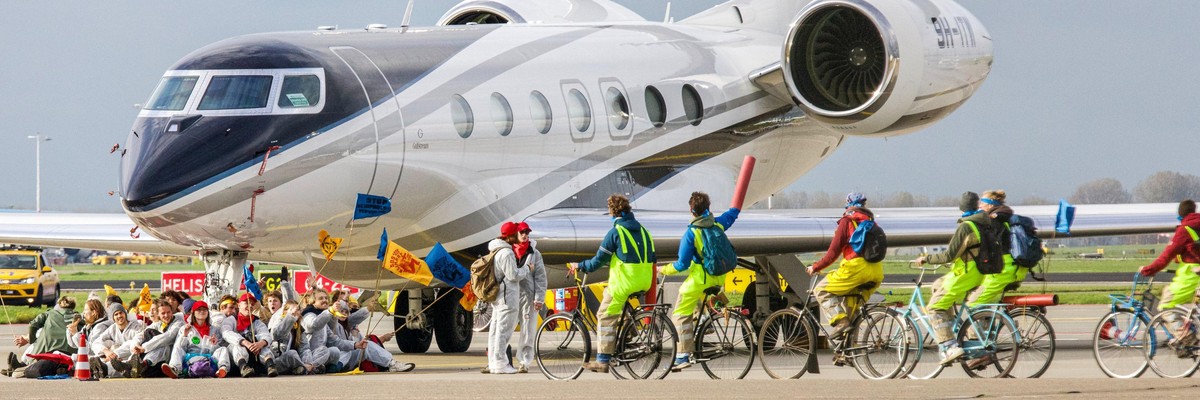
Greenpeace Netherlands and Extinction Rebellion activists block a private jet at the Schiphol Airport in Amsterdam on Saturday, November 5, 2022.
 (Photo: (c) Marten van Dijl/Greenpeace)

The planes tracked by a new Guardian report belong to celebrities, billionaires, CEOs, and their families, among them the Murdoch family, Taylor Swift, and the Rolling Stones.

The private jets of just 200 rich and famous individuals or groups released around 415,518 metric tons of climate-heating carbon dioxide between January 2022 and September 22, 2023, The Guardian revealed Tuesday.

That’s equal to the emissions burned by nearly 40,000 British residents in all aspects of their lives, the newspaper calculated.

The planes tracked by the outlet belong to celebrities, billionaires, CEOs, and their families, among them the Murdoch family, Taylor Swift, and the Rolling Stones. All told, the high-flyers made a total of 44,739 trips during the study period for a combined 11 years in the air.

“Pollution for wasteful luxury has to be the first to go, we need a ban on private jets.”

Notable emitters included the Blavatnik family, the Murdoch family, and Eric Schmidt, whose flights during the 21-month study period released more than 7,500 metric tons of carbon dioxide equivalent. The Sawiris family emitted around 7,500 metric tons, and Lorenzo Fertitta more than 5,000.

The Rolling Stones’ Boeing 767 wide-body aircraft released around 5,046 metric tons of carbon dioxide, which is equal to 1,763 economy flights from London to New York. The 39 jets owned by 30 Russian oligarchs released 30,701 metric tons of carbon dioxide.

For comparison, average per capita emissions were 14.44 metric tons in the U.S. for 2022, 13.52 metric tons in Russia in 2021, and 5.2 metric tons in the U.K. the same year.

Taylor Swift was the only celebrity or billionaire in the report whose team responded to a request for comment.

“Before the tour kicked off in March of 2023, Taylor bought more than double the carbon credits needed to offset all tour travel,” a spokesperson for the pop star told The Guardian.

Swift appears to have responded to public pressure to reduce private jet use. Her plane averaged 19 flights a month between January and August 2022, when she received criticism after sustainability firm Yard named her the celebrity who used her plane the most. After that point, the plane’s average monthly flights dropped to two.

The Guardian’s investigation was based on private aircraft registrations compiled by TheAirTraffic Database and flight records from OpenSky. Reporters calculated flight emissions based on model information found in the ADSBExchange Aircraft database and Planespotters.net and emissions per hour per model found in the Conklin & De Decker’s CO2 calculator and the Eurocontrol emission calculator.

The report was released the day after an Oxfam study found that the world’s richest 1% emitted the same amount as its poorest two-thirds. Given their high carbon footprint and luxury status, private jets have emerged as a rallying point for the climate justice movement.

“It’s hugely unfair that rich people can wreck the climate this way, in just one flight polluting more than driving a car 23,000 kilometers,” Greenpeace E.U. transport campaigner Thomas Gelin said in March. “Pollution for wasteful luxury has to be the first to go, we need a ban on private jets.”

In the U.S., a group of climate campaigners is mobilizing to stop the expansion of Massachusetts’ Hanscom Field, the largest private jet field in New England. An October report found that flights from that field between January 1, 2022, and July 15, 2023, released a total of 106,676 tons of carbon emissions.

“While plenty of business is no doubt discussed over golf at Aberdeen, Scotland, or at bird hunting reserves in Argentina (destinations we also documented), this is probably the least defensible form of luxury travel on a warming planet when a Zoom call would often do,” Chuck Collins, who co-authored the Hanscom report, wrote for Fortune on November 14.

Original article by OLIVIA ROSANE republished from Common Dreams under Creative Commons (CC BY-NC-ND 3.0). 

Continue Reading200 Private Jet Owners Burned as Much CO2 as 40,000 Brits

Leaked UK government plan to protect against climate heat ‘very weak’

Spread the love

https://www.theguardian.com/environment/2023/jul/17/new-uk-government-plan-to-protect-against-climate-heat-very-weak

[Guardian] Exclusive: Document ‘falls far short’ of what is needed to safeguard lives and livelihoods from heat, drought and storms, say experts

The government’s plan to cope with the climate crisis has been condemned as “very weak” by experts, who say not enough is being done to protect lives and livelihoods.

Responding to the document, which was leaked to the Guardian, one highlighted its failure to adequately protect people in the UK from extreme heat. The heatwave in 2022, when temperatures surpassed 40C for the first time, led to the early deaths of more than 3,000 people, wildfires, buckled rail lines and farmers struggling with drought. Southern Europe is in the grip of a searing heatwave.

Another expert said there was a “yawning gap” in measures to restore nature, which is a vital part of adapting to climate change.

The National Adaptation Programme is expected to be published on Tuesday by the Department for Environment, Food and Rural Affairs (Defra), which is required by law to produce a plan every five years. In March, the government’s official advisers, the Climate Change Committee, said its publication would be a “make-or-break moment”.

Ministers have been criticised for years over the failure to make adequate plans for the impacts of global heating. The CCC said in March that the UK was “strikingly unprepared” and that there had been a “lost decade” in action on adaptation. It said heatwaves, droughts, floods and storms would intensify in the coming years until carbon emissions reached net zero.

https://www.theguardian.com/environment/2023/jul/17/new-uk-government-plan-to-protect-against-climate-heat-very-weak

Continue ReadingLeaked UK government plan to protect against climate heat ‘very weak’

State of the UK Labour Party

Spread the love

Two articles about the UK Labour Party, Craig Murray discusses the pointless Keir Starmer:

Starmer’s role has been simply to emasculate the Labour Party, and to purge it of any elements that might seek to pose a threat to rampant neo-liberalism and wealth inequality. His efforts to ban Labour MPs from supporting striking railway workers must be anathema to anybody who has the slightest feel for the history and traditions of that party and indeed the most basic understanding of its very raison d’etre.

This Tony Benn quote from the 1980’s has come into vogue because it is prophetic, and the process appears now complete:

If the Labour Party could be bullied or persuaded to denounce its Marxists, the media – having tasted blood – would demand next that it expelled all its Socialists and reunited the remaining Labour Party with the SDP to form a harmless alternative to the Conservatives, which could then be allowed to take office now and then when the Conservatives fell out of favour with the public. Thus British Capitalism, it is argued, will be made safe forever, and socialism would be squeezed off the National agenda. But if such a strategy were to succeed… it would in fact profoundly endanger British society. For it would open up the danger of a swing to the far-right, as we have seen in Europe over the last 50 years.

Starmer is in one sense the apotheosis of this process. Not only has he acted to purge the Labour Party of socialism, he also offers so very little of a meaningful alternative to the Tories that there is very little danger of the Tories being voted out of office. Not only is he a safe right-wing backstop, he is a self-redundant safe right-wing backstop.

Jeremy Corbyn Sophie BrownCC BY-SA 4.0, via Wikimedia Commons

and Jeremy Corbyn openly discusses the many parties that obstructed him. The article also discusses Julian Assange.

The Guardian has long been viewed as the voice of the liberal-left in Britain, so it surprised many during the Corbyn leadership to see it act as one of the main media vehicles through which the campaign to bring him down was fought. 

The paper was a key part of the “anti-semitism crisis” that engulfed Corbyn’s leadership. From 2016-19, the Guardian published 1,215 stories mentioning Labour and anti-semitism, an average of around one per day, according to a search on Factiva, the database of newspaper articles. 

In the same period, the Guardian published just 194 articles mentioning the Conservative Party’s much more serious problem with Islamophobia. A YouGov poll in 2019, for example, found that nearly half of the Tory party membership would prefer not to have a Muslim prime minister. 

The Guardian’s coverage of anti-semitism in Labour was suspiciously extensive, compared to the known extent of the problem in the party, and its focus on Corbyn personally suggested that the issue was being used politically.

The late Jewish anthropologist David Graeber commented after the 2019 election: “As for the Guardian, we will never forget that during the ‘Labour antisemitism controversy’, they beat even the Daily Mail to include the largest percentage of false statements, pretty much every one, mysteriously, an accidental error to Labour’s disadvantage”.

Keir Starmer says he is scrapping Labour’s manifesto and ‘starting from scratch’ on policy

Continue ReadingState of the UK Labour Party