2023 Destroys Global Heat Record as Fossil Fuel Emissions Boil the Planet

Spread the love

Original article by JAKE JOHNSON republished from Common Dreams under Creative Commons (CC BY-NC-ND 3.0).

Indonesian firefighters work to extinguish a wildfire in Ogan Ilir, Indonesia on September 14, 2023.  (Photo: Muhammad A.F/Anadolu Agency via Getty Images)

“How many more records does it take before we phase out fossil fuels and deal with it?” asked one climate campaigner.

European scientists officially confirmed Tuesday that 2023 was the hottest year on record, surpassing 2016 by a huge margin as greenhouse gas emissions from fossil fuels continue to drive global temperatures to terrifying new highs.

The conclusion from the European Union’s Copernicus Climate Change Service was hardly unexpected given the unparalleled heatwaves that gripped large swaths of the planet last year, ushering in what the head of the United Nations called “the era of global boiling.”

Last year’s global average temperature was 14.98°C, 0.17°C warmer than 2016, 0.60°C warmer than the 1991-2020 average, and 1.48°C warmer than the 1850-1900 pre-industrial level, according to Copernicus.

“2023 was an exceptional year with climate records tumbling like dominoes,” said Copernicus deputy director Samantha Burgess. “Not only is 2023 the warmest year on record, it is also the first year with all days over 1°C warmer than the pre-industrial period. Temperatures during 2023 likely exceed those of any period in at least the last 100,000 years.”

Liz Bentley, chief executive of the U.K.’s Royal Meteorological Society told CNN on Tuesday that after last year’s record-shattering summer, scientists predicted that global warming would reach around 1.3°C above pre-industrial levels.

That projection, Bentley said, has been “annihilated” by the new Copernicus data, which shows that planetary warming is perilously close to the Paris accord’s 1.5°C target.

“If you look at climate projections, when we expect to see temperature changes of close to 1.5°C, indeed it has come sooner than many would have expected,” Bentley added. “We’ve definitely seen an acceleration towards that, rather than it being a kind of linear progression. It feels like it’s rising much more exponentially.”

Scientists expect 2024 to be even hotter than last year, raising the stakes for badly lagging global efforts to rein in planet-warming fossil fuel production, which in 2023 hit record levels in the United States—the largest historical contributor to greenhouse gas emissions.

“How many more records does it take before we phase out fossil fuels and deal with it?” asked climate campaigner Mike Hudema.

Copernicus director Carlo Buontempo said in a statement Tuesday that “the extremes we have observed over the last few months provide a dramatic testimony of how far we now are from the climate in which our civilization developed.”

“This has profound consequences for the Paris Agreement and all human endeavors,” said Buontempo. “If we want to successfully manage our climate risk portfolio, we need to urgently decarbonize our economy whilst using climate data and knowledge to prepare for the future.”

Original article by JAKE JOHNSON republished from Common Dreams under Creative Commons (CC BY-NC-ND 3.0).

Continue Reading2023 Destroys Global Heat Record as Fossil Fuel Emissions Boil the Planet

U.S. Expected to Reach New Record for Fossil Fuel Production This Year

Spread the love

https://www.ecowatch.com/fossil-fuel-production-us-2023.html

Construction cranes at the Golden Pass LNG Terminal in Sabine Pass, Texas, on April 14, 2022. The Washington Post / Getty Images

The year 2023 is already expected to be the hottest on record, following a record-hot summer. But despite this, the U.S. is expected to reach record numbers in fossil fuel production for the year.

Liquified natural gas exports from North America are expected to double through 2027, the Energy Information Administration (EIA) recently reported. Most of the liquified natural gas projects under construction in North America are in the U.S., particularly concentrated in the Gulf of Mexico, where a major oil spill with over 1 million barrels of crude oil was recently discovered.

The latest short-term energy outlook from EIA forecasted that for 2023, crude oil production in the U.S. will reach 12.9 million barrels per day, up from 11.27 million barrels per day in 2021 and 11.91 million barrels per day in 2022. Further, the administration estimated that in 2024, U.S. crude oil production will reach 13.15 million barrels daily.

Overall, U.S. officials predict that oil and gas production will likely continue reaching near-record levels year after year to 2050, The Guardian reported.

“It’s particularly alarming to see the projections of record U.S. oil and gas production year after year until 2050,” Michael Lazarus, a senior scientist at Stockholm Environment Institute, told The Guardian. “The U.S. is locking in production for years that makes it hard to meet climate goals. It’s out of sync and it needs reckoning.”

https://www.ecowatch.com/fossil-fuel-production-us-2023.html

Continue ReadingU.S. Expected to Reach New Record for Fossil Fuel Production This Year

Will 2023 be the hottest year yet? Climate scientists are ‘virtually certain’ after October record

Spread the love

https://www.euronews.com/green/2023/11/08/will-2023-be-the-hottest-year-yet-climate-scientists-are-virtually-certain-after-october-r

After four months of global records being “obliterated”, temperatures in October have left climate scientists nearly certain that 2023 will be the hottest on record.

Scientists now say that 2023 is “virtually certain” to be the warmest year on record.

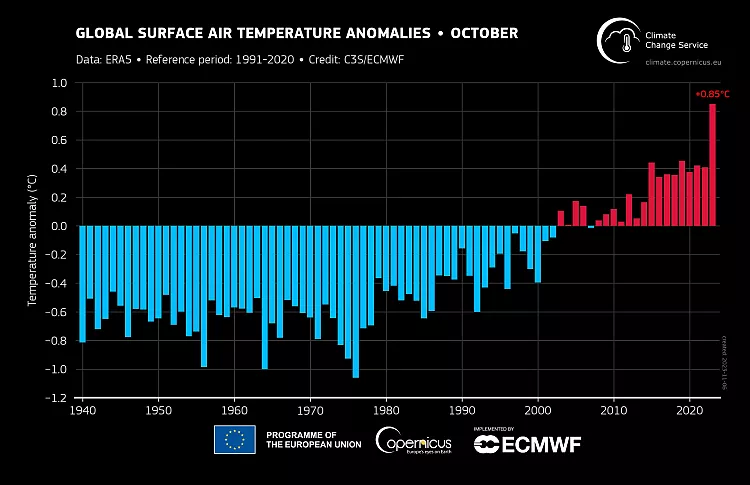
Data from the Copernicus Climate Change Service (C3S) reveals that this October was the warmest on record globally. As a whole, it was 1.7ºC above pre-industrial averages after four consecutive months of temperature records being broken.

In Europe, it was the fourth warmest October on record with temperatures 1.3ºC higher than the 1991 to 2020 average.

“October 2023 has seen exceptional temperature anomalies, following on from four months of global temperature records being obliterated,” says Samantha Burgess, deputy director of C3S, the European Union’s climate change agency. 

Globally averaged surface air temperature anomalies relative to 1991–2020 for each October from 1940 to 2023. Data Source: ERA5.C3S/ECMWF

https://www.euronews.com/green/2023/11/08/will-2023-be-the-hottest-year-yet-climate-scientists-are-virtually-certain-after-october-r

Continue ReadingWill 2023 be the hottest year yet? Climate scientists are ‘virtually certain’ after October record