When Lights Go Out in Cuba, Media Blame Communism—Not US Sanctions

Spread the love

Original article by Paul Hedreen republished from FAIR under a Creative Commons Attribution-NonCommercial-NoDerivs 3.0 Unported License.

Cuba is in the midst of an ongoing humanitarian crisis, and October’s widespread power outages are only adding to the Cuban people’s troubles. For the last six decades, Cuba has been on the receiving end of myriad sanctions by the United States government. This blockade has proved devastating to human life.

Reporting on Cuba’s blackouts have either omitted or paid brief lip-service to the effects of US sanctions on the Cuban economy, and how those sanctions have created the conditions for the crisis. Instead, media have focused on the inefficient and authoritarian Communist government as the cause of the island’s troubles.

Pulping the economy

The Hill: Cuba’s placement on the State Sponsor of Terrorism list has led to damaging consequences
Michael Galant (The Hill1/5/24): “Businesses and financial institutions, including many from outside the United States, often elect to sever all connections to Cuba rather than risk being sanctioned themselves for association with ‘a sponsor of terror.’”

One of President Donald Trump’s final acts in office was to re-designate Cuba as a State Sponsor of Terrorism, after President Barack Obama had removed them from the list in 2015 as a part of his Cuban thaw. Inclusion on the list subjects a country to restrictions on US foreign aid and financing, but, more importantly, the SSoT list encourages third-party over-compliance with sanctions. “Businesses and financial institutions, including many from outside the United States, often elect to sever all connections to Cuba rather than risk being sanctioned themselves,” The Hill (1/5/24) reported.

Trump reportedly added Cuba to the list for harboring members of FARC and ELN, two left-wing Colombian armed movements. However, Colombian President Gustavo Petro later “noted that Colombia itself, in cooperation with the Obama administration, had asked Cuba to host the FARC and ELN members as part of peace talks,” the Intercept (12/14/23) wrote. Indeed, if Cuba deported the dissidents, they would have been in violation of the protocols of the peace talks, which they were bound to by international law (The Nation2/24/23).

President Joe Biden has not begun the process of reviewing Cuba’s inclusion on the list, despite his campaign promises to the contrary.

The terror designation, plus the many other sanctions imposed by Trump and continued by Biden, are no small potatoes. Ed Augustin wrote at Drop Site (10/1/24) that

the terror designation, together with more than 200 sanctions enacted against the island since Obama left office, has pulped the Cuban economy by cutting revenue to the struggling Cuban state…. The combined annual cost of the Trump/Biden sanctions, [economists] say, amounts to billions of dollars a year.

Augustin argued that the economic warfare regime is a root cause of the rolling blackouts, water shortages and mass emigration that have plagued Cuba in recent years. Even imports that are ostensibly exempt from sanctions, like medication, are caught in the dragnet as multinational companies scramble to cut ties with the island. Banks are so reluctant to run afoul of US sanctions, Augustin wrote, “that often, even when the state can find the money to buy, and a provider willing to sell, there’s simply no way of making the payment.”

Cuba’s pariah status as a SSoT has put a stranglehold on its economy, and its government’s ability to administer public services. However, US restrictions on Cuba are almost never mentioned in US coverage, and reporting on the recent blackouts is no exception.

Cash-strapped Communists
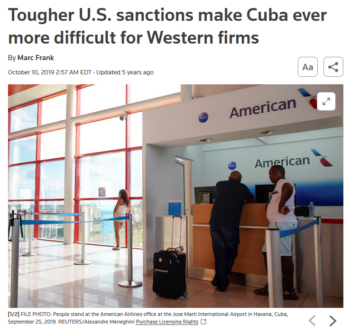
Reuters: Tougher U.S. sanctions make Cuba ever more difficult for Western firms
Reuters (10/10/19): “Tougher US sanctions against Cuba have led international banks to avoid transactions involving the island, while prospective overseas investors put plans on hold.”

Coverage has emphasized the inability of Cuba’s government to pay for necessary fuel imports. The New York Times (10/19/24) reported “the strapped Communist government could barely afford” to pay for fuel. Elsewhere, the Times (10/18/24) claimed “a severe economic crisis and the cash crunch it produced made it harder for Cuba to pay for those fuel imports.”

The Washington Post (10/18/24) made broadly similar arguments, chalking the blackouts up to “a shortage of imported oil and the cash-strapped government’s insufficient maintenance of the creaky grid.”

The “cash crunch” referenced by the Times is not just the result of an abstract economic crisis, as is implied. Instead, it is a direct effect of US sanctions on financial institutions. During the Obama administration, European banks, including ING and BNP Paribas, were fined to the tune of over $10 billion for transacting with Cuba (Jacobin3/27/22). Even before Cuba was choked further as a result of their SSoT designation, reporting by Reuters (10/10/19) showed the extent to which banks were terminating operations with Cuba and Cuban entities:

Many Western banks have long refused Cuba-related business for fear of running afoul of US sanctions and facing hefty fines.… Panama’s Multibank shut down numerous Cuba-related accounts this year and European banks are restricting clients associated with Cuba to their own nationals, if that.…

Businessmen and diplomats said large French banks, including Societe Generale, no longer want anything to do with Cuba, and some are stopping payments to pensioners living on the Caribbean island.… For the first time in years, the island has had problems financing the upcoming sugar harvest. Various joint venture projects, from golf resorts to alternative energy, are finding it nearly impossible to obtain private credit.

This de-risking by financial institutions manufactures a cash-scarce economy. Cuba’s inability to procure cash for imports is not a function of financial mismanagement, or a lack of credit-worthiness. Instead, it is a deliberate effect of American foreign policy. By omitting the actions of the most powerful government on earth, mainstream coverage allows only that only Cuban failures could be the cause of a shortage of cash.

‘Terrorism’ cuts off tourism

Telegraph: Europeans have abandoned Cuba, and it's all America's fault
Britain’s ambassador to Cuba told the Telegraph (11/6/23), “Those who come are profoundly shocked at what the SSOT designation is doing to the people here.”

Cuba has historically used tourism as a way of bringing money into the economy, but lately the Cuban tourism industry has been severely depressed. The explanation employed by corporate media for the decline of this industry is to blame the extended effects of the pandemic recession (New York Times10/19/24Washington Post10/18/24).

This explanation, however, is incomplete. Cuba has indeed had a lackluster rebound in their tourism industry, but the Times and the Post fail to explain why Cuba has faltered while other Caribbean islands have more than re-achieved their pre-pandemic tourist numbers.

Travelers from Britain, Australia, Japan and 37 other countries do not need to procure a visa for travel to the United States. Instead, they can use ESTA, an electronic visa waiver. This greatly reduces the cost and the annoyance of obtaining permission to visit the US. However, since Cuba’s 2021 listing as a SSoT, any visit to the country by an ESTA passport-holder revokes the visa waiver, for life (Telegraph11/6/23). In other words, any Brit (or Kiwi, or Korean, and so on) who visits Cuba must, for the rest of their lives, visit a US embassy and pay $180 before being able to enter the United States. US policy, not a Covid hangover, is hamstringing any possibility of a resurgence in tourism to Cuba.

Blame game

During Cuba’s most recent energy crisis, the New York Times published three stories describing the blackouts. Two of these stories mention the US blockade only as something that the Cuban government blames for the crisis.
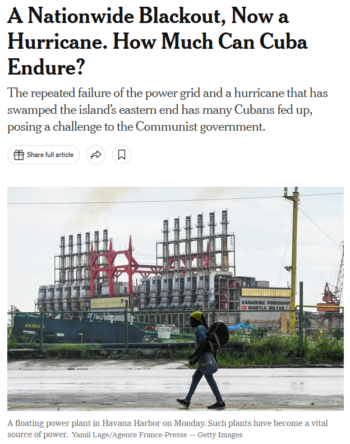
NYT: A Nationwide Blackout, Now a Hurricane. How Much Can Cuba Endure?
The New York Times (10/21/24) presented the idea that the US is punishing Cuba’s economy as a Communist allegation: “The Cuban government blames the power crisis on the US trade embargo, and sanctions that were ramped up by the Trump administration.”

The headline on the Times website (10/21/24) read: “A Nationwide Blackout, Now a Hurricane. How Much Can Cuba Endure?” The paper was right to report on the humanitarian crisis ongoing in Cuba, but it chose to downplay the most important root cause: the decades-long US blockade on Cuba’s economy and its people.

That same story described Cuba as “a Communist country long accustomed to shortages of all kinds and spotty electrical service.” Why is the country so used to shortages? Eleven paragraphs later, the Times gave an explanation, or at least, Cuba’s explanation:

The Cuban government blames the power crisis on the US trade embargo, and sanctions that were ramped up by the Trump administration, which severely restricts the Cuban government’s cash flow. The US Department of the Treasury blocks tankers that have delivered oil to Cuba, which drives up the island’s fuel costs, because Cuba has a limited pool of suppliers available to it.

Earlier coverage by the Times (10/18/24) similarly couched the effects of the blockade as merely a claim by Cuba. The Washington Post (10/22/24) also situated the blockade as something that “the Cuban government and its allies blame” for the ongoing crisis.

To report that Cuban officials blame the US sanctions for the energy crisis is a bit like reporting that fishermen blame the moon for the rising tide. It is of course factual that US trade restrictions–which affect not just US businesses, but also multinational businesses based in other countries–are a blunt weapon, with impact against not just a government, but an entire people.

At the very least, it is incumbent upon journalists to do at least minimal investigation and explanation of the facts concerning the subject of their reporting. None of the coverage in either major paper bothered to investigate whether this was a fair explanation, or even to report generally the effects a 60-year blockade might have on an economy.

Brief—and buried

NYT: Cuba Suffers Second Power Outage in 24 Hours, Realizing Years of Warnings
“Cuban economists and foreign analysts blamed the crisis on several factors,” the New York Times (10/19/24) reported; 18 paragraphs later, the story gets around to mentioning US sanctions.

On October 19, the Times gave its most complete explanation of the relationship between the US sanctions regime and the Cuban blackouts:

Cuba’s economy enjoyed a brief honeymoon with the United States during the Obama administration, which sought to normalize relations after decades of hostility, while keeping a longstanding economic embargo in place. President Donald J. Trump reversed course, leading to renewed restrictions on tourism, visas, remittances, investments and commerce.

This explanation can be found in the 31st paragraph of the 37-paragraph story. Only once the Times has painted a picture of all the ways the Communist government has gone wrong can there be a brief mention of the role of US sanctions. And how brief it is; the Times chose not to detail the extent of blockade against Cuba, nor how Cuba was wrongfully placed on the SSoT list, nor the failure of Biden to reevaluate Cuba’s status as he promised on the campaign trail.

Describing the US starvation of Cuba’s economy in abstract terms like “economic crisis” provides cover for deliberate policy decisions by the US government. By reporting on the embargo only as something that the Cuban government claims, it is easy for readers to dismiss that explanation as simply a Communist excuse. Instead of asking why the United States is choosing to enforce a crippling sanctions regime on another country, outlets like the New York Times find it easier to repeat the line that Cuba’s government has only itself to blame for its problems.

FAIR’s work is sustained by our generous contributors, who allow us to remain independent. Donate today to be a part of this important mission.

Original article by Paul Hedreen republished from FAIR under a Creative Commons Attribution-NonCommercial-NoDerivs 3.0 Unported License.

The blockade on Cuba is a failed policy but still has bipartisan support, says Dr. José R. Cabañas

Continue ReadingWhen Lights Go Out in Cuba, Media Blame Communism—Not US Sanctions

‘Devastating Blow to Humanity’: Barred From Gaza by Israel, Health Workers Cry Out for Help

Spread the love

Original article by Jon Queally republished from Common Dreams under Creative Commons (CC BY-NC-ND 3.0). 

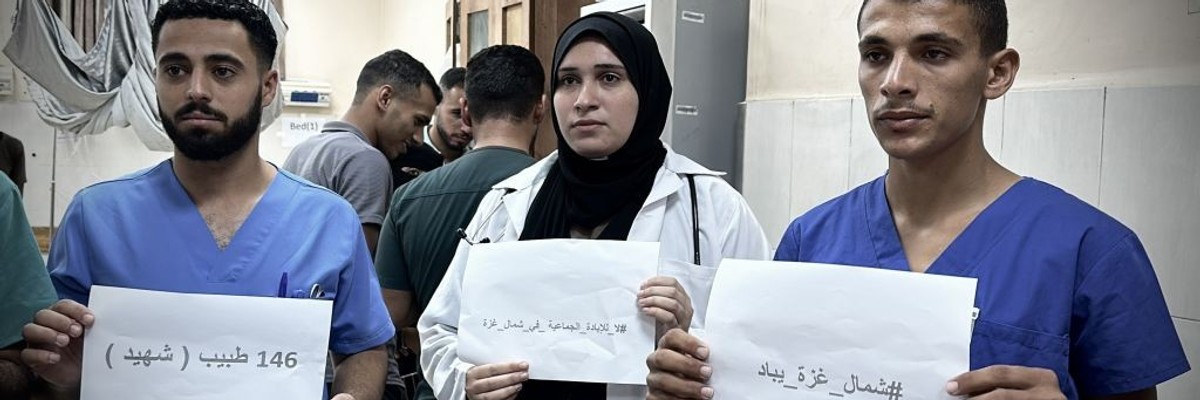
Health workers, holding banners and placards, gather at the Nasser Hospital to protest Israeli army’s attacks on northern Gaza and the prevention of the entry of necessary equipment and supplies to the besieged hospitals in Khan Yunis, Gaza on October 19, 2024.  (Photo by Doaa Albaz/Anadolu via Getty Images)

As the situation inside Gaza is increasingly described as “indescribable,” medical NGOs blocked from providing care to Palestinians trapped inside besieged territory demand world leaders to stop turning ‘blind eye’ to Israeli war crimes and violations of humanitarian law.

As more Israeli bombing of the Jabalia refugee camp in northern Gaza killed dozens of people Saturday, health workers from both inside and out of the besieged territory are again pleading with world leaders to bring an end to the indiscriminate attacks and imposed humanitarian crisis that witnesses on the ground increasingly say there are no words to describe.

At al Nasser Hospital in Khan Yunis and elsewhere in Gaza, doctors and other medical staff on Saturday staged protests and held press conferences to call attention to the ongoing attacks in northern areas, including the latest targeting of Jabalia in which reporting indicated anywhere from 33 to over 50 people—including civilian men, women, and children—were killed.

“The world is watching, and history will judge us by how we respond to this grave injustice. I call upon each and everyone one of you to join this fight for the preservation of our shared humanity.” —Dr. Khaled Saleh, FAJR Scientific

Al-Jazeera reports that hospitals, which have repeatedly been bombed by Israel over the last year, were not immune from this latest round:

Three partially functioning hospitals treating severely wounded patients and sheltering thousands of displaced Palestinian civilians in northern Gaza are now out of service after coming under intense Israeli fire, a Gaza health official told Al Jazeera, as the siege on Jabalia enters its third week, with at least 33 more people killed in the northern area.

Israeli forces bombed al-Awda Hospital in Jabalia early on Saturday, and have also shelled Kamal Adwan and the Indonesian hospitals in Beit Lahiya over the past few hours, Al Jazeera correspondents have reported.

Saturday’s attacks come days after Israel barred at least six medical service NGOs from continuing their life-saving work in Gaza. According to the Washington Post:

Two of those medical NGOs, Glia and the Palestinian American Medical Association (PAMA), confirmed to The Washington Post that they were notified by the WHO this week about the bans. Both groups have worked in Gaza for years preceding the war.

“WHO is concerned about the impact of these denials on Gaza’s strained healthcare system,” the organization said Thursday in a statement. It added that international emergency medical teams (EMTs) deployed to Gaza are essential to keeping the system operational, as only 17 of the enclave’s 36 hospitals remain functionaland “healthcare needs far exceed the system’s capacity.”

Dr. Khaled Saleh, chair of FAJR Scientific, which provides surgical expertise and trauma specialists to war-torn regions and was another of the groups notified by the WHO that it had been barred from entering Gaza, said in a statement that the move by the Israeli government filled him with “deep sadness and concern for the current state of our global family, questioning our shared humanity and ethics.”

Blocked from providing aid to people in dire need, Saleh called on people worldwide to push for an end to Israel’s blocking of vital medical aid and those seeking to provide it.

“This is a devastating blow to humanity, representing a level of destruction that we have not witnessed since World War II, yet our world leaders turn a blind eye,” he said.

“As a member of the global community,” Saleh continued, “I implore all of you who value compassion, ethics, and the sanctity of human life to stand with us and raise your voices against this unconscionable decision. Together, we must advocate for the voiceless and demand restoration of the fundamental right to access to medical care.”

Israel’s ban on the medical NGOs comes after a string of healthcare professionals who spent time in the Gaza strip have gone public with what they witnessed on the ground, telling tales of unspeakable horror and trying to shake the world out of its complacency on what experts say is a genocide in motion being carried out by Israeli forces.

https://twitter.com/ryangrim/status/1847415481340158265?ref_src=twsrc%5Etfw%7Ctwcamp%5Etweetembed%7Ctwterm%5E1847415481340158265%7Ctwgr%5Ea9ba79d1e9ff243bed5fc4882543079cfea6dc4e%7Ctwcon%5Es1_c10&ref_url=https%3A%2F%2Fwww.commondreams.org%2Fnews%2Fgaza-health-workers

Earlier this week, the UN humanitarian office, OCHA, said that Israel’s continued blocking of food and medical supplies to Jabalia and other ares in the northern was “having life-threatening impacts” for the people there.

OCHA spokesperson Farhan Haq said the OCHA was calling on Israeli authorities “to allowed safe, sustained and unimpeded access to Jabalia and all areas of the north where people are in desperate need of assistance.”

In a post on Friday, Oxfam International mourned the killing of Dr. Ahmad Al-Najar and midwife Laila Jneid, both of whom worked with Juzoor, “killed by Israeli airstrikes on Jabalia,” the group said. “They were providing lifesaving health care in Gaza. Attacking aid workers is a war crime.” Oxfam repeated its demand for a “cease-fire now” and said healthcare workers should never be a target.

In a dispatch on Friday, Dr. Taghreed Al-Imawi, Juzoor staff and an OBGYN doctor at Kamal Adwan Hospital in northern Gaza, described the untenable situation on the ground.

“The situation is beyond horrific and is very difficult and indescribable,” said Al-Imawi. “Dead people, severed body parts and injured people everywhere. We are receiving emergency calls from all the areas of the north. Ambulances are not able to reach the injured. We have seen more than 23 pregnant women among the injured coming to the hospital since last week, wounded either by shrapnel or gunfire, suffering from fractures. Some were in a critical condition. Kamal Adwan Hospital and other semi-operational hospitals have received displacement orders but there is no way to evacuate in any case.”

“The pediatrics section is closed as it is full of injured people,” Al-Imawi added, “the surgery section is full of injured people, even the reception, the hospital has been shelled several times and targeted by snipers, people are terrified to come to the hospital now.”

Having recently returned from a field mission in Gaza, pediatric nurse Becky Platt, working through Save the Children—who posted her testimony Saturday—described a situation on the ground that was “like nothing I’ve seen before.”

Platt said the horrific situation is “both in terms of healthcare need and just in terms of the whole humanitarian context—seeing homes and landscapes completely devastated and seeing just the absolute level of human suffering and need as absolutely mind blowing.”

https://twitter.com/i/status/1847518629484478816

“No child should have to be in pain,” she said. “And it just feels like your hands are tied when you can’t do what you know that you could do easily at home or in another context. I think that when it really hits. It’s just—it’s just not fair. It’s not okay that we’ve got children with devastating injuries who don’t have access to pain relief.”

For his part, Dr. Saleh of FAJR Scientific, said it was up to everyone in the world to make their voices heard.

“The world is watching,” he said, “and history will judge us by how we respond to this grave injustice. I call upon each and everyone one of you to join this fight for the preservation of our shared humanity.”

Original article by Jon Queally republished from Common Dreams under reative Commons (CC BY-NC-ND 3.0). 

Continue Reading‘Devastating Blow to Humanity’: Barred From Gaza by Israel, Health Workers Cry Out for Help

Amnesty Says Cutting Off Aid to UNRWA While Arming Israel Is ‘Stark’ Hypocrisy

Spread the love

Original article by JAKE JOHNSON republished from Common Dreams under under Creative Commons (CC BY-NC-ND 3.0). 

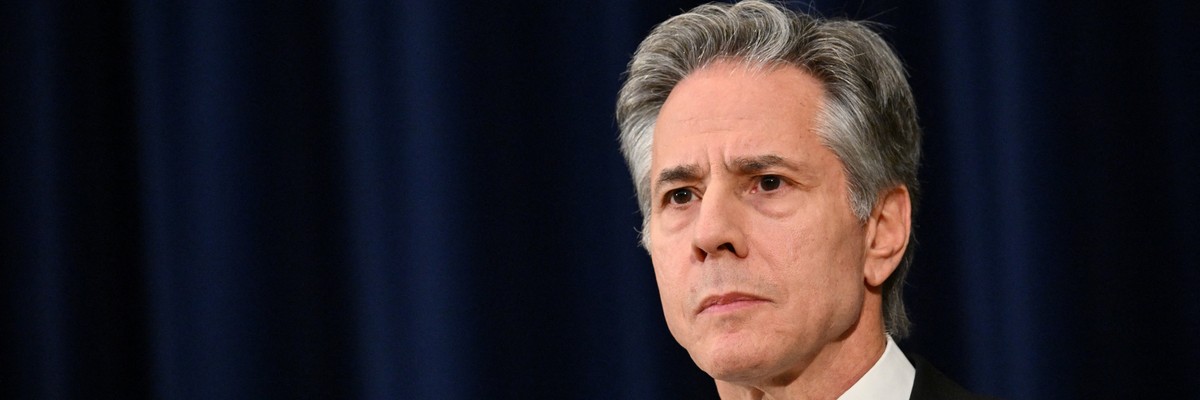
U.S. Secretary of State Antony Blinken speaks during a press conference in Washington, D.C. on January 29, 2024.  (Photo: Mandel Ngan/AFP via Getty Images)

“Some of the very governments that announced they will cut off funds to UNRWA over these allegations have, in the meantime, continued to arm Israeli forces despite overwhelming evidence that these arms are used to commit war crimes.”

Amnesty International on Monday joined the growing global chorus denouncing Israel’s allies for suspending aid to the United Nations’ Palestinian refugee agency even as they continue to support the Israeli military’s war on the Gaza Strip, risking complicity in genocide.

Agnès Callamard, Amnesty’s secretary-general and the former U.N. special rapporteur on extrajudicial killings, said that while Israel’s claim that a dozen staffers at the refugee agency played a role Hamas’ October 7 attack is “serious and must be independently investigated,” the “alleged actions of a few individuals must not be used as a pretext for cutting off lifesaving assistance in what could amount to collective punishment.”

“Some of the very governments that announced they will cut off funds to UNRWA over these allegations have, in the meantime, continued to arm Israeli forces despite overwhelming evidence that these arms are used to commit war crimes and serious human rights violations,” said Callamard. “Rushing to freeze funds for humanitarian aid, based on allegations that are still being investigated, while refusing to even consider suspending support for the Israeli military is a stark example of double standards.”

“Instead of suspending vital funding to those in need,” Callamard added, “states should be working to halt arms transfers to Israel and Palestinian armed groups and pushing for an immediate and sustained cease-fire and full humanitarian access to help alleviate devastating suffering.”

“The humanitarian crisis has reached catastrophic levels, and any additional limitations on aid will result in more deaths and suffering.”

The United States announced last week that it would temporarily cut off UNRWA funding as it reviews Israel’s allegations against the low-level agency employees—a decision that came just hours after the International Court of Justice (ICJ) ruled that Israel must ensure the provision of humanitarian aid to Gazans, tens of thousands of whom have been killed or wounded by Israeli bombs and shells in less than four months.

Francesca Albanese, the U.N. special rapporteur for the occupied Palestinian territories, said that “defunding UNRWA at this critical time overtly defies” the ICJ’s ruling.

Médecins Sans Frontières, also known as Doctors Without Borders, similarly warned Monday that “the consequences these cuts in funding will have on the ground contradict the provisional measures issued by the International Court of Justice.”

“The humanitarian crisis has reached catastrophic levels,” the group added, “and any additional limitations on aid will result in more deaths and suffering.”

Just over a week before the Biden administration decided to suspend its UNRWA contributions, a spokesperson for the U.S. State Department described the agency’s work as “invaluable” and “lifesaving.”

On Monday, U.S. Secretary of State Antony Blinken acknowledged that the UNRWA “has played and continues to play an absolutely indispensable role in trying to make sure that men, women, and children who so desperately need assistance in Gaza actually get it.”

“And no one else can play the role that UNRWA’s been playing, certainly not in the near term,” he added. “So that only underscores the importance of UNRWA tackling this as quickly, as effectively, and as thoroughly as possible, and that’s what we’re looking for.”

At least a dozen countries—including the United Kingdom, Canada, Australia, Germany, Italy, and the Netherlands—have joined the U.S. in suspending aid to the UNRWA, the most critical humanitarian aid organization in the famine-stricken Gaza Strip.

The moves have put the UNRWA’s operations in jeopardy, with the U.N. chief warning that the agency’s current funding levels won’t be enough to meet all of its requirements in February. The agency has no strategic financial reserves.

Amnesty said the countries that have suspended aid to the UNRWA thus far provided more than half of the agency’s budget in 2022.

Several major nations, including Norway and Spain, have refused to join the U.S.-led freeze of aid to the UNRWA, which the Israeli government has been targeting for years and is hoping to push out of Gaza entirely. The UNRWA quickly fired nine of the 12 workers that Israel accused of taking part in the October 7 attack and has launched an investigation.

On Monday, Spanish Foreign Minister José Manuel Albares said his country will not suspend UNRWA funding, which he said helps “alleviate the terrible humanitarian situation in Gaza.”

Albares also pledged to continue pushing for an end to Israel’s assault on Gaza, the release of hostages, and a lasting diplomatic solution.

“We will not resign ourselves to watching more innocent women, men, and children killed in Gaza and more suffering of Palestinian families,” he said. “We will not resign ourselves to keep watching the suffering of the families of hostages. The violence must stop.”

Original article by JAKE JOHNSON republished from Common Dreams under under Creative Commons (CC BY-NC-ND 3.0). 

Continue ReadingAmnesty Says Cutting Off Aid to UNRWA While Arming Israel Is ‘Stark’ Hypocrisy

Israeli Ambassador Slammed for Claiming ‘There Is No Humanitarian Crisis in Gaza

Spread the love
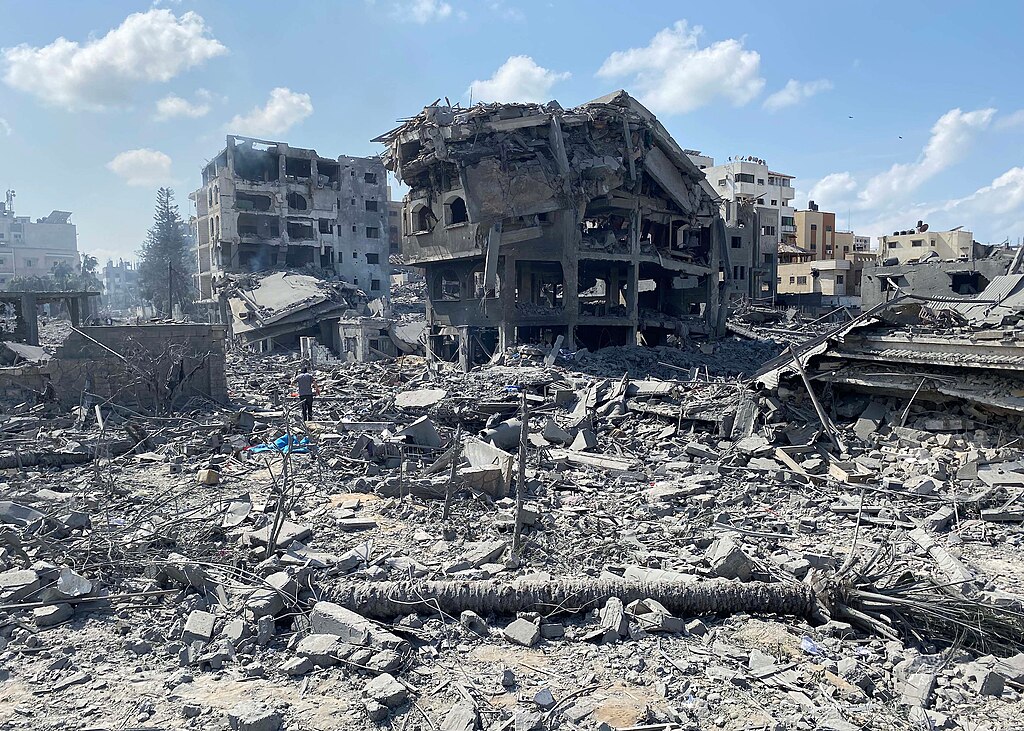
Palestinians inspect the damage following an Israeli airstrike on the El-Remal aera in Gaza City on October 9, 2023. Israel continued to battle Hamas fighters on October 10 and massed tens of thousands of troops and heavy armour around the Gaza Strip after vowing a massive blow over the Palestinian militants' surprise attack. Photo by Naaman Omar apaimages. licensed under the Creative Commons Attribution-Share Alike 3.0 Unported license.
Palestinians inspect the damage following an Israeli airstrike on the El-Remal aera in Gaza City on October 9, 2023. Israel continued to battle Hamas fighters on October 10 and massed tens of thousands of troops and heavy armour around the Gaza Strip after vowing a massive blow over the Palestinian militants’ surprise attack. Photo by Naaman Omar apaimages. licensed under the Creative Commons Attribution-Share Alike 3.0 Unported license.

Original article by JESSICA CORBETT republished from Common Dreams under Creative Commons (CC BY-NC-ND 3.0).

“Does he think the world is not seeing the horrific reality in Gaza? Does he think we will believe his lies?” said one peace advocate. “No, we won’t.”

Despite the abundance of evidence to the contrary, Israel’s ambassador to the United Nations claimed in a televised interview Sunday that “there is no humanitarian crisis in Gaza,” and was swiftly rebuked by people around the world.

Challenged by CNN‘s Dana Bash, Ambassador Gilad Erdan doubled down on his position: “I’m not saying that the life in Gaza is great. And, obviously, Hamas is the only one that should be held accountable for any situation in Gaza. But there’s a standard, due to international humanitarian law.”

“What does it mean, a humanitarian crisis? And I’m saying, again, there is no humanitarian crisis, based on the international humanitarian law, right now in Gaza,” added Erdan, who also cast doubt on the death toll being shared by local officials.

U.S. Congressman Mark Pocan (D-Wis.) called Erdan’s comments “unbelievable,” given the current conditions in Gaza a month into the war Israel launched after a Hamas-led attack on October 7, and urged the ambassador to resign from his position.

Also responding to Erdan’s appearance on “State of the Union,” Medea Benjamin, co-founder of the anti-war group CodePink, said: “Does he think the world is not seeing the horrific reality in Gaza? Does he think we will believe his lies? No, we won’t.”

As of Sunday, Israel’s air and ground assault of the besieged enclave—enabled by billions in U.S. military support—has killed at least 9,770 people, including over 4,000 children, according to the Palestinian Health Ministry in Gaza. The ministry last month publicly identified thousands of the dead as Israeli officials and others, including U.S. President Joe Biden, questioned the figures.

Those who have so far survived the Israeli assault are facing limited power, water, and communication services as well as dwindling supplies of food and medicine. The United Nations World Food Program stressed Sunday that the aid entering Gaza “is nowhere near enough to meet the exponentially growing needs.”

“Right now, parents in Gaza do not know whether they can feed their children today and whether they will even survive to see tomorrow,” said Cindy McCain, the U.N. program’s executive director, as she returned from the Rafah border crossing in Egypt. “The suffering just meters away is unfathomable standing on this side of the border.”

Erdan’s interview Sunday was not the first time during the war that the Israeli government has contested conditions in Gaza. During a Sky News appearance in Mid-October, Israeli diplomat Tzipi Hotovely also said that “there is no humanitarian crisis.”

As The New York Timesreported Wednesday:

Israel’s agency overseeing policy for the Palestinian territories, known as COGAT, maintained in a statement on Tuesday that there is “currently no humanitarian crisis in the Gaza Strip” despite the mounting evidence to the contrary from aid agencies, journalists, and people living there.

The statement said the Israeli government was monitoring the supply of water, food, fuel, and energy in Gaza and asserted that “the situation is far from crisis.”

The newspaper added that “asked on Tuesday why Israel had cut off water supplies, in particular, to Gaza, the agency said that ‘according to international law, Israel has no obligation to provide goods and services to the terrorist organization Hamas—especially in cases where the enemy uses them for war purposes (for example, with respect to electricity and fuel).'”

Former U.S. Ambassador David Satterfield, recently appointed by Biden as the special envoy for Middle East humanitarian issues, told reporters in Jordan on Saturday that “there is no evidence that Hamas is seizing or blocking aid entering the Gaza Strip.”

Original article by JESSICA CORBETT republished from Common Dreams under Creative Commons (CC BY-NC-ND 3.0).

Continue ReadingIsraeli Ambassador Slammed for Claiming ‘There Is No Humanitarian Crisis in Gaza

Over 150 trade unionists block arms factory in Kent

Spread the love
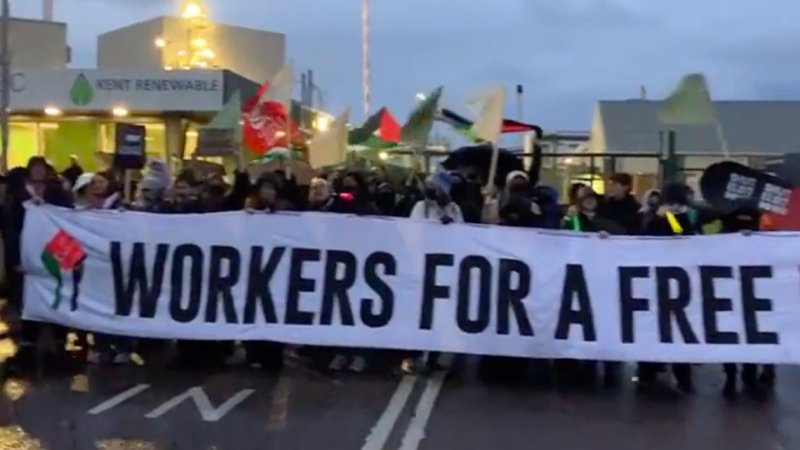
‘Workers For A Free Palestine’ protest at Instro Precision Ltd in Sandwich, Kent, a subsidiary of arms manufacturer Elbit Systems. Trade unionists responded to a request from Palestinan trade unions and the humanitarian crisis in Gaza.

https://leftfootforward.org/2023/10/over-150-trade-unionists-block-israeli-arms-factory-in-kent/

Over 150 young trade unionists created a blockade at the entrances to a factory in Kent this morning, which is the site of an Israeli weapons manufacturer.

Holding a banner reading ‘Workers For A Free Palestine’, the demonstration targeted Instro Precision Ltd in Sandwich, Kent, a subsidiary of arms manufacturer Elbit Systems which is one of Israel’s largest arms producers responsible for making drones and artillery for the military.

Members from the unions Unite, UNISON, the NEU, UCU, the BMA, BFAWU, RMT and IWGB were represented, demanding the UK stop arming Israel, in response to the humanitarian crisis in Gaza.

The action was organised by a new project called Workers for a Free Palestine, set up in response to an urgent call made by Palestinian trade unions for their international counterparts to halt arms trading with Israel.

Palestinian trade unions called on global workers to take action and “end all forms of complicity with Israel’s crimes” by refusing to build or transport weapons destined for Israel and to increase pressure on governments to call for a ceasefire.

According to Novara Media reporter Ash Sarkar, multiple lorries and vans were unable to make deliveries to the weapons factory after being turned away by the group today.

https://leftfootforward.org/2023/10/over-150-trade-unionists-block-israeli-arms-factory-in-kent/

Continue ReadingOver 150 trade unionists block arms factory in Kent