Unprecedented peril: disaster lies ahead as we track towards 2.7°C of warming this century
Spread the love
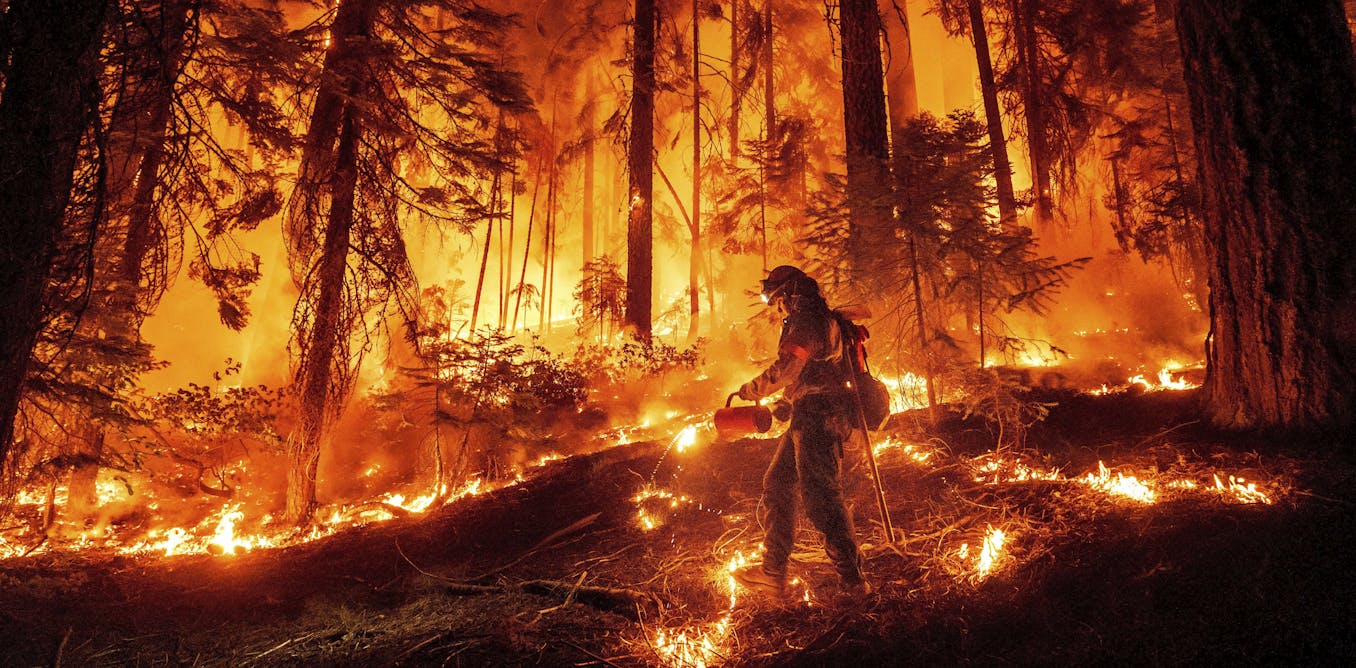
Noah Berger/AP

Thomas Newsome, University of Sydney and William Ripple, Oregon State University

You don’t have to look far to see what climate change is doing to the planet. The word “unprecedented” is everywhere this year.

We are seeing unprecedented rapidly intensifying tropical storms such as Hurricane Helene in the eastern United States and Super Typhoon Yagi in Vietnam. Unprecedented fires in Canada have destroyed towns. Unprecedented drought in Brazil has dried out enormous rivers and left swathes of empty river beds. At least 1,300 pilgrims died during this year’s Hajj in Mecca as temperatures passed 50°C.

Unfortunately, we are headed for far worse. The new 2024 State of the Climate report, produced by our team of international scientists, is yet another stark warning about the intensifying climate crisis. Even if governments meet their emissions goals, the world may hit 2.7°C of warming – nearly double the Paris Agreement goal of holding climate change to 1.5°C. Each year, we track 35 of the Earth’s vital signs, from sea ice extent to forests. This year, 25 are now at record levels, all trending in the wrong directions.

Humans are not used to these conditions. Human civilisation emerged over the last 10,000 years under benign conditions – not too hot, not too cold. But this liveable climate is now at risk. In your grandchild’s lifetime, climatic conditions will be more threatening than anything our prehistoric relatives would have faced.

Our report shows a continued rise in fossil fuel emissions, which remain at an all-time high. Despite years of warnings from scientists, fossil fuel consumption has actually increased, pushing the planet toward dangerous levels of warming. While wind and solar have grown rapidly, fossil fuel use is 14 times greater.

This year is also tracking for the hottest year on record, with global daily mean temperatures at record levels for nearly half of 2023 and much of 2024.

Next month, world leaders and diplomats will gather in Azerbaijan for the annual United Nations climate talks, COP 29. Leaders will have to redouble their efforts. Without much stronger policies, climate change will keep worsening, bringing with it more frequent and more extreme weather.


Bad news after bad news

We have still not solved the central problem: the routine burning of fossil fuels. Atmospheric concentrations of greenhouse gases – particularly methane and carbon dioxide – are still rising. Last September, carbon dioxide levels in the atmosphere hit 418 parts per million (ppm). This September, they crossed 422 ppm. Methane, a highly potent greenhouse gas, has been increasing at an alarming rate despite global pledges to tackle it.

Compounding the problem is the recent decline in atmospheric aerosols from efforts to cut pollution. These small particles suspended in the air come from both natural and human processes, and have helped cool the planet. Without this cooling effect, the pace of global warming may accelerate. We don’t know for sure because aerosol properties are not yet measured well enough.

Other environmental issues are now feeding into climate change. Deforestation in critical areas such as the Amazon is reducing the planet’s capacity to absorb carbon naturally, driving additional warming. This creates a feedback loop, where warming causes trees to die which in turn amplifies global temperatures.

Loss of sea ice is another. As sea ice melts or fails to form, dark seawater is exposed. Ice reflects sunlight but seawater absorbs it. Scaled up, this changes the Earth’s albedo (how reflective the surface is) and accelerates warming further.

In coming decades, sea level rise will pose a growing threat to coastal communities, putting millions of people at risk of displacement.

Accelerate the solutions

Our report stresses the need for an immediate and comprehensive end to the routine use of fossil fuels.

It calls for a global carbon price, set high enough to drive down emissions, particularly from high-emitting wealthy countries.

Introducing effective policies to slash methane emissions is crucial, given methane’s high potency but short atmospheric lifetime. Rapidly cutting methane could slow the rate of warming in the short term.

Natural climate solutions such as reforestation and soil restoration should be rolled out to increase how much carbon is stored in wood and soil. These efforts must be accompanied by protective measures in wildfire and drought prone areas. There’s no point planting forests if they will burn.

Governments should introduce stricter land-use policies to slow down rates of land clearing and increase investment in forest management to cut the risk of large, devastating fires and encourage sustainable land use.

We cannot overlook climate justice. Less wealthy nations contribute least to global emissions but are often the worst affected by climate disasters.

Wealthier nations must provide financial and technical support to help these countries adapt to climate change while cutting emissions. This could include investing in renewable energy, improving infrastructure and funding disaster preparedness programs.

Internationally, our report urges stronger commitments from world leaders. Current global policies are insufficient to limit warming to 1.5°C above pre-industrial levels.

Without drastic changes, the world is on track for approximately 2.7°C of warming this century. To avoid catastrophic tipping points, nations must strengthen their climate pledges, reduce dependence on fossil fuels, and accelerate the transition to renewable energy.

Immediate, transformative policy changes are now necessary if we are to avoid the worst effects of climate change.

Climate change is already here. But it could get much, much worse. By slashing emissions, boosting natural climate solutions and working towards climate justice, the global community can still fend off the worst version of our future.

Thomas Newsome, Associate Professor in Global Ecology, University of Sydney and William Ripple, Distinguished Professor and Director, Trophic Cascades Program, Oregon State University

This article is republished from The Conversation under a Creative Commons license. Read the original article.

Orcas discuss Donald Trump and the killer apes' concept of democracy. Front Orca warns that Trump is crashing his country's economy and that everything he does he does for the fantastically wealthy.
Orcas discuss Donald Trump and the killer apes’ concept of democracy. Front Orca warns that Trump is crashing his country’s economy and that everything he does he does for the fantastically wealthy.
Neo-Fascist Climate Science Denier Donald Trump says Burn, Baby, Burn.
Elon Musk urges you to be a Fascist like him, says that you can ignore facts and reality then.
Continue ReadingUnprecedented peril: disaster lies ahead as we track towards 2.7°C of warming this century

‘The Insurance Industry Is the Fossil Fuel Industry’: 

Spread the love

Original article by Janine Jackson republished from FAIR under a Creative Commons Attribution-NonCommercial-NoDerivs 3.0 Unported License.

CounterSpin interview with Derek Seidman on insurance and climate

Janine Jackson interviewed writer/researcher Derek Seidman about insurance and climate  for the October 4, 2024, episode of CounterSpin. This is a lightly edited transcript.

Janine Jackson: As we watch images of devastation from Hurricane Helene, it’s hard not to hold—alongside sadness at the obvious loss—anger at the knowledge that things didn’t have to be this way. Steps could have been, still could be taken, to mitigate the impact of climate change, and making weather events more extreme, and steps could be taken that help people recover from the disastrous effects of the choices made.

As our guest explains, another key player in the slow-motion trainwreck that is US climate policy—along with fossil fuel companies and the politicians that abet them—is the insurance industry, whose role is not often talked about.

Washington Post (9/3/24)

Derek Seidman is a writer, researcher and historian. He contributes regularly to Truthout and to LittleSis. He joins us now by phone. Welcome to CounterSpin, Derek Seidman.

Derek Seidman: Hey, thank you. Great to be here.

JJ: In your super helpful piece for Truthout, you cite a Washington Post story from last September. Here’s the headline and subhead:

Home Insurers Cut Natural Disasters From Policies as Climate Risks Grow:

Some of the largest US insurance companies say extreme weather has led them to end certain coverages, exclude natural disaster protections and raise premiums.

I think that drops us right into the heart of the problem you outline in that piece. What’s going on, and why do you call it the insurance industry’s “self-induced crisis”?

DS: Thank you. Well, certainly there is a growing crisis. The insurance industry is pulling back from certain markets and regions and states, because the costs of insuring homes and other properties are becoming too expensive to remain profitable, with the rise of extreme weather. And so we’ve seen a lot of coverage in the past few months over this growing crisis in the insurance industry.

Derek Seidman: “The insurance industry itself is a main actor in driving the rise of extreme weather, through its very close relationship to the fossil fuel industry.”

But one of the critical things that’s left out of this is that the insurance industry itself is a main actor in driving the rise of extreme weather, through its very close relationship to the fossil fuel industry. And in this narrative in the corporate media, the insurance industry on the one hand and extreme weather on the other hand, are often treated like they’re completely separate things, and they’re just sort of coming together, and this “crisis” is being created, and it’s a real problem that the connections aren’t being made there.

So I guess a couple things that should be said, first, are that the insurance industry is the fossil fuel industry, and its operations could not exist without the insurance industry.

We can look at that relationship in two ways. So first, of course, is through insurance. The insurance giants, AIG, Liberty Mutual and so on and so on, they collectively rake in billions of dollars every year in insuring fossil fuel industry infrastructure, whether that’s pipelines or offshore oil rigs or liquified natural gas export terminals. This fossil fuel infrastructure and its continued expansion, this simply could not exist without underwriting by the insurance industry. It would not get its permit approvals, it would just not be able to operate, it couldn’t attract investors and so on. So that’s one way.

Another way is that, and this is something a lot of people might not be aware of, but the insurance industry is an enormous investor in the fossil fuel industry. Basically, one of the ways the insurance industry makes money is it takes the premiums, and it pools a chunk of it and invests those. So it’s a major investor. And the insurance industry, across the board, has tens of billions of dollars invested in the fossil fuel industry.

And this is actually stuff that anybody can go and look up, because some of it’s public. So, for example, the insurance giant AIG, because it’s a big investor, it has to disclose its investments with the SEC. And earlier this year, AIG disclosed that, for example, it had $117 million invested in ExxonMobil, $83 million invested in Chevron, $46 million in Conoco Phillips, and so on and so on.

Jacobin (2/7/22)

So, on the one hand, you have this hypocritical cycle where the insurance industry is saying to ordinary homeowners, who are quite desperate, we need to jack up the price on your premiums, or we need to pull away altogether, we can’t insure you anymore—while, on the other hand, it’s driving and enabling and profiting from the very operations, fossil fuel operations, that are causing this extreme weather in the first place, that the insurance industry is then using to justify pulling back from insuring just regular homeowners.

JJ: This is a structural problem, clearly, that you’re pointing to, and you don’t want to be too conspiratorial about it. But these folks do literally have dinner with one another, these insurance executives and the fossil fuel companies. And then I want to add, you complicate it even further by talking about knock-on effects, that include making homes uninsurable. When that happens, well, then, that contributes to this thing where banks and hedge funds buy up homes. So it’s part of an even bigger cycle that folks probably have heard about.

DS: Yeah, absolutely. This whole scenario, it’s horrible, because it impacts homeowners and renters. If you talk to landlords, they say that the rising costs of insurance are their biggest expense, and they are, in part, taking that out on tenants by raising rents, right?

But it also really threatens this global financial stability. I mean, with the rise of extreme weather, and homes becoming more expensive to insure, or even uninsurable, home values can really collapse. And when they collapse, aside from the horrific human drama of all that, banks are reacquiring foreclosed homes that, in turn, are unsellable because of extreme weather, and they can’t be insured.

The big picture of all this is that it leads to banks acquiring a growing amount of risky properties, and it can create a lot of financial instability. And we saw what happened after 2008, as you mentioned, with private equity coming in and scooping up homes. And so, yeah, it creates a lot of systemic financial instability, opens the door for financial predators like private equity and hedge funds to come in.

JJ: And it seems to require an encompassing response, a response that acknowledges the various moving pieces of this. I wonder, finally, is there responsive law or policy, either on the table now or just maybe in our imagination, that would address these concerns?

DS: There are organizers that are definitely starting to do something about it, and there are some members of Congress that are also starting to do something about it.

For this story, I interviewed some really fantastic groups. One of them is Insure Our Future, and this is sort of a broader campaign that is working with different groups around the country, and really demanding that insurers stop insuring new fossil fuel build-out, that they phase out their insurance coverage for existing fossil fuels, for all the reasons that we’ve been talking about today.

At the state level, there’s groups that are doing really important and interesting things. So one of the groups that I interviewed was called Connecticut Citizen Action Group, and they’ve been working hard, in coalition with other groups in Connecticut, to introduce and pass a state bill that would create a climate fund to support residents that are impacted by extreme weather. (Connecticut has seen its fair share of extreme weather.) And this fund would be financed by taxing insurance policies in the state that are connected to fossil fuel projects. So it’s also a disincentive to invest in fossil fuels.

In New York, a coalition of groups and lawmakers just introduced something called the Insure Our Communities bill. And this would ban insurers from underwriting new fossil fuel projects, and it would set up new protections for homeowners that are facing extreme weather disasters.

I spoke to organizers in Freeport, Texas, with a group called Better Brazoria, and these are people that are on the Gulf Coast, really on the front lines. And Better Brazoria is just one of a number of frontline groups along the Gulf Coast that are organizing around the insurance industry, and they’re trying to meet with insurance giants, and say to them, “Look, what you’re doing is, we’re losing our homeowner insurance while you’re insuring these risky LNG plants that are getting hit by hurricanes, and fires are starting,” and trying to make the case to them that this is just not even good business for them.

And then, more recently, you’ve seen Bernie Sanders and others start to hold the insurance industry’s feet to the fire a little more, opening up investigations into their connection to the fossil fuel industry, and how this is creating financial instability.

Truthout (9/27/24)

So I think this is becoming more and more of an issue that people are seeing is a real problem for the financial system, and it’s something that we should absolutely think about when we think about the climate crisis, and the broader infrastructure that’s enabling the fossil fuel industry to exist, and continue its polluting operations that are causing the climate crisis and extreme weather. So I think we’re going to see only more of this going forward.

JJ: All right, then, we’ll end it there for now.

We’ve been speaking with Derek Seidman. You can find his article, “As Florida Floods, Insurance Industry Reaps What It Sowed Backing Fossil Fuels,” on Truthout.org. Thank you so much, Derek Seidman, for joining us this week on CounterSpin.

DS: Thank you.

FAIR’s work is sustained by our generous contributors, who allow us to remain independent. Donate today to be a part of this important mission.

Original article by Janine Jackson republished from FAIR under a Creative Commons Attribution-NonCommercial-NoDerivs 3.0 Unported License.

Continue Reading‘The Insurance Industry Is the Fossil Fuel Industry’: 

‘Reckless Conduct’ of Big Oil Caused Milton—And Now They Should Pay

Spread the love
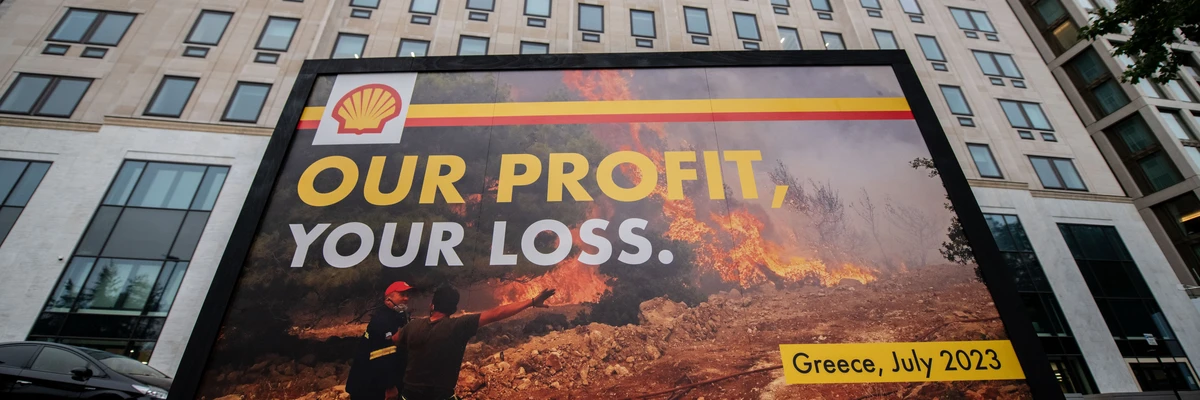
Greenpeace activists display a billboard during a protest outside Shell headquarters on July 27, 2023 in London.
Greenpeace activists display a billboard during a protest outside Shell headquarters on July 27, 2023 in London. (Photo: Handout/Chris J. Ratcliffe for Greenpeace via Getty Images)

Original article by Julia Conley republished from Common Dreams under Creative Commons (CC BY-NC-ND 3.0).

“The failure by our political class to deal with this completely solvable issue is staggering and shameful,” wrote one journalist.

As Hurricane Milton’s 145 mile-per-hour winds began closing in on Southwest Florida on Wednesday and people crowded into makeshift shelters across the state, climate advocates and other observers said the life-threatening storm and massive disruption to millions of people’s lives should make Americans “furious” at those who have helped make extreme weather more frequent and dangerous.

As Nathan J. Robinson wrote in Current Affairs, climate scientists and meteorologists have unequivocally told oil companies and policymakers that fossil fuel extraction is causing planetary heating, which has led to higher temperatures in oceans and bodies of water including the Gulf of Mexico, where the rapidly strengthening hurricane formed.

But despite the knowledge that fossil fuel giants like ExxonMobil and Shell had decades ago that drilling for oil and gas would cause “violent weather” and “potentially catastrophic events,” the industry’s profits have only grown as the U.S. has continued to subsidize their pollution-causing activities.

“The failure by our political class to deal with this completely solvable issue is staggering and shameful,” wrote Robinson. “Many of them have children and grandchildren. Presumably they would like their descendants to inherit a world worth living in. And they could make that happen. Unfortunately, it would require challenging the power and profits of some of America’s most influential corporations.”

In the Substack newsletter Heated, Arielle Samuelson explained on Wednesday how fossil fuel extraction and planetary heating “mutated” Hurricane Milton, which stunned weather experts this week as its wind speeds grew at a record-breaking pace, from 60 miles per hour to 180 miles per hour in just 36 hours.

It was the second time in recent weeks that a hurricane in the region has intensified quickly; areas that are expected to take a direct hit from Milton are still overwhelmed by the destruction left by Hurricane Helene.

Hot temperatures in the planets’ oceans and gulfs fuels hurricanes, and as Samuelson noted, scientists say the “extremely hot” Gulf of Mexico “was made far more likely by heat-trapping pollutants from the fossil fuel, agriculture, chemical, and cement industries.”

She continued:

In the past two weeks, ocean temperatures in the Gulf of Mexico were about 30-31° Celsius (86-88°F)—about 1 to 2° Celsius above average. The climate crisis made these extraordinarily high ocean temperatures at least 400 to 800 times more likely over the past two weeks, according to a rapid attribution study from Climate Central.

[…]

The science is also extremely clear that heat-trapping pollution causes sea-level rise and heavier rainfall, both of which make hurricanes more dangerous. Rainfall rates for tropical cyclones are expected to rise with the planet’s temperature, causing deadly flash floods like those found in Asheville, North Carolina. Sea level rise also means that coastal communities, and communities further inland, are more likely to be flooded during a storm.

That’s an objectively scary reality. But we know the primary source of greenhouse gas pollution, scientists note, so we also know how to slow the problem.

The lingering destruction of Helene and the impending landfall of Milton come, noted Fossil Fuel Media director Jamie Henn, weeks after three Democrats in Congress introduced legislation to require fossil fuel companies and oil refiners that do business in the U.S. to pay into a $1 trillion Polluters Pay Climate Fund, with their contributions based on a percentage of their global emissions.

The fund would be used to finance climate adaptation and other efforts to confront the impacts of the climate crisis.

In a press briefing on Wednesday, President Joe Biden noted how the damage done by Helene and the rapidly evolving news about Milton has left overwhelmed Americans vulnerable to misinformation, with some urging them to direct their anger at the White House or the Federal Emergency Management Agency (FEMA).

Republican presidential nominee Donald Trump has made baseless claims that FEMA funds were spent on funding for immigrant shelters, while U.S. Rep. Marjorie Taylor Greene (R-Ga.) wrote on social media that an unnamed “they” can control the weather and suggested the federal government is deliberately keeping emergency aid from people in states controlled by Republicans.

As fossil fuel firms and political leaders march “us toward the tipping points,” wrote Robinson, “many people won’t understand what is happening to them.”

“In a chaotic information environment filled with endless falsehoods, they’ll conclude that the president is manipulating the weather, or FEMA is trying to kill people,” he wrote. “The real story, however, is straightforward: We have a political class that is vastly more committed to sending weapons to war criminals than funding emergency management, and which will not acknowledge the basic facts of the problem (and the known solutions) because some large economic actors benefit in the short run from the destruction of the planet.”

“Truly, it’s revolting,” he added. “What an absolute disgrace our failure to deal with climate change is.”

Candice Fortin, U.S. campaigns manager for 350.orgsaid that fossil fuel executives and the politicians that support them have “blood on their hands” and called on Biden to unequivocally stand on the side of hurricane victims by declaring a climate emergency.

“This is a climate emergency,” said Fortin. “Every time we repeat that, countless more lives have been lost or upended by the fossil fuel industry. How many more times will it take? We call on President Biden to use his executive power to declare a climate emergency so we can finally protect frontline communities.”

At Newsweek, organizer and attorney Aaron Regunberg wrote that oil companies’ contributions to the climate emergency have been compounded by their vast efforts to spread misinformation and hide their knowledge that fossil fuel extraction was heating the planet.

Exxon CEO Darren Woods, he wrote, pushed for a surge in the company’s extractive activities while “overseeing a substantial portion of the company’s climate deception efforts,” and received $198.9 million for his “climate crimes” from 2015-23, as well as owning Exxon shares worth $371.1 million.

“Regular people are paying the ultimate price for this sociopathic greed,” wrote Regunberg. “The families made homeless, the wives and husbands and parents and children who lost loved ones to Helene—these victims deserve justice no less than victims of street-level crimes, and the companies and corporate executives responsible for their pain and suffering deserve criminal punishment at least as much as, if not far more than, the average street-level offender.”

“Climate victims have paid so much for Big Oil’s reckless conduct,” he added. “It’s time to make the polluters pay.”

Original article by Julia Conley republished from Common Dreams under Creative Commons (CC BY-NC-ND 3.0).

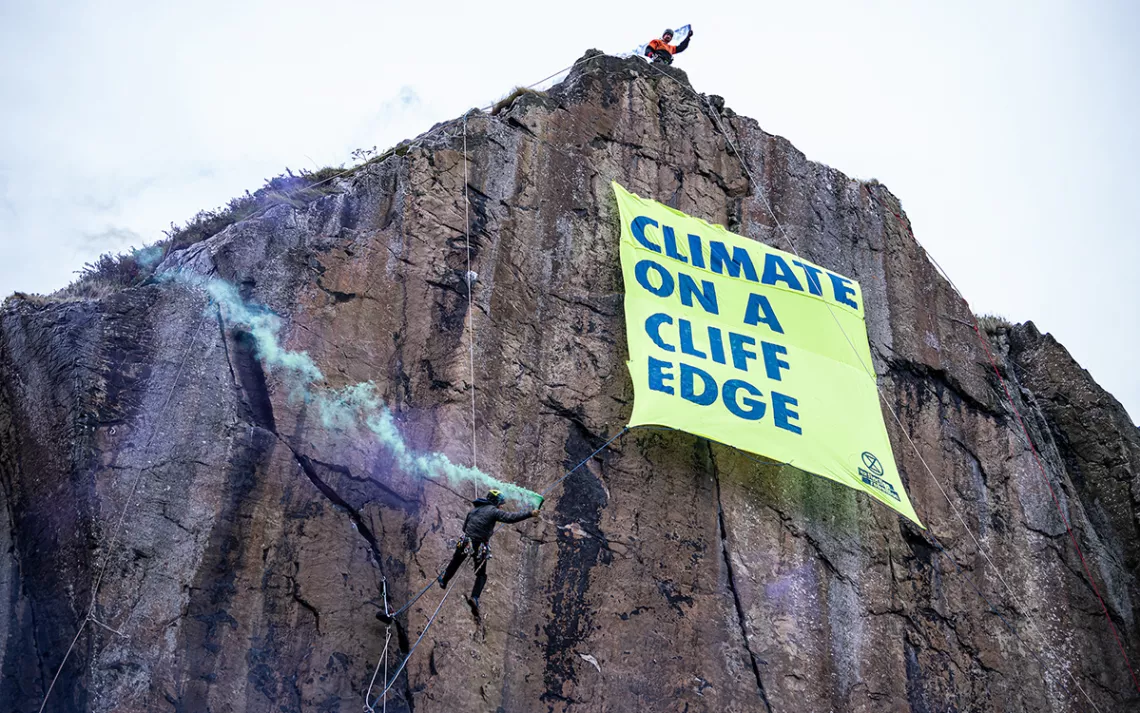
Experienced climbers scale a rock face near the historic Dumbarton castle in Glasgow, releasing a banner that reads “Climate on a Cliff Edge.” One activist, dressed as a globe, symbolically looms near the edge, while another plays the bagpipes on the shores below. | Photo courtesy of Extinction Rebellion and Mark Richards
Continue Reading‘Reckless Conduct’ of Big Oil Caused Milton—And Now They Should Pay

‘Very Fabric of Life’ at Risk Without Urgent Action to End Fossil Fuel Era

Spread the love

Original article by Jessica Corbett republished from Common Dreams under Creative Commons (CC BY-NC-ND 3.0).

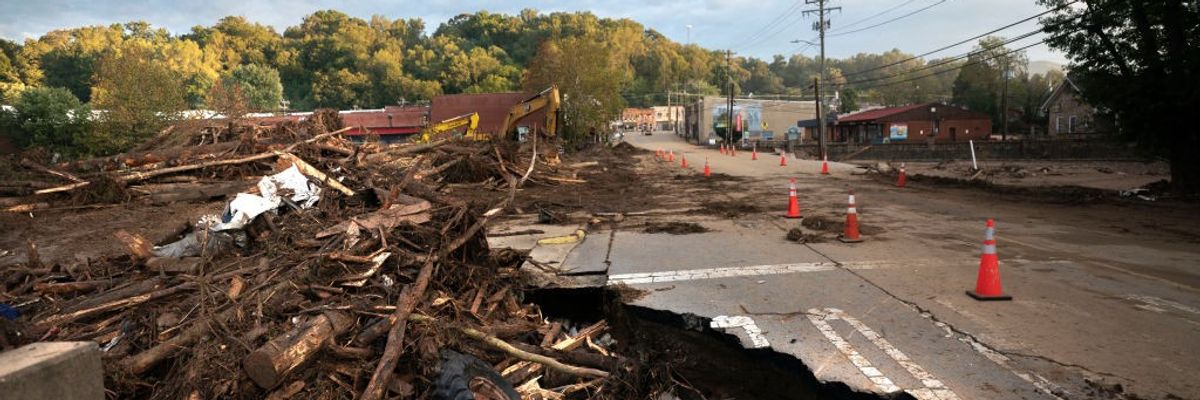
Flood damage is shown at a bridge across Mill Creek in the aftermath of Hurricane Helene on September 30, 2024 in Old Fort, North Carolina.
 (Photo: Sean Rayford/Getty Images)

“We are on the brink of an irreversible climate disaster. This is a global emergency beyond any doubt.”

As Hurricane Milton barreled toward Florida’s Gulf Coast, demonstrating the dangers of global warming, international scientists on Tuesday published a terrifying annual analysis that highlights the need to swiftly phase out planet-heating fossil fuels.

“Our aim in the present article is to communicate directly to researchers, policymakers, and the public,” the coalition wrote in BioScience. “As scientists and academics, we feel it is our moral duty and that of our institutions to alert humanity to the growing threats that we face as clearly as possible and to show leadership in addressing them.”

“We are on the brink of an irreversible climate disaster. This is a global emergency beyond any doubt. Much of the very fabric of life on Earth is imperiled. We are stepping into a critical and unpredictable new phase of the climate crisis,” warned the 14 experts from Australia, Brazil, China, Denmark, Germany, Switzerland, the United Kingdom, and the United States.

Their latest edition, “The 2024 State of the Climate Report: Perilous Times on Planet Earth,” shows that 25 of the 35 “planetary vital signs” the team uses to track the climate emergency are at record extremes. They include U.S.-heat related mortality, fossil fuel subsidies, coal and oil consumption, carbon dioxide equivalent emissions, per capita meat consumption, global tree cover loss due to fires, ocean acidity and heat content change, glacier thickness change, and ice mass change in Antarctica and Greenland.

“Ecological overshoot, taking more than the Earth can safely give, has pushed the planet into climatic conditions more threatening than anything witnessed even by our prehistoric relatives.”

The report emphasizes that “human-caused carbon dioxide emissions and other greenhouse gases are the primary drivers of climate change. As of 2022, global fossil fuel combustion and industrial processes account for approximately 90% of these emissions, whereas land-use change, primarily deforestation, accounts for approximately 10%.”

“For many years, scientists, including a group of more than 15,000, have sounded the alarm about the impending dangers of climate change driven by increasing greenhouse gas emissions and ecosystem change,” the publication notes. “For half a century, global warming has been correctly predicted even before it was observed—and not only by independent academic scientists but also by fossil fuel companies.”

“Despite these warnings, we are still moving in the wrong direction; fossil fuel emissions have increased to an all-time high, the three hottest days ever occurred in July of 2024, and current policies have us on track for approximately 2.7°C peak warming by 2100,” the article adds. “Tragically, we are failing to avoid serious impacts, and we can now only hope to limit the extent of the damage. We are witnessing the grim reality of the forecasts as climate impacts escalate, bringing forth scenes of unprecedented disasters around the world and human and nonhuman suffering.”

Oregon State University professor William Ripple, who led the team with Christopher Wolf of Terrestrial Ecosystems Research Associates, said in a Tuesday statement that “ecological overshoot, taking more than the Earth can safely give, has pushed the planet into climatic conditions more threatening than anything witnessed even by our prehistoric relatives.”

“We’re already in the midst of abrupt climate upheaval,” Ripple stressed. “For example, Hurricane Helene caused more than 200 deaths in the southeastern United States and massive flooding in a North Carolina mountain area thought to be a safe haven from climate change.”

“Since the publication of our 2023 report, multiple climate-related disasters have taken place, including a series of heatwaves across Asia that killed more than a thousand people and led to temperatures reaching 122°F in parts of India,” he continued. “Climate change has already displaced millions of people, with the potential to displace hundreds of millions or even billions. That would likely lead to greater geopolitical instability, possibly even partial societal collapse.”

To avoid that dark future, the article argues, “we need bold, transformative change: drastically reducing overconsumption and waste, especially by the affluent, stabilizing and gradually reducing the human population through empowering education and rights for girls and women, reforming food production systems to support more plant-based eating, and adopting an ecological and post-growth economics framework that ensures social justice.”

The assessment—whose authors include Michael Mann of the University of Pennsylvania, Naomi Oreskes of Harvard University, and Stefan Rahmstorf and Johan Rockström of the Potsdam Institute for Climate Impact Research—comes just over a month away from the next United Nations Climate Change Conference, COP29, which is scheduled for November 11-22 in Azerbaijan.

Pointing to previous summits, Wolf said Tuesday that “despite six reports from the International Panel on Climate Change, hundreds of other reports, tens of thousands of scientific papers, and 28 annual meetings of the U.N.’s Conference of the Parties, the world has made very little headway on climate change.”

“Humanity’s future depends on creativity, moral fiber, and perseverance,” he warned. “If future generations are to inherit the world they deserve, decisive action is needed, and fast.”

Original article by Jessica Corbett republished from Common Dreams under Creative Commons (CC BY-NC-ND 3.0).

Experienced climbers scale a rock face near the historic Dumbarton castle in Glasgow, releasing a banner that reads “Climate on a Cliff Edge.” One activist, dressed as a globe, symbolically looms near the edge, while another plays the bagpipes on the shores below. | Photo courtesy of Extinction Rebellion and Mark Richards
Continue Reading‘Very Fabric of Life’ at Risk Without Urgent Action to End Fossil Fuel Era

On Heels of Helene, Milton Explodes Into Category 5 Hurricane

Spread the love

Original article by Julia Conley republished from Common Dreams under Creative Commons (CC BY-NC-ND 3.0).

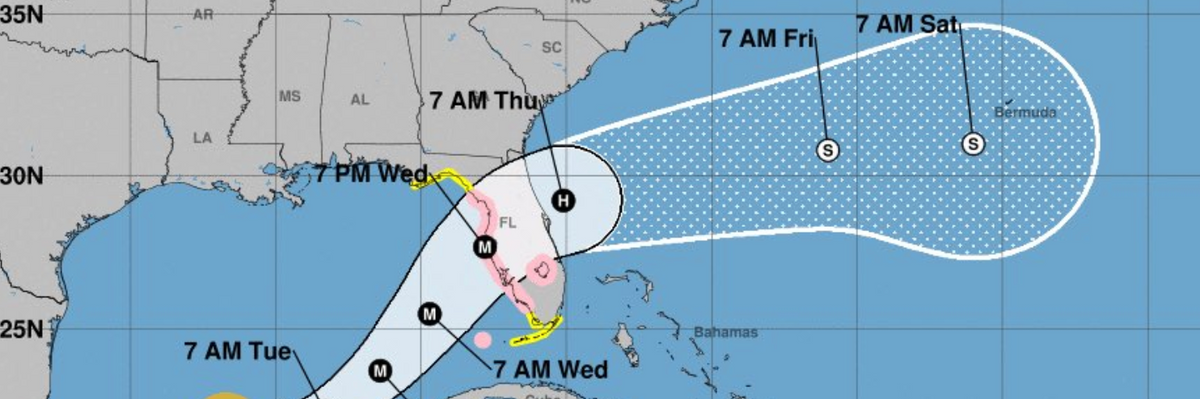
The expected path of Hurricane Milton is seen in a graphic released on October 7, 2024.(Photo: National Hurricane Center)

“The Gulf of Mexico is so warm that the models couldn’t predict how strong Milton has gotten so quickly,” said the Sunrise Movement. “This is a climate emergency.”

“This is not normal,” said climate advocates Monday as they expressed the same shock as weather experts who were reporting on the rapid strengthening of Hurricane Milton, whose winds sped up to 175 miles per hour as Florida residents struggled to recover from last month’s devastating storm, Helene.

Milton was classified as a Category 5 hurricane Monday afternoon—just five hours after it had been designated a Category 2 storm with 100 mile-per-hour winds and 48 hours after it became a tropical storm churning eastward over the Gulf of Mexico.

The winds “explosively” intensified over a matter of hours, according to the National Hurricane Center.

As the hurricane gathered strength, weather analyst Colin McCarthy of U.S. Stormwatch said that “not a single weather model predicted the storm would strengthen this quickly.”

The storm was expected to make landfall on Florida’s Gulf Coast on Wednesday, and Republican Gov. Ron DeSantis—who vehemently denies scientists’ consensus that human-caused climate change is causing more extreme weather—called for widespread evacuations ahead of “life-threatening” hazards.

“If we knew exactly where it’s going to hit, we probably would evacuate fewer people,” DeSantis said Monday morning. “But we don’t know that.”

President Joe Biden declared an emergency in Florida Monday afternoon and ordered federal assistance to the state.

The New York Times reported that Milton could weaken before Wednesday as it makes its way through the Gulf, but that could be accompanied by a widening of the hurricane’s size, threatening a greater portion of the vulnerable state.

“The entire peninsula, the entire west coast, has potential to have major, major impact because of the storm surge,” said DeSantis on Sunday.

Milton is expected to be the second hurricane to hit Florida in two weeks, with parts of the state still reeling from the damage left by Helene.

DeSantis said Monday that emergency workers had picked up 180,000 cubic yards of debris across the state, and said, “There’s still a lot of it.”

The Tampa Bay area, where residents were warned by National Weather Service meteorologist Rick Davis on Monday that Milton could be “the worst hurricane in their lifetime,” was inundated last month with record-high storm surges.

Barrier islands were damaged by Helene, and the destruction of sand dunes has left the area especially exposed to hazards, Davis told The New York Times.

“Just after our latest hurricane, we are extremely vulnerable, especially to surge,” said Davis. “Our ground is extremely saturated from several hurricanes already this year, and we’re going to have river flooding. So people that may be 20 miles inland from the coast won’t get storm surge, but they could get rainfall flooding, river flooding, retention ponds could flood creeks.”

Climatologists have warned that warmer oceans and bodies of water including the Gulf of Mexico are likely to cause more intense hurricane seasons. The Gulf has reached an average surface temperature of nearly 90°F—the hottest it’s been since modern records have been kept, Brian McNoldy, a climate researcher at the University of Miami, toldVox in August.

“The Gulf of Mexico is so warm that the models couldn’t predict how strong Milton has gotten so quickly,” said national climate advocacy group Sunrise Movement.

Officials called on residents to evacuate Monday rather than waiting for the hurricane to get closer to making its expected landfall. More than a dozen school districts in the state announced they were closing ahead of the storm.

But as pro-labor media group More Perfect Union reported, workers on Monday were already sharing stories online of how companies are planning to stay open until at least Tuesday night, making it impossible for people to obey evacuation orders.

One person working in retail management said that “after waiting all weekend to see if the corporate overlords would say we’re closed until further notice, I got notice today that we’re business as usual until Tuesday night… This gives me no time to evacuate or prepare accordingly.”

“Workers died during Hurricane Helene because they weren’t given time to evacuate,” said More Perfect Union. “This must stop.”

Original article by Julia Conley republished from Common Dreams under Creative Commons (CC BY-NC-ND 3.0).

Experienced climbers scale a rock face near the historic Dumbarton castle in Glasgow, releasing a banner that reads “Climate on a Cliff Edge.” One activist, dressed as a globe, symbolically looms near the edge, while another plays the bagpipes on the shores below. | Photo courtesy of Extinction Rebellion and Mark Richards
Continue ReadingOn Heels of Helene, Milton Explodes Into Category 5 Hurricane