Tag: immigration

  • ‘Concentration Camps’: Border Czar Says Trump to Detain Migrant Families

    Spread the love

    Original article by Jessica Corbett republished form Common Dreams under Creative Commons (CC BY-NC-ND 3.0)

    Incoming White House ‘border czar’ Tom Homan speaks during Turning Point’s annual AmericaFest 2024 in Phoenix, Arizona, on December 22, 2024. (Photo: Josh Edelson/AFP via Getty Images)

    “Decent people all over the world will hate this country… and they should,” said one critic.

    Adding to alarm over U.S. President-elect Donald Trump’s immigration plans, his “border czar” told The Washington Post in an interview published Thursday that the administration plans to return to detaining migrant families with children.

    Tom Homan, who served as acting director of U.S. Immigration and Customs Enforcement during Trump’s first term, said that ICE “will look to hold parents with children in ‘soft-sided’ tent structures similar to those used by U.S. border officials to handle immigration surges,” the Post summarized. “The government will not hesitate to deport parents who are in the country illegally, even if they have young U.S.-born children, he added, leaving it to those families to decide whether to exit together or be split up.”

    Since Trump beat Democratic Vice President Kamala Harris last month, migrant rights advocates have reiterated concerns about the Republican’s first-term policies—such as forced separation of families—and his 2024 campaign pledges, from mass deportations to attempting to end birthright citizenship, despite the guarantees of the 14th Amendment to the U.S. Constitution.

    Homan—who oversaw the so-called “zero tolerance” policy that separated thousands of migrant kids from their parents—said: “Here’s the issue… You knew you were in the country illegally and chose to have a child. So you put your family in that position.”

    Incoming "border czar" Tom Homan on shipping U.S.-born children out of the country with their undocumented parents: “You knew you were in the country illegally and chose to have a child.”"Chose"? That's an odd word choice. The right wants to force women to give birth, not give them a choice.

    — Mark Jacob (@markjacob.bsky.social) 2024-12-26T14:30:08.168Z

    Harris and President Joe Biden have come under fire for various immigration policies, but their administration did stop family detention—and when it was reported last year that the White House was weighing a revival of the practice, 383 groups urged the president to keep the pledge he made when he took office “to pursue just, compassionate, and humane immigration policies.”

    Under Biden, the government ended mass worksite immigration raids and—eventually—the “Remain in Mexico” policy that stopped asylum-seekers from entering the United States. Homan told the Post that the next Trump administration should bring them back.

    Less than a month before Trump’s inauguration, Biden is now facing pressure to “use the power of the pen to protect those seeking sanctuary from the coming deportation machine that will crush the human rights of our immigrant neighbors and those who have dreams of finding refuge here,” as Amnesty International USA executive director Paul O’Brien put it earlier this month.

    The Post reported that “of all the border hard-liners in the incoming administration, Homan is perhaps the most cognizant of the limits of the government’s ability to deliver on promises of mass deportation—and the potential for a political backlash.”

    Those hard-liners include dog-killing Republican South Dakota Gov. Kristi Noem, Trump’s pick to lead the Department of Homeland Security; family separation architect Stephen Miller, the president-elect’s homeland security adviser and deputy chief of staff for policy; and Caleb Vitello, the next acting ICE director whom Miller previously tried to install at the Office of Refugee Resettlement.

    “We’re going to need to construct family facilities,” Homan told the newspaper. However, he also said: “We need to show the American people we can do this and not be inhumane about it… We can’t lose the faith of the American people.”

    Critics of the next administration have suggested that—although Trump won the Electoral College and the popular vote last month—pursuing the GOP immigration policies, including “concentration camps” for migrant families, will anger the public.

    Maximum cruelty is the goal https://www.washingtonpost.com/immigration/2024/12/26/immigration-border-tom-homan-trump/

    — Ric Steinberger (@ricst.bsky.social) 2024-12-26T14:29:05.618Z

    “Decent people all over the world will hate this country… and they should,” media columnist and Brooklyn College professor Eric Alterman said on social media in response to the Post‘s reporting.

    Author and New York University adjunct associate professor Helio Fred Garcia said: “Trump’s next border czar previews performative cruelty. In the first term it included kidnapping of children from their parents and returning the parents to their home countries, with no record of which kids came from which parents. A crime against humanity.”

    Lee Gelernt, an ACLU attorney who has argued many major immigration cases, told the Post that “the incoming administration has refused to acknowledge the horrific damage it did to families and little children the first time around and seems determined to once again target families for gratuitous suffering.”

    “The public may have voted in the abstract for mass deportations,” he added, referring to the November election, “but I don’t think they voted for more family separation or unnecessary cruelty to children.”

    Original article by Jessica Corbett republished form Common Dreams under Creative Commons (CC BY-NC-ND 3.0)

  • Claudia Sheinbaum stands up to Donald Trump, calls for respect of migrants’ human rights

    Spread the love

    Original article by Pablo Meriguet republished from peoples dispatch under a Creative Commons Attribution-ShareAlike 4.0 (CC BY-SA) license.

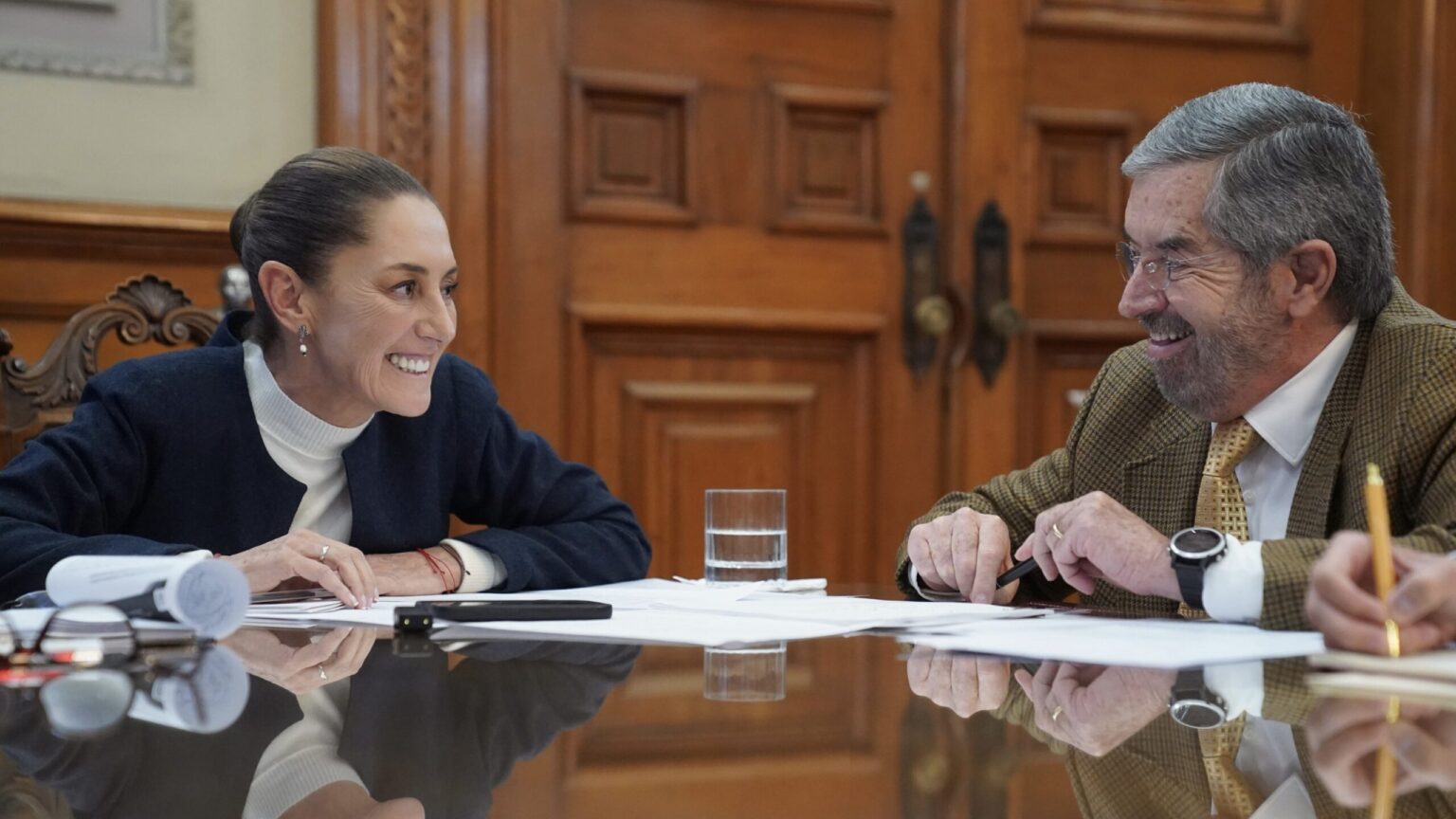
    Mexican President Claudia Sheinbaum speaking on the phone to US president-elect Donald Trump. Photo: Presidencia MX

    The Mexican President told the press that it is not true that she informed the US President-elect that she would close the border between both countries, contradicting statements from Trump about their conversation

    The tensions between Mexican President Claudia Sheinbaum and US president-elect Donald Trump are growing, with Trump continuing to launch accusations and threats at the Southern neighbor of the US, only to be met with a firm and resolute Sheinbaum.

    On November 25, Trump, in a post on his media platform Truth Social, threatened to impose a 25% tariff on Mexican and Canadian products until illegal migration and drug imports into US territory were stopped. He also threatened that products coming from China will have to pay 10% more tariffs if the Asian country does not further control the sale of certain chemicals from which fentanyl is made. The three targeted countries responded clearly and firmly (more so China and Mexico than Canada) to Trump’s warnings and pointed out that if the threat were to become a reality, a real “trade war” could be unleashed.

    For her part, the Mexican President stated in her daily morning press conference on November 26 that the imposition of new tariffs will not reduce drug consumption in the United States, nor will it curb illegal migration to the United States; on the contrary, “it would cause the United States and Mexico inflation and job losses.”

    That same day, Sheinbaum and Trump spoke on the phone and addressed several issues of interest to both nations, such as immigration, drug trafficking, drug consumption, and more. However, in the aftermath of their conversation, two versions have emerged of what was said and agreed on, with Trump insisting that Mexico has agreed to effective “clos[e] our Southern Border” to “stop the illegal invasion of the USA”.

    Donald Trump said through his social network, Truth Social “Just had a wonderful conversation with the new President of Mexico, Claudia Sheinbaum Pardo. She has agreed to stop Migration through Mexico, and into the United States, effectively closing our Southern Border. We also talked about what can be done to stop the massive drug inflow into the United States, and also, the US consumption of these drugs. It was a very productive conversation!”

    The president-elect added “Mexico will stop people from going to our Southern Border, effective immediately. THIS WILL GO A LONG WAY TOWARD STOPPING THE ILLEGAL INVASION OF THE USA. Thank you!!!”

    However, for the Mexican head of state, this version is far from the truth.

    Sheinbaum’s version

    For her part, Sheinbaum reported on X “I had an excellent conversation with President Donald Trump. We addressed the Mexican strategy on the migration phenomenon and I shared that no caravans are arriving at the northern border because they are being taken care of in Mexico. We also talked about strengthening collaboration on security issues within the framework of our sovereignty and the campaign we are carrying out in the country to prevent the consumption of fentanyl.”

    However, the Mexican President said that at no time did she communicate to Trump that she would order the closure of the Mexican-US border: “In our conversation with President Trump, I explained to him the comprehensive strategy that Mexico has followed to address the migratory phenomenon, respecting human rights. Thanks to this, migrants and caravans are attended to before they arrive at the border. We reiterate that Mexico’s position is not to close borders but to build bridges between governments and between peoples.”

    In an official visit to the state of Nuevo León, the Mexican leader highlighted that trade ties between the United States and Mexico are very deep, so a trade war would only bring higher inflation and a contraction of the GDP of the countries involved. In the case of the United States, Sheinbaum said that Mexican remittances are partially consumed in the United States, so a disruption could imply a major disruption of the US economy; she also noted that a reduction in migration would increase the US social security debt by 13%.

    The Mexican president also announced last week that in her letter to Trump, she called on the head of state to remove the economic sanctions and blockade on Cuba and Venezuela, and that respectful and open dialogues be established between all nations of the continent.

    Original article by Pablo Meriguet republished from peoples dispatch under a Creative Commons Attribution-ShareAlike 4.0 (CC BY-SA) license.

  • Shadow Foreign Secretary Priti Patel Has Ties to Group Behind ‘Extreme’ Trump Agenda

    Spread the love

    Original article by Sam Bright and Adam Barnett republished from DeSmog.

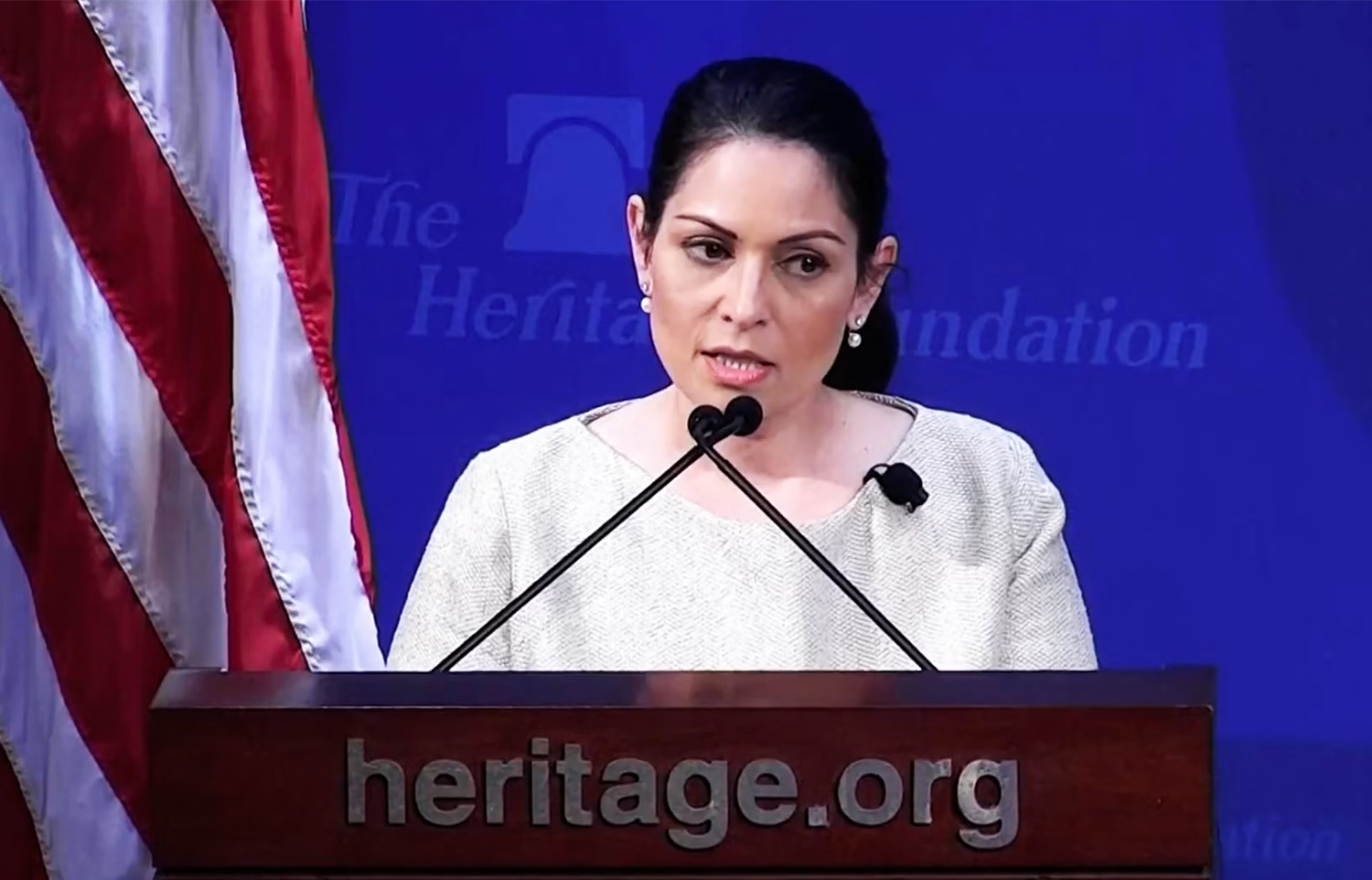
    Conservative MP Priti Patel speaking at the Heritage Foundation in 2021. Credit: GB News / Facebook

    The Heritage Foundation’s Project 2025 blueprint proposes sweeping anti-climate policies.

    New Shadow Foreign Secretary Priti Patel earlier this year welcomed into Parliament a radical U.S. organisation behind Donald Trump’s hard-right plan for a second term as president. 

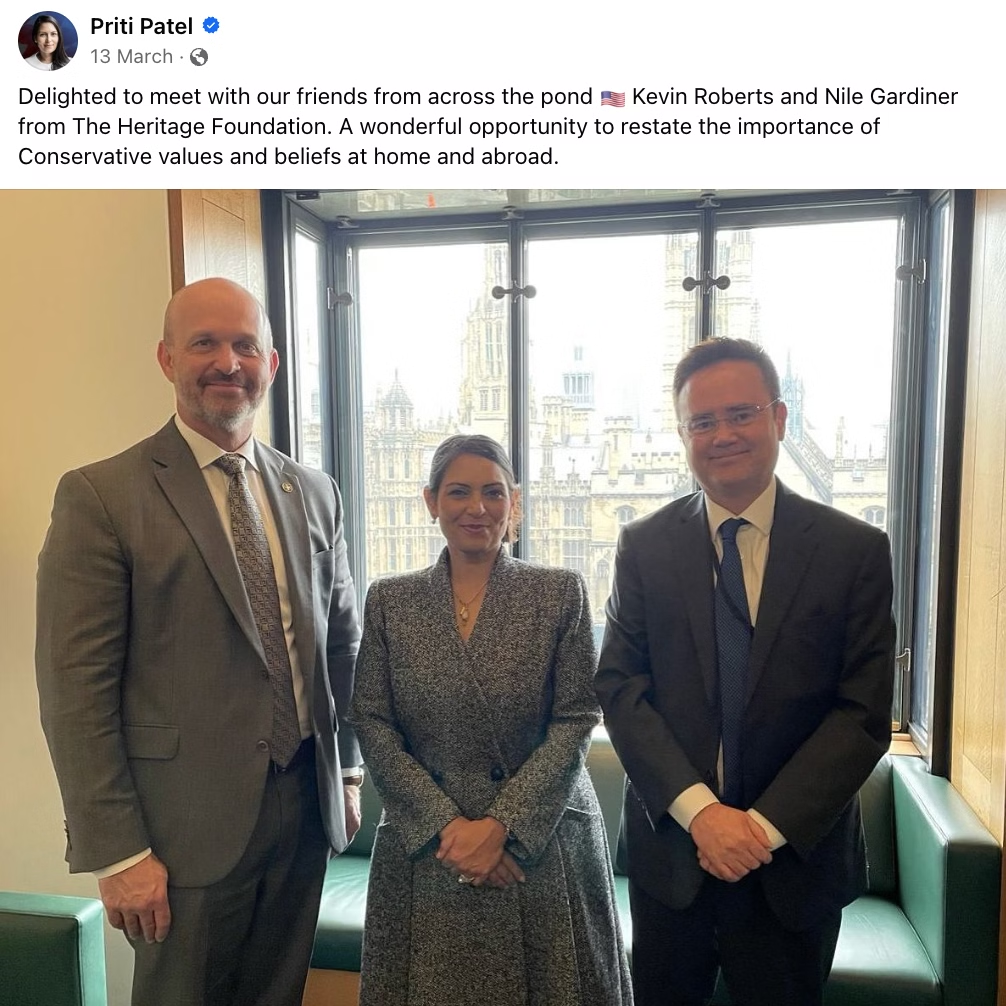
    As reported by DeSmog, Conservative MP Patel met with Kevin Roberts and Nile Gardiner of the Heritage Foundation in March, praising the pair on her Facebook page as “our friends across the pond” who stand for “Conservative values and beliefs at home and abroad”. 

    Roberts is the president of the Heritage Foundation, while Gardiner is the director of its ‘Margaret Thatcher Center for Freedom’. 

    The Heritage Foundation is an ultra-conservative group that authored the controversial Project 2025 blueprint for a second Donald Trump term, which proposes a range of radical anti-climate policies, including slashing restrictions on fossil fuel extraction, scrapping investment in renewable energy, and gutting the Environmental Protection Agency. 

    Project 2025 has been accused of being “extreme” and “authoritarian” for setting out a plan to rapidly “reform” the U.S. government by shuttering bureaus and offices, overturning regulations, and replacing thousands of public sector employees with hand-picked political allies of Trump. The agenda also proposes radical tax cuts, and a crackdown on reproductive rights. 

    On Wednesday (6 November), following Trump’s victory in the U.S. presidential election, Roberts sent an email on behalf of the foundation, saying that: “starting now, we will execute our plans to dismantle the administrative state.” 

    At least 140 authors of Project 2025 worked for the last Trump administration, according to CNN, while several are expected to hold positions in the next Trump White House.

    Patel also gave a speech about national security to the Heritage Foundation, hosted by Gardiner, in November 2021. Patel was at the time serving as home secretary, and her address was published on the UK government website. 

    This news comes as the Conservative Party realigns itself after the election of new leader Kemi Badenoch, positioning itself as having better relations with the incoming Trump administration. 

    In her first Prime Minister’s Questions (PMQs) this week, Badenoch called on Labour not to oppose a Trump address to Parliament, and asked whether Foreign Secretary David Lammy had apologised to the Republican for labelling him as a “neo-Nazi sympathising sociopath” in 2020.

    Patel was appointed to Badenoch’s new shadow cabinet earlier this week, alongside Shadow Justice Secretary Robert Jenrick, who also has ties to the Heritage Foundation. 

    In February, Jenrick – who came second in the recent Tory leadership election – gave a speech to the Heritage Foundation in Washington DC entitled, “Securing Sovereign Borders in an Age of Mass Migration”.

    Project 2025 proposes new sweeping restrictions on immigration into the U.S., while setting the foundations for mass deportations – a key promise of Trump’s 2024 campaign. 

    After being introduced by Roberts, Jenrick praised the foundation, and described meeting with and learning from Heritage while working as an intern for Condoleeza Rice, who served as secretary of state under Republican President George W. Bush. 

    Jenrick also praised the event’s co-host Gardiner, whom Jenrick described as “the special relationship made flesh”. He said Gardiner, who writes a regular column for the Daily Telegraph, “creates links between conservatives here and in the UK”. 

    As revealed by Democracy For Sale and Byline Times, Donald Trump and U.S. Republican campaigns received more than $45 million (£35 million) from donors who have funded the influential network of hard-wing Tufton Street think tanks in the UK. 

    “That senior Conservatives would take time out to travel halfway around the world to give talks at a pro-Trump think tanks is very revealing,” said Peter Geoghegan, editor of Democracy For Sale. “We need to be aware that the dark money that fuelled the likes of the Heritage Foundation is washing up in Britain, where secretive Tufton Street think tanks refuse to declare their donors but take millions from pro-Trump U.S. conservatives.”

    A Heritage Foundation spokesperson previously told DeSmog: “Project 2025 is a coalition of conservatives who wrote ‘Mandate for Leadership: The Conservative Promise’ which was published in April 2023, before any candidate declared a run for office. Project 2025 does not speak for any candidate or campaign.”

    Project 2025 and Climate Denial

    Project 2025 proposes replacing green investment with the further deregulation of the oil and gas industry. 

    Speaking at an event co-hosted by the Heritage Foundation and the Hungarian Danube Institute in September, key Trump ally Robert Wilkie – who served as U.S. veterans’ affairs secretary from 2018 to 2021 – confirmed that his former boss would “kill” climate budgets. 

    The Heritage Foundation received over £4.9 million between 1997 and 2017 from groups linked to the fossil fuel giant Koch Industries. The brothers behind the company, Charles and the late David Koch, have been the principal funders of climate denial groups in the U.S. since the 1980s. 

    As revealed by DeSmog, advisory groups working on Project 2025 have received at least $9.6 million from Charles Koch since 2020, along with at least $21.5 million from the Sarah Scaife Foundation, which is funded by the Mellon oil and banking fortune.

    The Heritage Foundation has disputed these figures, though has not offered its own calculations. A spokesperson previously told DeSmog: “Heritage research is independent and accurate, these numbers are not.”

    At a 2022 Heritage Foundation event, Nile Gardiner said: “I do think the British government needs to rethink the whole green energy agenda. It’s not a conservative agenda, in fact it’s a socialist agenda”. He added: “I think net zero has become basically a form of religion, and anyone who questions the dogma on this immediately is accused of being a heretic.”

    As DeSmog has reported, Kemi Badenoch has regularly criticised the UK’s green ambitions, describing herself as a “net zero sceptic” during her Conservative conference speech in October. 

    During the leadership contest, Badenoch published a 40-page manifesto that cited the Committee to Unleash Prosperity, a U.S. group led by former advisors to Trump, which has likened climate science to believing the earth is flat. 

    Jenrick has also attacked net zero policies and has advocated for increased fossil fuel extraction, including the development of new coal mines. 

    Original article by Sam Bright and Adam Barnett republished from DeSmog.

    Experienced climbers scale a rock face near the historic Dumbarton castle in Glasgow, releasing a banner that reads “Climate on a Cliff Edge.” One activist, dressed as a globe, symbolically looms near the edge, while another plays the bagpipes on the shores below. | Photo courtesy of Extinction Rebellion and Mark Richards
    Experienced climbers scale a rock face near the historic Dumbarton castle in Glasgow, releasing a banner that reads “Climate on a Cliff Edge.” One activist, dressed as a globe, symbolically looms near the edge, while another plays the bagpipes on the shores below. | Photo courtesy of Extinction Rebellion and Mark Richards
    Orcas comment on killer apes destroying the planet by continuing to burn fossil fuels. Second version, corrected text.
    Orcas comment on killer apes destroying the planet by continuing to burn fossil fuels. Second version, corrected text.
  • Starmer’s new immigration bill is just as racist as the Rwanda plan

    Spread the love

    Original article by Julia Tinsley-Kent Fizza Qureshi republished from Open Democracy under a Creative Commons Attribution-NonCommercial 4.0 International licence.

    Starmer announces plan to stop the boats in May 2024 | Dan Kitwood/Getty Images

    The UK immigration system is racist by design. The Border Security Bill will make it worse

    Over the past few years of increasingly hostile migration policies, many in the migrant, including refugee, charity sector have looked to the dawn of a new government with eager anticipation. Surely, a Labour government would undo so many of these cruel anti-migration laws and mark a more ‘progressive’ chapter in migrant rights?

    Unfortunately, at the Migrants’ Rights Network, we have not shared this optimism.

    While the new government wasted little time in scrapping the infamous Rwanda Plan (and rightly so) it has diverted funds from that scheme into yet another anti-migrant policy in the form of the Border Security, Asylum and Immigration Bill. The announcement of this bill proves our caution was completely justified. It’s simply a continuation of the UK’s track record of enacting immigration policies that disproportionately impact people of colour.

    We only have to look at the record of the last Labour government to see that they are no different to the Conservatives in embedding anti-migrant policies and rhetoric. Let’s not forget it was a Labour home secretary who first coined the term ‘hostile environment’ and it was New Labour that brought in the restrictive Immigration and Asylum Act 1999 and Nationality, Immigration and Asylum Act 2002, which laid the foundation for the hostile environment policies of the past 14 years.

    In the past year itself, now-prime minister, Keir Starmer, has made plenty of not-so-subtle signs indicating what approach his government would take towards people seeking safety, including a promise to treat so-called ‘smugglers’ like “terrorists”.

    Fast forward one year and these ideas have materialised in the form of the new Border Security Bill. The bill was announced as part of the King’s Speech and is part of a turn towards approaching migration through counter-terror, making space for even greater surveillance of and denial of rights for migrants, including refugees.

    This dangerous bill would introduce powers previously been confined to alleged terror offenders, including travel bans and restrictions in the UK and abroad, restrictions on access to the internet and banking, and the ability to apply these measures before someone is even convicted of smuggling offences.

    UK’s immigration policy has always been racist

    Successive UK governments have essentially tried to ‘outdo’ each other when it comes to making the lives of migrants, including refugees, and racialised communities unbearable. In fact, these rafts of policies stem from a long history of targeting ‘unwelcome’ groups based on colonial constructions of the ‘threat’ and who are considered to be of ‘good character’.

    In the Migrants’ Rights Network’s new Hostile Office report, we demonstrate that from the 1905 Aliens Act to the inhumane Migration Act 2023 (Illegal Migration Act), as well as the suffering of the Windrush victims and the government’s ability to deprive people of their citizenship, it should be evident to all of us that immigration laws are underpinned by a desire to limit the presence and freedom of racialised people in the UK.

    Proposed powers in the new Border Security Bill would enable border force officers to search people and examine and seize their belongings, including copying data from and retaining people’s mobile phones, without a requirement for reasonable suspicion. It mirrors Schedule 7 of the Terrorism Act 2000, where someone can be arrested and convicted for refusing to hand over sensitive and personal information, including passcodes to devices, in addition to failing to answer all questions or refusing to provide biometric data – all without the need for reasonable suspicion.

    However, implementing counter-terrorism policies into immigration is hardly surprising or new. It marks just another chapter of an increasingly cruel, racist and Islamophobic trajectory in the immigration system.

    Take citizenship laws, for example. Deprivation of citizenship and counter-terror laws are linked: most cases of deprivation on ‘public good’ grounds have been justified using counter-terror legislation. We have been campaigning against the expansion of deprivation of citizenship powers and highlighting the racist, Islamophobic nature of them.

    Since the 2003 ‘Hamza amendment’ to the British Nationality Act 1981 (an amendment that was passed specifically to deport one man, Abu Hamza, a naturalised British citizen), of those who have had their citizenship revoked since 2002, the majority of people affected have been British Muslims.

    Our findings show that between 2002 and 2022, 85% of those stripped of their citizenship had, or were deemed to have, nationalities of countries in Africa, South Asia or West Asia (the Middle East) and 83% were from former British colonies. Of this, 41% were South Asian, all being Pakistani or Bangladeshi.

    It is, therefore, not a huge leap to understand that the presence of counter-terror measures serves to limit the freedom, security and sense of belonging for racialised people in the UK, particularly those from a Muslim background.

    Meanwhile, in December 2023, the Home Office published an Independent Review of Prevent’s report and the government’s response by William Shawcross (Independent Reviewer of Prevent) in which he recommended the Government explore extending Prevent into the immigration and asylum system. Make no mistake, linking the racist criminal (in)justice and counter-terror systems will further the harm and punishment to people seeking safety and a new life. It will do nothing to target the true roots of why people migrate and are forced to make dangerous border crossings.

    The answer to a lack of safe routes is not further criminalisation through the introduction of counter-terror powers, which are often opaque and almost impossible to challenge. This lack of safe routes is why brokers exist, to capitalise on people’s desperation.

    The Border Security Bill, and the counter-terrorism approach as part of a package deal, will just continue a long tradition of punishing people of colour at the UK border.

    Original article by Julia Tinsley-Kent Fizza Qureshi republished from Open Democracy under a Creative Commons Attribution-NonCommercial 4.0 International licence.

  • Supreme court rules Rwanda plan unlawful: a legal expert explains the judgment, and what happens next

    Spread the love
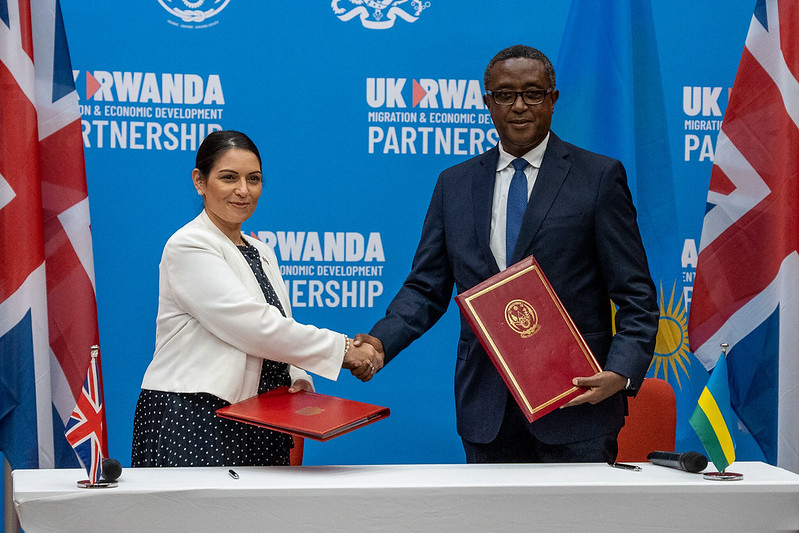
    The Rwanda deal was signed when Priti Patel was home secretary. Rwanda visit April 14, 2022. Image: UK Home Office.
    The Rwanda deal was signed when Priti Patel was home secretary. Rwanda visit April 14, 2022. Image: UK Home Office.

    Before publishing this article unaltered, I draw your attention to these excerpts:

    …

    It is important to note that the supreme court’s decision is not a comment on the political viability of the Rwanda plan, or on the concept of offshoring asylum processes generally. The ruling focused only on the legal principle of non-refoulement, and determined that in this respect, Rwanda is not a “safe third country” to send asylum seekers.


    …


    This ruling is likely to revive discussion about the UK leaving the European convention on human rights (ECHR), which holds the UK to the non-refoulement obligation. Some Conservatives, including the former home secretary Suella Braverman, have argued that leaving the convention would make it easier to pass stronger immigration laws.

    But while handing down the supreme court judgment, Lord Reed emphasised that there are obligations towards asylum seekers that go beyond the ECHR. The duty of non-refoulement is part of many other international conventions, and domestic law as well. In other words, exiting the ECHR would not automatically make the Rwanda plan lawful or easier to implement.

    …

    So it would appear that UK is not going to be sending refugees to Rwanda despite Rishi Sunak and Conservative claims that it will.

    Supreme court rules Rwanda plan unlawful: a legal expert explains the judgment, and what happens next

    Devyani Prabhat, University of Bristol

    The UK supreme court has unanimously ruled that the government’s plan to send asylum seekers to Rwanda is unlawful.

    Upholding an earlier decision by the court of appeal, the supreme court found that asylum seekers sent to Rwanda may be at risk of refoulement – being sent back to a country where they may be persecuted, tortured or killed.

    The courts cited extensive evidence from the UN refugee agency (UNHCR) that Rwanda does not respect the principle of non-refoulement – a legal obligation. The UNHCR’s evidence questioned the ability of Rwandan authorities to fairly assess asylum claims. It also raised concerns about human rights violations by Rwandan authorities, including not respecting non-refoulement with other asylum seekers.

    It is important to note that the supreme court’s decision is not a comment on the political viability of the Rwanda plan, or on the concept of offshoring asylum processes generally. The ruling focused only on the legal principle of non-refoulement, and determined that in this respect, Rwanda is not a “safe third country” to send asylum seekers.

    The ruling is another blow to the government’s promise to “stop the boats”. And since the Rwanda plan is at the heart of its new Illegal Migration Act, the government will need to reconsider its asylum policies. This is further complicated by Conservative party infighting and the firing of home secretary Suella Braverman, just two days before the ruling.

    How did we get here?

    For years, the UK government has been seeking to reduce small boat arrivals to the UK. In April 2022, the UK and Rwanda signed an agreement making it possible for the UK to deport some people seeking asylum in Britain to Rwanda, without their cases being heard in the UK. Instead, they would have their cases decided by Rwandan authorities, to be granted (or rejected) asylum in Rwanda.

    While the Rwanda plan specifically was found to be unlawful, the government could, in theory, replicate this in other countries so long as they are considered “safe” for asylum seekers.

    The government has not yet sent anyone to Rwanda. The first flight was prevented from taking off by the European court of human rights in June 2022, which said that British courts needed to consider all human rights issues before starting deportations.

    A UK high court then decided in December 2022 that the Rwanda plan was lawful.


    Catch up on our other coverage of the Rwanda plan:

    • Why UK court ruled Rwanda isn’t a safe place to send refugees – and what this means for the government’s immigration plans

    • Rwanda deportations: what is the European Court of Human Rights, and why did it stop the UK flight from taking off?

    • Suella Braverman is wrong about the UN refugee convention being ‘not fit for purpose’ – here’s why

    • The government passed a major immigration law last year – so why is it trying to pass another one?

    • ‘A toxic policy with little returns’ – lessons for the UK-Rwanda deal from Australia and the US


    Ten asylum seekers from Syria, Iraq, Iran, Vietnam, Sudan and Albania challenged the high court ruling, with the support of the charity Asylum Aid. Their claim was about whether Rwanda meets the legal threshold for being a safe country for asylum seekers.

    The court of appeal said it was not and that asylum seekers risked being sent back to their home countries (where they could face persecution), when in fact they may have a good claim for asylum.

    The government has since passed the Illegal Migration Act. The law now states that all asylum seekers arriving irregularly (for example, in small boats) must be removed to a safe third country. But now that the Rwanda deal has been ruled unlawful, there are no other countries that have said they would take asylum seekers from the UK.

    What happens next?

    Former Home Secretary Suella 'Sue-Ellen' Braverman
    Former Home Secretary Suella ‘Sue-Ellen’ Braverman continued with the Rwanda policy.

    It is clear that the government’s asylum policies will need rethinking. Should another country now be designated as a safe country and different arrangements put in place, these will probably be subject to further legal challenges, including in the European court of human rights and in British courts.

    This ruling is likely to revive discussion about the UK leaving the European convention on human rights (ECHR), which holds the UK to the non-refoulement obligation. Some Conservatives, including the former home secretary Suella Braverman, have argued that leaving the convention would make it easier to pass stronger immigration laws.

    But while handing down the supreme court judgment, Lord Reed emphasised that there are obligations towards asylum seekers that go beyond the ECHR. The duty of non-refoulement is part of many other international conventions, and domestic law as well. In other words, exiting the ECHR would not automatically make the Rwanda plan lawful or easier to implement.

    The prime minister, Rishi Sunak, has said that he is working on a new treaty with Rwanda and is prepared to change domestic laws to “do whatever it takes to stop the boats”.

    The UK is not the only country to attempt to off-shore asylum processing. Germany and Italy have recently been considering finding new safe third countries to accept asylum seekers as well.

    But ensuring these measures comply with human rights obligations is complicated. International law requires states to provide sanctuary to those fleeing persecution or risk to their lives. As this ruling shows, the UK is not going to find an easy way out of these obligations. The Conversation

    Devyani Prabhat, Professor of Law, University of Bristol

    This article is republished from The Conversation under a Creative Commons license. Read the original article.