NHS logo. Resident doctors in England will strike later this month after being offered a 5.4% pay rise, which the government say will not be revisited.
Resident doctors’ 29% pay claim is non-negotiable, reasonable and easily affordable for the NHS, the new leader of the medical profession has said.
Strikes to ensure resident – formerly junior – doctors in England get the full 29% could drag on for years, according to Dr Tom Dolphin, the British Medical Association’s new council chair.
The doctors’ union will not negotiate on or accept a lower figure because that is the extent of the real-terms loss of earnings resident doctors have suffered since 2008, which they want restored – in full – Dolphin told the Guardian in his first interview since taking over last month.
The 29% demand is not up for negotiation “because it’s based on a principle”, said Dolphin, a consultant anaesthetist. “If we picked a different number, that wouldn’t achieve the pay restoration. So that’s why it looks inflexible.”
Dolphin blamed the five-day strike that tens of thousands of resident doctors plan to stage later this month on Wes Streeting, the health secretary, giving them a 22% pay rise over two years last year but not following it up with an award this year to take account of the 29% claim. He said the disruption that the 120-hour walkout would cause was his fault, not theirs.
The government has announced its strategy for “giving every child the best start in life”, laying out proposals covering early years care, education and support in England.
The strategy builds on the current local family hub model of services, which offer a range of support aimed at babies and young children. Best Start family hubs will further bring together early years and family services in a similar way to the previous Sure Start programme. The government’s commitment includes £1.5 billion in investment to implement these reforms.
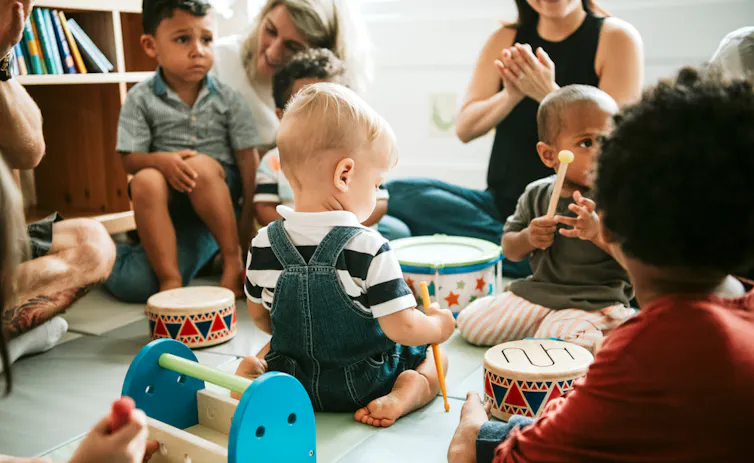
The Best Start Hubs will be a one-stop shop to support families with their child’s early development, from breastfeeding advice to speech and language support and stay and play sessions. The hubs will also support families with wider challenges such as housing and benefits, and provide courses for parents.
The attempt to bring services together to deliver local, holistic support to families is understandable given the impact of the original Sure Start initiative, introduced by Tony Blair’s Labour government.
Get your news from actual experts, straight to your inbox.Sign up to our daily newsletter to receive all The Conversation UK’s latest coverage of news and research, from politics and business to the arts and sciences.
The Sure Start Local Programmes that were established from 1999 onwards had a significant positive effect on those families who had access to them. From 2010, though, when the Conservative-Liberal Democrat coalition came into power, funding was cut and many Sure Start centres closed.
In May 2025 the Institute for Fiscal Studies published a summary report on the short- and medium-term effects of Sure Start on children’s lives.
They found that the impact of the Sure Start services for under-fives was remarkably long-lasting, with improvements during their teenage years in educational attainment and behaviour in school, and reductions in hospital admissions. The Institute for Fiscal Studies estimates that these long-term benefits significantly outweigh the cost of the Sure Start programme.
Like Sure Start, the Best Start strategy has the potential to be transformational for young children and their families.
However, the current range of challenges faced by families and the depth of child poverty in the country will make bringing about this transformation challenging. A 2023 report from charity the Joseph Rowntree Foundation estimates that there are one million children growing up destitute in the UK, without the means to stay warm, dry, clean and fed.
The challenge of poverty
The day after the Best Start strategy was launched, the children’s commissioner for England published a research report on children’s experience of growing up in a low-income family. Based on interviews with 128 children, the report outlines the “almost-Dickensian” levels of poverty experienced by children whose basic needs are not being met. Children described poor housing conditions, mouldy food and lack of hot water.
The significant impact that poverty has on children’s educational attainment, health and future lives will be difficult for the benefits that the Best Start programme may provide to negate.
I have witnessed these financial challenges and the wider range of issues families are dealing with on a daily basis in my own role as the director of the Early Years Community Research Centre at Sheffield Hallam University, and through my wider research with families.
In March 2024 I was part of a team of researchers who were commissioned by the Ministry for Housing, Community and Local Government to explore how multiple insecurities, such as financial difficulties, health problems, precarious work, poor housing and lack of support networks affected people’s lives.
Parents described the difficulties of making ends meet. They talked about having to deal with many different national and local agencies, the stress this created within their family and the toll on their health and wellbeing.
Even working full-time did not necessarily make families more secure. In one family, the working pattern the parents had to adopt to make ends meet meant that they only had one day a fortnight to be together.
We have to do stupid hours. I mean my partner, she works nights. I work mainly days … we’re kind of like passing ships in the night.
The places these families turned to were local community centres run by a range of organisations. The common themes about why they accessed these centres were the warm, welcoming, non-judgemental approach taken by staff, trusting relationships with staff and the range of services and support that were offered.
This bodes well for the Best Start strategy – if it is able to deliver the full range of services the government has outlined in a local trusted space. However, this will be a significant challenge in communities that have lacked support over recent years, are suffering the hardships of poverty and that may have lost trust in government services.
Keir Starmer says that the Labour Party under his leadership all feel a small part of Scunthorpe.Keir Starmer confirms that he’s proud to be a red Tory continuing austerity and targeting poor and disabled scum.Keir Starmer explains that he feels no shame or guilt benefitting personally from gifts from the rich and powerful while insisting on policies of severe austerity causing suffering and death.
New government statistics released today show the reach of the two-child limit. There are 1,665,540 children in England, Scotland and Wales living in households affected by the two-child limit, an increase of over 35,000 from the same time in 2024.
The two-child limit restricts means-tested child benefits to the first two children in a household, subject to some exceptions.
Its sister policy, the benefit cap, affects over 115,000 households, including 300,000 children. It routinely pushes families into deep poverty, far below the standard poverty line of 60% of median income.
The benefit cap places a limit on the total amount a household can receive if no-one in the household earns a minimum amount, again subject to some exceptions linked to receipt of disability benefits.
Get your news from actual experts, straight to your inbox.Sign up to our daily newsletter to receive all The Conversation UK’s latest coverage of news and research, from politics and business to the arts and sciences.
Over the past five years, we have been part of a team of academic researchers investigating the impact of both policies on families with three or more children. We’ve found that these policies drive up poverty, creating deprivation and hardship. This in turn causes sustained and severe harm to children and their families.
The two-child limit and benefit cap leave many families living with extreme financial insecurity. They harm parental mental health, as mothers and fathers struggle to try and make an inadequate income stretch to meet the needs of their children.
In addition, these policies do not fall evenly across the population when looking at ethnicity. Overall, 70% of the families affected by the two-child limit are white, as are 66% affected by the benefit cap. But our new analysis shows that children from an ethnic minority are up to three times as likely as white children to be affected by the two-child limit. They are also up to four times as likely to be affected by the benefit cap.
Alongside administrative statistics, we have analysed household survey data, published today as a policy brief. We find that one in five children from Pakistani families and one in four children from Bangladeshi families are now affected by the two-child limit.
Rising poverty
Our analysis also indicates that these policies are contributing to very high and rising levels of poverty. We estimate that 66% of Bangladeshi children, 60% of Pakistani children, and nearly half (48%) of black children live in poverty. This compares to one in four (24%) white children living below the poverty line – still far too many.
This new analysis provides us with better understanding of where the damage done by both policies is falling. It’s an important reminder of how the two-child limit and benefit cap directly conflict with ambitions not only to act on child poverty, but also to reduce systematic inequalities linked to ethnicity.
Scrapping the two-child limit would give larger families access to benefits they currently miss out on – but it would not have any effect on smaller families living in poverty, so isn’t the only policy solution needed.
Nonetheless, analysis by the Resolution Foundation has shown that getting rid of the two-child limit – which would cost £1.4 billion – is by far the most cost-effective way to reduce the number of children living in poverty. Spending £1.4 billion in other ways – for example by increasing benefits for all families – would make less difference to child poverty than if the two-child limit were ended.
It’s also important to keep in mind the impact on the depth of poverty. Larger families tend to be living further below the poverty line. Scrapping the two-child limit will make a big difference in many households, even if they are not lifted out of poverty as a result.
Labour came into government on a manifesto of “change”, and Keir Starmer has promised to be “laser-focused” in his commitment to drive down poverty.
Labour have already said that they want to get rid of the two-child limit, arguing that they just need to find the money to do so. The government has established a child poverty taskforce, due to report in the autumn, and made a first concrete policy commitment with the extension of free school meals provision for families in England. But there is no alternative to serious action on social security benefits if significant progress is to be made.
Keir Starmer says that the Labour Party under his leadership all feel a small part of Scunthorpe.Keir Starmer explains that he feels no shame or guilt benefitting personally from gifts from the rich and powerful while insisting on policies of severe austerity causing suffering and death.
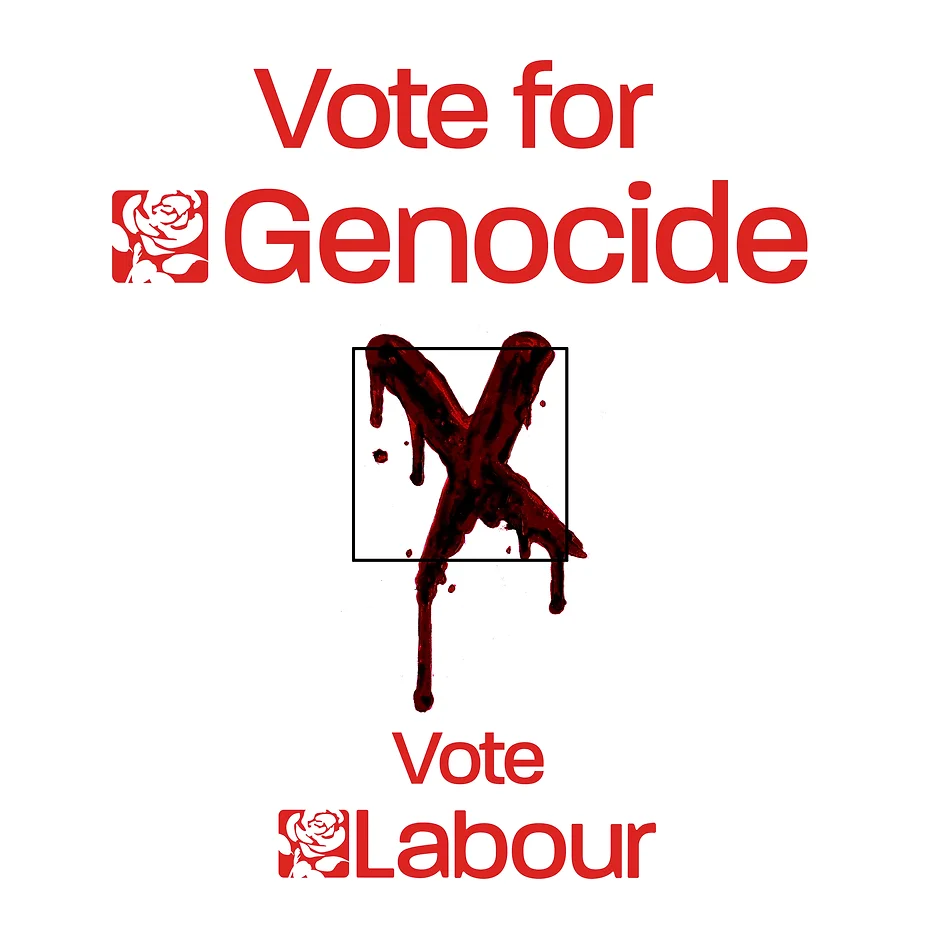
UK Labour Party government ministers Keir Starmer, Angela Rayner and Rachel Reeves explain that they are partners complicit in Israel’s Gaza genocide. The UK has provided Israel with arms, military and air force support. They explain that they don’t do gas chambers but do do forced marches, starvation, destroy hospitals, mass-murders of journalists and healthcare workers.Keir Starmer objects to criticism of the IDF. He asks how could anyone obect to them starving people to death, forced marches like the Nazis did, bombing Gaza’s hospitals and universities,mass-murdering journalists, healthworkers and starving people queuing for food, killing and raping prisoners and murdering children. He calls for people to stop obstructing his genocide for Israel.Vote Labour for Genocide.
Keir Starmer’s home secretary Yvette Cooper (right) has banned Palestine Action. (Photo: Alastair Grant / Alamy)
The Home Office briefed the Times that Palestine Action could be funded by Iran, and then UK media kicked into action spreading the story.
The proscription of Palestine Action took place alongside claims made in sections of the British media that the group could have been funded by Iran.
On the same day, 23 June, that home secretary Yvette Cooper formally announced to parliament she would proscribe the group, the Times published a report saying “Iran could be funding Palestine Action, Home Office officials claimed”.
It added: “Officials are understood to be investigating its source of donations amid concerns that the Iranian regime, via proxies, is funding the group’s activities given that their objectives are aligned”.
The Times provided no quotes from Home Office officials or any evidence of Iranian funding to Palestine Action.
The same day, the paper published another article, stating: “Support for the group [Palestine Action] from campaigns with alleged links to Iran has fuelled concerns it is unwittingly and covertly being funded by Tehran. It received backing yesterday by a group described in a government report as ‘aligned with the Iranian regime’”.
This referred to the Islamic Human Rights Commission (IHRC), a pro-Iranian UK-based NGO which had posted on X: “We stand in solidarity with our comrades PalestineAction!”
The Times noted that the IHRC was described in a 2023 government review of the Prevent counter-extremism programme as an “Islamist group ideologically aligned with the Iranian regime, that has a history of ‘extremist links and terrorist sympathies’”.
Keir Starmer objects to criticism of the IDF. He asks how could anyone obect to them starving people to death, forced marches like the Nazis did, bombing Gaza’s hospitals and universities,mass-murdering journalists, healthworkers and starving people queuing for food, killing and raping prisoners and murdering children. He calls for people to stop obstructing his genocide for Israel.UK Labour Party government ministers Keir Starmer, Angela Rayner and Rachel Reeves explain that they are partners complicit in Israel’s Gaza genocide. The UK has provided Israel with arms, military and air force support. They explain that they don’t do gas chambers but do do forced marches, starvation, destroy hospitals, mass-murders of journalists and healthcare workers.Vote Labour for Genocide.