NHS news review
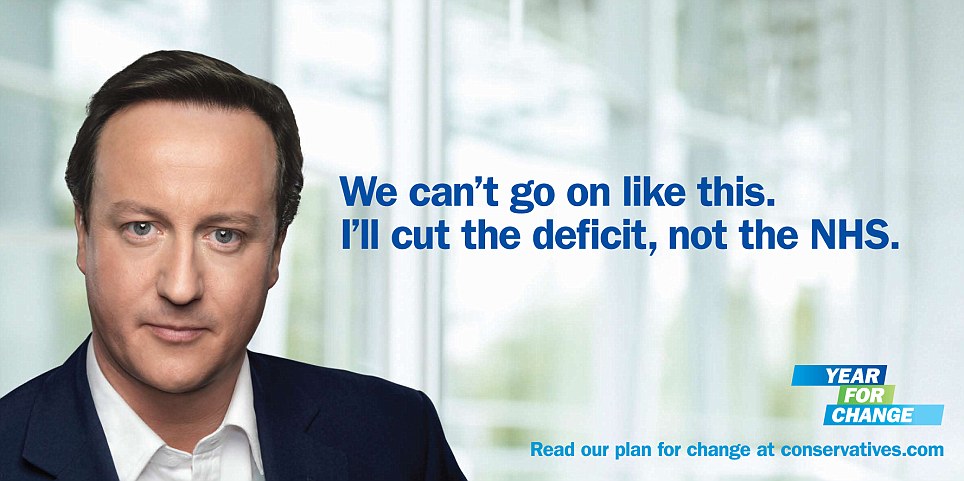
- Conservative election poster 2010
A few recent news articles concerning the UK’s Conservative and Liberal-Democrat coalition government – the ConDem’s – brutal attack on the National Health Service.
GPs will be forced to privatise NHS, GP leaders warn | GPonline.com
A DoH guidance document on the Any Qualified Provider policy, published this week, outlined that commissioners must offer a choice of three providers for a range of services.
But GPC chairman Dr Laurence Buckman warned that the ‘unavoidable implication’ of this drive is that commissioners will have to commission from private providers.
He said: ‘The government would say, “Well that’s alright because if they are providing NHS services at an NHS tariff, why does it matter?”.
‘Our answer is it does matter because services should be provided by the NHS or by people who are employed in the service.’
Dr Buckman also said it is now clear that clinical commissioning groups will have little freedom to make decisions and instead will be continually dictated to by a number of other bodies, including the NHS Commissioning Board.
He said: ‘The more documents come out the clearer it is that clinical commissioning groups are not going to be free to do whatever they like.
‘Clinical commissioning groups are going to end up being the fall guys, nominally in power but actually being told what to do and second guessed by a variety of other bodies.’
Patient, heal thyself: the new NHS mantra? – Health News, Health & Families – The Independent
NHS patients who smoke or are obese are being told they must “heal themselves” before being granted access to surgery, in a dramatic extension of NHS rationing as doctors struggle to find £20 billion of savings over the next four years.
Doctors from 50 GP practices in Hertfordshire providing care to 450,000 patients have agreed to block those who smoke or have a BMI of more than 30 from being referred for routine hip or knee replacement surgery, without first being referred to a weight management or smoking cessation scheme.
The restriction, introduced eight weeks ago, is to be extended to all routine surgery over the next few months. Similar moves to ration care are being debated by family doctors across the country, in fulfilment of Health Secretary Andrew Lansley’s plan to move the bulk of the NHS budget from managers, who don’t spend resources, to GPs, who do.
But critics of the move say GPs must act as advocates for their patients, not as rationers of NHS services, and that the confusion of the two roles under the NHS reforms will undermine patients’ trust. They say each patient must be treated according to their needs and a blanket restriction imposed on the basis of lifestyle is “unethical”.
…
Longer waits for cataract treatment – Main Section – Yorkshire Post
A fifth of GP practices have been affected by changes in criteria used to refer cataracts patients, with the average patient waiting an additional 15 weeks for NHS treatment, according to a new report.
Despite 85 per cent of GPs surveyed believing that postponing treatment has a detrimental effect on patients’ quality of life, more than a quarter (27 per cent) of practices admitted that their patients will now have to wait for their eyesight to deteriorate even further before they can be referred to the NHS.
In most cases, patients who previously had 20:20 vision will not be eligible for treatment until their vision has regressed to the minimum driving standard, the report said.
The most inconvenient factor is that the criteria must be reached for each eye, leaving many patients with only one eye treated for months while having to go through the referral process twice, it added.
For one in 10 practices, the time between diagnosing and referring patients is thought to have risen by an additional 15 weeks, with some GPs recording delays of up to 24 weeks for their patients.
…
NHS told to sell off disused land / Britain / Home – Morning Star
NHS managers are being asked to sell off disused land in order to raise urgent cash for a financially devastated health service, the government announced today.
Deputy NHS chief executive David Flory has asked trusts to earmark surplus land that could be used to build affordable homes.
The Department of Health said the money would be reinvested into front-line NHS services to benefit patients.
A spokesman said “financial accounting procedures” guarantee trusts reinvest the money in patient care.
…
But Royal College of Nursing’s chief executive Dr Peter Carter warned that the plans will not prevent short-term cuts being driven through and questioned whether “efficiency savings” will really be invested back into front-line services.
He said: “Unfortunately, some local trusts are taking a short-term approach, slashing jobs and services at an alarming rate.
“We have already identified 40,000 NHS posts that are earmarked to be lost across Britain and a study of 21 trusts found that more than half of job losses were front-line clinical posts.
“Nurses and patients want to see hard evidence that these efficiency savings are being reinvested back into frontline services. There is currently very little evidence to show this is actually happening.”
…
Unite questions government’s NHS land sell-off
There are big question marks over the government’s plans to sell off the NHS’ surplus land for affordable housing, Unite, the largest union in the country, said today (Friday 22 July).
Unite’s national officer for health, Rachael Maskell, said: ”There are a number of questions that need to be clarified about this announcement which we will be seeking answers to.
”We would be concerned if the land went to private health providers, where the private sector may be lining themselves up to deliver services. This would then be part of the government’s underlying NHS privatisation agenda, which we would oppose.
”However, if the land is for public sector use, then it would be beneficial for it go towards the building of much-needed social housing. The issue here is that with land prices at a low level, is this now the best time to sell the land, if the money is expected to cross-subsidise trusts’ debts?”
…
Brighton health campaigners call meeting to fight NHS reforms | Brighton and Hove News
Health workers, patients and community campaigners are holding a public meeting tomorrow evening (Monday 25 July) about health services.
The group behind the meeting, Keep Our NHS Public, said that it wants to discuss how to stop the government from privatising the NHS.
Speakers include Dr Ron Singer, president of the Medical Practitioners Union, Steve Bell, a member of the union Unison’s National Executive Council, and Bronwen Handyside, from Hackney Keep Our NHS Public.
Information about the Conservative and Liberal Democrat coalition government’s plans will be outlined along with how these changes will affect health workers and patients.
The organisers said that the coalition had been trying to water down its NHS reforms under pressure from the huge weight of opposition from trade unions, health professionals and almost 500,000 public signatures on the 38 Degrees online petition.
But, the organisers said, the threat of privatisation was still embedded in the Health and Social Care Bill.
In the past week, the organisers said, the government announced that £1 billion of NHS services are to be opened up to competition from private companies and charities.
They said that this would place profits and bank balances ahead of patient needs and care.
…
The day they signed the death warrant for the NHS – Telegraph
You might think that historians will record last Tuesday as the day the Murdoch empire was brought to book by MPs. Yet I suspect that in years to come, they will realise the significance of that day, not for the phone-hacking scandal but for the health service.
While the nation’s attention was focused on the most powerful man in the media attempting to dodge questions and cream pies, this was a good day to bury bad news. And the Department of Health duly obliged.
Andrew Lansley explained that from April next year, eight NHS services worth £1 billion, including musculoskeletal services for back pain, wheelchair services for children and adult community psychological therapies, will be opened up to competitive bids from the private sector.
This means that in these areas, the NHS will no longer exist. Sure, the logo will still be there, but the NHS will no longer be national, any more than British Telecom is.
There is no doubt that this signals the first wave of privatising the NHS. Yet MPs of all persuasions continue to be deluded.
In a letter that has been passed to me, Stephen Williams, Liberal Democrat MP for Bristol West, assures a worried constituent that the NHS Reform Bill will “improve the NHS and therefore definitely not lead to the privatisation of services”.
Doubtless Mr Williams means this sincerely. But I wonder if he has actually read the Bill. I telephoned and asked him: no, he hadn’t. The problem is that the MPs who are voting on this assume that the Bill’s content reflects the Government’s White Paper on the NHS, published last summer. I have read both and it is clear to me that the White Paper bears little relation to the legislation that is being pushed through.
…
Welfare policy ‘turns public against disabled’ | Society | The Observer
The government’s flagship Welfare to Work policy is inciting hatred and violence towards the disabled by portraying them as cheats and benefits scroungers, an alliance of charities has warned.
A drip-feed of statistics about claimants who have been denied benefits by the Department for Work and Pensions because they are deemed fit to work threatens the safety and quality of life of its members, says an alliance of 50 charities. The government is feeding a negative attitude towards people with disabilities, which, the charities warn, will ultimately end in violence.
The alliance has written an open letter to Iain Duncan Smith, the work and pensions secretary, after complaining that private warnings on the issue have gone unheeded. The charities say the government should instead be promoting the talents of those who no longer need to claim benefits. Alice Maynard, the chair of Scope, who is a wheelchair user, said: “We just feel it is too much now. It is becoming such a frequent occurrence, it is likely to have some very serious negative effects. I think in the end it ends up in violence.”
She added that a hardening of attitudes meant she now “thought harder” about going out at night in London.
…
27/11/13 Having received a takedown notice from the Independent newspaper for a different posting, I have reviewed this article which links to an article at the Independent’s website in order to attempt to ensure conformance with copyright laws.
I consider this posting to comply with copyright laws since
a. Only a small portion of the original article has been quoted satisfying the fair use criteria, and / or
b. This posting satisfies the requirements of a derivative work.
Please be assured that this blog is a non-commercial blog (weblog) which does not feature advertising and has not ever produced any income.
dizzy