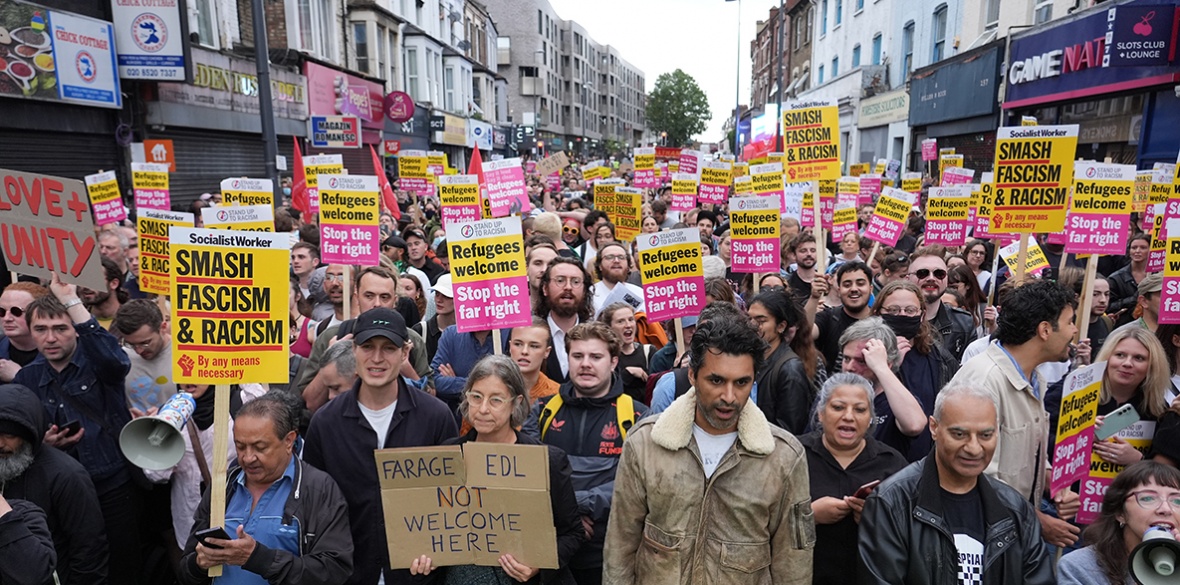
25,000 counter-protesters take to the streets in show of clear resistance
…
Weyman Bennett, co-convener of Stand Up to Racism which has helped organise rallies around the country, said: “In city after city, people came together to unite against racism and the far-right threat.
“We need more of that. They’re not going to go away.
“We’re building a movement across Britain to stop the far right — and it’s a movement built on solidarity and unity.”
…
Prime Minister Sir Keir Stamer chaired another Cobra meeting as the country braced for another 20 potential gatherings this evening before the Morning Star went to print.
Ahead of the meeting, he said that violence was prevented on Wednesday thanks to the police deployment, ignoring the crucial role of tens of thousands of counter-protesters who had mobilised to defend their communities nationwide.
He said the decision to speed up prosecutions of those involved in riots “sent a very powerful message.”
Many newspapers took a rare break from peddling racist hate to feature the large counter-demos on their front pages.
…
The surge of racist violence came after the fatal stabbing of three young girls in Southport last week.
Far-right agitators exploited the tragedy and spread lies online claiming that the attacker, who was born in Britain to a Christian family, was Muslim and a migrant.
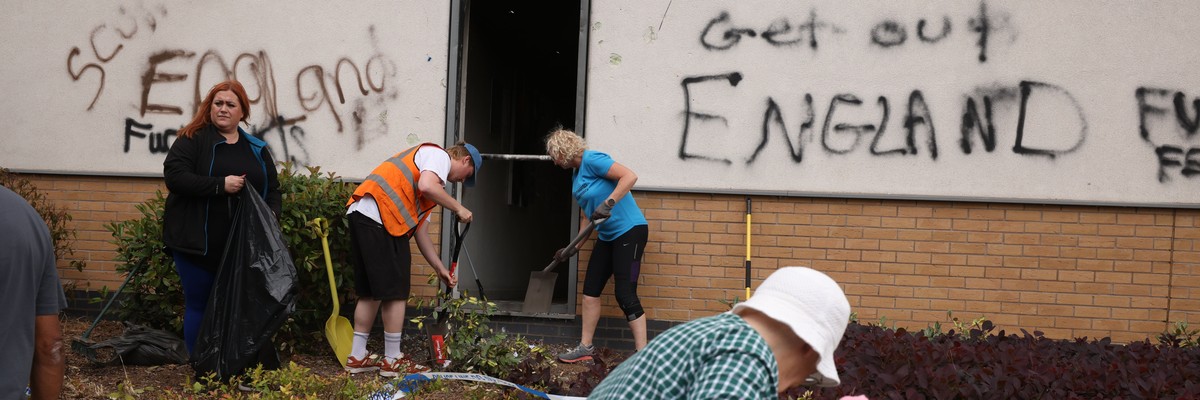
People clean up debris outside a Holiday Inn Express whose walls bear graffiti reading “Get Out England” and a racial epithet on August 5, 2024 in Tamworth, England.
“There are politicians and there are journalists who have played an active role in fanning the flames of hate and division, and we are seeing that play out,” said Zarah Sultana.
As British Prime Minister Keir Starmer covened an emergency security meeting on Monday to respond to violent attacks on immigrant and Muslim communities that have spread across the United Kingdom in recent days, progressive MP Zarah Sultana said the crisis—fueled by rampant disinformation and xenophobia—must serve as a reckoning for politicians and journalists who have “fanned the flames” of hatred for years.
Sultana, who represents Coventry South in the House of Commons, appeared on ITV’s “Good Morning Britain” to discuss the violent riots that have taken place in at least a dozen cities across the U.K. in recent days, mostly in England, with far-right protesters attacking mosques, libraries, and a hotel housing asylum-seekers.
The attacks have been in response to disinformation that has pinned the blame for a deadly stabbing attack on a children’s dance class in Southport, England last week on undocumented immigrants. The suspect was born and raised in the U.K., according to police.
“Rather than saying, this is the result of political decisions made by consecutive governments, people have blamed and scapegoated minorities.”
Sultana said that the violent attacks in cities including Blackpool, Leeds, and Manchester “shouldn’t be a surprise,” considering the years the British government—led for 14 years by the Conservative Party until the Labour Party won last month’s elections—has spent pushing anti-immigration policies and demonizing asylum-seekers, with the help of national news outlets.
“There is decades of work by the right-wing press and by politicians who have fanned the flames of this hate,” said Sultana in a panel discussion that also included journalists from The Daily Mail. “When we look at the role that media outlets like GB News has played, that The Daily Mail has played… There are politicians and there are journalists who have played an active role in fanning the flames of hate and division, and we are seeing that play out.”
The media and political class is complicit in the far right, racist and Islamophobic violence we’re seeing across our country.
Andrew Pierce of The Daily Mail took issue with Sultana’s remarks, demanding that she provide examples of anti-Muslim news stories in the paper.
The lawmaker did so after the broadcast, posting an image of 16 front pages from the outlet, including ones that asked “how many more” migrants the U.K. can take, referred to asylum-seekers as “illegals,” and claimed that migrants are taking the majority of jobs in the U.K. and sparking a “housing crisis.”
Here’s just a few examples of Daily Mail headlines that have fanned the flames of hate and normalised Islamophobic and anti-migrant rhetoric #GMBpic.twitter.com/kqzQqewnGk
Sultana added that former Home Secretary Suella Braverman referred to refugees arriving in the U.K. as an “invasion” and far-right Reform UK leader Nigel Farage said in May that British Muslims do not share “British values.”
“So when we look at the complicity,” said Sultana, “there’s a lot of mirrors that people have to be looking into.”
Sultana also implored politicians and the British media to explicitly refer to the riots over the weekend as Islamophobic, noting that Prime Minister Keir Starmer and others have denounced the attacks as racist but have not clearly expressed solidarity with the Muslim communities that have been targeted.
“Naming it as Islamophobia is really important because that allows us to shape our response,” said Sultana. “If we’re not identifying what is happening, the language that is being used and what this is about, we’re not going to be able to address this fundamentally.”
“Why is there such controversy around calling it Islamophobia?” asked Sultana after “Good Morning Britain” host Ed Balls dismissed her concerns, displaying what the lawmaker called “sneering contempt.”
The sneering contempt of ‘journalists’ will never stop me from calling out racism and Islamophobic hate. pic.twitter.com/cQoNKDzJ78
The interview took place a week after three children were killed and 10 were injured in a knife attack in Southport. The 17-year-old suspect, Axel Rudakubana, was born and raised in Britain, according to authorities, who took the unusual step of making his identity public to counter disinformation that quickly spread online and fueled riots that first began in Southport the day after the crime.
The first riot included anti-Muslim and anti-immigrant demonstrators throwing bricks at a mosque in the town, setting cars on fire, and damaging a convenience store.
The authorities’ decision to disclose the suspect’s identity did not stop the violence from escalating over the weekend, with rioters setting a library on fire in Liverpool, burning books, and attempting to block firefighters from putting out the flames on Saturday.
In Rotherham, an anti-immigration mob broke into a hotel housing asylum-seekers and attempted to set the building on fire while blocking exits.
Nearly 150 people were arrested for taking part in the attacks, and Starmer warned Sunday that “those who have participated in this violence will face the full force of the law.”
“This is not protest. It is organized, violent thuggery,” said Starmer.
BJ Harrington, the National Police Chiefs’ Council lead for public order, said in a statement Sunday that “disinformation is a huge driver of this appalling violence and we know a lot of those attending these so-called protests are doing so in direct response to what they’ve read online.”
“Often posts are being shared and amplified by high profile accounts. We’re working hard to counteract this,” added Harrington. “They won’t win.”
While calling on the government and media to directly confront the Islamophobia that has been fomented in the U.K. in recent decades, Sultana said the new Labour government should also correct the austerity policies that have caused unrest and scapegoating of immigrants and Muslim communities.
“The economic system which has allowed inequality to exacerbate in this country, has brought down living standards,” said Sultana. “Our communities have faced the brunt of Tory austerity, and what has happened on the right-wing side of politics, in the media and in politics, is that migrants, Muslims, and trans people have been blamed for people not being able to access council housing, not being able to get [National Health Service] appointments, not being able to find school places for their kids. Rather than saying, this is the result of political decisions made by consecutive governments, people have blamed and scapegoated minorities.”
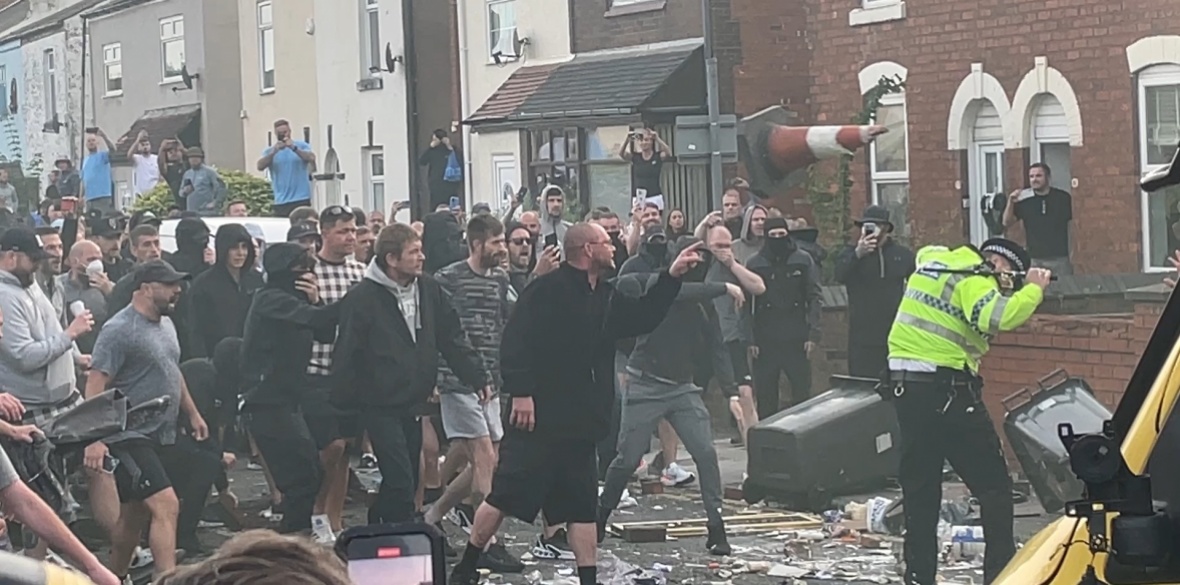
Trouble flares during a protest in Southport, after three children died and eight were injured in a “ferocious” knife attack during a Taylor Swift event at a dance school on Monday, July 31, 2024
THE racist riot in Southport following the murderous knife attack on a children’s dance class speaks both to the unscrupulousness and mobilising reach of Britain’s fascist right.
Locals are still coming to terms with Monday’s horrific killings, which have so far claimed the lives of three little girls, with others still in critical condition. A suspect is in custody, an investigation is ongoing. Nobody interested in justice for the victims would be muddying the waters with false rumours. Police stress that unfounded speculation about the attacker is deeply unhelpful.
Fascists are not interested in justice. One of the few things we do know about the suspect is that he lived in the village of Banks in Lancashire, and that he was born in Cardiff.
Yet far-right rabble-rouser “Tommy Robinson,” again abroad having skipped bail, was promoting nonsense on the X social media site from the off about the attack being linked to immigration. Other lies were quickly spreading across social media: a fake name of the supposed perpetrator; the false claim that he was an asylum-seeker, arrived by boat.
…
Vulnerable people who have faced torture, abuse or trafficking for modern slavery, or been bereaved in wars often fuelled by our government, are now fair game to be blamed for unspeakable crimes committed by others.
…
Southport is a reminder that fascists don’t wait for elections. The mayhem and terror they spread is their true element.
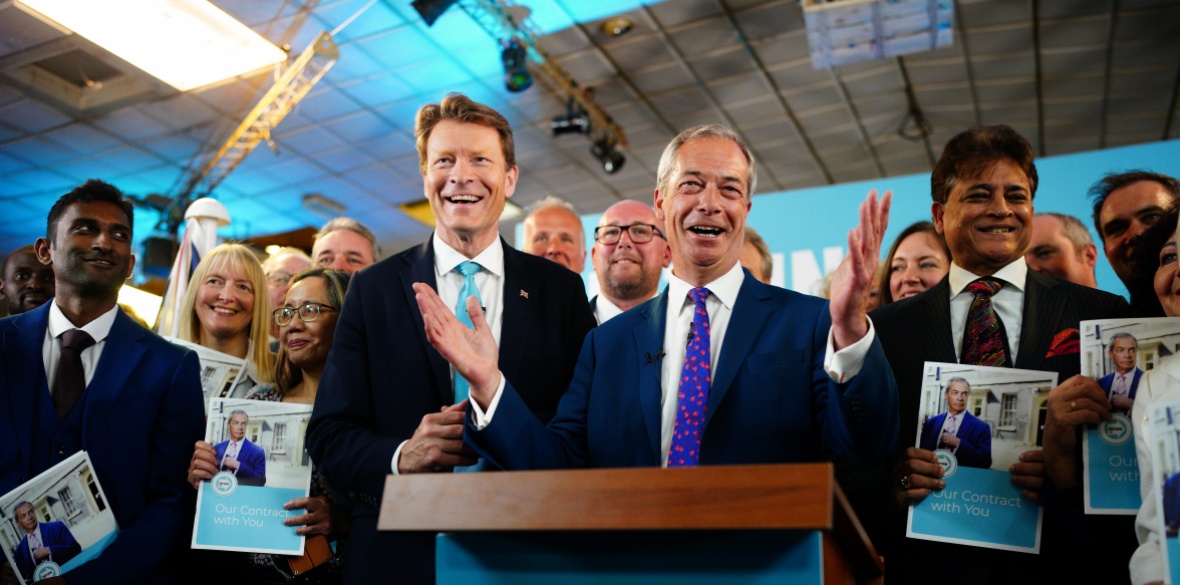
Reform UK chairman Richard Tice (left) and party leader Nigel Farage launch ‘Our Contract with You’ in Merthyr Tydfil while on the General Election campaign trail, June 17, 2024
REFORM started targeting Labour “red wall” voters today as the hard-right party launched its reactionary election manifesto in Wales.
The party’s owner and leader Nigel Farage went to Merthyr Tydfil, once represented by Labour pioneer Keir Hardie, to tell voters that “Labour is not very different to the Conservatives … it is just more incompetent.”
And he restated his aim of being the main challenger to Labour for government by 2029, likely date of the next general election following July 4.
The nationalist party’s platform is anti-migrant, opposed to climate action and supportive of NHS privatisation while cutting foreign aid and leaving the European Court of Human Rights.
It aims to take advantage of muted enthusiasm for Sir Keir Starmer’s Labour in working-class communities by rekindling the Brexit divisions it skilfully exploited in 2019.
Reform’s increasing prominence in the general election comes as the Tory Party’s campaign looks on the verge of expiring.
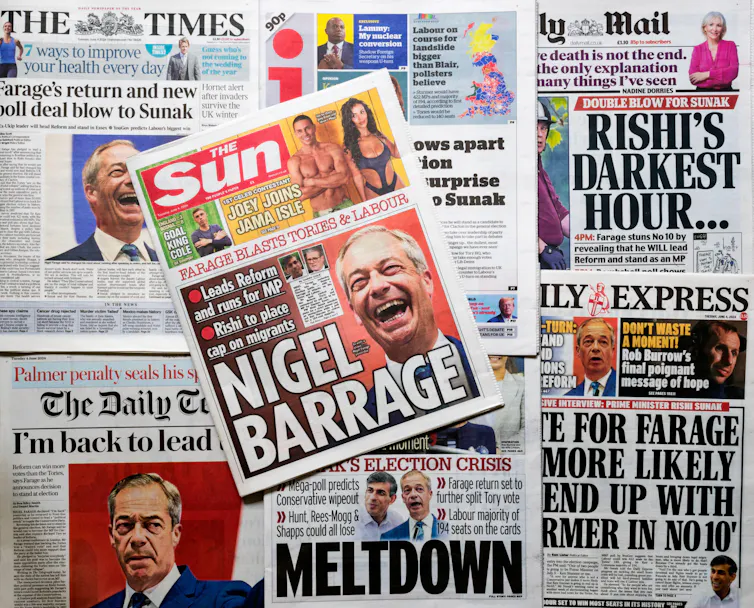
Nigel Farage, a man who has never been elected to the House of Commons despite years of trying, has again been allowed to set the agenda in the UK.
Ten years after Ukip won the European parliament elections, throwing the Conservative party into turmoil and leading David Cameron to promise a referendum on the UK’s membership of the European Union, Farage is at it again. Or more precisely, he is being allowed to go at it again.
The mainstream elite in the media and in politics who claim to oppose Farage, and who pretend to stand as a bulwark against far-right politics, are again duly buying into the hype he has created for himself.
We could already feel that hype bubbling as Farage took over as leader of Reform. He’d seen the party’s fortunes rising and started to think there could be something in it for him to step into the campaign.
We could see it in the coverage of every move he made thereafter – every milkshake thrown, every inflammatory quip quoted and beer drunk, snapped and plastered all over the news as some kind of morbid excitement set in among the media. Finally, something exciting is happening in this otherwise rather dull campaign, where offers of “change” and pledges to be “bold” are hollow slogans for the sides of battle buses.
To understand how a party which only received 2% of the registered votes in the 2019 general election, failing to get even one MP elected, can get such attention, we must travel back in time.
Ukip was a party created by a eurosceptic elite, for a eurosceptic elite, to put pressure on the Conservatives via the EU elections. It all seemed a rather desperate move at the time, as the issue was marginal at best.
The party received 15.6% of the vote in the 2004 European elections and 16% in 2009. But these are second order elections, prone to low turnout and high protest vote. In these settings, Ukip really only received a mere 6% and 5.6% of the registered vote, once turnout was taken into account. Hardly the voice of the “silent majority”.
The 2005 and 2010 general elections clearly showed the limits of Ukip’s appeal. In 2005, the party received 1.4% of the vote and in 2010, it took 2%.
Ukip’s election vote share
Ukip results in general elections (GE) and European elections (EU). A Mondon., CC BY-ND
Still, the first “breakthrough” was in 2014 when Ukip won the EU elections with 26.6%. An “earthquake”, we were told. This was the start of the “left behind” myth which served Farage well as it diverted attention away from his elitist stance. The fantasised “white working class” would come to play a key role in shaping the narrative after the victories of both Donald Trump in the US and Brexit. Proper scrutiny of Ukip’s (and Reform’s) programmes (or Trump’s for that matter) would have also shown that beyond typical far-right measures and other gimmicks, their project was always deeply skewed in favour of the wealthy.
Yet even though Ukip really only received the support of one out of ten registered voters (9.5%) in 2014, in particularly favourable circumstances, the mainstream elite could not get enough of Farage. Finally, the UK had a “populist” contender worthy of the name. They too could feel the same voyeuristic thrills as their European counterparts, watching the “irresistible” rise of the far right (or “populism” to be politically correct, as we would not want to offend the far right, no matter how clear Farage has made his views).
What is striking is that it is this election which set in motion the 2016 referendum, even though Ukip was the only party running on a platform demanding that the UK leave the EU. For all the talk of “taking back control” and “sovereignty”, this reactionary experiment was decided based on the support of less than 10% of voters. Even in terms of votes cast, the referendum was forced onto almost three out of four voters who had decided to vote for parties who were not formally demanding the country leave the EU.
In case you missed it… Alamy/Urban images
All this is to say, Farage has simply never been that popular. This is despite him campaigning in incredibly fertile environments in which parts of the media are dedicated to propping him up, and where even those who seemingly oppose his politics cannot get enough of him – as demonstrated by his record number of appearances on the BBC or the countless articles on “populism” in the Guardian.
Just look at how much coverage a press conference given after one single poll has received, when other parties fail to get issues such as climate change, poverty or social care on the agenda.
And if you think this is because immigration is people’s key concern, think again. Indeed, as I explored with Lancaster university’s Aaron Winter in a report for the Runnymede Trust, the “immigration issue” is one that is clearly constructed in a top-down manner. Unsurprisingly, when people are asked about the key concerns in their personal lives, immigration doesn’t rate. Ironically, the exaggerated focus on immigration could be argued to be elite manipulation rather than the other way around.
So, what’s behind the rise of Farage? Well, the same processes which have been at play across much of Europe: the hyping of far-right politics as a diversion. As has become abundantly clear, there is no mainstreaming or rise of far-right politics without the active involvement of mainstream forces who normalise and platform them.
Want more election coverage from The Conversation’s academic experts? Over the coming weeks, we’ll bring you informed analysis of developments in the campaign and we’ll fact check the claims being made.
Sign up for our new, weekly election newsletter, delivered every Friday throughout the campaign and beyond.
The far right then plays a convenient role, serving to scare the electorate at a time when distrust in governing parties is sky high. The message is: “we are bad but they are worse”.
Yet this strategy is exhausted. Patience has run out and the far right is no longer as repulsive as it once was, now that most mainstream parties mimic its discourse.
The solution is simple. Stop fighting it on its turf. Instead, turn to issues which are not only core to people’s concerns, but far less amenable to far right hijacking. This takes bold actions and real change though – both being in short supply in our mainstream parties.