Young People Can’t Afford to Give Up on International Climate Action

Spread the love

Original article by Hailey Campbell republished from Common Dreams under Creative Commons (CC BY-NC-ND 3.0). 
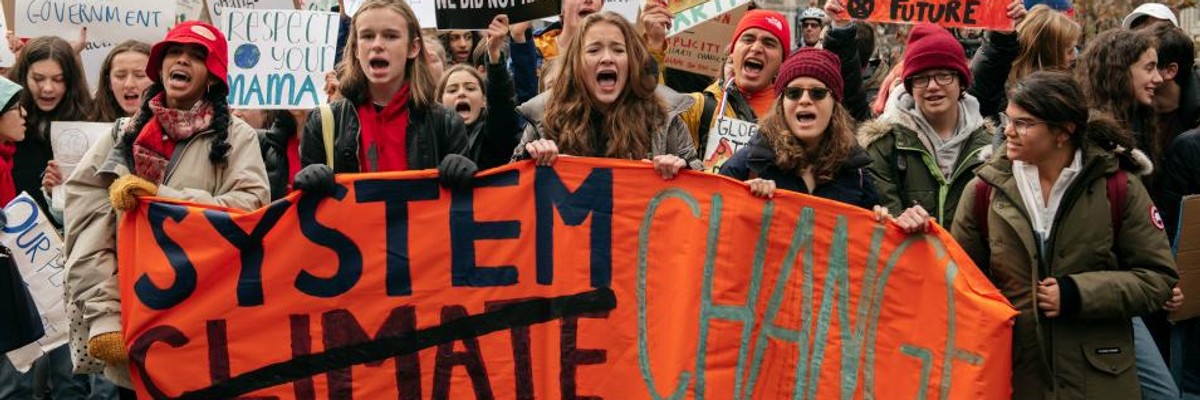
Demonstrators from several environmental groups including Extinction Rebellion and Sunrise Movement demand broad action at a youth-led climate strike near City Hall on December 6, 2019 in New York City. (Photo: Scott Heins/Getty Images)

Youth voices at COP represent the needs of the upcoming generations who will have to either assert our rights to a just climate future or figure out how to survive the catastrophic impacts that accompany a warmer planet.

Donald Trump is once again elected president of the United States only days before more than 30,000 people are expected to attend COP29 in Baku, Azerbaijan to negotiate new global commitments on protecting the planet not only for those inhabiting it today, but also for future generations. Trump’s victory is sounding alarm bells in the climate community as his administration has made their disregard for global climate action abundantly clear across their campaign, but the world recognizes we cannot afford inaction.

When Trump announced his plans in 2017 to withdraw the country from the Paris agreement, an international treaty to limit global temperature rises to 1.5°C, Gebru Jember Endalew, chair of the Least Developed Countries group, which represents 48 countries, stated “global climate momentum will continue with or without the U.S.” China also joined the E.U., Canada, and many more governments to reiterate their commitment to the agreement and global climate action.

Even if the Trump administration chooses to ignore the importance of investing in our planet, climate change will continue to affect our lives.

In 1995, the first Conference of the Parties (COP) was held in Berlin, Germany and subsequent COPs have produced targets to curb emissions, appropriate much-needed funds to tackle climate change, and build transparent reporting processes. The U.S. often sets the tone at COP as the country’s decisions around climate ambitions and climate finance have a global ripple effect. This year’s conference will be the fifth COP I’ve attended. It’s always been clear to me that youth climate activists and frontline communities are a crucial part of the COP process—pushing governments, like the U.S., which is the world’s largest historical polluter, to create and abide by ambitious targets and to address loss and damage so the planet is livable for all. And it’ll be no different this year, especially with a Trump win. Youth voices at COP represent the needs of the upcoming generations who will have to either assert our rights to a just climate future or figure out how to survive the catastrophic impacts that accompany a warmer planet.

We need all the help we can get. U.S. state and local officials are stepping up, as they did in 2017. A coalition of more than two dozen governors committed to achieving “the Paris agreement’s goal of keeping temperature increases below 1.5°C” as did large coalitions of U.S. mayors, county officials, and business leaders. In fact, I had the honor of being present as an intern for the City of San Antonio when my mayor signed a resolution with his commitment. The bipartisan group consists of governors from Washington state all the way to Puerto Rico who are committed to curbing emissions and accelerating climate action. States like California have also been working with other nations, such as China, to promote climate policy. Even if the U.S., at a national level, fails to act once again, it’s encouraging to see local and global communities committed to multilateral action.

My first COP was under the first Trump administration, and I remember feeling disappointed and embarrassed seeing my country failing to step up and lead on climate action. While everyone else had pavilions, announcements, and a large presence, the U.S. had a small office. Because of all the advantages the U.S. has gained by exploiting other communities, cultures, and nature, the U.S. had and still has so much historical and current responsibility to do better. Seeing national and global leaders reiterate their climate commitments gave me hope then and serves as a reminder today—efforts to tackle the climate crisis will continue regardless of the U.S. election results.

Even if the Trump administration chooses to ignore the importance of investing in our planet, climate change will continue to affect our lives. Attribution studies show human-induced climate change is making heatwaves, like the ones in the Southwest, hotter and more likely, while hurricanes and droughts have become more severe and destructive. Climate change is severely costing the environment and the economy. According to the World Economic Forum, “climate change is costing the world $16 million per hour.”

This horrific and costly reality isn’t inevitable. Phasing out fossil fuels, the biggest contributor to climate change, and investing in a greener and cleaner future for all are the antidotes. This is not the time to give up on climate cooperation, but rather strengthen the commitment to it. We cannot be paralyzed by fear. We’ll be at Baku calling for equitable and funded climate solutions, because if climate multilateralism is in jeopardy, so is our future, and we can’t afford to give up on either.

Original article by Hailey Campbell republished from Common Dreams under Creative Commons (CC BY-NC-ND 3.0). 

Continue ReadingYoung People Can’t Afford to Give Up on International Climate Action

Starmer commits to restore honesty and integrity to politics …

Spread the love
Keir Starmer commits to restore honesty and integrity to politics and whores out access to all areas of Number 10 to a huge donor.

https://www.bbc.com/news/articles/cvgr5rnyrlqo

Keir is facing accusations from the Conservatives that he is handing important taxpayer-funded jobs to Labour supporters and donors – the kind of “cronyism” Labour used to accuse them of practising.

He insisted that didn’t mean “process doesn’t matter” and that he was absolutely determined to restore honesty and integrity to government.

Over the past few weeks, the Tories have criticised Labour for appointing a donor to a Treasury role and giving another donor, Lord Alli, a temporary pass to No 10.

Continue ReadingStarmer commits to restore honesty and integrity to politics …

‘Climate Arsonists’: 8 Major Oil Companies Fail to Align With Paris Agreement

Spread the love

Original article by OLIVIA ROSANE republished from Common Dreams under Creative Commons (CC BY-NC-ND 3.0).
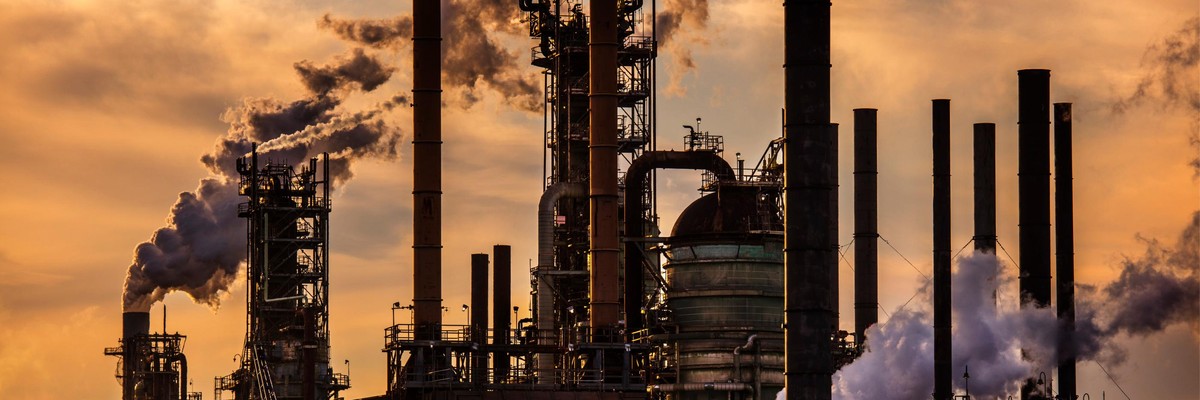
An ExxonMobil oil refinery is pictured in Baton Rouge, Louisiana. (Photo: Barry Lewis/InPictures via Getty Images)

“We cannot trust fossil fuel corporations to do anything but line the pockets of their CEOs and investors at the cost of our climate and communities,” one campaigner said.

The eight largest U.S. and Europe-based oil and gas producing companies are failing to align their plans with the Paris agreement goal of limiting global heating to 1.5°C above preindustrial levels and avoiding ever more catastrophic climate impacts.

Oil Change International’s Big Oil Reality Check report, released Tuesday, concludes that the plans of BP, Chevron, ConocoPhillips, Eni, Equinor, ExxonMobil, Shell, and TotalEnergies would actually put the world on track for more than 2.4°C of warming and burn through nearly one-third of the global carbon budget for hitting the 1.5°C target.

“It’s clearer than ever that oil and gas companies—the climate arsonists fueling climate chaos—cannot be trusted to put out the fire,” David Tong, report author and global industry campaign manager at Oil Change Internationalsaid in a statement. “There is no evidence that big oil and gas companies are acting seriously to be part of the energy transition.”

The Big Oil Reality Check report reveals that oil and gas corporations are more interested in looking like they are acting on climate change than actually acting on climate change.”

For its fourth annual Big Oil Reality Check, Oil Change International judged the oil companies’ climate plans and pledges against a set of minimum standards for alignment with the Paris agreement. The standards were divided into three main categories: ambition, integrity, and people-centered transitions.

Under ambition, the companies were assessed on whether they had plans to stop oil and gas exploration, stop approving new extraction projects, decrease production every year through 2030, and stop extraction on a certain date while outlining a long-term plan to end production.

Under integrity, the companies were assessed on whether their emissions-reduction plans included their entire supply chain, whether they relied on carbon capture or offsets, whether their methane-reduction plans were really in line with climate goals, and whether they lobbied or advertised against climate action.

For people-centered transitions, they were assessed on whether they had just transition plans for employees and members of frontline communities and whether they respected human rights overall and the rights of Indigenous peoples, including to free, prior, or informed consent to any fossil fuel activities.

The companies were then rated from “fully aligned” to “grossly insufficient” for how well their plans complied with the Paris goals within the assessment’s framework, but all eight companies scored “insufficient” or “grossly insufficient” for a majority of the criteria.

Only one company—Eni—scored above “insufficient” in any category, earning a ranking of “partially aligned” for having greenhouse gas-reduction plans that included its supply chains. The three U.S.-based companies—Chevron, ConocoPhillips, and ExxonMobil—scored “grossly insufficient” for all 10 criteria.

“American fossil fuel corporations are the worst of the worst,” Oil Change International’s U.S. program manager Allie Rosenbluth said. “Chevron, ExxonMobil, and ConocoPhillips perpetuate harm in frontline communities not only across the U.S. but worldwide.”

Oil Change found that six out of the eight companies have official plans to increase oil and gas production. The only two that did not were BP and Shell; however, these companies employ a misleading strategy. They compensate for new oil and gas projects by selling off polluting assets. While the emissions from the sold operations no longer count toward company emissions, they still count toward the planet’s total. This practice is out of line with the GHG Protocol on corporate emissions accounting and may violate the United Nations Guiding Principles on Business and Human Rights.

Four of the companies assessed in the report—BP, Shell, Exxon, and Chevron—were also the subject of a recent U.S. House investigation and Senate hearing detailing how the fossil fuel industry playbook has shifted from outright denial of climate science to greenwashing its activities by presenting itself as part of the solution to the climate crisis while its day-to-day operations continue to raise global temperatures.

“The efforts of climate and social movements have forced oil and gas companies to acknowledge that fossil fuels are dirty and dangerous, leading to a variety of climate pledges and ‘plans,'” said Oil Change campaigner Myriam Douo. The Big Oil Reality Check report reveals that oil and gas corporations are more interested in looking like they are acting on climate change than actually acting on climate change.”

“They spend billions on smoke and mirrors to try to fool us into believing they have solutions for a livable planet when, in reality, they are perpetuating harm to the climate and local communities while trying to suck every last ounce of profit out of their dirty fossil fuel business,” Douo concluded.

All told, Rystand energy data suggests that the combined production of the eight companies will be 17% by 2030 than they were last year.

“Such an increase in production on a global scale would put the world on a path towards global heating well beyond 2°C, locking in destruction of vulnerable communities and ecosystems,” the report authors wrote.

The report finds that all of the companies intend to rely on unproven carbon capture technology or offsets schemes to meet their claimed emission-reduction goals and have continued to spend money on lobbying against climate action and greenwashing their own activities since the agreement in Paris.

Further, no company has plans consistent with ensuring a just transition or protecting human rights. In one recent and urgent example, ExxonMobil, Chevron, TotalEnergies, BP, Shell, and Eni all continue to provide Israel with crude oil despite “the Israeli military’s ongoing assault on Palestinian civilians, ecosystems, and infrastructure in Gaza and mounting evidence of war crimes,” a March Oil Change investigation found.

The report comes nearly half a year after world leaders agreed to contribute to “transitioning away from fossil fuels” at the COP28 U.N. climate change conference in Dubai. In light of its conclusions, Oil Change called on governments to take action to further a just transition:

  1. Stop permitting or approving new fossil fuel projects or infrastructure;
  2. Set a Paris-aligned date for phasing out fossil fuel production;
  3. End subsidies and financing for fossil fuels and false solutions like carbon capture;
  4. Use tax policy to incentivize against investing in fossil fuels;
  5. Craft a just transition, including by making polluters pay for cleanup and reparations; and
  6. Passing laws to protect human rights and Indigenous rights and giving communities a legal mechanism to seek redress from corporate polluters.

Oil Change also argued that governments in the Global North should hold companies headquartered within their borders accountable for harm abroad and put money into funds to enable the Global South to transition to renewable energy, adapt to climate change, and pay for inevitable loss and damage.

“This year’s Big Oil Reality Check makes it clearer than ever—we cannot trust fossil fuel corporations to do anything but line the pockets of their CEOs and investors at the cost of our climate and communities,” Rosenbluth said. “People around the world are rising up to end the era of fossil fuels and build a just energy system that puts climate and communities first.”

Original article by OLIVIA ROSANE republished from Common Dreams under Creative Commons (CC BY-NC-ND 3.0).

Continue Reading‘Climate Arsonists’: 8 Major Oil Companies Fail to Align With Paris Agreement

‘Devastating’: Right-Wing Swedish Government Shutters Environment Ministry

Spread the love

“It is impossible to describe more clearly how little this government values ​​the environment and the climate,” said the leader of the Swedish Greens.

This image has an empty alt attribute; its file name is jake-johnson-200x200.jpg

JAKE JOHNSONOctober 19, 2022

In one of its first moves after taking power Tuesday, Sweden’s newly elected right-wing government scrapped the country’s environment ministry, drawing outrage from opposition lawmakers who say the step threatens to undermine the nation’s chances of meeting its climate targets.

“They don’t care about our common future. Expect huge cuts in green funding.”

Per Bolund, the leader of the Swedish Greens, wrote on social media that the axing of the environment ministry shows “how little this government values ​​the environment and the climate.”

“This is a historic decision with devastating consequences for environmental issues,” Bolund added, noting that Sweden will now be without a separate environment ministry for the first time in five decades.

Pär Holmgren, a Swedish meteorologist and member of the European Parliament, also expressed outrage on Twitter.

Following the change announced by right-wing Prime Minister Ulf Kristersson, new environment minister Romina Pourmokhtari will work under the minister for energy, business, and industry, Ebba Busch.

Busch is the leader of Sweden’s Christian Democrats, part of the right-wing coalition now governing the country after winning a slim majority in September’s elections. The bloc includes the Sweden Democrats, a far-right xenophobic party.

Bloomberg reported Tuesday that “Kristersson’s government is heavily dependent on the nationalist Sweden Democrats, the only party in parliament that doesn’t back the country’s target of having net zero emissions by 2045.”

“The four-party alliance that agreed on forming the new government last week said they would seek to lower fuel prices, partly by reducing the percentage of biofuels that has to be mixed into gas and diesel to the minimum level required by the European Union,” Bloomberg noted. “That would make it more difficult to reach a target of reducing transport emissions by 70% by 2030.”

Kristersson is also pushing for an expansion of nuclear power, aiming to reverse earlier efforts to dismantle the country’s reactors.

The Associated Press reported Tuesday that Kristersson said “Sweden’s goal on electricity production would change from ‘100% renewable’ to ‘100 percent fossil-free,’ which leaves room for nuclear energy.”


Republished from Common Dreams under Creative Commons (CC BY-NC-ND 3.0) licence.

Apologies for bad news Sunday, this blog doesn’t do denial of reality.

Continue Reading‘Devastating’: Right-Wing Swedish Government Shutters Environment Ministry

Open Letter to Liz Truss on ‘Anti Growth’ – XR co-founder, Gail Bradbrook

Spread the love

Dear Liz Truss,

In your recent speech at the Conservative party conference you mentioned growth 29 times; said “I will not allow the anti-growth coalition to hold us back” and named Extinction Rebellion as part of this coalition.

Thank you for opening up this critical conversation. We appreciate the opportunity to share our understanding and we hope many others will join us for a grown up conversation in these urgent times. 

We know that members of your party understand our concerns, and are also worried about your economic ideology. When we met Michael Gove in 2019 he said:

“We have had an economic model for generations which has been extractive and exploitative, and in the same way as we’ve created debt fuelled economic growth that creates a burden for the next generation, so our approach towards natural resources has had to change and we’re wrestling as a government with how to do that, how to move towards a more circular economy. And also how to re think different parts of our economy, and again we may disagree over the imperative or the importance placed on growth, but certainly how we can achieve a greater degree of human flourishing and at the same time be more respectful to the limited resources that the earth has and critically also recognise that its not simply about drawing down resources, the earth is a system, our environment is a system of which we are a part and if we do violence to it then we are doing violence to ourselves, we are hacking at the tree of life.”  

There are many forms of growth that are beneficial. Specific sectors of our economy badly need to grow, for example homegrown sources of renewable energy. A sector that would do so much better if this supposed free market was not distorted by the vast subsidies the UK gives to fossil fuels.

However, the data is clear, growth for growth’s sake, without limits, without purpose, is destroying life on earth. When unfettered growth happens in a human body we call it cancer. Economic growth is only beneficial up to a certain point, beyond which it is harmful to people and planet. Economic growth is lucrative to those who are already wealthy (who unsurprisingly then insist on keeping it as the focus). Trickle down economics has failed us for a long time, everyone knows it’s just an out of date idea, not a realistic method that improves the lives of the general public. When we are measuring GDP we would best consider it a measure of the Gross Destruction of the Planet by the Greedy Death Project! 

Do you not agree when Margaret Thatcher said “We should always remember that free markets are a means to an end. They would defeat their object if by their output they did more damage to the quality of life through pollution than the well-being they achieve by the production of goods and services”

Extinction Rebellion are calling for a Well Being economy, which has a clear and measured purpose to maximise wellness and minimise harm; at home and across the world. There is no shortage of fantastic ideas about how to achieve that, including ideas to support circular uses of materials whilst staying within planetary and social boundaries. We love imaginative ideas, such as regenerative finance and mission based economics; where there could be a focus of our specific strengths on tackling major challenges together, making use of the innovation and delivery capabilities in business and markets, the organising capacities of our civil service, the intellect of our academics. We are a wealthy country, we could afford to pay for universal basic services and lead the world on tackling the climate and ecological crisis. And Extinction Rebellion champions assemblies of ordinary people, to think together with experts about how to make this vital transition.

Because it doesn’t matter how attached your Government is, Ms. Truss, to a specific form of free market ideology. Physics and ecology are ultimately in charge and the life support systems of the earth are starting to tip. Doubling down on the extraction of fossil fuels commits our children and grandchildren here and globally to lives where food production fails and civilisation  collapses. We charge that members of your Government, who are making decisions now, against the advice of scientists and international bodies, are committing crimes against humanity. 

We see truths shared from many quarters. King Charles has said “We need nothing short of a paradigm shift, one that inspires action at revolutionary levels and pace.” The Chief Executive of Shell Ben Van Beurden recently called for a windfall tax and  Philip Kotler, father of modern  marketing called for Degrowth (the academic term for an economy focussed on Wellbeing) In October 2018 the IPCC said that limiting global warming would require “rapid, far-reaching and unprecedented changes in all aspects of society”. 

People will become increasingly desperate in this country as the consequences of years of terrible choices come home and impact us all. Choices to sell off our assets, to poison our food, air and water; while at the same time we failed to invest in homegrown renewables and insulate homes. We are left with little security and a cost of living scandal. Over 20,000 people in the UK already died unnecessarily this year since April. Those with the least responsibility for these crises are suffering in the millions, battered and uprooted by climate disasters, from the Horn of Africa, to Bangladesh, to Mozambique, to Pakistan.

We see the callousness and the corruption and the refusal to face reality. Those of us who have the capacity and the conscience will do all we can to stop this death machine. There are a growing number of people who just can’t pay the bills that are mounting and others who won’t work for poverty wages, unable to make ends meet despite their hard work (though I understand you, Liz Truss, think British workers “need more graft”). We will strike bill payments in solidarity and strength, and we will not let you frack the British countryside, poison the water and the people.

Yes, we are uniting, because we believe in our shared humanity, we love our country, and this Earth, and we are willing to take responsibility, whether that comes at a cost to us, on behalf of our collective wellbeing. 

A key aspect of civil disobedience is a belief in the need to talk. I would welcome a dialogue with yourself or colleagues – please be in touch!

Sincerely,

Gail Bradbrook

Dr. Gail Bradbrook, Co-Founder Extinction Rebellion

Notes for Editors

  1. https://www.theguardian.com/environment/2019/jan/23/uk-has-biggest-fossil-fuel-subsidies-in-the-eu-finds-commission
  2.  A systematic review of the evidence on decoupling of GDP, resource use and GHG emissions, part I: bibliometric and conceptual mapping https://eprints.whiterose.ac.uk/159385/; Tim Parrique https://unevenearth.org/2020/06/decoupling/ Limits to Growth review https://www.vice.com/en/article/z3xw3x/new-research-vindicates-1972-mit-prediction-that-society-will-collapse-soon 
  3.  When countries have low GDP, economic growth brings a high marginal benefit. But, for developed countries with high GDP, the marginal benefit of economic growth is lower. There is a diminishing marginal utility of extra income and at higher levels, the problems of growth may outweigh the benefits. https://www.economicshelp.org/macroeconomics/economic-growth/benefits-growth/ 
  4.  The academic term is Degrowth – eg see Jason Hickel Less is More, https://weall.org/ etc
  5.  Circular Economy eg https://ellenmacarthurfoundation.org/topics/circular-economy-introduction/overview
  6.  Doughnut Economics https://doughnuteconomics.org/about-doughnut-economics
  7. Eg https://thefinanser.com/2022/10/what-is-regenerative-finance-refi-part-one 
  8.  Mariana Mazzucato https://ec.europa.eu/research-and-innovation/en/horizon-magazine/missions-could-make-europe-cool-again-prof-mariana-mazzucato 
  9.  UBS eg https://universalbasicservices.org/; Calls for UK to not drop its commitments : https://www.theguardian.com/environment/2022/oct/03/cop27-host-egypt-warns-uk-not-backtrack-climate-agenda
  10. https://theconversation.com/climate-tipping-points-could-lock-in-unstoppable-changes-to-the-planet-how-close-are-they-191043
  11. https://www.theguardian.com/business/2022/oct/04/shell-chief-tax-energy-firms-ben-van-beurden-gas-electricity
  12. Philip Kotler, father of modern marketing, supports degrowth: https://www.linkedin.com/posts/ben-tolhurst_degrowth-the-case-for-constraining-consumption-activity-6982821869351510016-jRQb?utm_source=share&utm_medium=member_ios
  13. https://www.newscientist.com/article/2335991-there-are-thousands-more-uk-deaths-than-usual-and-we-dont-know-why/
Continue ReadingOpen Letter to Liz Truss on ‘Anti Growth’ – XR co-founder, Gail Bradbrook