Labelling the Palestinian resistance: Political propaganda or legal classification?

Spread the love

This work by Middle East Monitor is licensed under a Creative Commons Attribution-NonCommercial-ShareAlike 4.0 International License.

People, holding flags and banners, gather to demand sanctions against Israel during pro-Palestinian protest and march through the city’s streets in Melbourne, Australia on August 24, 2025. [Recep Sakar – Anadolu Agency]

The dominant narrative in the West portrays the Islamic Resistance Movement – Hamas – as a “terrorist group”, uncritically repeating the rhetoric of Israel and its allies. However, when analysing the issue from the perspective of international law and the history of national liberation movements, it is clear that the “terrorism” label is more a tool of political propaganda than a legal definition.

In light of international law and the United Nations Charter, Hamas should be understood as a Palestinian resistance movement in the face of more than seven decades of Israeli colonisation, ethnic cleansing, and military occupation. This also includes almost two years of uninterrupted confrontation with genocide in the Gaza Strip.

The United Nations (UN) has never declared Hamas a terrorist group. Only a few countries, such as the United States, the European Union, Canada, the United Kingdom, and Australia, have unilaterally adopted this classification. International law, in turn, does not criminalise resistance against occupation.

Since 1967, Israel has maintained its occupation of the Gaza Strip, the West Bank, and East Jerusalem, in flagrant violation of the UN Charter and Security Council resolutions. According to International Humanitarian Law, peoples subjected to foreign occupation have the legitimate right to resist, including by armed means, against the occupying power.

This principle is supported by Article 51 of the UN Charter, as well as Resolutions No. 2649/1970, 2787/1971, 3070/1973, and 3103/1974, which explicitly recognise the inalienable right of peoples to fight against colonial domination, foreign occupation, and apartheid. Furthermore, the Geneva Conventions of 1949 and the Additional Protocols of 1977, along with the practice of the International Criminal Court (ICC), distinguish between armed resistance and terrorism.

Ceasefire intransigence: Palestinian prisoners and Israeli reluctance

Therefore, the existence of an armed struggle against occupation does not constitute terrorism, but rather a legitimate exercise of resistance.

Founded in 1987 during the First Intifada, Hamas is not just an armed group; it is also a political, social, and religious movement deeply rooted in Palestinian society.

Its surprising victory in the 2006 legislative elections, which were recognised as free and democratic by international observers, demonstrates its popular representation. It won 76 of the 132 seats, while its main rival, Yasser Arafat’s Fatah, won 43 seats.

Over the decades, Hamas has administered social institutions, hospitals, schools, and assistance programmes, playing a similar role to liberation movements in Algeria (FLN), Vietnam (Viet Minh), or South Africa (ANC), all of which were also labelled terrorists at some point in history. Today, many of these movements are recognised as legitimate builders of their national states.

The classification of Hamas as “terrorist” serves the clear objectives of Israeli policy: To silence the debate on occupation, apartheid, and genocide, diverting attention from the root cause of the conflict; to justify massive attacks against civilians in Gaza, presented as “the fight against terrorism”; to criminalise all forms of Palestinian resistance, whether armed or peaceful – from NGOs to journalists and students.

Judith Butler, an American philosopher from the University of Berkeley, observes that armed resistance under occupation cannot be reduced to terrorism, as this ignores the structural causes of violence: colonialism, supremacism, and military occupation.

Since 2007, Israel has imposed a land, air, and sea blockade on the Gaza Strip, which the UN classifies as collective punishment – a practice prohibited by international law. Millions of Palestinians live without freedom of movement, drinking water, electricity, and medicines. With each Israeli offensive, thousands of civilians are massacred, homes and hospitals are destroyed, and entire neighbourhoods are razed.

The current scenario of indiscriminate attacks on hospitals, schools, and refugee camps is described by international law experts and UN rapporteurs as ongoing genocide, due to the scale of the destruction and the explicit intention to expel or exterminate the original Palestinian population of Gaza.

“Greater Israel”: A huge challenge to Arab national security

In the face of this reality, Hamas’s armed resistance should be understood not as terrorism, but as the exercise of a people’s right to self-defence under occupation and ethnic cleansing. The Palestinian struggle is, in essence, a struggle for physical and cultural survival in the face of a colonial project to eliminate all forms of life in Palestine.

The framing of Hamas as a terrorist group is a political construct of Israel and its Western allies, without a basis in international law. Palestinian resistance, whether armed or not, is recognised as legitimate by the UN, the BRICS countries, and international treaties whenever it is intended to confront foreign occupation and colonial oppression.

Calling Hamas “terrorist” is an attempt to delegitimise the struggle of a people seeking freedom, justice, and self-determination. The truth is that Israel, as the occupying power, systematically violates international law, practices apartheid, and commits war crimes and crimes against humanity.

Hamas is an integral part of the Palestinian resistance and must be understood as a national liberation movement, not as terrorism. Recognising this fact is a fundamental step towards a fair and honest reading of the conflict and for seeking a solution based on historical truth, justice, and the right of peoples to self-determination.

The views expressed in this article belong to the author and do not necessarily reflect the editorial policy of Middle East Monitor.

Keir Starmer objects to criticism of the IDF. He asks how could anyone object to them starving people to death, forced marches like the Nazis did, bombing Gaza's hospitals and universities,mass-murdering journalists, healthworkers and starving people queuing for food, killing and raping prisoners and murdering children. He calls for people to stop obstructing his genocide for Israel.
Keir Starmer objects to criticism of the IDF. He asks how could anyone object to them starving people to death, forced marches like the Nazis did, bombing Gaza’s hospitals and universities,mass-murdering journalists, healthworkers and starving people queuing for food, killing and raping prisoners and murdering children. He calls for people to stop obstructing his genocide for Israel.
UK Labour Party government ministers Keir Starmer, Angela Rayner and Rachel Reeves explain that they are partners complicit in Israel's Gaza genocide. The UK has provided Israel with arms, military and air force support. They explain that they don't do gas chambers but do do forced marches, starvation, destroy hospitals, mass-murders of journalists and healthcare workers.
UK Labour Party government ministers Keir Starmer, Angela Rayner and Rachel Reeves explain that they are partners complicit in Israel’s Gaza genocide. The UK has provided Israel with arms, military and air force support. They explain that they don’t do gas chambers but do do forced marches, starvation, destroy hospitals, mass-murders of journalists and healthcare workers.
Experiencing issues with this image not appearing. I suspect because it's so critical of Zionist Keir Starmer's support of and complicity in Israel's genocides.
Genocide denier and Current UK Prime Minister Keir Starmer is quoted that he supports Zionism without qualification. He also confirms that UK air force support has been essential in Israel’s mass-murdering genocide. Includes URLs https://www.declassifieduk.org/keir-starmers-100-spy-flights-over-gaza-in-support-of-israel/ and https://youtu.be/O74hZCKKdpA
Continue ReadingLabelling the Palestinian resistance: Political propaganda or legal classification?

The Courage and Necessity of the Gaza Freedom Flotilla

Spread the love

Original article by Margaret Knapke republished from Common Dreams under Creative Commons (CC BY-NC-ND 3.0).

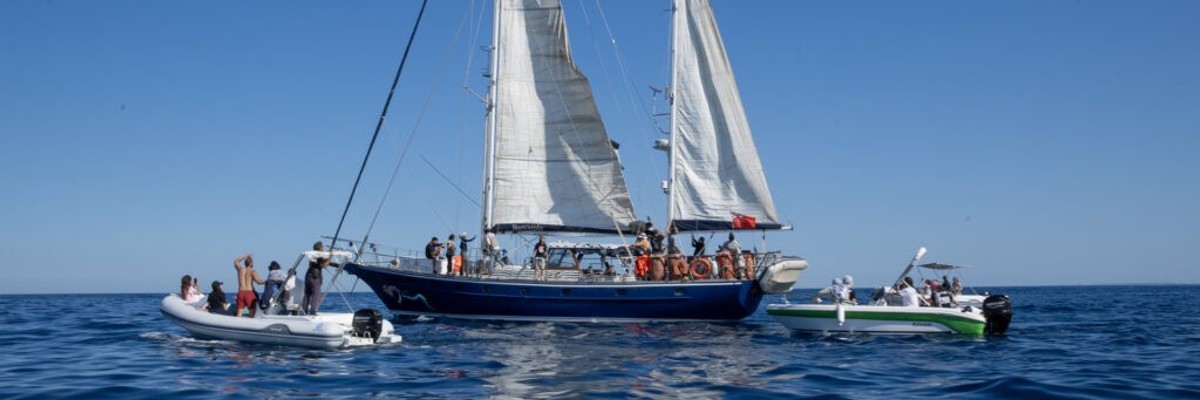
The Freedom Flotilla Coalition (FFC) launched the Madleen, a civilian ship now sailing toward Gaza carrying humanitarian aid and international human rights defenders in direct defiance of Israel’s illegal and genocidal blockade. (Photo: Courtesy of the FFC)

“We are doing this because no matter what odds we are against, we have to keep trying,” says humanitarian Greta Thunberg, “because the moment we stop trying is when we lose our humanity.”

Many people, armed only with moral and political convictions, would be too intimidated to confront an army or navy directly. But not all.

Twelve nonviolent human-rights activists with the international Freedom Flotilla Coalition (FFC) are currently sailing a small boat, the Madleen, to Gaza. They hope to create a humanitarian sea corridor through Israel’s illegal blockade. If all goes well, they should arrive this weekend, with “baby formula, flour, rice, diapers, women’s sanitary products, water desalination kits, medical supplies, crutches, and children’s prosthetics.”

They know the danger. Ten volunteers were killed by Israeli commandos when they boarded the Mavi Marmara in 2010. But, as Greta Thunberg said before she embarked last Sunday, “We are doing this because no matter what odds we are against, we have to keep trying, because the moment we stop trying is when we lose our humanity.”

How Palestinians See It

The history is important, and one does not have to approve of Hamas’ attack against Israeli civilians in October 2023 to understand that.

During the Nakba in 1948, at least 750,000 Palestinians were violently displaced from their homelands by Zionist paramilitaries and nascent Israeli forces. As Palestinian-Canadian Samah Al-Sabbagh recently told a crowd, those who survived that colonial onslaught left their “homes, land, olive groves, even the freshly baked bread.”

The occupation has never stopped, and now the violence is more high-tech and all-inclusive in its reach. In Gaza, bombs (largely supplied by the United States) have destroyed homes, apartment buildings, schools, universities, hospitals, mosques, churches, and more—leaving thousands buried under rubble. Adding to that nightmare, doctors report the intentional killing of children with high-velocity bullets that can destroy surrounding tissues and organs.

The death toll is staggering. As of May 27, 2025, the Palestinian Ministry of Health in Gaza reports that at least 54,056 people, including at least 17,400 children, have been confirmed as killed in Gaza since October 2023.

For those still living, Israel’s stranglehold on international humanitarian aid has created widespread malnutrition and starvation, with babies and children the most vulnerable. “One in five people in Gaza, about 500,000 people, faces starvation, the Integrated Food Security Phase Classification platform said on May 12,” according to the UN. Indeed, the UN calls Gaza the “hungriest place on Earth.”

Israel and its fellow perpetrators, including the United States, refuse to take seriously the rulings by the International Criminal Court and the International Court of Justice, much less the many human-rights groups decrying genocide, and less still the students and people in the streets making a ruckus for justice.

Perhaps the perpetrators think that ignoring the voice of the people will make it stop, that heartbroken people will give up their moral and legal agency. They should think again.

A Global Civil Society Initiative of Unarmed Civilians

Huwaida Arraf is a Palestinian-American lawyer and activist. She has worked with the International Solidarity Movement, the Free Gaza Movement, and more recently the FFC. Her rationale for sending small, unarmed boats in nonviolent direct actions against Israeli policy? “Our governments have failed. And so the people are taking action.”

Lawyers Arraf and Luigi Daniele assert that there is a strong legal basis for citizens taking action, as world governments ignore their “clear and urgent humanitarian obligations.”

In August 2008, the Free Gaza Movement successfully delivered aid to Gaza, using two small fishing boats named Liberty and Free Gaza. Participants included 44 activists from 17 countries, and they promised that they’d keep returning “until the siege on Gaza was broken.”

Included in the aid they brought were 200 pairs of hearing aids—far short of the 9,000 requested—because so many children were experiencing hearing loss as a result of Israel’s sonic booms.

Two years later, on May 31, 2010, the Israeli navy swarmed the Mavi Marmara. This ship was part of a larger flotilla, carrying nearly 700 people, which was attempting to deliver 10,000 tons of humanitarian aid to Gaza. The Israelis killed 10 activists—one died after being comatose for four years—and wounded fifty more.

Although the UN Human Rights Council declared the attack illegal—and despite Prime Minister Netanyahu’s apology to Turkey, whose citizens were killed—Israel continued its oppressive blockade.

Between 2010 and 2024, the FFC continued to challenge the siege. But “all ships were pirated by the IOF, and participants were assaulted, kidnapped, interrogated, imprisoned, and/or deported.” (“IOF” identifies the IDF as an occupation force.)

By May 2, 2025, the FFC had prepared their next attempt. The ship was named Conscience as an appeal to the world’s conscience. It was sitting in international waters near Malta, waiting for the volunteers to board and set out for Gaza. But the crew heard drones, and Conscience was struck by two explosives.

The bombing was a deliberate act of aggression and intimidation,” the FFC wrote on their website. “Four crew members were injured, the ship was set ablaze, communications were severed, and the vessel was left adrift and taking on water. The attack occurred in European waters, in violation of international law.”

Madleen: Never Give Up

The activists say of the Madleen, “She may be small, but her mission is powerful: To break the silence. To challenge Israel’s illegal blockade through nonviolent direct action. To stand firmly and unapologetically, with Gaza.”

The Madleen set sail on June 1, one day after the fifteenth anniversary of the murderous assault on the Mavi Marmara. Activists gathered in Catania, Sicily, in preparation for their launch. The boat is named for Gaza’s first gender-role-defying fisherwoman; she personifies FFC’s steadfastness.

The ship’s namesake, Madleen, fell in love with the sea as a young child. When she was only 13 years old, she took over her injured father’s fishing boat and became the main breadwinner for her family. Although Madleen’s focus was on her family’s survival—not politics—she shared the fishermen’s encounters with Israeli patrols. She recounted, “They often directly attacked my boat. They stole my fishing nets more than once. The thing was that each time they attacked me, I would get a little stronger. I never gave up.”

Years later, she hopes her two daughters will become “two strong fisherwomen.”

May Madleen and the activists happily meet in Gaza this month. And may this stubbornly committed “civil society initiative of unarmed civilians” help the world see that legal and moral obligations are not overridden by governments’ corrupt colonial agendas.

To that end, the FFC asks that people raise their voices and contact the media and government officials to express support for breaking the siege against Gaza.

Readers can track the progress of the Madleen in real time and explore ways to support the FFC’s work. They promise: “We sail until Palestine is free.”

This article first appeared in Foreign Policy In Focus and appears here with permission

Original article by Margaret Knapke republished from Common Dreams under Creative Commons (CC BY-NC-ND 3.0).

Continue ReadingThe Courage and Necessity of the Gaza Freedom Flotilla

‘Huge’: 1,600+ Institutions Holding $41 Trillion in Assets Have Now Divested From Fossil Fuels

Spread the love
A divestment message is shared on the Climate Clock in Union Square in New York City in June 2023.  (Photo: Climate Clock Union Square)

Original article by OLIVIA ROSANE at Common Dreams shared under Creative Commons (CC BY-NC-ND 3.0).

The milestone, one campaigner said, should “give hope to folks that we are making an impact.”

An earlier version of this story said that 16,000 institutions had divested. The correct number is 1,600 and it has been updated to reflect that.

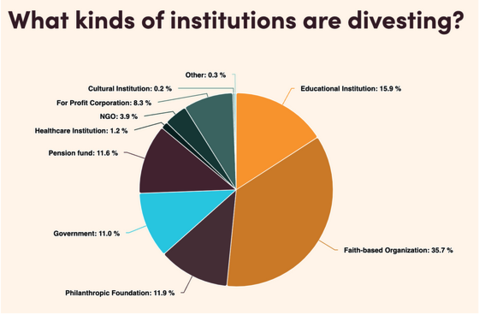
More than 1,600 institutions like universities, pension funds, and governments that hold more than $40.6 trillion in assets have now divested from fossil fuels, the Global Fossil Fuel Divestment Movement announced Friday.

The announcement comes days after the 28th United Nations Climate Change Conference wrapped with a call for “transitioning away from fossil fuels” but stopped short of agreeing to the stronger “phaseout” of oil, gas, and coal backed by climate advocates and frontline communities.

“This number is huge,” Amy Gray, Stand.earth climate finance associate director and coordinator of the Climate Safe Pensions Network, told Common Dreams. To put it in perspective, $40.6 trillion is equal to a little less than half of global gross domestic product.

The scale of the divestments to date, said Gray, “should show and give hope to folks that we are making an impact and we are making a difference and changing things for the better, regardless of these elitist events where the everyday person and the folks in the Global South and other places are discounted.”

A Decade of Divestment

Friday’s update to the Global Fossil Fuel Divestment Commitments Database reflects around a decade of organizing, Gray said. Organizers at 350.org started tracking divestment commitments when Gray and current Stand.earth climate finance director Richard Brooks worked there. When the pair moved to launch a climate finance team at Stand.earth, they brought the database with them.

While the divestment movement has seen ups and downs over that decade, Gray said it had picked up momentum over the last five or six years. In less than two years, the number of institutions divesting jumped by 120, holding a combined $1.4 trillion in assets.

“We’ve definitely seen a massive increase in divestment commitments as the divestment movement has built itself out and gotten stronger,” Gray said.

“This milestone follows years of attempted shareholder engagement, now a proven futile strategy, with fossil fuel corporations hell-bent on our destruction.”

Notable victories in 2023 included PMT, the largest private pension in the Netherlands; New York University, the National Academy of Medicine, and the Church of England.

The Church of England divestment was especially notable, Gray said, because of the statement that accompanied it. The church emphasized that it had tried to engage with the oil and gas companies it was invested in and urged them to adopt policies in line with the Paris agreement, but the companies did not change.

“The decision to disinvest was not taken lightly,” Alan Smith, first church estates commissioner, said at the time. “Soberingly, the energy majors have not listened to significant voices in the societies and markets they serve and are not moving quickly enough on the transition. If any of these energy companies come into alignment with our criteria in the future, we would reconsider our position. Indeed, that is something we would hope for.”

Gray remembered thinking at the time that it was the best divestment statement she’d ever read.

“It was really powerful,” she said.

The Church of England wasn’t the only institution that thought it could persuade Big Oil to change its ways without divesting.

“This milestone follows years of attempted shareholder engagement, now a proven futile strategy, with fossil fuel corporations hell-bent on our destruction,” Brooks said in a statement. “Instead of financing climate chaos-causing fossil fuels, violence, and extraction, financial institutions like big banks and pension funds must protect people and planet alike, cutting ties with fossil fuels and reinvesting in proven community-led climate-safe solutions.”

People vs. Fossil Fuels

The success of the divestment movement has been driven by “people power, 100%,” Gray said.

This includes larger organizations like Stand.earth or the Sierra Club and big-name activists like Bill McKibben or former New York Comptroller Tom Sanzillo, but ultimately comes down to smaller grassroots efforts.

“It’s the little group in Wisconsin that’s working on divesting their pension fund,” Gray said. “It’s a small group in the Bay Area who is pressuring Citi or one of the big banks, and it’s the kids at the colleges.”

“Oil companies are finding it increasingly difficult to raise financing amid rising ESG and sustainability concerns.”

There’s evidence that all this activism is making a difference for the industry. The “cost of capital” for funding new fossil fuel projects has risen steeply in the last decade, from 8% to 10% to around 20% as of 2021, according to Bloomberg.

During the same time, the cost for financing renewables has dropped from that same 8% to 10% to between 3% and 5%.

Bloomberg Intelligence analyst Will Hares laid the divergence at the feet of the push for environmental and social governance (ESG) in investing.

“Oil companies are finding it increasingly difficult to raise financing amid rising ESG and sustainability concerns, while banks are under pressure from their own investors to reduce or eliminate fossil-fuel financing,” Hares said.

Gray also added that Indigenous-led movements such as the Wet’suwet’en struggle against the Coastal GasLink pipeline in Canada have had a material impact on the industry.

The pipeline’s costs have more than doubled during that time from an estimated $6.6 billion to $14.5 billion, CBC News reported this month.

At the same time, divesting from fossil fuels is actually a financial win for pension funds and other institutions: A study released this year by the University of Waterloo found that six U.S. pension funds would actually be $21 billion richer today if they had quit fossil fuels 10 years ago.

The Next 1,600

In the context of a disappointing outcome at COP28, President Joe Biden’s greenlighting of drilling projects, and the specter of a second Trump presidency, the success of the divestment movement offers hope that climate campaigners can shift the world away from fossil fuels without needing to rely on international agreements or national legislation.

“It’s not necessary to enact the change we need to see,” Gray said. “We can change these systems of oppression from within.”

Looking ahead to 2024, Gray thinks there’s a good chance that California will finally pass legislation to divest its two pension funds, CalPERS and CalSTRS, from fossil fuels. The two funds, the largest public pensions in the country, control a total of $685 billion, including more than $42 billion in fossil fuels.

“Even the person with the smallest amount of investments can get involved.”

If California does pass the legislation, it will “cause a massive ripple effect,” Gray said.

“If we’re able to divest the two largest pension funds in the country, there’s nothing we can’t divest.”

Another thing Gray expects to see is more coordination between the efforts to divest from both fossil fuels and the weapons industry, as more and more people react with shock watching U.S.-made and -funded arms devastating the people of Gaza.

“War is a climate issue,” Gray said.

For people not yet involved in the divestment movement, Gray recommends signing up for email updates from Stand.earth or the Climate Safe Pensions Network and looking up local climate groups and going to a meeting.

“Even the person with the smallest amount of investments can get involved,” Gray said. “Anybody can join the climate movement, and we’re always ready to help folks take that step.”

Original article by OLIVIA ROSANE at Common Dreams shared under Creative Commons (CC BY-NC-ND 3.0).

Continue Reading‘Huge’: 1,600+ Institutions Holding $41 Trillion in Assets Have Now Divested From Fossil Fuels