THE British government faces a backlash for showing a “complete disregard” for Palestinian suffering by abstaining from a key UN vote on ending Israeli occupation.
The UN general assembly resolution passed last night demanded that Israel end its “unlawful presence” in the West Bank and the Gaza Strip within a year.
An overwhelming majority of 124 countries voted in favour of the resolution. Britain was one of 43 countries to abstain. Just 14 countries, including the US, voted against it.
Amnesty International’s secretary-general Agnes Callamard said that governments, including Israel’s allies, must ensure that the country complies with the resolution.
Tensions in the Middle East have reached a new high after thousands of pagers and radios used by members of Hezbollah exploded across various cities in Lebanon and Syria over September 17 and 18. The attacks – which have widely been attributed to Israel, which has not commented – have resulted in at least 30 people killed and more than 3,000 wounded.
Many analysts and politicians are now speculating that the conflict between Israel and Hezbollah, which has been simmering during the 11-month conflict in Gaza, will spiral into open warfare.
Far from taking place in a legal vacuum, the attacks are governed by international humanitarian law (IHL). This is the international legal regime that regulates the conduct of hostilities in situations of armed conflict.
Since the Hamas attacks on October 7 provoked Israel’s ferocious response in Gaza, Israel and Hezbollah have been involved in a series of cross-border hostilities. These qualify as what is called a “non-international armed conflict”, to which IHL applies. This includes the rules set out in, among other instruments, the Geneva conventions.
In pursuing the objective of protecting civilians in wartime, the Geneva conventions rely on the fundamental principles of “distinction” and “proportionality”.
What international law says
The principle of distinction essentially requires belligerents to distinguish at all times between the civilian population and combatants.
Combatants are lawful targets and can be attacked at all times. But intentionally attacking civilians is prohibited and constitutes a war crime under the Rome statute of the International Criminal Court. To this end, military commanders are under an obligation to do everything feasible to verify that the target of an attack is not a civilian.
Even assuming that only Hezbollah members were using the radios and pagers at the moment of the attacks, that does not mean that they shall be presumed to be combatants (and, therefore, lawful targets). Under IHL, a combatant is a “member of the armed forces of a party to the conflict”. This comprises “all organized forces, groups and units which are under a command responsible to that party for the conduct of its subordinates”.
By contrast, whoever is not a member of the armed forces of a party to the conflict is a civilian and subject to the protection of IHL.
There is no doubt that members of the military wings of Hezbollah are “members of the armed forces”, so they qualify as combatants. But those members of Hezbollah’s political wing who are not combatants should be considered as civilians and accordingly, are protected from attack.
Civilians may lose protection from attack for such time as they take a direct part in hostilities. This includes conduct like the intentional killing of civilians and carrying out acts which adversely affect the military capacity of a party to an armed conflict – for example, the planning of attacks against Israel.
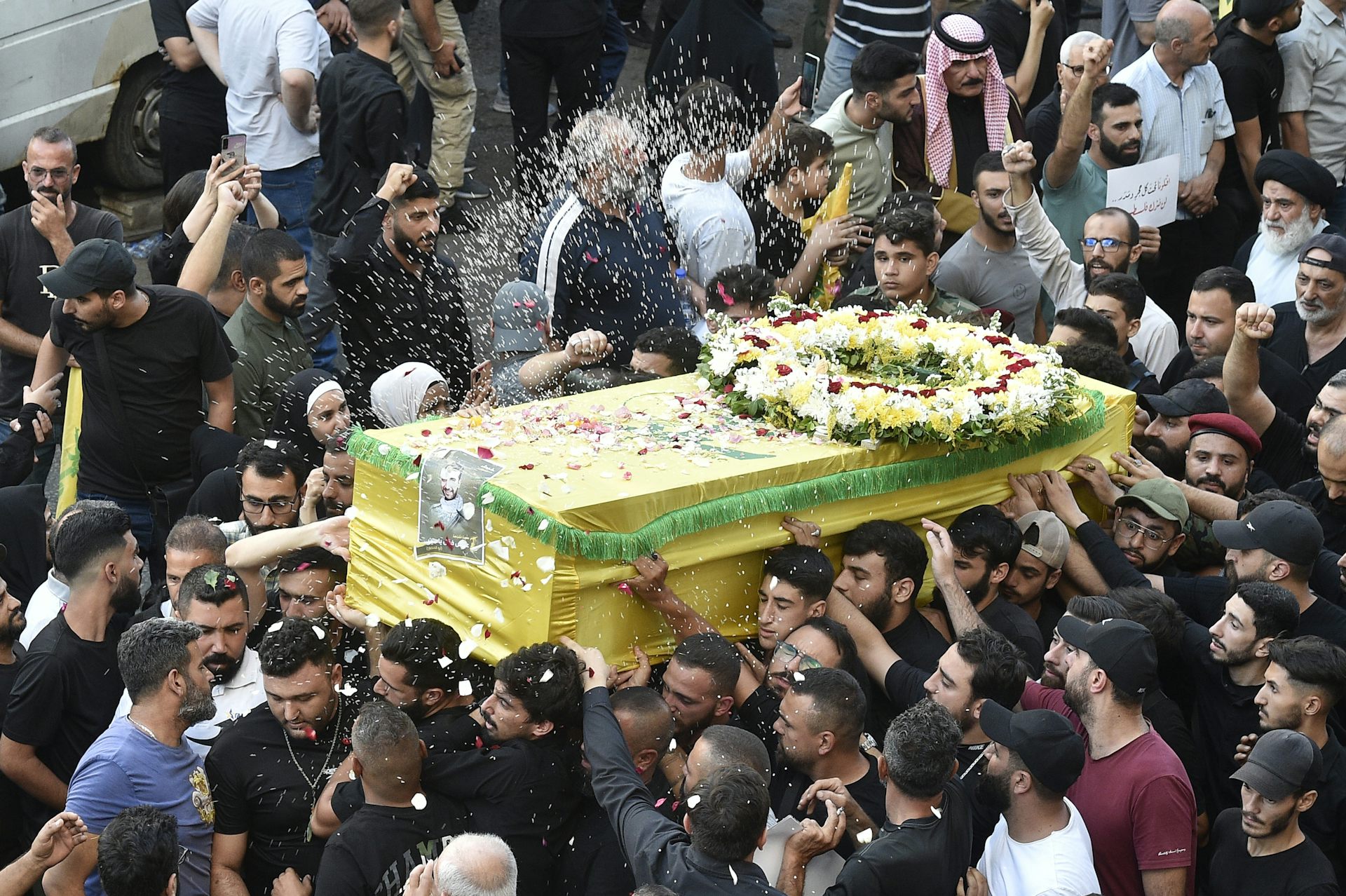
The pagers were detonated at 3:30, on September 17 in hundreds of locations in Beirut and other Lebanese cities. Abaca Press / Alamy Stock Photo
What about the attacks against members of Hezbollah’s military wing?
In this case, complying with the principle of distinction does not suffice, since the attack must also respect the principle of proportionality. This requires that the expected “collateral damage” (that is, the incidental killing or wounding of civilians) should not be excessive to the “concreted and direct military advantage” anticipated from the attacks.
Launching an attack with the knowledge that it would cause excessive collateral damage also constitutes a war crime.
Collateral damage
In this case, the attacks killed several civilians. These included the nine-year-old daughter of a Hezbollah member, an 11-year-old boy and at least two health workers. Moreover, the attacks injured thousands more, including Iran’s ambassador to Lebanon.
Although we do not know how many of those killed or injured were civilians, it seems logical that the level of collateral damage to be expected from the attacks would be substantial. After all, the pagers and radios were remotely detonated at the same time, exploding in crowded places such as markets and funerals. In these situations, the likelihood of killing and wounding civilians is extremely high.
These elements suggest that the expected incidental damage is excessive to the military advantage anticipated from the pager attacks – which, at the time of writing, remains unclear.
But it’s important to note that what amounts to “excessive” incidental damage is subject to disagreement. On the one hand there are those who, like the International Committee of the Red Cross, believe that extensive incidental damage is always excessive. Others – including the Israeli government – consider that even extensive incidental damage is allowed if the attack results in a high amount of military advantage.
In my opinion, Israel’s interpretation should be rejected. It turns IHL’s aims of protecting the civilian population on its head and allows for unrestricted warfare.
My conclusion, based on the available information, appears to be that the pager and walkie-talkie attacks purportedly carried out by Israel against Hezbollah members appear to violate the principles of distinction and proportionality. In other words, they could well amount to war crimes.
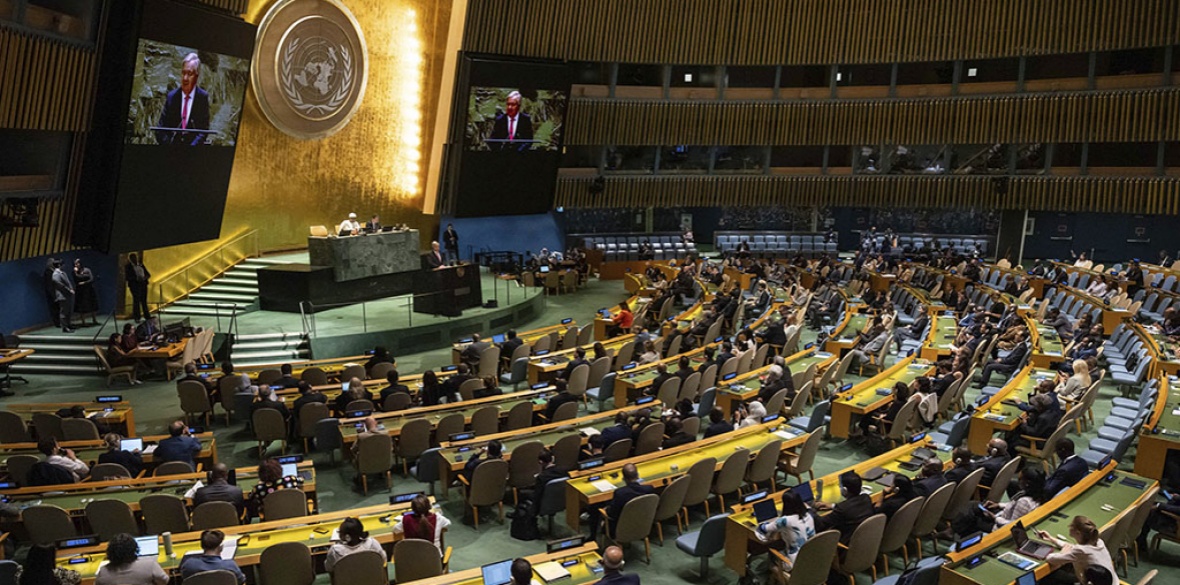
The U.N. General Assembly approves a resolution calling for an end to Israel’s occupation of Palestinian territories on September 18, 2024. (Photo by Selcuk Acar/Anadolu via Getty Images)
“The vast majority of countries have made it clear: Israel’s occupation of Palestine must end, and all countries have a definite duty not to aid or assist its continuation.”
The United Nations General Assembly on Wednesday passed a resolution demanding that the Israeli government end its occupation of Palestinian territories within 12 months, affirming a recent International Court of Justice opinion that deemed the decadeslong occupation unlawful.
The Palestine-led resolution, co-sponsored by dozens of nations, calls on Israel to swiftly withdraw “all its military forces” from Gaza and the West Bank, including East Jerusalem. The final vote tally was 124 member states in favor and 14 against, with 43 nations abstaining.
Unsurprisingly, Israel and the United States—Israel’s top ally and arms supplier—were among the 14 countries that opposed the resolution, which is not legally binding. The United Kingdom, which recently suspended some arms export licenses for Israel, abstained from Wednesday’s vote, a decision that the advocacy group Global Justice Now (GJN) said shows “complete disregard for the ongoing suffering of Palestinians forced to live under military-enforced racial discrimination.”
“The vast majority of countries have made it clear: Israel’s occupation of Palestine must end, and all countries have a definite duty not to aid or assist its continuation,” said GJN’s Tim Bierley. “To stay on the right side of international law, the U.K.’s dealings with Israel must drastically change, including closing all loopholes in its partial arms ban and revoking any trade or investment relations that might assist the occupation.”
The Palestinian-led Boycott, Divestment, and Sanctions (BDS) Movement welcomed passage of the resolution, noting that the U.N. General Assembly voted “for the first time in 42 years” in favor of “imposing sanctions on Israel.”
The resolution specifically calls on all U.N. member states to “implement sanctions, including travel bans and asset freezes, against natural and legal persons engaged in the maintenance of Israel’s unlawful presence in the occupied Palestinian territory, including in relation to settler violence.”
NEWS: UN General Assembly adopts resolution demanding that Israel brings to an end its unlawful presence in the Occupied Palestinian Territory without delay and within the next 12 months.https://t.co/Vj0Ve1lLBipic.twitter.com/2rKKvDNDqd
The resolution’s passage came nearly two months after the International Court of Justice (ICJ), the U.N.’s highest legal body, handed down an advisory opinion concluding that Israel’s occupation of Palestinian territories is illegal and must end “as rapidly as possible.”
The newly approved resolution states that “respect for the International Court of Justice and its functions… is essential to international law and justice and to an international order based on the rule of law.”
The Biden administration, which is heavily arming the Israeli military as it assails Gaza and the West Bank, criticized the ICJ’s opinion as overly broad.
Nihad Awad, national executive director of the Council on American-Islamic Relations (CAIR), said in a statement Wednesday that “the Biden administration should join the overwhelming majority of nations around the world in condemning these crimes against the Palestinian people, demanding an end to the occupation, and exerting serious pressure on the Israeli government to comply.”
“We welcome this U.N. resolution demanding an end to one of the worst and ongoing crimes against humanity of the past century,” said Awad.
Ahead of Wednesday’s vote, a group of U.N. experts said in a statement that many countries “appear unwilling or unable to take the necessary steps to meet their obligations” in the wake of the ICJ’s opinion.
“Devastating attacks on Palestinians across the occupied Palestinian territory show that by continuing to turn a blind eye to the horrific plight of the Palestinian people, the international community is furthering genocidal violence,” the experts said. “States must act now. They must listen to voices calling on them to take action to stop Israel’s attacks against the Palestinians and end its unlawful occupation. All states have a legal obligation to comply with the ICJ’s ruling and must promote adherence to norms that protect civilians.”
A person is carried on a stretcher outside the American University of Beirut Medical Center following the pager blasts on Tuesday, September 17, 2024. Photo: Al Manar
Facing no consequences from the international community on its first series of cyber terrorist attacks in Lebanon, Israel launched a new wave of similar attacks within less than 24 hours
At least nine people were killed and more than 300 others injured when thousands of wireless devices including walkie-talkies were detonated in different parts of Lebanon on Wednesday, September 18. The new blasts took place, while the information regarding the first day’s cyber terrorist attacks through pagers remained largely unknown and subject to speculation.
Preliminary media reports stated that the trademark of Taiwan pager manufacturer Gold Apollo was identified on the remains of the pagers, which detonated on Tuesday and that they were model AR-924. In response to the reports, Gold Apollo issued a statement on Wednesday denying that it had manufactured the pagers used by Hezbollah members, clarifying that its logo was only labelled on the devices, which were manufactured by a Hungarian company called BAC through a licensing agreement with the Taiwanese company.
“According to the cooperation agreement, we authorize BAC to use our brand trademark for product sales in designated regions, but the design and manufacturing of the products are solely the responsibility of BAC,” Gold Apollo said in a statement, while the Hungarian partner BAC has not commented on the incident so far.
Meanwhile, some of the walkie-talkie devices that exploded on Wednesday, were reportedly identified as Icom model V82s, according to media sources. Nonetheless, Icom has not commented on the tragic blasts yet.
Although the United States said on Tuesday that it was not aware of the cyber terrorist attacks on Lebanon in advance, CNN published a report on Wednesday unveiling that Israeli officials informed the US about an Israeli plan to carry out an operation in Lebanon on Tuesday without providing it with further details about the planned operation.
While media outlets have been relying on information provided by anonymous or special sources, as well as analysts to demystify the terrorist attacks that rocked Lebanon on Tuesday and Wednesday, no official statement has been issued on the circumstances of the attacks by Hezbollah yet. However, Hezbollah-run Al Manar news network announced that Hezbollah Secretary General Sayyed Hassan Nasrallah will deliver a speech via Al-Manar television at 17:00 (Beirut time) on Thursday to respond to the new development.
The United Nations Security Council also announced on Wednesday that it will hold an emergency meeting on Friday afternoon to discuss the recent mass explosions of communication devices across Lebanon. The meeting was scheduled after Algeria submitted a request to the Security Council on Wednesday, amidst the near complete silence of the international community, which was slammed by the Belgian Deputy Prime Minister Petra de Sutter. “Silence is not an option. An international investigation is called for. The bloodshed must end,” Sutter wrote on her platform on X, strongly condemning the “massive attack”, which she described as a “brutal escalation of violence.”
Izzat al-Rishq, a senior official in the Palestinian Islamic Resistance movement Hamas, also urged the international community to abide by its legal obligations to put an end to Israel’s actions. Al-Rishq described Israel’s cyber terrorist attacks on Lebanon as an assault that violated Lebanon’s land, its leadership, and its people.
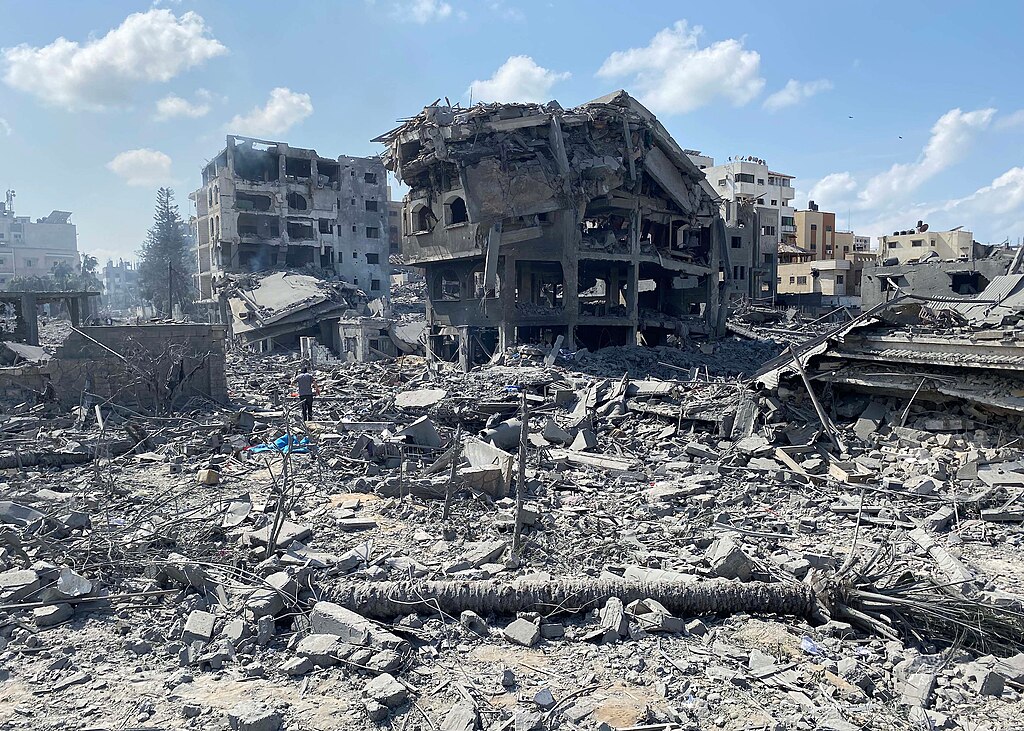
Palestinians inspect the damage following an Israeli airstrike on the El-Remal aera in Gaza City on October 9, 2023. Israel continued to battle Hamas fighters on October 10 and massed tens of thousands of troops and heavy armour around the Gaza Strip after vowing a massive blow over the Palestinian militants’ surprise attack. Photo by Naaman Omar apaimages. licensed under the Creative Commons Attribution-Share Alike 3.0 Unported license.
15 aid organisations demand international pressure for an immediate ceasefire, arms embargo, and end to Israel’s systematic aid obstruction
New data has revealed the scale of aid obstruction, and the consequential drastic fall in aid entering Gaza. This is driving a humanitarian disaster, with the entire population of Gaza facing hunger and disease, and almost half a million at risk of starvation.
While Israeli military attacks on Gaza intensify, lifesaving food, medicine, medical supplies, fuel, and tents have been systematically blocked from entering for almost a year.
Data analysis by organisations working in Gaza has found that as a consequence of the Israeli government’s obstruction of aid:
83% of required food aid does not make it into Gaza, up from 34% in 2023.This reduction means people in Gaza have gone from having an average of two meals a day to just one meal every other day. An estimated 50,000 children aged between 6-59 months urgently require treatment for malnutrition by the end of the year.
65% of the insulin required and half of the required blood supply are not available in Gaza.
Availability of hygiene items has dropped to 15% of the amount available in September 2023. One million women are now going without the hygiene supplies they need.
Only around 1,500 hospital beds in Gaza remain operational, compared to around 3,500 beds in 2023 which was already well below sufficient to meet the needs of a population of more than 2 million people. By comparison, cities of similar size, such as Chicago and Paris average 5 to 8 times more beds than in Gaza.
While humanitarian needs are ever increasing, agencies have detailed six main ways their life-saving aid is systematically obstructed on a daily basis.
These include the denial of safety, with more than 40,000 Palestinians and nearly 300 aid workers killed since last October; the sharp tightening of a 17-year blockade to a full siege, which prevents aid from entering Gaza; delays and denials which restrict the movement of aid around Gaza; tightly restrictive and unpredictable control of imports; the destruction of public infrastructure such as schools and hospitals; and the displacement of civilians and humanitarian workers (witnessed again in recent displacement orders from the so-called “humanitarian zone” in Deir el-Balah.)
Ahead of the UN General Assembly in New York this week, aid agencies are calling on governments to demand Israel end aid obstruction and to:
Secure an immediate and lasting ceasefire in Gaza.
Implement an arms embargo and end the export of weapons and military equipment that risk being used in violations of international humanitarian law and human rights law.
Demand compliance with the International Court of Justice’s findings and recommendations, an end to the Israeli government’s siege of Gaza, and heed the call of the ICJ in its advisory opinion to end the occupation of Palestinian territory.
Jolien Veldwijik, CARE Country Director in the West Bank and Gaza, said:
“The situation was intolerable long before last October’s escalation and is beyond catastrophic now. Over 11 months, we have reached shocking levels of conflict, displacement, disease and hunger. Yet, aid is still not getting in, and humanitarian workers are risking their lives to do their jobs while attacks and violations of international law intensify. Aid, which is urgently required for 2.2 million people at risk of dying in the coming weeks and months, should never be politicised. We demand an immediate and sustained ceasefire, and the free flow of humanitarian aid into and throughout Gaza.”
Amjad Al Shawa, the director of the Palestinian NGOs Network (PNGO), an umbrella organisation of 30 Palestinian NGOs and a partner of ActionAid, said:
“There is a shortage of all humanitarian items. We are overwhelmed [with] these needs and [these] urgent requirements…People [are] starving due to the shortage of aid…100% of the population depend on humanitarian aid…It’s the worst situation that we [witnessed] during …. the Israel war in Gaza.”