UN Tells Israel: Cease Fire; NYT Says: If You Want

Spread the love

Original article by DAVE LINDORFF republished from FAIR under Creative Commons Attribution-NonCommercial-NoDerivs 3.0 Unported License.

The editorial boards of the nation’s major media organizations must have been frantic last week.

Used to reporting on US foreign policy, wars and arms exports so as to portray the United States as a benevolent, law-abiding and democracy-defending nation, they were confronted on March 25 with a real challenge dealing with Israel and Gaza. No sooner did the Biden administration, for the first time, abstain and thus allow passage of a United Nations Security Council resolution that was not just critical of Israel, but demanded a ceasefire in Gaza, than US officials began declaring that the resolution that they allowed to pass was really meaningless.

It was “nonbinding,” they said.

The New York Times (3/25/24) reported that US’s UN Ambassdor “Thomas-Greenfield called the resolution ‘nonbinding’”—and let no one contradict her.

That was enough for the New York Times (3/25/24), which produced the most one-sided report on the decision. That article focused initially on how Resolution 2728 (which followed three resolutions that the US had vetoed, and a fourth that was so watered down that China and Russia vetoed it instead) had led to a diplomatic dust-up with the Israeli government: Prime Minister Benjamin Netanyahu canceled a planned visit to Washington by a high-level Israeli delegation to discuss Israel’s planned invasion of Rafah and the future of Gaza and the West Bank.

The Times quoted Richard Gowan, a UN expert at the International Crisis Group: “The abstention is a not-too-coded hint to Netanyahu to rein in operations, above all over Rafah.”

Noting that “Security Council resolutions are considered to be international law,” Times reporters Farnaz Fassihi, Aaron Boxerman and Thomas Fuller wrote, “While the Council has no means of enforcing the resolution, it could impose punitive measures, such as sanctions, on Israel, so long as member states agreed.”

This was nevertheless followed by a quote from Washington’s UN Ambassador Linda Thomas-Greenfield, who abstained from the otherwise unanimous 14–0 vote of the rest of the Security Council, characterizing the resolution as “nonbinding.”

The Times offered no comment from any international law scholars, foreign or US, to rebut or even discuss that claim. Such an expert might have pointed to the unequivocal language of Article 25 of the UN Charter: “The members of the United Nations agree to accept and carry out the decisions of the Security Council in accordance with the present Charter.”

If the US offered its claim that this language only applies to resolutions explicitly referencing the UN Charter’s Chapter VII, dealing with “threats to the peace,” an international law expert (EJIL: Talk!1/9/17) might note that the International Court of Justice stated in 1971, “It is not possible to find in the Charter any support for this view.”

‘Creates obligations’

The Washington Post (3/26/24) quoted an international law expert to note that the resolution “creates obligations for Israel and Hamas.”

The Washington Post (3/26/24), though like the Times a firm defender of Washington’s foreign policy consensus, did marginally better. While the Times didn’t mention Britain or France, both major US NATO allies, in its piece on the Security Council vote, the Post noted that the four other veto powers—Britain and France, as well as China and Russia—had all voted in favor of the resolution, along with all 10 elected temporary members of the Council.

The Post also cited one international law legal expert, Donald Rothwell, of the Australian National University, who said the “even-handed” resolution “creates obligations for Israel and Hamas.”

While that quote sounds like the resolution is binding, the Post went on to cite Gowan as saying, “I think it’s pretty clear that if Israel does not comply with the resolution, the Biden administration is not going to allow the Security Council members to impose sanctions or other penalties on Israel.”

The Post (3/25/24) actually ran a stronger, more straightforward piece a day earlier, when it covered the initial vote using an AP story. AP did a fairer job discussing the fraught issue of whether or not the resolution was binding on the warring parties, Israel and Hamas (as well as the nations arming them).

That earlier AP piece, by journalist Edith M. Lederer, quoted US National Security spokesperson John Kirby as explaining that they decided not to veto the resolution because it “does fairly reflect our view that a ceasefire and the release of hostages come together.”

Because of the cutbacks to in-house reporting on national and international news  in most of the nation’s major news organizations, most Americans who get their news from television and their local papers end up getting dispatches—often edited for space—from the New York TimesWashington Post or AP wire stories. (The Wall Street Journal, for example, ran the same AP report as the Post.)

‘A demand is a decision’

CNN (3/27/24) quoted US officials claiming the resolution was nonbinding—and noted that “international legal scholars” disagree.

In TV news, CNN (3/27/24) had some of the strongest reporting on the debate over whether the resolution was binding. The news channel said straight out, “While the UN says the latest resolution is nonbinding, experts differ on whether that is the case.”

It went on to say:

After the resolution passed, US officials went to great lengths to say that the resolution isn’t binding. State Department spokesperson Matthew Miller repeatedly said during a news conference that the resolution is nonbinding, before conceding that the technical details of are for international lawyers to determine. Similarly, White House National Security Council spokesman John Kirby and US ambassador to the UN Linda Thomas-Greenfield separately insisted that the resolution is nonbinding.

Those US positions were challenged by China’s UN Ambassador Zhang Jun, who “countered that such resolutions are indeed binding,” and by UN spokesperson Farhan Haq, who said Security Council resolutions are international law, and “so to that extent they are as binding as international law is.”

CNN quoted Maya Ungar, another International Crisis Group analyst:

The US—ascribing to a legal tradition that takes a narrower interpretation—argues that without the use of the word “decides” or evocation of Chapter VII within the text, the resolution is nonbinding…. Other member states and international legal scholars are arguing that there is legal precedence to the idea that a demand is implicitly a decision of the Council.

‘A rhetorical feint’

According to the Guardian (3/26/24), the US’s “nonbinding” interpretation “put the US at odds with other member states, international legal scholars and the UN itself.”

To get a sense of how one-sided or at best cautious the US domestic coverage of this critically urgent story is, consider how it was covered in Britain or Spain, two US allies in NATO.

The British Guardian (3/26/24), which also publishes a US edition, ran with the headline: “Biden Administration’s Gaza Strategy Panned as ‘Mess’ Amid Clashing Goals.” The story began:

The Biden administration’s policy on Gaza has been widely criticized as being in disarray as the defense secretary described the situation as a “humanitarian catastrophe” the day after the State Department declared Israel to be in compliance with international humanitarian law.

Washington was also on the defensive on Tuesday over its claim that a UN security Council ceasefire resolution on which it abstained was nonbinding, an interpretation that put the US at odds with other member states, international legal scholars and the UN itself.

But the real contrast is with the Spanish newspaper El País (3/29/24), which bluntly headlined its story “US Sparks Controversy at the UN With Claim That Gaza Ceasefire Resolution Is ‘Nonbinding.’” Not mincing words, the reporters wrote:

By abstaining in the vote on the UN Security Council resolution demanding an immediate ceasefire in Gaza, the United States on Monday sparked not only the anger of Israel, which had asked it to veto the text, but also a sweeping legal and diplomatic controversy due to its claims that the resolution—the first to be passed since the start of the Gaza war—was “nonbinding.” For Washington, it was a rhetorical feint aimed at making the public blow to its great ally in the Middle East less obvious.

El País (3/29/24) quoted the relevant language from the UN Charter: “The members of the United Nations agree to accept and carry out the decisions of the Security Council in accordance with the present Charter.”

After quoting Thompson-Greenfield saying it was a “nonbinding resolution,” and Kirby saying dismissively, “There is no impact at all on Israel,” they wrote,

These claims hit the UN Security Council—the highest executive body of the UN in charge of ensuring world peace and security—like a torpedo. Were the Council’s resolutions binding or not? Our was it that some resolutions were binding and others were not?

The reporters answered their own rhetorical question:

Diplomatic representatives and legal experts came out in force to refute Washington’s claim. UN Secretary-General António Guterres made his opinion clear: the resolutions are binding. Indeed, this is stated in Article 25 of the UN Charter: “The members of the United Nations agree to accept and carry out the decisions of the Security Council in accordance with the present Charter.” Several representatives of the Security Council, led by Mozambique and Sierra Leone, pointed to case law to support this argument. The two African diplomats, both with legal training, said that the Gaza ceasefire resolution is binding, regardless of whether one of the five permanent members of the Council abstains from the vote, as was the case of the US. The diplomats highlighted that in 1971, the advisory opinion of the International Court of Justice (ICJ) established that all resolutions of the UN Security Council are legally binding. The Algerian ambassador to the UN summed it up even more categorically: “Security Council resolutions are binding. Not almost, not partly, not maybe.”

Unlike most most US news organizations, El País went to an expert, in this instance seeking out Adil Haque, a professor of international law at Rutgers University, where he is a professor, and also executive editor of the law journal Just Security. Haque, they wrote, “has no doubts that the resolution is binding.” He explains in the article:

According to the UN Charter, all decisions of the Security Council are binding on all member states. The International Court of Justice has ruled that a resolution need not mention Chapter VII of the Charter [action in case of threats to the peace, breaches of the peace or acts of aggression], refer to international peace and security, or use the word “decides” to make it binding. Any resolution that uses “mandatory language” creates obligations, and that includes the term “demands” used in the resolution on Gaza.” He adds, “For now, it does not seem that the US has a coherent legal argument.”

It should be noted that the New York Times, when there is a dispute regarding a document, typically runs a copy of the document in question—or, if it is too long, the relevant portion of it. In the case of Resolution 2728, which even counting its headline only runs 263 words, that would have not been a hard call. Despite the disagreement between the US and most of the Council over the wording of the ceasefire resolution, the Times chose not to run or even excerpt it.

Original article by DAVE LINDORFF republished from FAIR under Creative Commons Attribution-NonCommercial-NoDerivs 3.0 Unported License.

Continue ReadingUN Tells Israel: Cease Fire; NYT Says: If You Want

Lawyers Sue Germany in Bid to Block Arms Exports to Israel

Spread the love

Original article by BRETT WILKINS republished from Common Dreams under Creative Commons (CC BY-NC-ND 3.0).

A woman protests the German government’s arms exports to Israel during a December 28, 2023 protest in Berlin. 
(Photo: Maryam Majd/Getty Images)

“There is reason to believe that these weapons are being used to commit grave violations of international law, such as the crime of genocide and war crimes.”

The Berlin-based Lawyers’ Collective on Friday sued the German government in an effort to stop weapons transfers to Israel, whose government and military are waging a genocidal war against Palestinians in Gaza.

According to the Stockholm International Peace Research Institute, Germany is the second-largest arms exporter to Israel, providing 30% of its imported weaponry from 2019-23. The top exporter, the United States, provided 69% of Israel’s imported armaments during that same period.

“As there is reason to believe that these weapons are being used to commit grave violations of international law, such as the crime of genocide and war crimes, the applicants are hereby demanding that the German government protect their right to life,” groups supporting the lawsuit—including the European Legal Support Center, Palestine Institute for Public Diplomacy, Law for Palestine, and Forensis—said in a statement.

Ahmed Abed, an attorney in the case who is representing Palestinian families, said during a Friday press conference in Berlin that “Germany has a constitutional responsibility to protect human life.”

“The German government must stop its arms exports to Israel, as they are in violation of international law,” he added. “The government cannot claim that it is not aware of this.”

According to the Lawyers’ Collective:

In 2023, the German government issued arms exports licenses to Israel worth €326.5 million, the majority of which were approved after October 7, 2023, a tenfold increase compared to 2022. The German government is currently supporting the Israeli army by approving the supply of 3,000 portable anti-tank weapons, 500,000 rounds of ammunition for machine guns, submachine guns, or other fully or semi-automatic firearms, as well as other military equipment, while in early 2024 Germany was preparing the authorization of 10,000 rounds of 120mm tank ammunition…

The arms deliveries and support provided by the Federal Government to Israel violate the Federal Republic’s obligations under the War Weapons Control Act. The criteria for the approval of arms exports include, among other things, that the weapons are not used against Germany’s obligations to international law.

The groups said that since the International Court of Justice (ICJ) found in January that Israel is plausibly committing genocide in Gaza, they believe that “the delivery of weapons is contrary to these obligations.”

In February, lawyers from some of the same groups involved in the new lawsuit sued senior German officials, including Chancellor Olaf Scholz, for “aiding and abetting” Israel’s genocide in Gaza.

Last month, Nicaragua filed an ICJ lawsuit against Germany accusing its government of helping Israel commit genocide against Palestinians.

In addition to exporting hundreds of millions of euros worth of arms to Israel, Germany also suspended contributions to the United Nations Relief and Works Agency for Palestine Refugees in the Near East in response to unsubstantiated Israeli accusations that 12 of the agency’s 13,000 workers in Gaza were involved in the Hamas-led October 7 attacks on Israel. This, as Palestinians starve to death.

The German government has been intensely criticized for its nearly unconditional support for Israel and for violently cracking down on pro-Palestinian protests. Numerous observers contend that Germany’s actions are driven by historical guilt over the Holocaust, with some critics claiming the German government is weaponizing that guilt in order to demonize Palestinians and their defenders.

The new lawsuit came as the United Nations Human Rights Council on Friday voted 28-6 with 13 abstentions in favor of a resolution demanding that Israel be held accountable for possible war crimes and crimes against humanity in Gaza. The United States and Germany were the two biggest countries to vote against the measure.

Palestinian and international human rights officials say at least 33,173 Palestinians—most of them women and children—have been killed by Israel’s bombing, invasion, and siege of Gaza since October 7. More than 75,800 others have been wounded, while over 7,000 Gazans are missing and believed dead and buried beneath the rubble of the hundreds of thousands of homes and other structures damaged or destroyed by Israeli attacks.

Original article by BRETT WILKINS republished from Common Dreams under Creative Commons (CC BY-NC-ND 3.0).

Continue ReadingLawyers Sue Germany in Bid to Block Arms Exports to Israel

Sadiq Khan calls for immediate halt on British arms exports to Israel

Spread the love

https://leftfootforward.org/2024/04/sadiq-khan-calls-for-immediate-halt-on-british-arms-exports-to-israel/

Speaking to PoliticsJOE, Khan said that we should be “holding the Israeli government to account” over its actions in Gaza.

The Mayor of London has called for an immediate halt on British arms exports to Israel.

Sadiq Khan’s intervention comes after more than three former supreme court justices, including the court’s former president Lady Hale, were among more than 600 lawyers, academics and retired senior judges who warned that the UK government is breaching international law by continuing to arm Israel.

The signatories have warned that the present situation in Gaza is “catastrophic” and that given the international court of justice (ICJ) finding that there is a plausible risk of genocide being committed, the UK is legally obliged to act to prevent it.

Speaking to PoliticsJOE, Khan said that we should be “holding the Israeli government to account” over its actions in Gaza.

His comments come after seven international aid workers, including three British citizens, were killed by an Israeli airstrike in Gaza on Monday. John Chapman, 57, James Henderson, 33, and James Kirby, 47, were among the seven World Central Kitchen (WCK) workers killed in Monday’s strike.

https://leftfootforward.org/2024/04/sadiq-khan-calls-for-immediate-halt-on-british-arms-exports-to-israel/

Continue ReadingSadiq Khan calls for immediate halt on British arms exports to Israel

MPs involved in Israel arms exports could be criminally liable for war crimes

Spread the love

https://morningstaronline.co.uk/article/mps-involved-in-israel-arms-exports-could-be-criminally-liable-for-war-crimes

A Palestinian man cries while holding a dead child who was found under the rubble of a destroyed building following Israeli air strikes in Nusseirat refugee camp, central Gaza Strip on October 31, 2023

600 legal experts warn Sunak of Britain’s complicity in Gaza bloodshed

MINISTERS involved in arms exports to Israel could be criminally liable for war crimes, legal experts warned today.

More than 600 lawyers, including three former Supreme Court justices, have signed a letter telling Prime Minister Rishi Sunak that Britain risks breaching international law by continuing to arm Israel in its assault on Gaza.

It said that the International Court of Justice’s conclusion that there is a “plausible risk of genocide” oblige Britain to suspend the sales.

They called on the government to immediately halt arms exports given the clear risk that they might be used to commit serious violations “in breach of the UK’s domestic Strategic Export Licensing Criteria […] including its obligations under the Arms Trade Treaty.”

The letter said: “We recall that UK nationals responsible for aiding and abetting international crimes, as well as those committing them as primary perpetrators, are liable for prosecution in the UK pursuant to the Geneva Conventions Act 1957 and the International Criminal Court Act 2001.”

https://morningstaronline.co.uk/article/mps-involved-in-israel-arms-exports-could-be-criminally-liable-for-war-crimes

Response to Rishi Sunak's extremism speech at Downing Street 1 March 2024. Second version of this image with text slightly altered.
Response to Rishi Sunak’s extremism speech at Downing Street 1 March 2024. Second version of this image with text slightly altered.
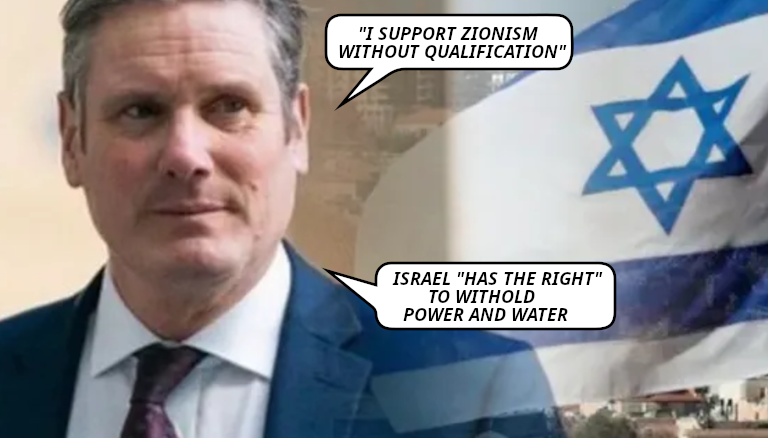
Zionist Keir Starmer supports Israel's Gaza genocide.
Zionist Keir Starmer supports Israel’s Gaza genocide.

Continue ReadingMPs involved in Israel arms exports could be criminally liable for war crimes

Green party repeats call for ending arms sales to Israel

Spread the love
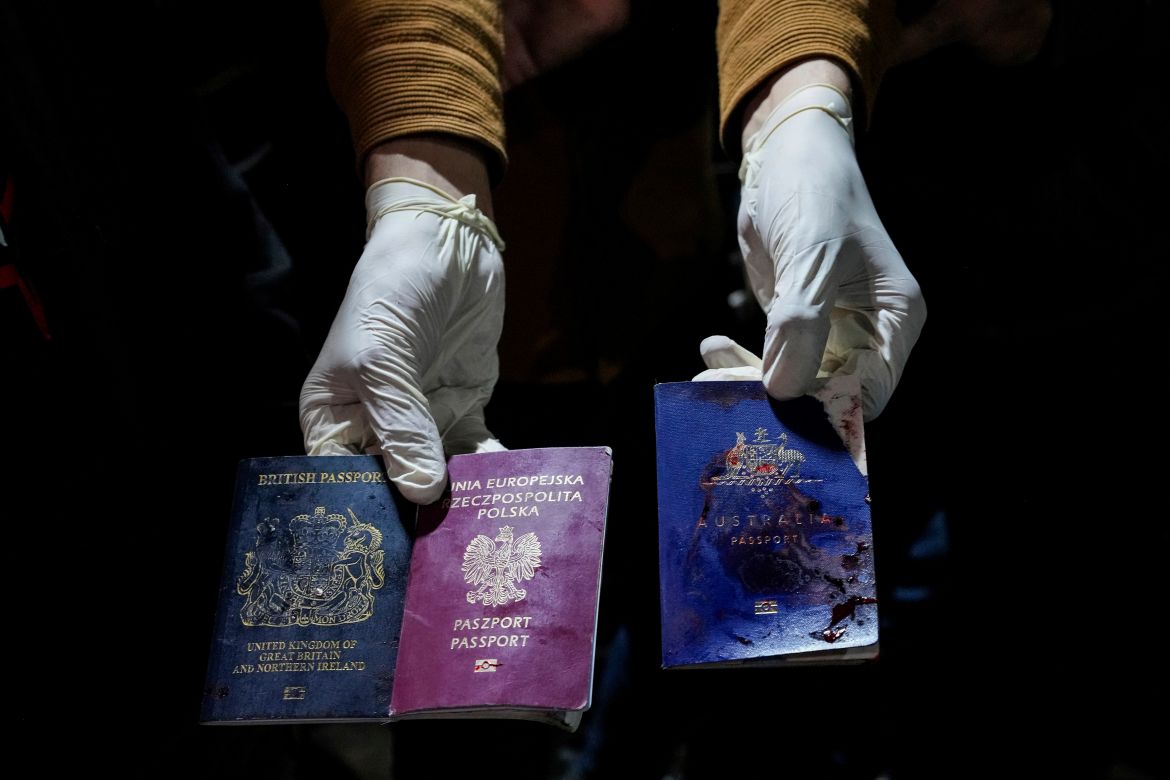
A man displays blood-stained British, Polish, and Australian passports. [Abdel Kareem Hana/AP Photo]

In the wake of the attack on the World Central Kitchen convoy, which killed seven aid workers, the Green Party have repeated their call for the UK government to cancel all arms export licences to Israel.  The Party’s Global Solidarity spokesperson and former Middle East diplomat, Carne Ross, said

“The death of compassionate humanitarian volunteers was an outrageous and avoidable tragedy. The cynical attempts by the Netanyahu government to portray the attack on World Central Kitchen (WCK) as an accident have been dismissed by those agencies trying to feed the starving in Gaza. Under international humanitarian law, this humanitarian aid is the responsibility of the Israeli government, yet they are keeping routes closed and not ensuring that those emergency routes operated by aid agencies are safe.  

“It is clear that the Israeli government is violating the terms of the licences under which arms are exported and is failing to abide by basic international humanitarian law. It is a national shame that we are arming the Israel defence forces who are responsible for the deaths of tens of thousands of innocent Palestinians. It appears that the deadly Israeli strike on the aid workers used a drone produced in the UK. This only strengthens the case for an immediate arms embargo.

“It is hugely disappointing, but sadly predictable, to hear calls to end arms exports coming only after Western lives have been lost. It comes too late for the thousands of Palestinian children slaughtered by western supplied bombs and bullets.  

“Foreign Secretary Cameron can show global leadership during his talks with NATO leaders today by first ending UK arms sales and then persuading other NATO countries to follow suit. We cannot allow the humanitarian calamity in Gaza to continue a day longer.” 

Continue ReadingGreen party repeats call for ending arms sales to Israel