‘Macron Get Out!’ Unions Lead Massive Anti-Austerity Protests Across France
Original article by Jessica Corbett republished from Common Dreams under Creative Commons (CC BY-NC-ND 3.0).
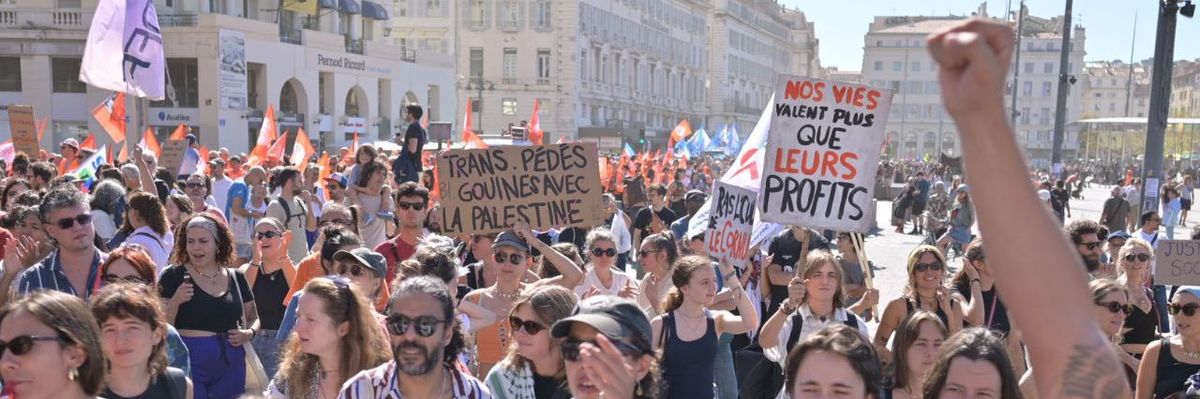
“We’re in a situation of injustice,” one protester said. “Workers can no longer feed themselves, students no longer have future prospects.”
Echoing demonstrations against French President Emmanuel Macron’s pension reforms two years ago, hundreds of thousands of people joined protests across France on Thursday, outraged by the government’s proposed austerity measures.
While the CGT trade union—one of several labor groups that pushed for the mass mobilization—put the count at over 1 million, French authorities, whose figures are usually much lower than unions, said more than 500,000 demonstrated nationwide, including 55,000 in Paris.
Thursday’s demonstrations followed last week’s ”Block Everything” protests, which coincided with French Prime Minister Sébastien Lecornu’s first full day in office. Macron picked Lecornu, his ally and a former defense minister, for the post after François Bayrou lost a no-confidence vote in the National Assembly over the budget plan.
Although “Lecornu quickly scrapped one of the most unpopular proposals—eliminating two public holidays—he has not ruled out the rest,” Euronews noted Thursday. “These include an overhaul of unemployment benefits, delinking pensions from inflation, and raising out-of-pocket medical costs.”
A protester named Alexandre told Euronews that “right now, we have a government that doesn’t listen to us and is even the opposite of what the population needs. A government that robs fellow citizens, and it’s important for everyone to mobilise, for the people of France who want to be dignified and who also want to give others their dignity throughout the world.”
“We’re in a situation of injustice,” he added. “Workers can no longer feed themselves, students no longer have future prospects.”
Hospital staff, railway workers, students, and teachers were among those who poured into the streets across France—including major actions in cities such as Lyon, Marseille, and Paris—rallying behind the message: “Strikes, Blockades, Macron Get Out!”
The Public Service Ministry said that nearly 11% of France’s 2.5 million state employees were on strike. According to Le Monde, “Around 1 in 6 teachers walked out of primary and secondary schools, 9 out of 10 pharmacies were shuttered, and severe disruption occurred on the Paris metro network, where only the three driverless automated lines are working normally.”
Protesters want the government to not only kill the proposed austerity measures but also spend more on public services and impose higher taxes on the wealthy. Sophie Binet, the head of the CGT union, said that “the anger is huge, and so is the determination. My message to Mr. Lecornu today is this: It’s the streets that must decide the budget.”
Multiple elected officials with La France Insoumise (LFI), a party founded by Jean-Luc Mélenchon that is now part of the Nouveau Front Populaire alliance, shared social media posts about them joining the protests.
“The mobilization of youth continues,” said Claire Lejeune, an LFI member of the National Assembly, after speaking with secondary school students in Essonne who “no longer want this policy that is wrecking their future.”
Citing “the dismantling of public education,” “war policy,” and “ecological inaction,” Lejeune said: “They are absolutely right; in the country, no one wants Lecornu or Macron anymore. I was in support of this peaceful mobilization, alongside the unions and teachers, and faced with a completely disproportionate police setup.”
Approximately 80,000 police and gendarmes were deployed for the protests. Early Thursday, LFI’s Clémence Guetté, a vice president in the National Assembly, shared footage of officers kicking and shoving a woman.
“Everywhere this morning, the repression strikes and hits without distinction or restraint,” she wrote. “The images reaching us are shameful. Here in Marseille. To everyone, be careful. France no longer has a government: Macron is the only one responsible.”
After the 1 million estimate began circulating, Guetté called the mass action “immense, everywhere, impressive,” and declared: “The people are in the streets! We are going to win.”
As Al Jazeera reported: “Across the country, Palestinian flags were visible as some protesters also stood in solidarity with Palestinians in Gaza during Israel’s war on the strip. Protesters blocked the Eurolinks arms factory in Marseille, which is believed to supply equipment to Israel, while holding a large banner that read: ‘Shut down the genocidal factory.‘”
Noting the solidarity with the Palestinian people on Thursday, LFI’s Sarah Legrain called for sanctions, an arms embargo, and lifting Israel’s blockade of Gaza, where civilians are starving to death.
Later Thursday, Legrain celebrated the massive turnout and pledged that “we will keep the pressure up until Macron leaves!”
Original article by Jessica Corbett republished from Common Dreams under Creative Commons (CC BY-NC-ND 3.0).
- “Citizens’ Insurrection”: Huge Protests in France Aim to Kill Macron Pension Plan ›
- Parisians Defy France’s New Ban on Pro-Palestinian Rights Protests ›
- Hundreds Arrested in France at Anti-Austerity ‘Block Everything’ Protests ›
- ‘This Election Is Being Stolen From Us’: French Left Calls Mass Protest Against Macron ›
- 100,000+ People Across France March to Decry Macron’s ‘Denial of Democracy’ ›
Workers in Europe refuse cargo to Israel: “Our solidarity is with the oppressed, not with war criminals”
Original article by Ana Vračar republished from peoples dispatch under a Creative Commons Attribution-ShareAlike 4.0 (CC BY-SA) license.
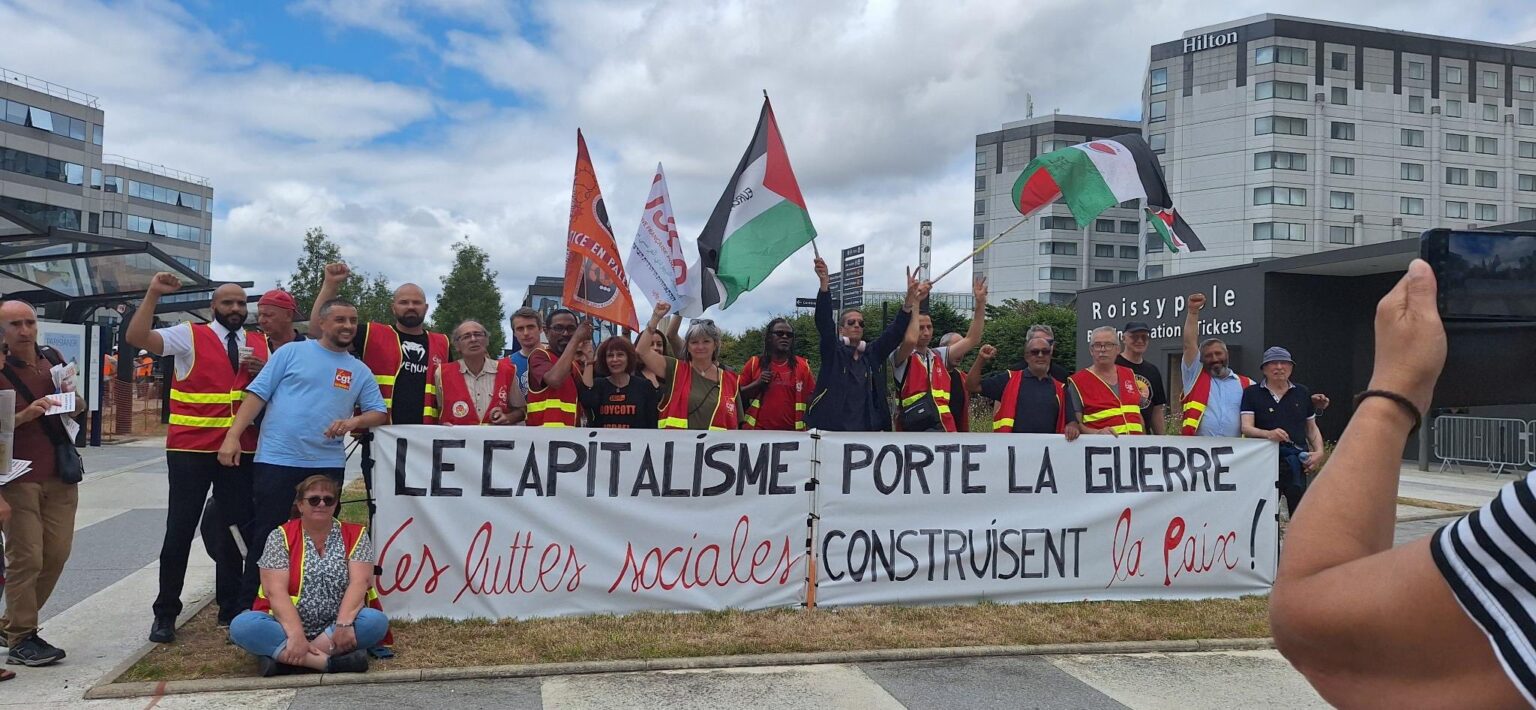
Worker-led actions to block military and dual-use cargo to Israel continue across Europe, defying government support for occupation and genocide.
A growing number of logistics and transport workers, along with trade unions across Europe, are taking action against military shipments to Israel as it continues its genocide in the Gaza Strip. One of the most recent examples is the refusal by airport workers in Paris, primarily organized by the trade unions SUD Aérien and CGT Roissy, to deal with military cargo destined for Israel.
“As workers in the aviation sector, we categorically refuse to participate, directly or indirectly, in logistical operations that could contribute to the crimes currently being committed in Gaza,” SUD Aérien stated.
Read more: The genocide industry: UN rapporteur exposes over 60 companies complicit in Israel’s crimes against Palestinians
French workers have also called for similar blockades in other locations, expressing their solidarity with Palestinians. “Refusing to transport military equipment to Israel is an act of resistance and dignity with the Palestinian people,” read a joint statement from rail, air, and transport unions in June. “We will not stay silent in the face of the collective punishment of an entire people.”
This is not the first time French transport workers have disrupted shipments to the Israeli occupation. Earlier in June, SUD Aérien called for a boycott of Elbit Systems cargo through the same Paris airport, while dockworkers in Fos-sur-Mer, near Marseille, refused to handle similar freight. Workers’ pressure has escalated to the point that leaders of major union confederations felt compelled to publicly urge the French government to act and prevent similar shipments.
However, prospects for action from President Emmanuel Macron remain slim, so trade unions are instead urging workers to take matters into their own hands by refusing to handle military or dual-use cargo. “No hierarchy, no contract, no silence can justify participation in acts that everyone knows to be unjust or inhumane,” SUD Aérien said. “We call on all workers, unionized or not, to refuse to load this cargo, to assert their right to conscience, and to refuse to be complicit in this policy of death.”
Read more: Israel escalates crackdown on Palestinian Prisoners’ Movement
Similar appeals can be found circulating in Piraeus, the port of Athens, where dockworkers have organized several actions to prevent arms shipments. Their union ENEDEP is now calling for broader mobilization, including students, workers, and community groups, ahead of the expected passage of the ship Ever Golden, bound for Israel. According to ENEDEP, Ever Golden, scheduled to dock in Athens on Monday, July 14, is carrying military-grade steel which will be used in attacks on Palestinians. “This cargo will be used to continue the slaughter of civilians, the bombing of hospitals, schools, children, infants, and women,” the union wrote.
ENEDEP has urged the public to gather at the port Monday morning to demonstrate widespread opposition to Greece’s facilitation of arms transfers. “Our goal is to block the unloading and prevent the transfer of this deadly cargo,” they stated. “We will not stain our hands with blood, we will not become accomplices.”
Read more: Maersk faces growing pressure for supporting Israel’s genocide in Gaza
Efforts to halt arms shipments to Israel are also ongoing in Sweden, Italy, and Britain, among others. In the United Kingdom, workers from various sectors had taken direct action against Elbit Systems and Rafael Advanced Defense Systems through the group Palestine Action, recently proscribed by the Labour government. In Sweden, dockworkers previously voted for a full-scale embargo on military equipment to and from Israel.
In Italy, dockworkers in Genoa and the wider membership of the union Unione Sindacale di Base (USB) have organized actions to obstruct military cargo – most recently at the airport in Brescia. During that mobilization, USB emphasized that workers continue to repudiate war and highlighted an ongoing campaign to support the right to strike in cases involving the handling of military material, as well as the right to conscientious objection in research institutions, universities, and schools.
Through all these actions, workers are making clear that they reject being made complicit in genocide by employers or governments. “Our job is not to transport war,” SUD Aérien stated, echoing the sentiment of other unions. “Our solidarity is with the oppressed, not with war criminals.”
Original article by Ana Vračar republished from peoples dispatch under a Creative Commons Attribution-ShareAlike 4.0 (CC BY-SA) license.


Repression of protests continues in Panama
Original article by Pablo Meriguet republished from peoples dispatch under a Creative Commons Attribution-ShareAlike 4.0 (CC BY-SA) license.
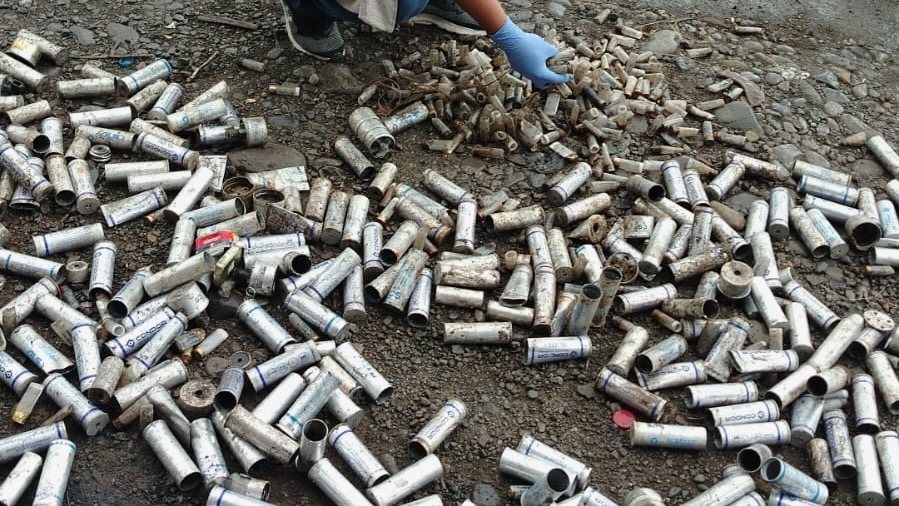
The demonstrations, which have lasted more than 70 days, have been firmly repressed by the Mulino government, which has affirmed that it will not repeal the social security law that has caused so much controversy.
On July 5, nearly 800 people from 17 countries signed a letter addressed to the president of Panama, José Raúl Mulino, calling for international observation due to the increasing repression of protests in Panama. The document, signed by academics, artists, activists, workers, and trade unionists, also points out that the Central American country is witnessing growing criminalization of political dissent, which, according to the document, is reminiscent of the darkest years in its national history. Furthermore, the letter adds that the government is demonstrating an “authoritarian drift”.
The letter states: “President Mulino leads a legally legitimate government, but with minimal support. And he has responded to a wave of legitimate and democratic protests most violently and systematically ever recorded in the country’s history since 1903.”
For more than 70 days, thousands of Panamanians have taken to the streets, closed roads, and staged strikes against the neoliberal policies of the Mulino government. The demonstrators are demanding the repeal of:
- A law reforming Social Security – reducing pensions and opening the door for the privatization of the system.
- Growing US interference – according to the demonstrators, the US intends to install several military bases in Panama.
- The reopening of a copper mine – the largest and most controversial in the country, already closed by the Panamanian justice system.
On June 20, the government suspended constitutional rights for 10 days in the banana-producing province of Bocas del Toro, the most active in the protests. According to the government, the measure was taken to safeguard the security of the area, although several demonstrators called that an excuse to persecute and imprison the leaders of the protests. More than 200 people have been arrested, including local community leaders.
In this regard, the letter states: “The step taken by the Executive to suspend constitutional guarantees in the province of Bocas del Toro makes it, de facto, an authoritarian government willing to suspend the Constitution when it is unable to negotiate, dialogue or listen to its people… The abuse of power of the State through the security forces and the arguments used to justify the violation of human rights, repression, and the prosecution of leaders are not acceptable in any way.”
Therefore, the letter denounces that the country is “going backwards in terms of human rights” and requests the immediate intervention of international human rights agencies to address the Panamanian situation and thus guarantee the fundamental freedoms of demonstrators and citizens alike.
Read more: Labor wins and increased repression: 50 days of Panama’s national strike
A few days ago, Roger Montezuma joined Michelle Becker and Arcenio Abrego on the growing list of those who have been killed during anti-government demonstrations. Montezuma, according to some accounts, was killed in Bocas del Todo in the context of “Operation Omega”, a campaign by the national police that protestors describe as “a bloody repression”.
For this and other cases, the National Human Rights Commission (CNDH) and the Indigenous Peasant Movement of the Ngäbe Buglé region requested that the legislature establish a commission specialized in studying cases of human rights violations to monitor the protests. The CNDH presented more than 100 alleged cases of human rights violations, including alleged arbitrary detentions, humiliating treatment, deaths, etc. The legislature has not yet offered a response to the request.
Thus, the Panamanian political dispute has led to a massive confrontation between protesters and the forces of law and order, which is still not over.
However, as the days go by, more and more denunciations are surfacing in the media, increasing the discomfort for moderate Panamanians (former allies of Mulino), and raising concerns among international actors about partnering with a government that is widely seen as repressive.
Original article by Pablo Meriguet republished from peoples dispatch under a Creative Commons Attribution-ShareAlike 4.0 (CC BY-SA) license.
Black workers 50 per cent more likely to be employed on exploitative zero-hour contracts than white workers, TUC reveals

BLACK workers are more than 50 per cent more likely to be employed on exploitative zero-hour contracts than white workers, new TUC analysis reveals.
The union body published the research showing how black workers are bearing the brunt of insecure work today as delegates gather for TUC black workers’ conference.
The analysis also found that nearly four in 10 BME (black and minority ethnic) workers are also at risk of unfair dismissal, due to having been with their employer for less than two years.
Black workers are also overrepresented in four of the five occupations with the highest number of workers on zero-hours contracts.
This is most stark in social care, where one in 15 is employed, compared to one in 50 white workers.
…
Article continues at https://morningstaronline.co.uk/article/black-workers-50-per-cent-more-likely-to-be-employed-on-exploitative-zero-hour-contracts-than-white-workers-tuc-reveals