The home secretary ripped up the rule book by forcing through new police powers. So Liberty is taking her to court
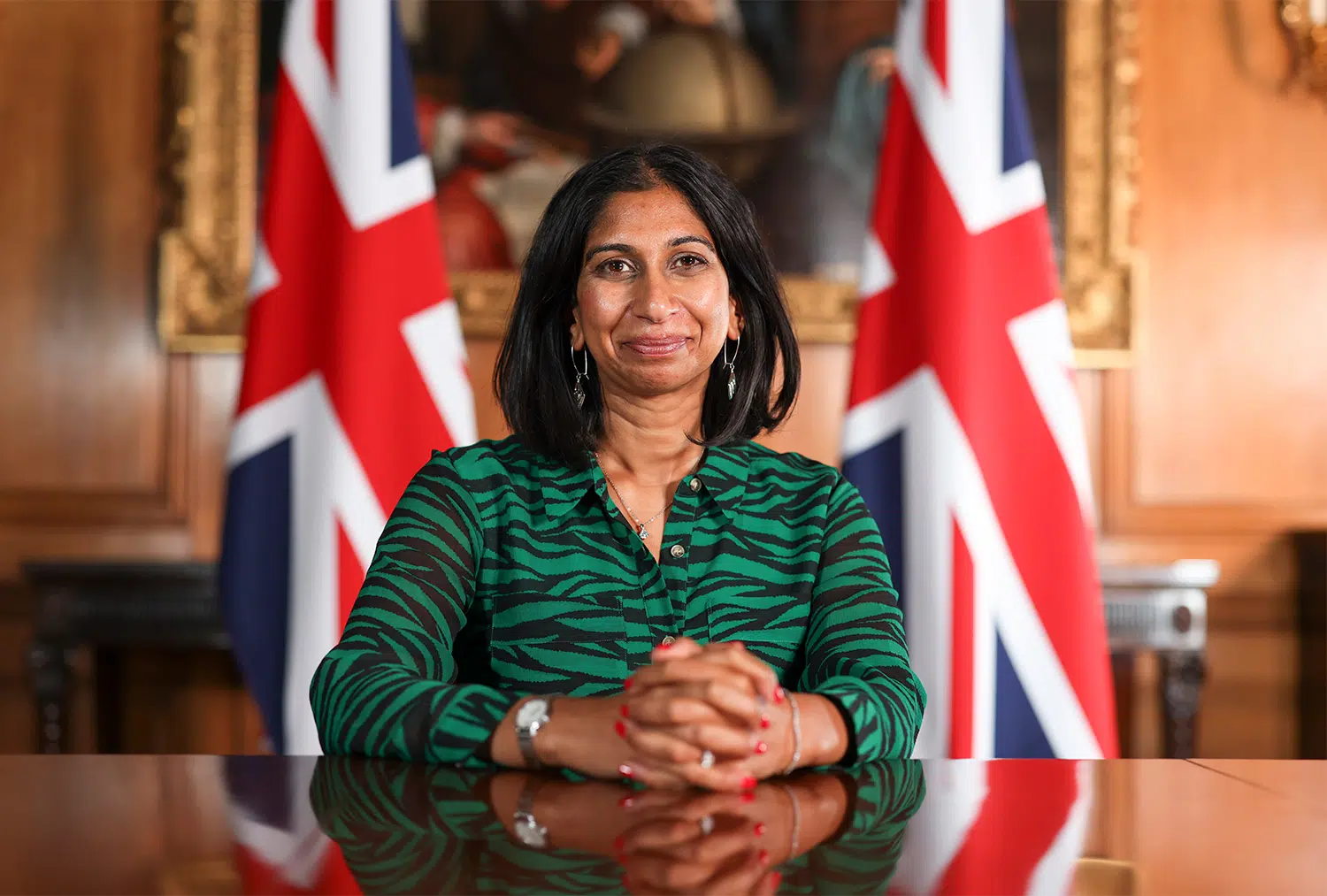
Home secretary Suella Braverman is being sued by Liberty for forcing through anti-protest law in the Public Order Act
The home secretary confirmed just how little this government cares about the UK’s long-established democratic systems when in June she overrode Parliament to sneak in even more anti-protest powers that had already been voted down months earlier.
What she did is unlawful, and the High Court has just given us permission to take her to court.
A year ago, people were asked how much they trust the UK government – and the results were stark. Just one in three said they had faith in those in power and only one in five trusted political parties.
In the 12 months since then the government has continued to dismantle our rights and make it harder for all of us to hold it to account. The cruel and inhumane Illegal Migration Act is making it harder for people to seek refuge, voter ID has created barriers to voting, and anti-strike legislation and a raft of new anti-protest laws are stopping people from standing up for their rights. It is getting harder and harder for ordinary people to keep this government – and future governments – in check.
On 14 June, secondary legislation – a way to bring a new law in without having to create a whole new bill – was signed, changing the threshold in the Public Order Act for police intervention at a protest. Whereas before police could only get involved if protests caused ‘serious disruption’ to the community, now they can step in when they deem there to be ‘more than minor disruption’. The change gives the police almost unlimited powers to shut down protests due to the vagueness of the new language.
RISHI SUNAK will come under pressure on Friday to explain why he ignored expert warnings during the pandemic, after the Covid inquiry heard politics drove government’s public messaging about the virus.
TUC assistant general secretary Kate Bell is giving evidence to the hearing this morning and has said the Prime Minister has “serious questions to answer” after the Treasury “massively undermined” Britain’s public health effort.
“It pushed up infection rates, put a huge strain on our public services and ballooned the cost of Test and Trace,” she said.
“The Prime Minister must come clean about why these decisions were taken, especially when senior government advisers were warning that people couldn’t afford to stay home when sick.
“And he must explain why he saw fit to spend more on Eat Out to Help Out than on helping people to self-isolate.
“The failure to provide proper financial support was an act of self-sabotage that left millions brutally exposed to the pandemic.”
This week the inquiry heard that Mr Sunak blocked chief medical officer Chris Whitty’s calls in May of 2020 for “an accessible offer of financial support” to help reduce the risk of “no adherence” to Covid rules.
…
The TUC will urge Mr Sunak on Friday to answer why he didn’t provide better statutory sick pay (SSP) than just £94 a week, which left the average worker facing a £418 drop in earnings if they had to self-isolate.
The government had been warned at the start of the pandemic that two million workers had no sick pay protection at all, it added, noting that 23 per cent of the country’s workforce had to rely on SSP if they needed to self-isolate during the pandemic, rising to three in 10 for the lowest paid.
Meanwhile freedom of information requests showed the then-chancellor spent more than £800 million on Eat Out to Help Out than the £385m on funding the self-isolation scheme.
One of the many occasions UK Prime Minister Rishi Sunak uses a private jet.
Political leaders owe their citizens the truth about the costs and the challenges of the energy transition on a warming planet. Last week, UK Prime Minister Rishi Sunak failed – and California Governor Gavin Newsom passed – that test.
…
If Sunak had mustered the courage to tell Brits the truth, rather than throwing up flack about excessive costs and burdens, he could have taken a cue from Newsom and said this instead: “The cost-of-living crisis is a fossil fuel crisis. Inflation persists. It’s not complicated. It’s not complicated. It’s the burning of oil. It’s the burning of gas. It’s the burning of coal – and we need to call that out.”
“The rise in energy prices started last winter, when many countries experienced low gas stocks, leading to a rise in gas prices. Russia’s invasion of Ukraine and volatile market conditions led to further price hikes,” wrote van Halm. European gas prices peaked in August 2022 at more than €300 per megawatt-hour (/MWh), she noted, when before the Covid-19 pandemic and Russia’s invasion of Ukraine, European gas prices were regularly around €10–20/MWh.
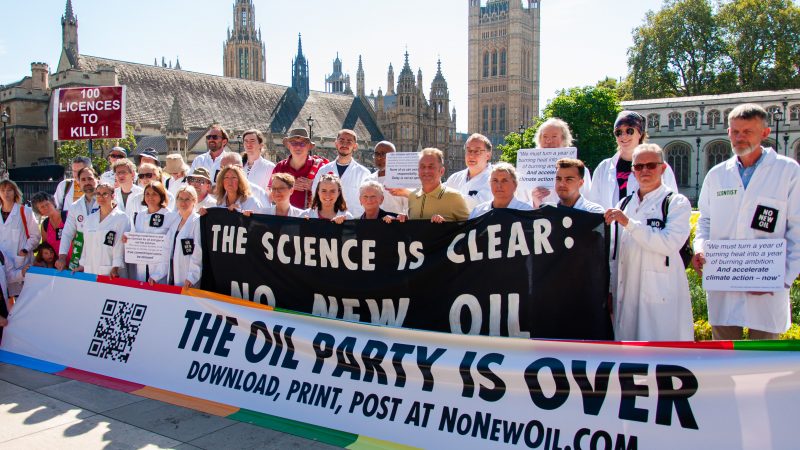
Image of InBedWithBigOil by Not Here To Be Liked + Hex Prints from Just Stop Oil’s You May Find Yourself… art auction. Featuring Rishi Sunak, Fossil Fuels and Rupert Murdoch.
The recently-approved Rosebank oil field in the North Sea has been touted as a way to boost the UK economy and its energy security. But even with its windfall tax on energy company profits, the project is a good example of how the UK could miss out on billions in taxes over the life of an oilfield.
Energy companies Equinor and Ithaca expect to invest £8.1 billion in Rosebank from development, during its operation and when they decommission the field once they’ve finished extracting its oil. Of this, 78% will be invested in UK-based businesses, and the project will support 1,600 jobs at the height of construction and around 450 UK-based jobs over its entire lifetime.
The UK charges a headline 75% rate of tax on all UK energy production and so, at first glance, a major project like Rosebank would be expected to generate billions in tax payments for the UK Treasury over the years. But, according to my research, it could instead create billions in tax savings for the companies involved.
Of the 75% tax that energy companies are currently charged, profits from oil and gas extraction in the UK are charged a corporate tax of 30%, supplemented by an extra 10% charge. The other 35% in taxes comes from the UK’s windfall tax.
Such levies are typically used to redistribute profits when a company benefits from external circumstances. For example, energy companies have recently seen profits soar as prices rose due to concerns about satisfying global oil and gas demand during Russia’s invasion of Ukraine.
The UK rolled out an additional 25% windfall tax in 2022 for oil and gas companies in response to this profit spike. On January 1 2023, the government increased it to 35% until at least the spring of 2028. The UK government raised £2.6 billion from the windfall tax alone last year.
When the windfall tax is added to the 30% rate and the 10% extra, that makes for a whopping 75% tax on energy companies. This seems like a lot, but the reliefs and other tax breaks open to companies often help a lot of these charges disappear. When a business invests its profits, it can benefit from first-year capital allowances, subtract costs related to daily operations and gain additional investment allowances that can be saved up to reduce taxes on future profits.
Crunching the numbers
If an oil company makes £10 million, for example, current tax rules would claim £7.5 million from this. But if the company reinvests the earnings in oil and gas extraction, it wouldn’t just zero out its tax, it could also set aside an extra £1.6 million against future gains – or £3.4 million if it invests in decarbonisation.
Project this on to Equinor and Ithaca’s multibillion-pound Rosebank investment and it could generate up to £8.4 billion in tax savings for the companies involved, based on my analysis of levies on energy producers,
A spokesperson for Equinor told The Conversation: “These are numbers we don’t recognise.” Adding that estimates by energy consultancy Wood Mackenzie found Rosebank would bring £26.8 billion to the UK through tax payments and investments, he continued: “Over the years, oil and gas taxation in the UK has changed many times. It is impossible to estimate with any certainty exactly how large tax revenue and value creation this project will generate for the UK.” Ithaca did not respond to a request for comment.
Many players in the UK’s oil and gas sector can take advantage of a range of capital and investment allowances, deductions and taxation reliefs. In fact, before the windfall tax, companies often got back more from the UK government than they paid in taxes.
The windfall tax will expire in 2028 or if energy prices fall below a certain level for six months. And so while it has forced some companies pay tax on some recent bumper profits, it won’t always be around to make even that happen.
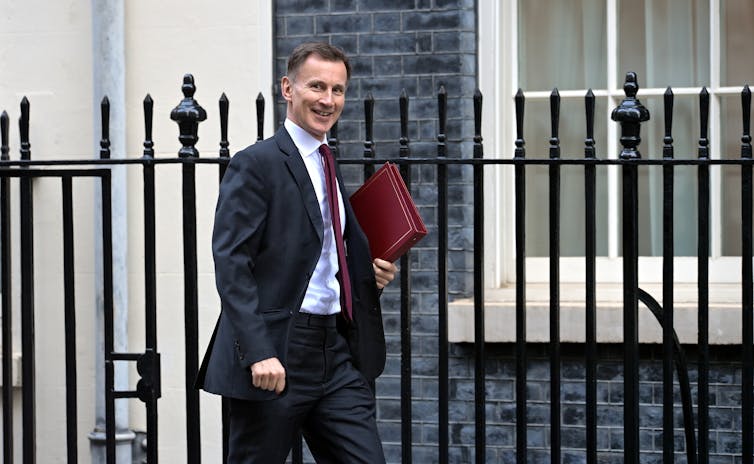
UK chancellor Jeremy Hunt increased and extended a UK windfall tax on oil and gas companies last year. Sean Aidan Calderbank/Shutterstock
Shortsighted or strategy?
Compared to nations like Norway that offer more long-standing corporate tax regimes, the UK’s history is riddled with policies that have been swayed by short-term political urgencies. This sidelines long-term vision and provides a very weak signal to companies considering investment in the UK.
A revolving door of UK prime ministers in recent times hasn’t helped and has also seen investors lose some confidence in the country’s economy. A slew of lucrative tax reliefs might seem like the perfect way to counterbalance recent policy oscillations.
Central to the UK’s energy strategy is an intent to ramp up extraction, ostensibly to enhance national energy security. But will this happen with Rosebank?
When asked about this, the Equinor spokesperson said: “Rosebank will strengthen our contributions to UK energy security. The field is estimated to start producing in 2026/2027 and produce for more than 20 years. The gas will go into the UK pipeline system. The oil will be offloaded offshore. It is a light, sweet crude oil that can be used in refineries in the UK. If the UK needs the oil, when the field starts producing, the UK will get it.”
The UK continues to feed the oil and gas industry with reliefs, while renewable energy projects (but not gas-generation) face the electricity generator levy – a 45% charge on power generated above a £75 per megawatt hour (MWh) threshold. As much of the rest of the world moves towards more sustainable energy solutions, the UK should realign its tax priorities with the broader, greener global vision.
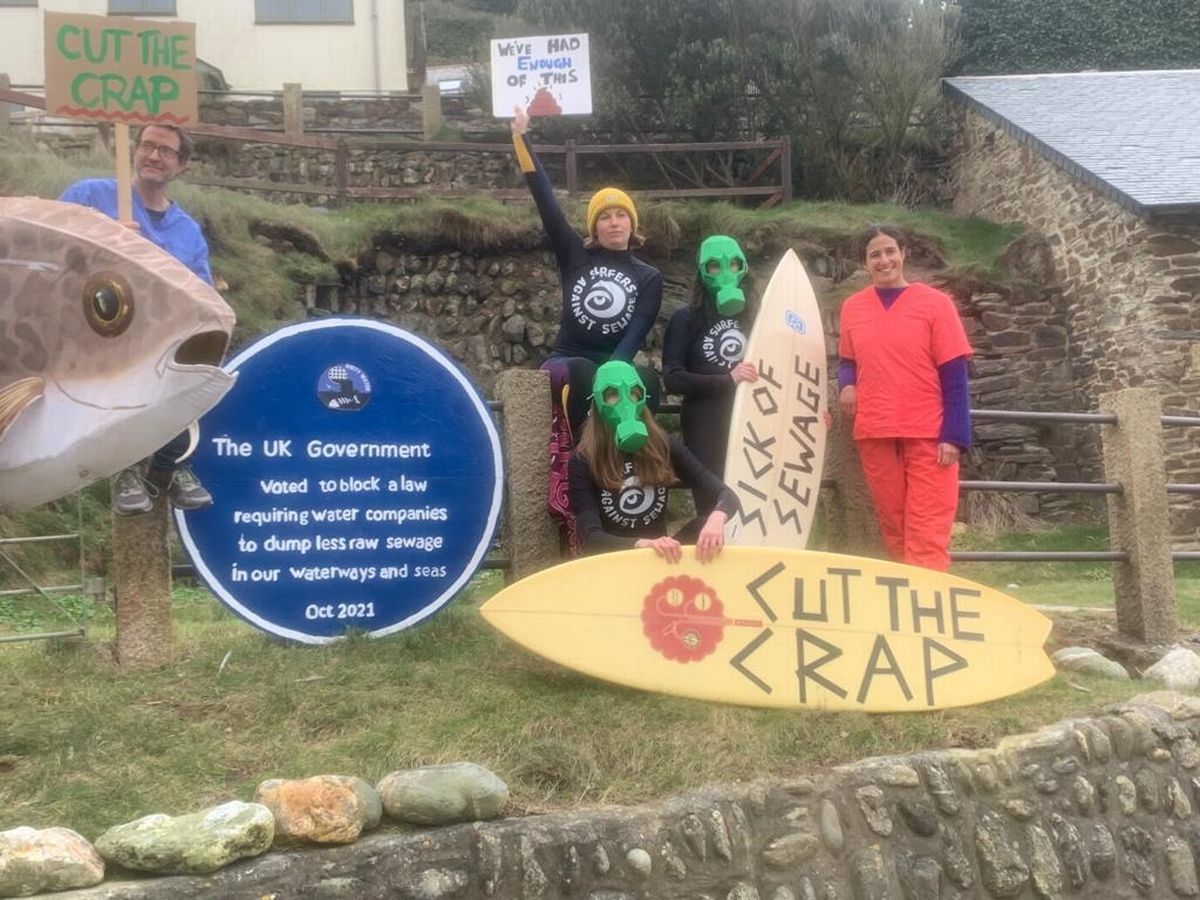
April 2023 Surfers Against Sewage and Extinction Rebellion protests in St Agnes, Perranporth, Truro and Charlestown which unveiled spoof Blue Plaques to the MPs and Conservative Government who allowed raw sewage to be dumped in the sea (Image: Surfers Against Sewage)
The Green Party has reiterated its call for water companies to be brought into public ownership after Water UK apologised for a series of sewage discharges.
The Green Party has reiterated its call for water companies to be brought into public ownership after Water UK apologised for presiding over a rising tide of sewage discharges.
Water UK represents 25 water companies across the UK and said that the public was ‘right to be upset about the current quality of our rivers and beaches’. The companies have also promised to triple funding for sewer system upgrades, cut spilly by up to 25 per cent by 2030, and provide the public with ‘near real-time’ data on sewage spills.
Green Party co-leader Adrian Ramsay said: “Rivers and coastlines up and down the country have faced years of assault at the hands of the water companies and a government that has refused to act.
“Currently water companies can, almost with impunity, dump sewage into our rivers, waterways and coastal waters with an appalling cost to public health and our wildlife. This situation cannot go on.