Climate activists face ‘crippling’ legal fees for injunctions banning protest
Spread the love
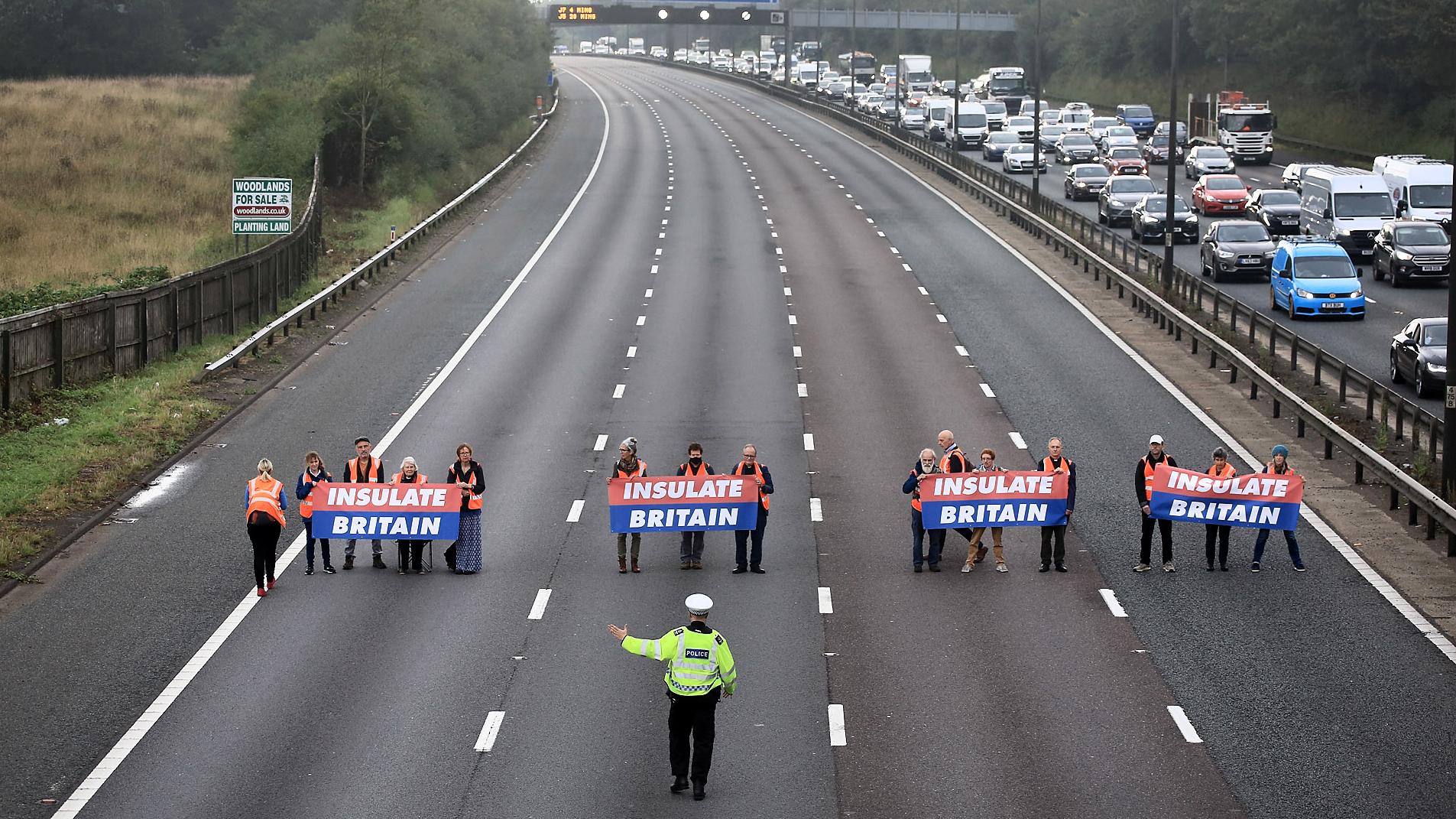
Image of an Insulate Britain roadblock September 2021

Original article by Anita Mureithi repubished from Open Democracy under a Creative Commons Attribution-NonCommercial 4.0 International licence

Protesters facing criminal convictions are being punished twice as National Highways and TfL seek costly injunctions

Climate activists have told openDemocracy they are being hit with “crippling” bills totalling thousands of pounds because of legal action brought by government and public bodies to prevent protests.

Injunctions – orders issued through civil courts, usually to ban something – are increasingly being used to crack down on climate demonstrations, activists say, in what they believe is an attempt to silence dissent.

Both National Highways and Transport for London (TfL) have named supporters of environmental campaign groups Insulate Britain and Just Stop Oil on injunctions intended to stop protests on certain roads in recent years. One person named on a TfL injunction told openDemocracy they have never even protested in London.

Breaching an injunction can lead to a contempt of court conviction, which is punishable by up to two years’ imprisonment, an unlimited fine and the seizure of assets.

One Just Stop Oil protester said they had been warned by their lawyers that those who go to trial to fight an alleged breach and lose could be made to pay up to £150,000 to £200,000 in legal fees, while accepting a breach could incur costs of between £5,000 and £20,000.

The protester told openDemocracy that the costs could leave defendants vulnerable to “the kinds of debts which could cripple you and potentially make you homeless”.

Raj Chada, a partner at law firm Hodge Jones & Allen who represents a number of Insulate Britain supporters, said the way injunctions are now being used is “astonishing” and something he’s never seen before in 15 years of working with protesters.

“The injunctions that are currently being used have always been there but it has never been the case that National Highways Agency or TfL would seek injunctions to completely prevent protests in certain areas,” he said.

Yesterday, it was reported that Rishi Sunak is considering weakening the government’s net-zero commitments, including by delaying a ban on the sale of new petrol and diesel cars, watering down the phasing out of gas boilers, and scrapping plans for new energy-efficiency targets for private rented homes.

Such actions are likely to lead to increased environmental protests. Climate activists say the use of injunctions is one way the government has been cracking down on such protests in recent years, alongside new police powers to shut down demonstrations deemed too disruptive, and existing public nuisance laws that can see people imprisoned for up to ten years for taking part in civil resistance.

Chada agrees, saying: “This government in particular doesn’t like being challenged by groups such as Just Stop Oil or Extinction Rebellion.”

Hefty fees

National Highways is a government-owned company responsible for operating, maintaining and improving motorways and major A-roads in England.

According to a court document seen by openDemocracy, National Highways initially sought costs of £727,573 for legal fees incurred in securing injunctions blocking protests on and around the M25. Split between more than 130 climate activists it named on its injunctions, this would have worked out at more than £5,000 per person.

Those named in an interim injunction must go to court to negotiate its full terms, or to try to have their names removed or the injunction overturned. During this process, which can take years, the terms of the interim injunction – which can be harsher than the final parameters – are binding.

In the National Highways case, the court granted a final injunction against 24 people who were found in contempt of court for breaching the interim injunction. It also issued an anticipatory injunction against a further 109 people, meaning they were injuncted in anticipation of potential wrongdoing.

The court ruled that the 109 people who weren’t found in contempt of court should pay £1,500 in interim payments towards National Highways’ legal fees, while the remaining 24 will pay £3,000. The full extent of the costs will be determined at a later hearing.

Labour councillor Giovanna Lewis, an Insulate Britain supporter who has been fighting the National Highways injunction on behalf of all defendants, says the financial consequences are far-reaching. Some of the 133 people injuncted have had to set up payment plans to pay legal fees. Missed payments could result in a visit from bailiffs.

Annie, a 66-year-old retired grandmother from Dorchester, is among those paying off the £1,500 ordered by the court. She believes the government is “trying to squash” protesters.

After being left feeling “shocked” and “horrified” to hear of people dying of cold in their own homes, Annie took part in three road-blocking Insulate Britain protests in the south of England in September 2021. She was arrested and charged with wilful obstruction of the highway, a criminal offence. Thinking that was it, the injunction issued days later came as a shock.

“We were suddenly getting these people in black knocking on the door and trying to deliver massive letters to us,” she said. “This is both National Highways Ltd and TfL. I’ve kept everything, it’s all in a box and there’s between 10 kilograms and 12 kilograms of mail.”

Annie described feeling hounded by lawyers trying to deliver injunction documents. “It came to a point where if I knew that I was making arrangements with friends, I’d ask them not to knock on the front door and come around the back. I just stopped answering,” she said.

A spokesperson for National Highways said people were added to the injunction due to evidence that they “had previously been engaged in protests on or near our roads shortly before or after the injunction order was made, and therefore posed a risk of breaching the injunction in future”. They added that such evidence typically came from the police after arrests.

A spokesperson for TfL also said the names of protesters it included on an injunction that it sought due to “continuing threats of disruptive protests from Just Stop Oil and Insulate Britain” were disclosed by the Metropolitan Police.

‘Anxious and vulnerable’

Organisations applying for an interim injunction don’t have to prove any of the claims they make, according to Green and Black Cross, a grassroots project that helps protesters with legal matters. Companies can name specific people, wider groups, or ‘persons unknown’ who have protested against the organisation or are believed to be likely to do so.

Insulate Britain and Just Stop Oil supporters told openDemocracy that those who are named are being forced to front expensive legal fees to fight the injunction. The hourly rate for a solicitor in London with more than eight years’ experience is £512, according to government guideline figures.

If they lose the case and are injuncted against, the activists can also be made to pay the legal fees of the winning side. The court has discretion over how much they should pay.

They try to impoverish people so that they’re more concerned about earning to pay things off than campaigning on the climate crisis

Mya, who is also the subject of multiple injunctions, was arrested in November 2022 after attempting to climb a gantry over the M25 with Just Stop Oil. She told openDemocracy that costs for people who admit to breaching a National Highways injunction range from £5,000 to £20,000.

These figures were described as “broadly correct” by National Highways, though they said the amount would “vary from person to person, taking into consideration individual circumstances, the severity of the breach and the number of breaches”.

Mya said: “I think the injunctions are there to try and deter people. And then they’re there to also keep people caught up in all these legal proceedings and to try to impoverish people so that they’re more concerned about trying to earn money to pay things off, rather than trying to campaign on the climate crisis.”

As well as the hefty financial costs, Chada told openDemocracy that the human impact of the injunctions has left people feeling “concerned, anxious, vulnerable and fearful of what the cost of their actions will now be”.

“It really is just quite astonishing – the chilling effect of what all of this could be,” he said.

A National Highways spokesperson said: “Our primary concern is always safety – protesting on the strategic road network is extremely dangerous to the protesters and motorists.

“It’s right that dangerous and reckless protesters who disrupt our strategic road network should face the necessary consequences; anyone intending to protest on these roads should know that they run the risk of imprisonment and/or an unlimited fine. People rely on the strategic road network for so many things and they have a right to expect it to operate as it should.”

TfL said it is “doing all it can to ensure that London’s road network operates safely and efficiently and that vital emergency service vehicles are able to move freely through the city”.

Original article by Anita Mureithi repubished from Open Democracy under a Creative Commons Attribution-NonCommercial 4.0 International licence

Whatever you’re interested in, there’s a free openDemocracy newsletter for you. HAVE A LOOK

Continue ReadingClimate activists face ‘crippling’ legal fees for injunctions banning protest

AOC Says Climate Movement Must Become ‘Too Big and Too Radical to Ignore’

Spread the love
Rep. Alexandria Ocasio-Cortez (D-NY) speaks in front of the U.S. Capitol on July 28th, 2022. (Photo by Nathan Posner/Anadolu Agency via Getty Images)

Original article by JON QUEALLY republished from Common Dreams under Creative Commons (CC BY-NC-ND 3.0). 

“We have to send the message that some of us are going to be living on this planet 30, 40, 50 years from now and we will not take no for an answer.”

Congresswoman Alexandria Ocasio-Cortez issued a fiery speech to the tens of thousands of climate marchers who took to the streets of New York City on Sunday, telling the crowd that “it means something” when people show up in force because now is the time for elected leaders in the United States and around the world to finally show “urgency” on the issue of soaring global temperatures that are driven by the burning of fossil fuels.

“The way that we create urgency on the issue of climate,” declared Ocasio-Cortez, “is when we have people all across the world in the streets—in the streets!—showing up, demanding change, and demanding a cessation of what is killing us. We have to send the message that some of us are going to be living on this planet 30, 40, 50 years from now and we will not take no for an answer.”

Over 75,000 are estimated to have marched Sunday ahead of the rally that capped off days of organized action in New York and elsewhere in the country and around the world. All of the coordinated activities came ahead of this week’s United Nation’s General Assembly, including a Climate Ambition Summit initiated by U.N. Secretary-General António Guterres slated for Wednesday.

Calling the climate crisis “the biggest issue of our time,” the New York Democrat said the organized movement demanding bold change “must be too big and too radical to ignore.”

Ocasio-Cortez touted her 2019 Green New Deal legislation that called for a 10-year time period for rapid decarbonization alongside a shift to renewable energy that also includes a just transition for workers impacted by the shift away from good-paying and reliable jobs in the oil, gas, and coal industries.

“We are demanding a change,” she said, “so that working people get better jobs and lower bills under a renewable energy economy—that is what we are here to make sure we achieve!”

Further, Ocasio-Cortez slammed the U.S. government under the Biden administration for approving a record number of oil and gas drilling leases and told the crowd “that has got to end today” as she applauded the climate movement for starting to “crack the grip” which the fossil fuel industry holds on the nation’s political economy.

“That’s because of you,” she said to those in the crowd. “Don’t let the cynics win. The cynics want us to think that this isn’t worth it. The cynics want us to believe that we can’t win. The cynics want us to believe that organizing doesn’t matter; that our political system doesn’t matter; that our economy doesn’t matter. But we’re here to say that we organize out of hope! We organize out of commitment! We organize out of love! We organize out of the beauty of our future! And we will not give up. We will not let go! We will not let cynicism to prevail!”

Original article by JON QUEALLY republished from Common Dreams under Creative Commons (CC BY-NC-ND 3.0). 

Continue ReadingAOC Says Climate Movement Must Become ‘Too Big and Too Radical to Ignore’

Response to Rishi Sunak abandoning climate crisis policies

Spread the love
One of the many occasions UK Prime Minister Rishi Sunak uses a private jet.

This post should be regarded as a draft subject to change or elaboration. dizzy deep

Politicians given a climate brief often come to appreciate and understand how desperate and important the current climate situation is. I have reached the same conclusion from my experience of addressing the climate. By contrast people who attack activists and protesters are totally ignorant and have no idea.

Zac Goldsmith resigned from Rishi Sunak’s government on 30th June 2023 claiming that Prime Minister Sunak was “simply uninterested” in the environment.

Zac Goldsmith resigns accusing Sunak of being ‘uninterested’ in environment

In his letter stepping down from the Foreign Office, where his portfolio was overseas territories, Commonwealth, environment, energy and climate, Goldsmith said it had been a privilege to work as an environment minister, particularly under Johnson.

He said he had been horrified by the Sunak government’s “abandonment” of policies around animal welfare, and that its efforts on environmental issues at home had “simply ground to a standstill”.

Addressing Sunak directly, the Tory peer said: “Prime minister, having been able to get so much done previously, I have struggled even to hold the line in recent months. The problem is not that the government is hostile to the environment, it is that you, our prime minister, are simply uninterested. That signal, or lack of it, has trickled down through Whitehall and caused a kind of paralysis.”

Sunak’s disinterest should not come as any surprise: Sunak became UK Prime Minister on 25 October 2022; during his first week in office he announced that he intended to not attend the COP27 climate conference at Sharm-el-Sheik. That decision was reversed and he did attend, partly to avoid getting embarrassed by previous Prime Minister Boris Johnson’s intended attendance. Sunak routinely uses private jets and helicopters to travel regardless of the damage he causes to the climate.

I consider that Sunak’s disregard for the climate is due to his privileged situation: being excessively wealthy he is part of the problem of excessively wealthy individuals disproportionately damaging the climate. His lifestyle is that of a climate destroyer. He has a holiday home in Santa Monica, California, he routinely travels by private jet, he had to have the electricity grid to his home upgraded at his own expense to heat his private swimming pool FFS. He’s not able to address the issues of the climate debate because to do so would require he recognise and address his own destructive actions instead of ignorantly carrying on.

This post should be regarded as a draft subject to change or elaboration. I will also be increasing my attention to Sunak and the Conservatives. dizzy deep

Continue ReadingResponse to Rishi Sunak abandoning climate crisis policies

Global heating made Greece and Libya floods more likely, study says

Spread the love
Destruction caused by floods in Derna, Libya

https://www.theguardian.com/environment/2023/sep/19/global-heating-made-mediterranean-floods-more-likely-study-says

Report says climate change made rainfall heavier but human factors turned extreme weather into humanitarian disaster

Carbon pollution led to heavier rains and stronger floods in Greece and Libya this month but other human factors were responsible for “turning the extreme weather into a humanitarian disaster”, scientists have said.

Global heating made the levels of rainfall that devastated the Mediterranean in early September up to 50 times more likely in Libya and up to 10 times more likely in Greece, according to a study from World Weather Attribution that used established methods but had not yet been peer-reviewed.

The amount of rain that fell in Libya was “far outside that of previously recorded events”, the WWA report found. Up to 50% more rain fell than it would have in a world where people had not changed the climate, the report found, though the researchers cautioned that the level of uncertainty was high.

The report found the ongoing conflict and political instability in Libya compounded the effects of the flooding. Dams built in the 1970s had been poorly maintained. They may also have been designed based on short rainfall records that underestimated how strong an extreme storm could be.

The report found that people were at greater risk because the dams stored so much water and failed at night, leaving little time to escape.

https://www.theguardian.com/environment/2023/sep/19/global-heating-made-mediterranean-floods-more-likely-study-says

Continue ReadingGlobal heating made Greece and Libya floods more likely, study says

‘Missing half the equation’: scientists criticise Australia over approach to fossil fuels

Spread the love

https://www.theguardian.com/environment/2023/sep/19/missing-half-the-equation-scientists-criticise-australia-over-approach-to-fossil-fuels

Image of a kangaroo.

Prof Lesley Hughes and others says there is ‘cognitive dissonance’ between Labor’s stated commitment to the climate crisis and its policies

The Australian government is “missing half the equation” in acting on the climate crisis by backing a shift to renewable energy but having no plan to get out of fossil fuels, according to an author of a new scientific review.

Prof Lesley Hughes is a leading climate change scientist and member of the independent Climate Council and government advisory body the Climate Change Authority. Hughes said there is a “cognitive dissonance” between Labor’s stated commitment to addressing the problem and the pace at which it is moving.

The dissonance is most clear in it subsidising or approving new and expanded fossil fuel developments while arguing it supports trying to limit global heating to 1.5C – a goal agreed at UN climate conferences.

“The two things are completely at odds with each other,” she said.

Hughes is the co-author of a Climate Council review, released on Wednesday, which found Australia should be cutting national carbon dioxide emissions by 75% by 2030. The government’s legislated target is a minimum 43% cut (compared with 2005 levels).

The report said the country should be aiming to reach net zero emissions by 2035 – much sooner than the current 2050 goal. The finding is broadly consistent with other analyses that have found Australia should be moving more rapidly.

https://www.theguardian.com/environment/2023/sep/19/missing-half-the-equation-scientists-criticise-australia-over-approach-to-fossil-fuels

Dissonance but not cognitive dissonance to this pedant but understood …

Continue Reading‘Missing half the equation’: scientists criticise Australia over approach to fossil fuels