California Joins States Suing Big Oil for Its Role in the Climate Crisis

Spread the love

Original article by Dana Drugmand republished from DeSmog.

Lawsuit filed against five oil and gas majors and API demands they pay for their decades of deception.

The California State Superior Court in San Francisco. Credit: Cocoablini (CC BY-SA 4.0), via Wikimedia Commons

The state of California has jumped into the ring in the fight to hold some of the world’s biggest fossil fuel producers accountable for their role in driving the worsening climate crisis. On Friday, California Attorney General Rob Bonta filed a lawsuit against five oil and gas majors including ExxonMobil, Chevron, BP, Shell, and ConocoPhillips as well as their chief lobby group the American Petroleum Institute. The lawsuit alleges these entities deliberately deceived the public about the dangers of fossil fuels and their impact on the climate system, and effectively engineered a delayed societal response to addressing the climate problem.

California’s filing adds to a growing wave of climate lawsuits brought by cities, counties and states across the country against Exxon and its industry peers. A handful of the state’s coastal communities led the way in this wave of litigation by filing some of the first cases against fossil fuel companies in 2017 and 2018. Now more than three dozen states and municipalities are taking corporate climate polluters to court.

California has become the eighth state to file a climate liability lawsuit, joining Rhode Island, Massachusetts, Connecticut, Vermont, Delaware, Minnesota, and New Jersey. Given its sheer size, California’s move to take legal action adds significant weight to this mounting roster of states.

california-sues-big-oil-climate-crisis

“California’s decision to take Big Oil companies to court is a watershed moment in the rapidly expanding legal fight to hold major polluters accountable for decades of climate lies,” Richard Wiles, president of the Center for Climate Integrity, a group advocating for holding climate polluters accountable, said in a statement.

According to the complaint, filed in Superior Court for the County of San Francisco, the defendants “have misled consumers and the public about climate change for decades,” mounting a disinformation campaign to discredit the emerging scientific consensus dating back to at least the 1970s. The alleged deception continues to this day through misleading advertising that greenwashes the companies’ image by portraying them as climate-friendly, the complaint contends.

Misleading advertising is among the charges the lawsuit brings, along with misleading environmental marketing; unlawful, unfair, or fraudulent business practices; products liability; pollution and destruction of natural resources; and public nuisance. California is seeking monetary damages.

Noting that just this year the state has suffered from multiple climate-related disasters such as extreme flooding and drought, severe wildfires, and a record-hot summer, the complaint argues that California taxpayers should not have to bear all the costs of dealing with these escalating climate impacts. Instead, “the companies that have polluted our air, choked our skies with smoke, wreaked havoc on our water cycle, and contaminated our lands must be made to mitigate the harms they have brought upon the State,” the complaint states, adding it “seeks to hold those companies accountable for the lies they have told and the damage they have caused.”

Original article by Dana Drugmand republished from DeSmog.
Continue ReadingCalifornia Joins States Suing Big Oil for Its Role in the Climate Crisis

Climate change is set to make our holidays look very different – here’s how

Spread the love

Nick Davies, Glasgow Caledonian University

Holidays are making a comeback after several years of disruption caused by the COVID pandemic. Nearly 4 billion passengers boarded international flights in 2022, up from fewer than 2 billion in 2020. Recent research suggests that people are likely to continue travelling more in 2023 and beyond.

But this resurgence in travel is concerning. The tourism sector alone is responsible for an estimated 8%–10% of global greenhouse gas emissions. And conditions at traditional holiday destinations in high summer are becoming increasingly unpleasant if not downright hazardous.

During the past year, numerous climate records have been broken as heatwaves and wildfires ravaged large parts of Europe, Asia and North America. In July, both Sardinia and Sicily experienced temperatures in excess of 46°C, nearly breaking European records.

Most of what we do while on holiday, particularly on holidays abroad, releases greenhouse gases into the atmosphere and ultimately has an impact on the climate. But the way most of us get there – by flying – is potentially most damaging. UK data suggests that a single passenger on a short-haul flight, for instance, is responsible for releasing the equivalent of approximately 154g of CO₂ for every kilometre travelled.

As the effects of climate change become increasingly severe, there’s genuine concern that traditional destinations will become too hot in summer to remain appealing to visitors. This raises the question: how will tourism adapt?

Changing destinations

Researchers have been trying to predict the future of tourism for quite some time. One idea is that tourism will undergo a “poleward shift” as global warming causes temperatures to rise not only in traditionally hot regions, but also in locations further to the north and south.

A modelling study from 2007 predicted that, by 2050, hotter weather would make popular tourist hotspots like the Mediterranean less appealing in the summer. At the same time, northern destinations such as Scandinavia and the UK would experience longer holiday seasons.

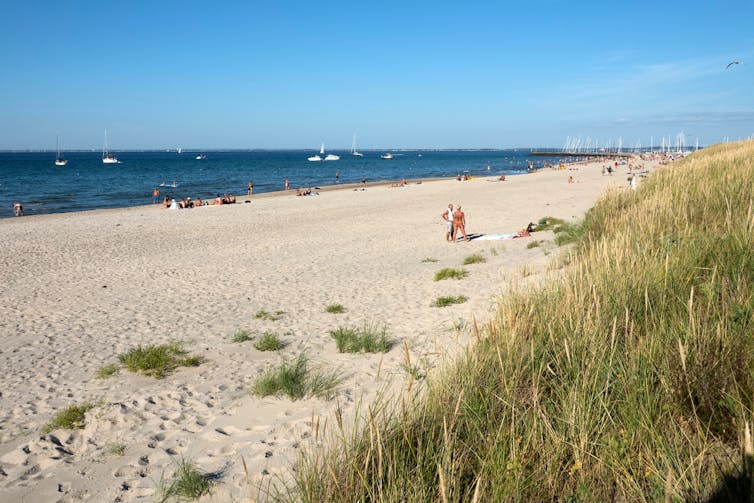
A white, sandy beach.
Destinations like Hornbæk strand in Denmark may become more popular in the future.
Jo Jones/Shutterstock

Approximately half of global tourism is concentrated in coastal areas. So another concern is the potential loss of beaches due to rising sea levels. In the Caribbean, an estimated 29% of resort properties would be partially or fully inundated by one metre of sea-level rise – though many of these resorts would have lost a significant amount of their beach area before this.

Some other beach destinations are potentially even more vulnerable. Sardinia was hit by disruptive storms in 2022. Research suggests that the beaches there may struggle to accommodate tourists in the near future due to a greater risk of flooding and storms.

The impact of climate change on tourism will extend beyond just coastal areas. Many popular city break destinations, including Porto in Portugal, are expecting to endure more severe heat. Tourism in mountainous areas will be affected, too, as accelerated snow melt leads to shorter ski seasons.

The practicalities of tourism shifting

Changing conditions will affect where humans can safely travel to. But travel patterns take time to evolve. In the meantime, established destinations will need to change to withstand challenges such as extreme heat, rising sea levels and other climatic conditions.

Existing tourist destinations in areas of the world that are vulnerable to the effects of climate change, such as the Nile Delta in Egypt, are already considering ways to adapt. These include building seawalls and natural dunes to protect tourist areas from coastal flooding. Changing construction materials and reconfiguring urban spaces to improve ventilation have also been proposed as ways to reduce reliance on expensive and energy-intensive air-conditioning.

New destinations that begin to emerge in more temperate regions will require substantial infrastructure development to support the influx of visitors. This includes transport systems, accommodation, dining options and attractions. The process of establishing tourist destinations typically takes time and requires careful thought.

Barcelona, for example, has experienced a rapid surge in tourism demand since the 1992 Olympics. This has resulted in a tenfold increase in visitors over the past three decades.

Such rapid tourism development can put a strain on local people and the environment. Although Barcelona already had a transport system and some infrastructure to accommodate visitors, the rapid growth in tourism has led to strong opposition from local residents.

Graffiti on a shutter that says
Tourists have caused a nuisance in Barcelona.
Volodymyr Dvornyk/Shutterstock

What will happen next year?

The current thinking among tourism academics is that those responsible for managing tourist destinations should work towards reducing carbon emissions by focusing on the domestic market.

But, as recent summers have shown, international tourism does not look set to slow down yet. Even amid crises such as the fires burning through Rhodes in summer 2023, tourists continued to arrive.

Rather than choose different destinations, the most likely scenario – at least in the short-term – is that tourists themselves will adapt to the effects of climate change. During Europe’s summer 2023 heatwave, there were reports that people were staying in their hotel rooms in the hottest part of the day and taking sightseeing trips in the evening.

Nevertheless, there are some signs that travellers may be starting to worry about more extreme weather conditions and adapt their travel plans accordingly. A survey conducted in May 2023 showed that 69% of Europeans planned to travel between June and November – a fall of 4% compared to 2022.

The heatwave of summer 2023 might mean that tourists start looking for cooler destinations as early as the coming year.

The evolving landscape of global tourism in the face of climate change is complex. What is clear, though, is that if Europe continues to experience extreme weather conditions like the summer of 2023, many people will think twice about booking their place in the sun.The Conversation

Nick Davies, Lecturer and Programme Leader, BA International Tourism and Events Management, Glasgow Caledonian University

This article is republished from The Conversation under a Creative Commons license. Read the original article.

Continue ReadingClimate change is set to make our holidays look very different – here’s how

Climate protests everywhere yesterday and today

Spread the love

https://youtu.be/df9YUP1uCBE

Greta Thunberg was arrested in Sweden on Friday after allegedly disobeying police orders during a climate protest. Quintin Bignell reports on what happened and the plans for this week.

Continue ReadingClimate protests everywhere yesterday and today

Climate activists block A12 in The Hague for eighth day in a row; removed by police

Spread the love

https://nltimes.nl/2023/09/16/climate-activists-block-a12-hague-eighth-day-row-removed-police

The estimated several hundred climate activists who blocked the A12 highway in The Hague on Saturday have been removed from the road by the police.

Several hundred climate activists are blocking the A12 highway in The Hague on Saturday for the eighth day in a row. They are protesting against government measures that support the fossil fuel industry. The Police used water cannons after some time.

dizzy: Extinction Rebellion NL have blocked the A12 at the Hague on previous occasions. The current programme of ongoing protests is to demand that the Dutch government stops it’s huge fossil fuel subsidies. They have blocked the A12 daily since last Saturday with the police using water cannon to clear them and reporting minors to the Dutch equivalent of Social Services for protesting. The following video is at least a day old and so does not cover today’s protest.

https://youtu.be/X9O_WbEbTsg

Even more subsidies for fossil fuels than previously assumed, up to €46 billion annually

Image of loads of money

Even more subsidies and tax breaks are flowing into the fossil sector than previously assumed. According to a calculation by the Ministry of Economy and Climate, these amount to 39.7 to 46.4 billion euros annually. This is stated in the documents that will be released on Budget Day, September 19.

Insiders confirm corresponding reports from NOS. This is only a sum of all the benefits of the use of fossil energy and raw materials. It does not include, however, the cost to consumers. The report also states that a large part of the benefits (about 17 billion) is specified in international treaties or European Union directives.

A recent research report by SOMO, Oil Change International, and Milieudefensie already came to a total of 37.5 billion euros. Outgoing Minister Rob Jetten (Climate and Energy) said at the time that this amount sounded familiar. In general, Jetten wants to eliminate fossil fuel rebates.

According to NOS, this affects large steel companies, coal-fired power plants, greenhouse nurseries, inland shipping and oil refineries. Airlines, for example, do not have to pay kerosene tax in the Netherlands, which earns them more than 2 billion euros per year.

In recent years, fossil benefits have also disappeared. According to Jetten, phasing out fossil fuel perks can’t be done in one swoop. There has to be a phase-out plan for that, he says. “In this way we say goodbye to the old economy and create space for new jobs and prosperity,” he posted on X. For a long time, it was unclear how many subsidies and tax breaks went to the fossil fuel sector.

Continue ReadingClimate activists block A12 in The Hague for eighth day in a row; removed by police