WHITEHALL cleaners, security guards and support staff are to strike for five days after being offered a below-inflation pay rise.
They are angry to have been offered just a 3.5 per cent rise by outsourced contractor ISS when inflation is running at 6.8 per cent, the Public and Commercial Services (PCS) union said.
Nearly 100 PCS members at the Department for Energy Security & Net Zero, Department for Business & Trade and Department for Science, Innovation & Technology are set to take action from September 4 to 8.
PCS general secretary Mark Serwotka said: “It’s obscene that ISS can afford to pay board members £988,000 — a rise of 8.9 per cent from last year — yet claim they can’t afford to pay cleaners a fair rise.
Image of InBedWithBigOil by Not Here To Be Liked + Hex Prints from Just Stop Oil’s You May Find Yourself… art auction. Rishi Sunak, Fossil Fuels and Rupert Murdoch appear.
BRITAIN’S biggest oil and gas producer Harbour Energy’s whopping £337 million profit comes “at the expense of every living thing on the whole planet,” campaigners said today.
…
It is thought that the company benefited from tax loopholes Prime Minister Rishi Sunak put in place while he was chancellor.
This means that for every £100 a company invests in new oil and gas capacity, they can benefit from as much as £45 in windfall tax relief.
…
Climate activists This is Rigged commented: “The profit these private companies make is at the expense of every living thing on the whole planet, the least they can do is pay some f****** tax.
“The Orwellian windfall tax introduced by Mr Sunak provides massive tax loopholes for oil and gas companies meaning they can claim almost half the profits back, if they reinvest it directly into —not renewable energy — no, more oil and gas projects.
“That sounds like a bit of policy dreamt up by an arsonist, not a politician.”
“From Alaska to Maui, our communities are struggling to survive the rapidly worsening impacts of the climate crisis, all the while, Big Oil is raking in billions at our expense.”
As about 111 million people in nearly two dozen states continued to face heat advisories, with temperatures reaching as high at 115°F in some cities, the nonprofit media lab Fossil Free Media unveiled a multicity campaign with one simple goal: ensuring that all Americans understand that the intense heatwaves across much of the country this summer have not been a natural phenomenon, but the result of continued fossil fuel extraction.
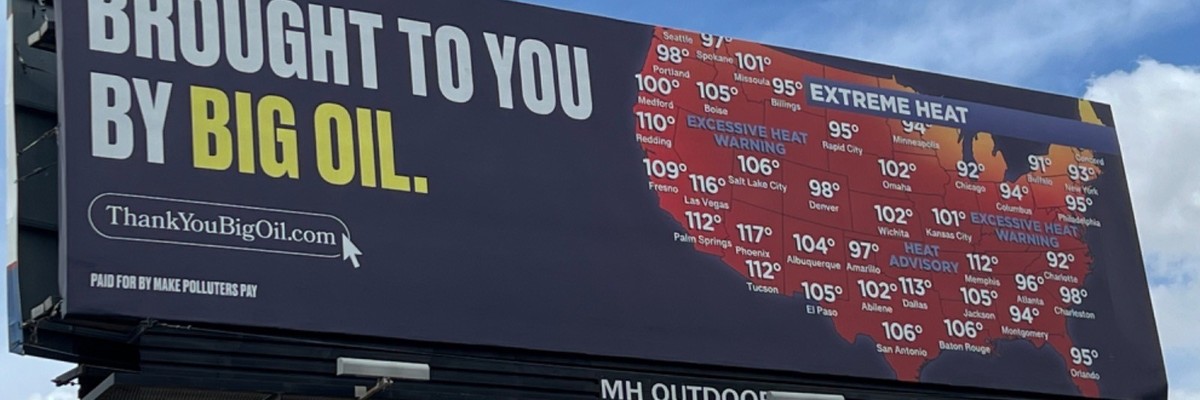
Starting Thursday drivers along stretches of highway in Phoenix, Arizona; Austin, Texas; and Fresno, California will pass by prominent billboards displaying a map of record-breaking temperatures that have been recorded across the U.S. this summer.
Fresno drivers will be reminded of a 109°F day in their city while those in Phoenix will see 117°F plastered over their hometown on the map, accompanied by the words, “Brought to you by Big Oil” and ThankYouBigOil.com.
That website redirects to Fossil Free Media’s (FFM) Stop the Oil Profiteering (STOP) project, where visitors can read about the estimated cost of climate-related disasters such as hurricanes, extreme heat, and wildfires—over $600 billion from 2016-20 alone—and the 5,000 people killed by such events in that same time period.
“The fossil fuel industry has known for decades that their products are fueling climate change and extreme weather, yet they have failed to act,” reads the website. “Instead, major oil and gas companies continue to invest billions into new projects that lock in decades more fossil fuel extraction while our communities take the heat… literally.”
Jamie Henn, director of the organization, said on social media that the public “needs to understand that this summer’s brutal heatwave was brought to you by Big Oil.”
The public needs to understand that this summer's brutal heatwave was Brought To You By Big Oil.
The World Weather Attribution said last month that the heatwaves experienced by people across the U.S. and Europe in July would have been “virtually impossible” without the climate crisis, which scientists have for years said is being fueled by heat-trapping emissions from oil, gas, and coal extraction.
The organization also reported this week that wildfires in eastern Canada in recent weeks were made twice as likely by the climate emergency, which as STOP said, has created “tinderbox conditions” by making droughts longer and more intense.
“From Alaska to Maui, our communities are struggling to survive the rapidly worsening impacts of the climate crisis, all the while, Big Oil is raking in billions at our expense,” said Cassidy DiPaola, spokesperson for FFM and STOP. “There’s no denying that this summer’s brutal heatwaves are being fueled by the same Big Oil companies who are spreading climate disinformation and blocking much needed climate progress.”
More than 100 people in the U.S. have died of heat-related causes so far this year, and weather experts have continued to report high temperatures throughout August after July set a world record for the hottest month in recorded history.
Jennifer Falcon, a resident of Austin, told FFM that the climate crisis has emerged as an economic justice issue in her community as Texas broke its all-time record for power consumption last month, with people across the state struggling to stay cool.
“Texans are paying 800% more to cool their homes during the extreme heat that blankets our state,” she said. “This means choosing between food on the table or cooling your home to mitigate health impacts from the sweltering heat while Big Oil profits.”
As millions of people in the U.S. faced sweltering temperatures this summer—raising the risk of heat-related illness and even severe contact burns—ExxonMobil reported $7.9 billion in profits, its second-highest profit margin for a second quarter in over a decade.
Along with the billboards, STOP unveiled an ad showcasing the Big Oil’s link to the climate extremes Americans are increasingly at risk of facing.
Record heat waves? You can thank Big Oil for that. Deadly wildfires? Yep, that’s Big Oil. Catastrophic storms? Smog-covered cities? You guessed it–Big Oil. #BlameBigOilpic.twitter.com/QHusxdTaQc
“Record heatwaves? You can thank Big Oil for that,” said STOP. “Deadly wildfires? Yep, that’s Big Oil. Catastrophic storms? Smog-covered cities? You guessed it—Big Oil.”
The group is one of several scheduled to lead a March to End Fossil Fuels in New York City on September 17, with the rally being held as the United Nations holds a Climate Ambition Summit.
Aimed at pressuring U.S. President Joe Biden to declare a climate emergency, Fossil Free Media said the march is expected to be “the largest climate action since before the pandemic.”
“These carbon credits are essentially predicting whether someone will chop down a tree, and selling that prediction,” said one study author. “If you exaggerate or get it wrong, intentionally or not, you are selling hot air.”
Most carbon offset schemes significantly overestimate their impact on reducing deforestation, with many of the carbon credits purchased by polluting corporations amounting to little more than “hot air,” according to a researcher behind a study released Thursday that could portend billions of dollars in losses for speculators.
“Reducing emissions from deforestation and forest degradation (REDD) projects are intended to decrease carbon emissions from forests to offset other carbon emissions and are often claimed as credits to be used in calculating carbon emission budgets,” explains the study, which was published in the journal Science.
However, according to the study:
We examined the effects of 26 such project sites in six countries on three continents using synthetic control methods for causal inference. We found that most projects have not significantly reduced deforestation. For projects that did, reductions were substantially lower than claimed…
Methodologies used to construct deforestation baselines for carbon offset interventions need urgent revisions to correctly attribute reduced deforestation to the projects, thus maintaining both incentives for forest conservation and the integrity of global carbon accounting.
“Carbon credits provide major polluters with some semblance of climate credentials. Yet we can see that claims of saving vast swathes of forest from the chainsaw to balance emissions are overblown,” study co-author Andreas Kontoleon, from the University of Cambridge’s Department of Land Economy, said in a statement.
“These carbon credits are essentially predicting whether someone will chop down a tree, and selling that prediction,” he added. “If you exaggerate or get it wrong, intentionally or not, you are selling hot air.”
A new analysis in Science reveals that emission reductions from forest conservation projects—sometimes used to “offset” carbon emissions from other sources—have been overestimated.
Kontoleon added that overestimations of forest preservation have driven an increase in the number of carbon credits on the market, resulting in artificial price suppression.
“Potential buyers benefit from consistently low prices created by the flood of credits,” he said. “It means that companies can tick their net-zero box at the lowest possible cost.”
This could mean that carbon speculators stand to lose billions of dollars in the future as offsets become stranded assets.
“It’s currently a buyer’s market and buyers are, rightly, prioritizing quality. There are over a billion tons of issued but not retired credits in the market—this suggests lots of credits can be written off, and there will remain a large supply for buyers to tap into,” Anton Root, head of research at AlliedOffsets, toldThe Guardian Thursday.
“A correction like that could help to orient the market toward fundamental supply-demand dynamics, which we don’t currently tend to see, and drive up the price for credits that are deemed to be above the quality threshold,” he added.
“Carbon credit speculators could lose billions as scientific evidence shows many offsets they have bought have no environmental worth and have become stranded assets.” https://t.co/gnx6fZy8yS
The new research follows other scientific research and journalistic investigations, including a January study by The Guardian, Die Zeit, and SourceMaterial that concluded that over 90% of the rainforest carbon offsets sold by Verra, the nonprofit organization that sets the world’s leading sustainability standard, “are largely worthless and could make global heating worse.”
While some scientists argue that CO2 extraction, either via natural or technological means, is needed in order to meet the goals of the Paris climate agreement, opponents call the technology a “false climate solution.”
“Carbon offset markets are widely discredited,” Food & Water Watch policy director Jim Walsh said earlier this year. “Their only benefit lies in enriching the middlemen charged with selling the lie.”
Despite this, the Biden administration is pushing ahead with a plan to invest $2.5 billion in a pair of major carbon capture and storage projects, which it claims will “significantly reduce carbon dioxide emissions from electricity generation and hard-to-abate industrial operations” as part of the “effort critical to addressing the climate crisis and meeting the president’s goal of a net-zero emissions economy by 2050.”
Seasons like this one will only become more likely and intense if policymakers allow global temperatures to rise by 2°C above preindustrial levels.
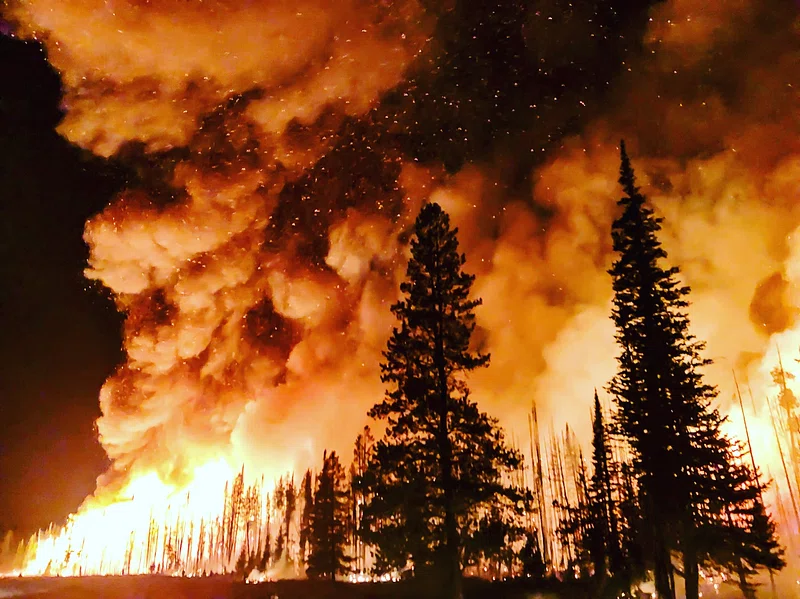
The hot, dry conditions that fueled eastern Canada’s unprecedented wildfire season were made at least two times more likely by the climate crisis, the latest study from World Weather Attribution has found.
The study, published Tuesday, also found that, by the end of July, Quebec’s fire season was 50% more intense than it would have been without the human-generated release of greenhouse gas emissions.
“The Pyrocene is well and truly here, thanks to our continued burning of fossil fuels,” study co-author and Imperial College London physicist Friederike Otto tweeted.
Canada’s wildfire season has been the worst on the record books since late June, but the weather conditions that fueled it began the month before. The entire May to July period was the nation’s warmest since 1940, according to World Weather Attribution (WWA). As of August 16, the Canadian government calculated that 5,753 fires had ignited to burn a total of 13.7 million hectares—that’s 123% more fires and 602% more land burned than normal.
The fires have had a devastating impact on human communities, killing at least 17 people, damaging at least 200 buildings, and forcing more than 150,000 to flee their homes, WWA said in a statement.
“The wildfires had disproportionate impacts on Indigenous, fly-in, and other remote communities who were particularly vulnerable due to lack of services and barriers to response interventions,” WWA wrote.
“Now we are able to put the number or an estimate on to what extent those conditions that we have seen this year are caused actually by climate change—and the numbers are very high.”
The dangerous smoke from all this combustion has menaced the air quality in cities from Ottawa and Toronto to Washington, D.C. and New York City, where pollution neared a record June 7 with an air quality index of 341.
“The consequences from the wildfires reached far beyond the burned areas with displaced impacts due to air pollution threatening health, mobility, and economic activities of people across North America,” WWA added.
For the study, the Canada-, U.K.- and Netherlands-based team looked specifically at the fires in eastern Canada, which were particularly abnormal and contributed the most to the smoke that drifted down over the U.S. East Coast and Midwest. They studied the daily severity rating, which defines how hard it is to put out a particular fire. To establish how extreme the season was at its peak, they also looked at the year’s highest seven-day moving average of the fire weather index.
“Climate change made the cumulative severity of Quebec’s 2023 fire season to the end of July around 50% more intense, and seasons of this severity at least seven times more likely to occur,” the study authors concluded.
They also found that this peak fire weather was at least twice as likely and around 20% more intense.
Yan Boulanger, one of the study authors who works as a research scientist for Natural Resources Canada, toldCBC News that the results were “shocking.”
“We know that those extreme fire-prone weather conditions are occurring more frequently,” he said. “Now we are able to put the number or an estimate on to what extent those conditions that we have seen this year are caused actually by climate change—and the numbers are very high.”
The study authors also found that seasons like this one will only become more likely and intense if policymakers allow global temperatures to rise by 2°C above preindustrial levels.
“Until we stop burning fossil fuels, the number of wildfires will continue to increase, burning larger areas for longer periods of time,” Otto told The Guardian.