‘Climate Scam’: 180+ Groups Tell Biden to Drop Support for Hydrogen

Spread the love

Original article by JAKE JOHNSON republished from Common Dreams under Creative Commons (CC BY-NC-ND 3.0).
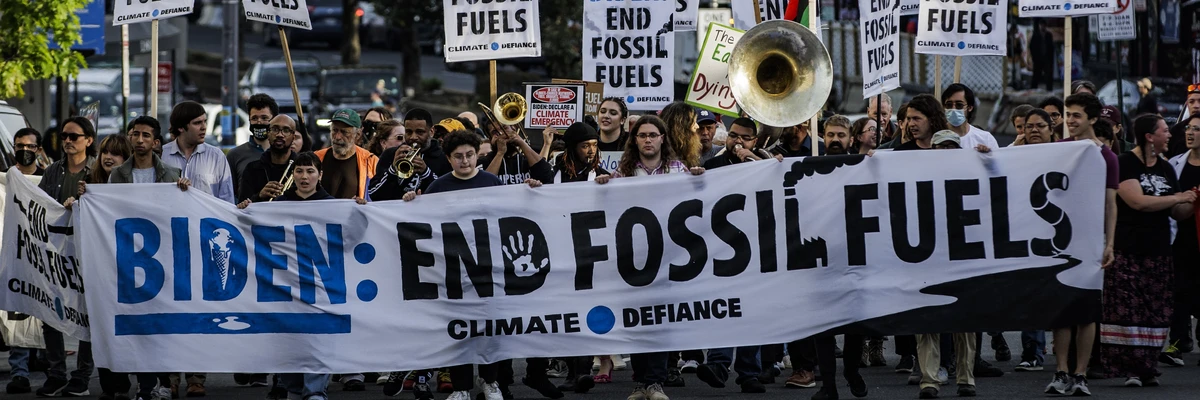
Climate protestors march in Washington DC

“Calling hydrogen clean energy is a scam to prop up the oil and gas industry,” said one campaigner.

More than 95% of hydrogen produced in the United States is made using fossil fuels, but that hasn’t stopped its backers—including industry groups such as the U.S. Chamber of Commerce—from touting the energy source as critical to the fight against climate change.

A diverse coalition of advocacy organizations on Tuesday implored the Biden administration to stop buying into the hype.

In a letter to officials at the U.S. Department of Energy (DOE), more than 180 groups called on the administration to abandon plans to invest in hydrogen projects, warning that “a large-scale buildout of hydrogen infrastructure will further exacerbate the climate crisis and disproportionately harm people of color, low-income communities, and Indigenous peoples.”

Two recently enacted pieces of legislation—the Inflation Reduction Act and a bipartisan infrastructure measure championed by oil industry ally Sen. Joe Manchin (D-W.Va.)—include benefits for the hydrogen industry.

The latter bill authorized the Department of Energy to spend roughly $8 billion on developing Regional Clean Hydrogen Hubs (H2Hubs), drawing outrage from community organizers in Colorado, New Mexico, and other states behind the Western Interstate Hydrogen Hub, a project aimed at expanding U.S. hydrogen production.

“We recognize that the Bipartisan Infrastructure Investment and Jobs Act directs DOE to fund these hubs, but we ask DOE to find a different path and reject this false solution. It’s time for DOE to do the right thing,” the groups wrote in their letter on Tuesday.

The groups behind the letter—including the Center for Biological Diversity and Food & Water Watch—note that hydrogen production generates significant planet-warming emissions.

“Hydrogen lifecycle emissions which use carbon capture and storage are 20% greater than directly burning natural gas or coal, and 60% greater than burning diesel oil, because of the increased fossil fuels required to power it,” the letter states. “The process of producing gray and blue hydrogen is a major source of fugitive methane emissions from flaring, transportation, and other upstream processes—releasing even more potent greenhouse gases and exacerbating atmospheric warming over the next two decades.”

“President Biden can’t claim to be a climate leader while his administration continues to embrace the hydrogen climate scam and other policies that continue to perpetuate fossil fuel production and infrastructure.”

As Nature explained in an editorial warning against “overhyping” hydrogen, “Most hydrogen is currently made by processes—such as steam reformation of natural gas (methane)—that produce large amounts of CO2 as a by-product.”

“Although ‘green’ hydrogen can be made by using electricity from renewable sources to split water molecules,” the outlet added, “this process is costly compared with more conventional production methods.”

Silas Grant, a campaigner with the Center for Biological Diversity, said Tuesday that “calling hydrogen clean energy is a scam to prop up the oil and gas industry.”

“The Biden administration’s plans to expand this dirty energy will only increase oil and gas extraction at a time when the climate emergency demands the opposite,” said Grant. “We need investment in affordable, reliable, community-supported renewable energy like wind and solar.”

The coalition’s letter comes two months after New Mexico-based advocacy organizations urged the Biden administration to reject funding for the Western Interstate Hydrogen Hub, arguing the initiative would “devastate public health, clean air, Indigenous sacred places, and the climate.”

“The climate crisis poses a grave threat to all life on Earth,” the groups wrote in a letter to the U.S. Energy Department. “DOE has the power to help lead a transformation to a more sustainable future. To do so, you must help phase out fossil fuels and reject false solutions like hydrogen.”

But the Biden White House has yet to waver in its support for hydrogen, claiming in a brief last month that “clean hydrogen has the potential to play an important role in decarbonizing the U.S. economy.”

Jim Walsh, policy director at Food & Water Watch, countered Tuesday that investments in hydrogen are “a distraction from real climate action that will cause more pollution, more strain on water resources, and more extraction of climate warming fossil fuels.”

“President Biden can’t claim to be a climate leader while his administration continues to embrace the hydrogen climate scam and other policies that continue to perpetuate fossil fuel production and infrastructure,” Walsh added.

Original article by JAKE JOHNSON republished from Common Dreams under Creative Commons (CC BY-NC-ND 3.0).

Continue Reading‘Climate Scam’: 180+ Groups Tell Biden to Drop Support for Hydrogen

The Atlas Network and the Building of Argentina’s Donald Trump

Spread the love

Original article by Lucas Araldi republished from DeSmog

Javier Milei, a climate change denier widely supported by Atlas Network, a web of free market think tanks, won the necessary votes to run in Argentina’s presidential election in October.

ANALYSIS By Lucas Araldi on Aug 22, 2023 @ 15:15 PDT

Argentine presidential candidate Javier Milei haș been influenced, and boosted, by the Atlas Network. Credit: Todo Noticias (CC BY 3.0)

Ask Argentine politician, economist, and presidential candidate Javier Milei what he thinks of climate change, and he might tell you that it’s “another lie of socialism” and “part of the agenda of Cultural Marxism.” 

The right-wing politician is part of coalition Libertad Avanza and this August won the most votes in Argentina’s primary election, enabling him to run for president on October 23. 

He gained prominence through his talk show appearances, making his debut on the political talk show Animales Sueltos (Stray Animals) in 2016. In addition, he hosted his own radio program called Demoliendo Mitos (Debunking Myths).

In 2021, Milei was elected as a national deputy for Buenos Aires. Prior to this, he had built an extensive career in both the public and private sectors as an economist, even holding the position of Chief Economist at HSBC.

Milei has been compared to right-wing populist leaders Donald Trump and Jair Bolsonaro due to his direct and aggressive way of speaking and his radical proposals. Milei would likely be flattered by the comparison — he is a huge fan of these right-wing populists that have emerged in recent years.

Milei won 30 percent of the vote in the August primary — nearly 10 percent more than the next-most-popular candidate — with a political platform that combines radical neoliberal policy proposals with a conservative populist moral agenda. His economic proposals include reducing the number of government ministries, cutting public spending, dollarizing the economy, and “exploding” the Central Bank, in Milei’s own words. 

Milei didn’t arrive at these proposals on his own; his views, particularly in regards to the economy, have been shaped by the Atlas Network, a U.S. nonprofit that works to spread free-market think tanks all over the world. 

Based in Washington, D.C., the Atlas Network supports more than 500 free-market organizations. Some of these groups, such as the Heartland Institute, are also involved in climate science denial and in campaigns against legislation to limit greenhouse gas emissions.

Around 100 think tanks in Latin America — 10 of which are in Argentina — are part of Atlas’s web. Between 2010 and 2021, Atlas gave approximately $12 million USD to think tanks in the region, mostly for “economic education,” according to U.S. tax filings analyzed by DeSmog. Across the world, including in Latin America, Atlas think tanks collaborate beyond national borders, sharing strategies and ideology. It is common, for example, for Atlas think tanks to share board members or even create their own networks, such as Red Liberal de America Latina (RELIAL).

Alberto Benegas Lynch, who serves as an adviser for Milei and also is a director at Mont Pelerin Society, is an example of transnational ties within the network. He is part of several Atlas Network groups in Latin America, such as Fundación Federalismo y Libertad and Instituto Libertad y Progreso, both in Argentina, Universidad Francisco Marroquín in Guatemala, and Centro de Estudios para el Desarrollo in Uruguay.  

Lynch is also known for making denialist statements about climate change. In an opinion article published in 2018 in the Argentinian online newspaper Infobae, for example, he argued that climate change is a fraud based on distortion of statistics. He built his argument from alleged studies of John ColemanIvar Giaever, and Patrick Moore

The Argentine newspaper La Nación describes the relationship between Milei and Lynch as one of admiration, as Milei frequently cites Lynch. Beyond that, Lynch wrote several times on the Instituto Libertad y Progreso’s website about his relationship with Milei, as well as his proposals, and how Milei means a miracle for Argentine politics.

Milei benefits from the whole infrastructure of ideas boosted by the Atlas Network to project himself as presidential. While the other traditional candidates do not have a platform of think tanks that can help them, Milei manages to move between these institutes and use them as hubs for disseminating his ideas and as a safe arena for advancing the debate on his agenda.

For instance, Milei has connections to other Latin American think tanks in the Atlas Network. He has attended conferences and participated in events promoted by the Fundación Libertad y ProgresoFederalismo y Libertad, and Fundación Atlas, all based in Argentina. He also participated in Instituto de Estudos Empresariais’s Liberty Forum 2022 in Porto Alegre, Brazil. Articles in Fundación Atlas’s blog praise him, with Axel Kaiser, executive director at Fundación para El Progreso in Chile, writing that Milei is helping restore Argentina’s Libertarian legacy by setting up a “cultural and political movement which became the third way.” In 2018, Fundación Atlas awarded Milei the Liberty Prize.

Milei sat on the advisory board of Fundación Libre (FL), an Argentine far-right think tank that was part of Atlas. FL promoted “individual freedom and republicanism” in the face of “hegemonic progressive ideology and the empire of politically correctness.” Although FL did not focus primarily on denying climate change, it did feature climate-related content, like a YouTube video criticizing Greta Thunberg, that has since been removed. 

Milei, however, is known for denying climate change, claiming that the planet’s temperature is currently at its lowest level in the past 15,000 years. His source for this belief is a graph from a 2008 study by the geologist Don J. Easterbrook — who is known for erroneously predicting “global cooling.” However, this graph is based on data only from Greenland and is not a reliable indicator of climate change, according to fact-checking groups in Argentina.

Although Milei uses climate denialism to ignite his followers, climate change was barely discussed in the Argentine primaries, even though the occurrence of extreme weather events has increased twofold since 1980 and could become even worse in the coming decades. Instead, candidates focused on the country’s current food crisis: Argentina faces one of the biggest food inflations in the world and more than 4 million people in the country are food insecure. This scenario also could become worse due to climate change’s impacts on Argentine agriculture. 

Milei’s significant result at the polls shows that the free-market, neoliberal ideals the Atlas Network is promoting have a huge organizational strength in Argentina that can be converted into votes. Even if Milei doesn’t win the October presidential election, his rise to this level of politics means a victory for the Atlas Network.

Original article by Lucas Araldi republished from DeSmog

Continue ReadingThe Atlas Network and the Building of Argentina’s Donald Trump

Rail fare increase: Green Party calls for fare freeze and for railways to be taken into public ownership

Spread the love

https://bright-green.org/2023/08/15/rail-fare-increase-green-party-calls-for-fare-freeze-and-for-railways-to-be-taken-into-public-ownership/

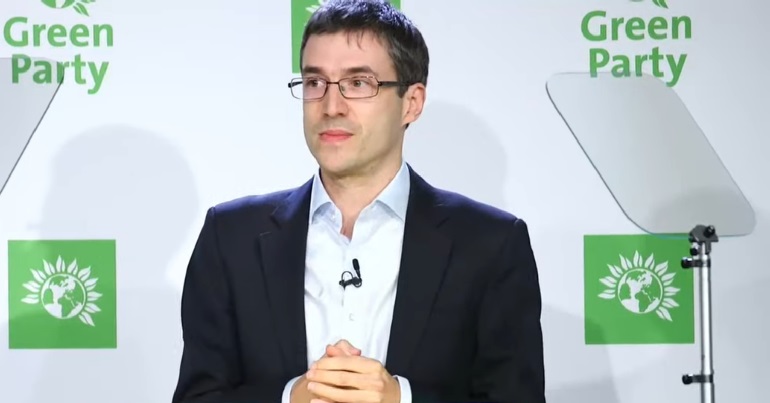
Green Party’s co-leader Adrian Ramsay.

The Green Party of England and Wales has called for rail fares to be frozen on the day the government has announced that regulated fares will increase in January 2024.

Ramsay said: “This government is moving in completely the wrong direction. Fuel duty has been frozen since 2011, while air passenger duty cuts this year will be a disaster for the climate crisis by encouraging people to fly more. This is despite the fact UK rail passengers are already paying more to travel by train than flying and are faced with some of the most expensive tickets in Europe.

“Emissions from transport are higher than for any other sector of the economy. If the UK is to meet its climate commitments, then we need more people choosing trains over cars and planes, and we need more commuters opting for public transport and active travel to get to work. Making train travel more expensive, while closing rail ticket offices that support travellers to get the best deal, would underscore the government’s contempt for climate action and the travelling public.

https://bright-green.org/2023/08/15/rail-fare-increase-green-party-calls-for-fare-freeze-and-for-railways-to-be-taken-into-public-ownership/

Continue ReadingRail fare increase: Green Party calls for fare freeze and for railways to be taken into public ownership

World’s richest countries gave record sums of public money to fossil fuel industry last year

Spread the love

https://leftfootforward.org/2023/08/worlds-richest-countries-gave-record-sums-of-public-money-to-fossil-fuel-industry-last-year/

$1.4 trillion of public money went to the fossil fuel sector last year

Just Stop Oil protesting in London 6 December 2022.

Public financing of the fossil fuel industry by G20 countries reached record levels in 2022, a new report has found. The fossil fuel industry is among the sectors most directly responsible for driving the climate crisis.

According to a report by the International Institute of Sustainable Development (IISD), $1.4 trillion of public money flowed into the industry last year in G20 countries, which are among the world’s largest economies. The staggering sums are more than double that of the pre-covid period, despite commitments made at the Glasgow COP26 climate summit in which world leaders pledged to the phasing out ‘inefficient’ subsidies for fossil fuels.

The IISD research found that much of the support related to mitigating the cost of energy for consumers, but that one third was driving investment in new fossil fuel production, equivalent to around $440 billion.

The report’s authors wrote: “This support perpetuates the world’s reliance on fossil fuels, paving the way for yet more energy crises due to market volatility and geopolitical security risks. It also severely limits the possibilities of achieving climate objectives set by the Paris Agreement by incentivizing greenhouse gas (GHG) emissions while undermining the cost-competitiveness of clean energy.

https://leftfootforward.org/2023/08/worlds-richest-countries-gave-record-sums-of-public-money-to-fossil-fuel-industry-last-year/

Continue ReadingWorld’s richest countries gave record sums of public money to fossil fuel industry last year

Sanctions make it harder for benefit claimants to find work, new research finds

Spread the love

https://leftfootforward.org/2023/08/sanctions-make-it-harder-for-benefit-claimants-to-find-work-new-research-finds/

Image of cash and pre-payment meter key

“Demanding compliance from people means they end up jumping through hoops rather than finding jobs that are a good fit for them”

Benefit sanctions make it harder for claimants to find a good job, new research has found. According to the research carried out by the New Economics Foundation (NEF), the majority of people required to attend job centres to access benefits think that being sanctioned undermines their ability to find a good job.

According to a report in PoliticsHome, NEF commissioned polling of unemployed people receiving universal credit and required to attend job centre appointments found that 61 per cent said the threat of sanctions found it harder for them to have a trusting relationship with support services. That figure is higher for unemployed people who are also disabled – at 69%. 63% also said that the threat of sanctions negatively impacted their mental health, rising to 73% for disabled people.

Welfare claimants were also likely to report negative experiences of attending job centre appointments. 73 per cent reported that their first meeting at the job centre focused on the rules and obligations placed on claimants. 59 per cent also said they felt that the job centre wanted them to get a job as quickly as possible, rather than finding a role which was a good fit.

https://leftfootforward.org/2023/08/sanctions-make-it-harder-for-benefit-claimants-to-find-work-new-research-finds/

Continue ReadingSanctions make it harder for benefit claimants to find work, new research finds