Climate Crisis ‘Out of Control’ as Global Temperature Breaks Record for 3rd Time in 4 Days

Spread the love

Thursday’s record came after the revelation that the seven-day stretch ending Wednesday was also the hottest week in at least 44 years.

For the third time in just four days, the Earth sweated through its unofficial hottest day on record Thursday.

The average global temperature reached 17.23°C, or 63°F, on July 6, up from the record set Monday, surpassed Tuesday, and matched Wednesday, according to data from the University of Maine’s Climate Reanalyzer. Thursday’s record came after the revelation that the seven-day stretch ending Wednesday was also the hottest week in at least 44 years.”Climate change is out of control,” United Nations Secretary-General António Guterres said in response to Monday’s and Tuesday’s records, as The Associated Press reported. “If we persist in delaying key measures that are needed, I think we are moving into a catastrophic situation.”

Scientists attribute the high temperatures to a combination of global heating caused primarily by the burning of fossil fuels and an El Niño event officially declared by the U.N.’s World Meteorological Organization Tuesday.

“Such records are the predictable consequence of a short-term El Niño temperature boost coming on top of the long-term global warming trend due to mankind’s greenhouse gas emissions.”

Earth’s temperature reached 17.01°C, or 62.62°F, Monday and then 17.18°C, or 62.9°F, Tuesday, according to data from the U.S. National Centers for Environmental Prediction (NCEP). While these temperatures are the hottest since record-keeping began in 1979, The Washington Post explained, data from ice cores and tree rings indicate that they haven’t been experienced on Earth since the last interglacial period 125,000 years ago, when sea levels were around 18 feet higher. The week ending Wednesday was also 0.08°F, or 0.04°C, warmer than any in the record books, according to AP.

“Such records are the predictable consequence of a short-term El Niño temperature boost coming on top of the long-term global warming trend due to mankind’s greenhouse gas emissions,” lead Berkeley Earth scientist Robert Rohde tweeted in response to Thursday’s new record.

The University of Maine’s Climate Reanalyzer uses both temperature readings from the surface, air balloons, and satellites, along with NCEP forecast data, to provide daily average two-meter air temperatures, according to The Guardian.

The records it reports are considered “unofficial” by the National Oceanic and Atmospheric Administration (NOAA) because they rely partly on computer models, AP explained, but the agency did not deny the impact of the climate emergency and El Niño on recent extremes.

“Although NOAA cannot validate the methodology or conclusion of the University of Maine analysis, we recognize that we are in a warm period due to climate change,” NOAA said in a statement reported by AP.

There are also other indicators speaking to spiking temperatures: The European Union’s Copernicus ECMWF ERA5 dataset put Monday’s mean temperature at a record 16.88°C and Tuesday’s at a new record temperature of 17.03°C.

June was also the warmest June on record, according to a report from the E.U.’s Copernicus Climate Change Service released Thursday, with temperatures more than 0.5°C above the 1991-2020 average. Sea surface temperatures also broke monthly records for both May and June, and Antarctic sea ice dwindled to 17% below average for a record low for June.

“We are in uncharted territory and we can expect more records to fall as El Niño develops further and these impacts will extend into 2024,” Chris Hewitt, WMO Director of Climate Services, said in a statement responding to the report. “This is worrying news for the planet.”

Scientists predict that the record breaking will continue into July, which is usually the warmest month of the year.

“Chances are that the month of July will be the warmest ever, and with it the hottest month ever,” Karsten Haustein, a research fellow in atmospheric radiation at Leipzig University, told The Guardian, clarifying that “ever” meant in the last 120,000 years.

“I’ve never seen anything like it. I’ve been having heart palpitations because of the heat. I’m starting to think seriously that I’m going to leave Timbuktu.”

The records aren’t just numbers. They have been felt in extreme heatwaves around the globe from Texas to China. Cities in China are opening air raid shelters to help people hide from heat that has already turned deadly, APreported Friday, and temperatures in Beijing surpassed 35°C for more than nine days in a row for the first time since 1961.

Temperatures were also high in Timbuktu, Mali.

“Usually, at night it’s a bit cool even during the hot season. But this year, even at night, it’s been hot—I’ve never seen anything like it,” 50-year-old Fatoumata Arby toldAP. “I’ve been having heart palpitations because of the heat. I’m starting to think seriously that I’m going to leave Timbuktu.”

Beyond high temperatures, the impacts of the climate emergency continue to be felt in other ways. In an update Thursday, Canadian officials said the country’s record-breaking wildfire season—which has sent toxic smoke pouring across the border in recent weeks—continues, with nearly 5,000 people forced from their homes and more than 8.8 million hectares of forest burned, CBC News reported. That’s nearly 11 times the average hectares burned in the last decade.

“This number is literally off the charts,” Michael Norton, director of the Northern Forestry Centre with the Canadian Forest Service at NRCan, said during a press conference reported by Politico, “with at least three more months left in the active wildfire season.”

Officials say the climate emergency is playing a major role in the unprecedented season.

“This summer, we are witnessing the effects of climate change first-hand as Canada continues to experience more intense and frequent severe weather events,” Chief Public Health Officer Dr. Theresa Tam said in a briefing reported by CBC News.

In Pakistan, meanwhile, heavy monsoon rains have killed at least 50 people in two weeks, Al Jazeera reported Friday. The deluge comes a year after devastating flooding in Pakistan swallowed a third of the country and claimed more than 1,700 lives. Pakistan contributes less than 1% to global greenhouse gas emissions, but it is one of the most vulnerable countries to climate change, and scientists said that rising temperatures made last year’s disaster more likely.

“Only when we bring carbon emissions to zero does the warming stop.”

In response to news of broken records and weather extremes, University of Pennsylvania climate scientist Michael Mann said people should not be paralyzed with fear.

“Rather than being ‘terrified’ by this expected consequence of human-caused warming, we should be motivated to act—in particular, holding politicians accountable at the ballot box,” he tweeted. “Only when we bring carbon emissions to zero does the warming stop.”

There’s a chance that living through this summer of extremes could help with that motivation.

“The issue of climate change doesn’t often get its 15 minutes of fame. When it does, it’s usually tied to something abstract like a scientific report or a meeting of politicians that most people can’t relate to,” George Mason University climate communications professor Ed Maibach told AP.

“Feeling the heat—and breathing the wildfire smoke, as so many of us in the Eastern U.S. and Canada have been doing for the past month—is a tangible shared public experience that can be used to focus the public conversation,” he said.

Continue ReadingClimate Crisis ‘Out of Control’ as Global Temperature Breaks Record for 3rd Time in 4 Days

Sanders Warns of ‘Dystopian Future’ If Governments Don’t Immediately Act on Climate

Spread the love

Original article by JAKE JOHNSON republished from Common Dreams under Creative Commons (CC BY-NC-ND 3.0).

“We must act and act boldly. Our earth is warming rapidly. We see this every day, in every part of the world.”

U.S. Sen. Bernie Sanders issued a stark call to action Thursday as heatwaves shatter global temperature records and extreme weather wreaks havoc across the planet, climate impacts that the senator called a mere glimpse of what Earth’s “dystopian future could look like” if governments remain subservient to the fossil fuel industry.

“Climate change is ravaging the planet,” Sanders (I-Vt.) said in an 11-minute address posted to his social media accounts. “If there is not bold, immediate, and united action by governments throughout the world, the quality of life that we are leaving our kids and future generations is very much in question.”

The senator ran through a litany of alarming statistics and recent real-world examples of the consequences of world leaders’ failure to rein in planet-warming fossil fuels, including two consecutive days of record-breaking heat just this week, unprecedented wildfires in Canada, rapidly rising sea levels on China’s densely populated coast, catastrophic flooding in Pakistan, drought and increasingly severe hunger in Somalia, and more.

“It is no great secret that human beings are not particularly anxious to address painful realities,” Sanders said. “This is especially true when it requires taking on powerful special interests like the fossil fuel industry and their endless amounts of money. But this time, this time, we must act and act boldly. Our Earth is warming rapidly. We see this every day, in every part of the world.”

Acknowledging that some progress was made toward speeding the development of renewable energy sources under the 2022 Inflation Reduction Act, Sanders said that “obviously much much more needs to be done” and called on Congress to take legislative action “instead of doing the bidding of oil, gas, and coal companies” and “fomenting a new Cold War with China.”

“Mostly, to my mind, that means raising the level of urgency and bringing the world together now, not next year, not five years from now, but now to address this existential threat. Failure to act will doom future generations to an increasingly unhealthy and uncertain future,” the senator warned. “For the sake of our kids and our grandchildren, for the sake of our common humanity, we cannot allow that to happen.”

The senator’s remarks came hours after the European Union’s Copernicus Climate Change Service said last month was the hottest June on record globally “by a substantial margin.”

The agency’s conclusion followed data showing that July 3 and July 4 were Earth’s two hottest days on record, fueled by the human-caused climate crisis and El Niño conditions.

“This is alarming,” Jennifer Marlon, a climate scientist at the Yale School of Environment, toldCNN on Thursday. “It’s hard to imagine what summers will be like for our children and grandchildren in the next 20 years. This is exactly what global warming looks like.”

Original article by JAKE JOHNSON republished from Common Dreams under Creative Commons (CC BY-NC-ND 3.0).

Continue ReadingSanders Warns of ‘Dystopian Future’ If Governments Don’t Immediately Act on Climate

The climate credentials of Rishi Sunak’s cabinet :: Keir Starmer

Spread the love

While Keir Starmer is leader of the UK Labour Party and therefore notionally supposedly opposed to Rushi Sunak’s cabinet and government, he’s a Tory pretending to be a Socialist, a red Tory.

https://youtu.be/DDEdFxUZ01s

Keir Starmer has abandoned every one of his Socialist ‘pledges’ on taking over the Labour Party. Included in these pledges is

3. Climate justice

Put the Green New Deal at the heart of everything we do. There is no issue more important to our future than the climate emergency. A Clean Air Act to tackle pollution locally. Demand international action on climate rights.

https://www.theguardian.com/politics/2023/feb/23/keir-starmer-denies-abandoning-labour-leadership-pledges

… He denied that the 10 promises he made during the 2020 race to succeed Jeremy Corbyn had been abandoned and insisted they remained “important statements of value and principle”.

However, Starmer refused to confirm that he stood by several of them, including public ownership of utilities and rail services and the abolition of university tuition fees.

He has been repeatedly criticised by some on the left of the party who accuse him of shifting away from the platform he stood on three years ago.

Challenged on BBC Radio 4’s Today programme over whether voters could trust him to deliver the five new national missions, Starmer said the pledges made during his Labour leadership bid “haven’t all been abandoned by any stretch of the imagination”.

He said: “What I’ve had to do is obviously adapt some of them to the circumstances we find ourselves in. Since I ran for leader, we’ve had Covid. Since I ran for leader, we’ve had the conflict in Ukraine. Since I ran for leader, we’ve had a government that’s done huge damage to our economy.” …

On climate commitments specifically,

9 Jun 2023 Labour postpones £28bn green plan as it seeks to be trusted on public finances

… Labour has scaled back plans to borrow £28bn a year to invest in green jobs and industry as the party’s leadership looks to review its spending in an attempt to prove its fiscal credibility.

The shadow chancellor, Rachel Reeves, delayed plans for a green prosperity fund to start in the first year of a Labour government, saying it would “ramp up” by the middle of a first parliament.

She said the decision had to be taken as a result of the poor economic backdrop and rising interest rates, after Liz Truss’s short premiership crashed the markets last autumn. …

18 Jun 2023 Keir Starmer to ‘throw everything’ at plan to get UK to net zero

… Keir Starmer will pledge to “throw everything” at net zero and the overhaul of the UK’s energy system and industries, promising new jobs in “the race of our lifetime” to a low-carbon future.

The Labour leader will seek to regain the initiative on his plan for green growth on Monday, having rowed back earlier this month on a pledge to invest £28bn in a green industrial strategy, a figure that will not now be reached until the second half of a Labour parliament, as well as damaging rows with trade unions over the future of the North Sea.

Announcing a package of policies designed to decarbonise the energy system and industry, Starmer will say: “We’re going to throw everything at this: planning reform, procurement, long-term finance, R&D, a strategic plan for skills and supply chains … Pulling together for a simple, unifying priority: British power for British jobs.” …

This is when the Tories started accusing Labour of pursuing Just Stop Oil policies. “Grant Shapps, the energy secretary, accused the Labour leader of being “the political wing” of Just Stop Oil.” There’s also actually a suggestion of terrorism in Grant Shapp’s comment … that phrase.

His team also rebuffed suggestions of a U-turn on the North Sea oil ban. Rescinding permission for projects that have cleared all regulatory hurdles before the general election would be costly and legally complex, so the party’s proposed ban on new oilfields will not cover projects that have achieved all three levels of consent, for exploration, development and production.

It is unlikely that many of the more than 100 North Sea licences the government is mulling would fall into that category, though one of the biggest – the Rosebank oil and gas field – could clear the final regulatory hurdles soon.

It’s not possible to get to Net Zero if Rosebank is permitted. Just like everything else, Keir Starmer and the Labour party can’t be trusted on the climate.

Which is why he gets heckled by climate protestors

Continue ReadingThe climate credentials of Rishi Sunak’s cabinet :: Keir Starmer

Campaigners Rip Shell CEO’s ‘Cynical Case’ Against Ditching Fossil Fuels

Spread the love

Original article by JULIA CONLEY republished from Common Dreams under Creative Commons (CC BY-NC-ND 3.0).

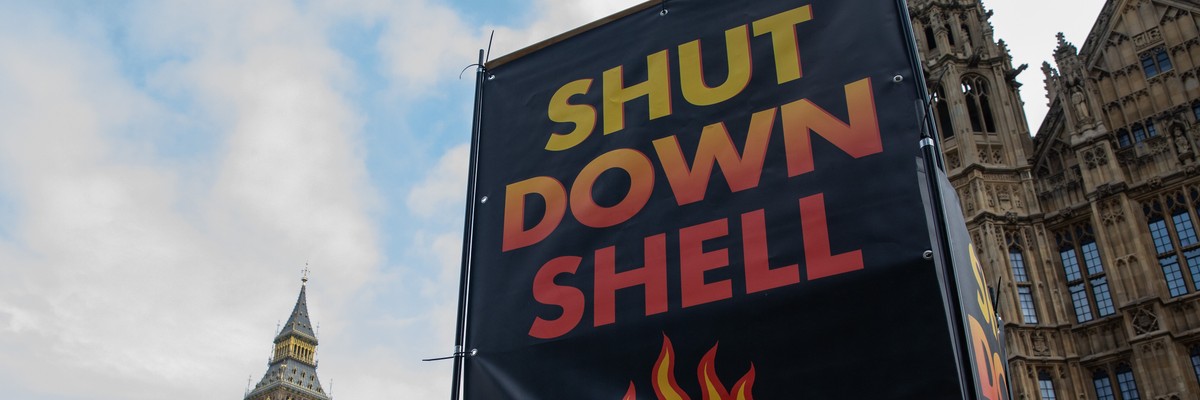
A large display from the environmental group Fossil Free London is seen during a climate protest

A large display from the environmental group Fossil Free London is seen during a climate protest in London on April 24, 2023.  (Photo: Mark Kerrison/In Pictures via Getty Images)

“The only ‘danger’ Shell would see in cutting production is to their eye-watering profits,” said one campaigner.

Two days after scientists recorded the hottest day on record and warned that the milestone is the latest clear sign that all fossil fuel production must be urgently phased out, the CEO of multinational oil and gas giant Shell claimed that transitioning to renewable energy sources is what would endanger the world and expressed what campaigners called “cynical” concerns for the well-being of the Global South.

Wael Sawan, who took over the U.K.-based company last year, told the BBC Thursday that the world’s energy system “continues to desperately need oil and gas,” contrary to evidence put forward by the International Energy Agency, the Intergovernmental Panel on Climate Change, United Nations Secretary-General António Guterres, and other experts.

“I think what would be dangerous and irresponsible is actually cutting out the oil and gas production so that the cost of living—as we saw just last year—starts to shoot up again,” said Sawan.

Cost-of-living increases have raised alarm in communities around the world following the coronavirus pandemic and Russia’s invasion of Ukraine—but numerous analyses have pointed to corporate greed and price-gouging, not the decreasing supply of oil and gas, as primary drivers of financial hardship for working people.

Shell reported record-breaking profits of nearly $40 billion last year, doubling its total for 2021.

“The only ‘danger’ Shell would see in cutting production is to their eye-watering profits,” Alice Harrison of the international human rights group Global Witness told The Guardian Thursday. “Whether blinded by the pound signs or simply willfully ignorant, Shell’s CEO is wrong. Ending our dependence on fossil fuels and transitioning to green energy will serve both the planet and provide energy security for all. Shell [has] once again made their loyalties clear—profit over people and planet.”

Guterres is among the critics who have warned that companies that continue to invest in fossil fuels will not continue to see enormous profits forever, and as Common Dreams reported last week, research from the University of Waterloo in Canada found that public pensions in the United States have lost tens of billions of dollars due to their refusal to pull out of the oil, gas, and coal sectors.

“Investing in new fossil fuels infrastructure is moral and economic madness,” Guterres said earlier this year. “Such investments will soon be stranded assets—a blot on the landscape and a blight on investment portfolios.”

In his comments to the BBC, Sawan suggested his concern is not with his own company’s future, but that of the Global South—where people are suffering disproportionately from the effects of the climate crisis and planetary heating, despite causing a tiny fraction of the fossil fuel pollution that originates in wealthier countries.

He said the distribution of benefits from the use of renewable energy must be “globally responsible” so the Global North doesn’t hoard energy sources such as solar and wind power.

“Let’s be clear, companies like Shell are fueling both the climate crisis and the soaring cost of energy,” Jamie Peters of Friends of the EarthtoldThe Guardian. “They are profiting from the misery of ordinary people while destroying the planet, and they’re making a cynical case to continue locking us into the volatile fossil fuel markets that are the root cause of the energy crisis.”

As environmental journalist Harry Cockburn noted on social media, for all Sawan’s claims of concern for people in the Global South, he made clear that Shell’s profits are his top priority as the interview concluded.

“Cutting production is only dangerous in the kind of upside-down world where profit rules over everything,” said the grassroots coalition Stop Cambo, which pressured Shell to pull out of the Cambo oil field off the coast of Scotland in 2021. “Even as the planet burns and people are forced to choose between heating and eating.”

Original article by JULIA CONLEY republished from Common Dreams under Creative Commons (CC BY-NC-ND 3.0).

Continue ReadingCampaigners Rip Shell CEO’s ‘Cynical Case’ Against Ditching Fossil Fuels

World’s 500 Richest People Added $852 Billion to Their Wealth in First Half of 2023

Spread the love

Original article by JAKE JOHNSON republished from Common Dreams under Creative Commons (CC BY-NC-ND 3.0).

Image of mega-rich Elon Musk and Zuckenberg.
Image of mega-rich Elon Musk and Zuckenberg. Imge:James Duncan Davidson
Copyright: CC BY-NC 3.0

“They can afford to pay their fair share in taxes.”

The 500 richest people on the planet collectively added $852 billion to their fortunes in the first half of 2023 due in large part to a record-breaking rally in the U.S. stock market.

According to a Bloomberganalysis of its Billionaires Index, the world’s richest people added an average of $14 million per day to their wealth over the past six months, “the best half-year for billionaires since the back half of 2020, when the economy rebounded from a Covid-induced slump.”

Tesla CEO and Twitter owner Elon Musk saw the largest net worth boost of any global billionaire, adding nearly $97 billion in the first half of the year. Mark Zuckerberg, the chief executive of Meta, saw his wealth grow by close to $59 billion, the second-largest gain of any billionaire.

“They can afford to pay their fair share in taxes,” Americans for Tax Fairness said Wednesday in response to the Bloomberg analysis.

In the U.S., capital gains are only taxed when they’ve been realized, such as when stock is sold. That’s how Musk and other mega-billionaires have massive fortunes but small tax bills, as ProPublica detailed last year in its reporting on a trove of IRS documents.

“With the exception of one year when he exercised more than a billion dollars in stock options, Musk’s tax bills in no way reflect the fortune he has at his disposal,” the investigative outlet noted. “In 2015, he paid $68,000 in federal income tax. In 2017, it was $65,000, and in 2018 he paid no federal income tax. Between 2014 and 2018, he had a true tax rate of 3.27%.”

In his budget proposal for fiscal year 2024, U.S. President Joe Biden called for a tax on the unrealized gains of the ultra-wealthy—an idea previously put forth by Sen. Ron Wyden (D-Ore.). But the measure is unlikely to get through the Republican-controlled House, which is currently looking to slash taxes for the wealthiest Americans.

The already-slim prospects of getting a wealth tax approved in the near future could soon get even worse.

Late last month, the conservative-dominated U.S. Supreme Court agreed to take up a case that “could preempt Congress and the Biden administration from instituting a federal wealth tax,” The Leverreported.

“The new case, Moore v. United States, is tailored to try to block Democrats’ promised agenda by defining what can—and cannot—count as taxable ‘income’ under the Constitution. It specifically challenges a one-time levy on some shareholders for their foreign corporate earnings that was included in the 2017 Republican tax law,” The Lever explained. “The real goal of the case is ‘to slam shut the door on a federal wealth tax,’ as the couple’s lawyers wrote in a 2021 column. The couple’s petition to the Supreme Court expressly decries previous wealth tax proposals from Democrats, including Biden, and urges the justices to ‘head off a major constitutional clash down the line.'”

Wyden, the chair of the Senate Finance Committee, warned in a statement that “the petitioners in Moore are hoping the Supreme Court will toss out a Ninth Circuit ruling along with potentially decades of settled tax law and bipartisan agreement on congressional authority, all for the benefit of the ultra-wealthy.”

“If the Republicans on the Supreme Court take the petitioners’ side, they’d be handing a massive windfall to multinational corporations and could potentially lock in a right for billionaires to opt out of paying anything remotely close to a fair share in taxes,” the senator said. “I designed my approach to taxing billionaires, the centerpiece of which is an accounting method already used in our tax code, with the understanding that special interests would come at it with well-funded legal challenges. I’m totally confident that it’s constitutional.”

Original article by JAKE JOHNSON republished from Common Dreams under Creative Commons (CC BY-NC-ND 3.0).

Continue ReadingWorld’s 500 Richest People Added $852 Billion to Their Wealth in First Half of 2023