The heads of three major messaging apps have exclusively told The Standard that the Online Safety Bill, which is facing one of it’s final votes this week, will lead to the mass surveillance of every private online message and London’s reputation as a place to do business will be destroyed if the bill passes into law.
They also say Prime Minister Rishi Sunak can forget about the UK becoming a technology superpower if that happens, as tech firms will leave London and no one will want to start a business here.
“If the Online Safety Bill does not amend the vague language that currently opens the door for mass surveillance and the nullification of end-to-end encryption, then it will not only create a significant vulnerability that will be exploited by hackers, hostile nation states, and those wishing to do harm, but effectively salt the earth for any tech development in London and the UK at large,” Meredith Whittaker, president of not-for-profit secure messaging app Signal told The Standard.
“Passing the bill as-is sends the clear message that the UK government would rather make law based on magical thinking, than honor longstanding expert consensus when it comes to issues of complex technology.”
“Still we are not acting with the urgency and determination that is required,” the U.N. High Commissioner for Human Rights said Monday.
As parts of the world from China to Texas bake under extreme heat, scientists and advocates are warning that world leaders are running out of time to take action on the climate crisis.
In a speech to a United Nations panel discussion on Monday,, U.N. High Commissioner for Human Rights Volker Türk cautioned that current policies put the planet on course for a “dystopian future.”
“Yet still we are not acting with the urgency and determination that is required. Leaders perform the choreography of deciding to act and promising to act and then… get stuck in the short term,” Türk said.
[Twitter refuses to embed.]
Türk’s remarks came after Reuters ran an article highlighting recent weather extremes and land- and sea-temperature records. Scientists warn that the clock is running out on the chance of limiting global warming to 1.5°C above preindustrial levels.
“We’ve run out of time because change takes time,” University of New South Wales climate scientist Sarah Perkins-Kirkpatrick told Reuters.
Early June 2023 was the hottest on record, with average temperatures even overshooting the 1.5°C mark for a few days. While this has happened before during the Northern Hemisphere winter, this was the first time it has happened during the Northern Hemisphere summer, according to Reuters.
At the same time, sea surface temperatures broke records in both April and May. Temperatures in the Indian and Pacific oceans could rise to 3°C warmer than normal by October, Australia’s weather agency said, according to Reuters.
“We know that our environment is burning. It’s melting. It’s flooding. It’s depleting. It’s drying. It’s dying.”
University of Leeds professor of climate physics Piers Forster told Reuters that the climate crisis was predominantly to blame, but that El Niño, a drop in dust from the Sahara blowing over the ocean, and a turn to low-sulfur shipping fuels that reduced atmospheric particulates also contributed.
“So in all, oceans are being hit by a quadruple whammy,” he said. “It’s a sign of things to come.”
Other signs of things to come include the wildfires burning in Canada, which is in the midst of its worst fire season on record, as AFP reported June 28. The fires have displaced more than 100,000 people, sent toxic smoke spewing south and east, and released a record almost 600 million tons of carbon dioxide into the atmosphere.
Places from India to the southern U.S. have sweltered through deadly heat waves. On Thursday, several states in the South and Midwest had reached the highest threat level for their wet bulb temperature—the temperature of a thermometer covered in a wet cloth which is meant to simulate how the human body would react to a combination of heat and humidity in full sun, as The Hill reported. Studies have shown that the human body cannot sweat to cool down when heat and humidity reach certain levels—the most recent research points to a threshold of 88°F at 100% humidity.
[Twitter refuses to embed.]
On Sunday, Chinese authorities said that the country had broken records for the number of hot days during the first six months of the year, with Beijing breaking its all-time temperature record to hit a high of 41.1°C on Thursday, as CNN reported.
When the capital finally saw relief Monday, flooding displaced more than 10,000 people in Hunan province, and Shaanxi province’s Zhenba county experienced its worst flooding in 50 years, according to the Independent.
“We know that our environment is burning. It’s melting. It’s flooding. It’s depleting. It’s drying. It’s dying,” Türk said during his remarks Monday.
Türk warned that conditions could get even more extreme if global temperatures rise to around 3°C, which current policies put them on track to do, according to the most recent report from the Intergovernmental Panel on Climate Change.
“Vast territories would disappear under rising oceans, or become effectively uninhabitable, due to heat and lack of water,” he said.
Türk’s speech was focused on the right to food specifically, and how the climate crisis would continue to interfere with it. Between 2000 and 2023, there had already been a 134% increase in climate and flood disasters, he said.
“More than 828 million people faced hunger in 2021,” he said. “And climate change is projected to place up to 80 million more people at risk of hunger by the middle of this century—creating a truly terrifying scale of desperation and need.”
Yet so far, political and corporate leaders are not responding to the situation with the urgency experts and advocates say it requires. The Bonn climate talks, which occurred amidst the record early June heat, ended with little progress.
“I am hoping that the sheer reality will help us change people’s moves and change the politics.”
“It was very detached from what was going on outside of the building in Bonn—I was very disappointed by that,” Li Shuo, Greenpeace’s senior climate adviser in Beijing, told Reuters.
The next major international climate conference—COP28—begins in the United Arab Emirates in late November, but campaigners are concerned by the fact that its president, Sultan Ahmed al-Jaber, is also the head of the UAE’s state oil company.
Meanwhile, Li and Türk still expressed hope for 11th-hour progress.
“We are really getting to the moment of truth,” Li told Reuters. “I am hoping that the sheer reality will help us change people’s moves and change the politics.”
Türk recommended a list of actions including an end to fossil fuel subsidies, a phaseout of fossil fuel use, and a “just transition to a green economy.”
He also said that COP28 needed to be a “decisive game-changer.”
“There is still time to act,” he said. “But that time is now. We must not leave this for our children to fix—no matter how inspiring their activism. The people who must act—who have the responsibility to act—are our leaders, today.”
Image of Rashida Tlaib by SecretName101 Creative Commons Attribution-Share Alike 4.0 International viia WikiMedia.
“Israeli forces are now blocking ambulances from reaching the dozens of wounded Palestinians after at least eight people were killed in Jenin,” the Michigan Democrat said Monday.
In the wake of another deadly raid on the Jenin refugee camp in the illegally occupied West Bank of Palestine, Congresswoman Rashida Tlaib on Monday led renewed calls for Congress to cut off the nearly $4 billion in annual U.S. military aid to Israel’s apartheid government.
Israeli forces killed at least eight Palestinians and wounded dozens of others in the early morning attack on Jenin that included bombardment by unmanned aerial drones. Israeli and international media described the airstrikes as the fiercest to hit the West Bank in nearly two decades.
Retweeting an Al Jazeera English video of an Israeli bulldozer destroying a street in Jenin, Tlaib (D-Mich.)—the first Palestinian-American woman elected to the House—asserted that “Congress must stop funding this violent Israeli apartheid regime.”
“Last night,” the group said Monday, “the Israeli military unleashed a full-scale assault on Jenin, surrounding the Palestinian city, preventing people from leaving and launching airstrikes. The state-sanctioned violence Palestinians endure daily must end. End U.S. military funding to Israel now.”
The U.S. Campaign for Palestinian Rights called Monday’s attack a “horrific massacre” that was “directly funded with $3.8+ billion/year of our U.S. tax dollars.”
Lamenting that “the Israeli government is completely out of control because it does not expect to face any consequences from the Biden administration,” Council on American Islamic Relations national executive director Nihad Awad said that “this must change.”
The Institute for Middle East Understanding, an advocacy group headquartered in Tustin, California, tweeted: “Israel has no right to invade Palestinian cities, and must be held accountable for its war crimes.”
“The U.S. sends Israel nearly $4 billion a year in military funding,” the group added. “Enough is enough.”
The peace group CodePink reshared a petition urging President Joe Biden and Congress to “stop funding the ethnic cleansing of Palestine.”
[Twitter under **** Elon Musk]
Monday’s raid came less than two weeks after Palestinian militants killed four Israelis near Eli, an illegal Jewish-only settler colony built partly on land stolen from residents of the Palestinian village of Qaryut. In response to the killings, a mob of Israeli settlers attacked the West Bank town of Turmus Ayya, killing one Palestinian and burning many homes, businesses, and vehicles.
Progressive members of Congress including Tlaib and Rep. Ilhan Omar (D-Minn.) condemned U.S. military aid to Israel following what the two lawmakers called the “pogrom” in Turmus Ayya.
In May, Rep. Betty McCollum (D-Minn.) and co-sponsors reintroduced legislation that would prohibit Israel from using U.S. taxpayer funds to detain or abuse Palestinian children in the West Bank.
A new analysis catalogs alarming facts about the destructive private jet industry, which is emblematic of runaway economic and carbon inequality.
Research published Monday details how the working class is paying the price, in more ways than one, for the “jet-owning oligarchy” to hop around the globe in their personal luxury planes.
It’s well-established that private jet travel by the super-rich is worsening the fossil fuel-driven climate crisis. Adding insult to injury, this conspicuously carbon-intensive consumption is being subsidized by ordinary taxpayers, as the Institute for Policy Studies (IPS) and Patriotic Millionaires make clear in their new analysis.
To begin with, “private jets emit at least 10 times more pollutants than commercial planes per passenger,” the report notes. “Unsurprisingly, approximately 1% of people are believed to be responsible for about half of all aviation carbon emissions.”
Amid a surge in wealth inequality since the start of the Covid-19 pandemic, “private jet use has increased by about a fifth, and private jet emissions have increased more than 23%,” the report points out. “The private jet sector set industry records with regards to transaction and dollar volume in 2021 and 2022.”
While a coronavirus-era boom is evident, the industry has been growing steadily alongside wealth inequality since the turn of the century. As the report states: “The size of the global fleet has increased 133% in the last two decades from 9,895 in 2000 to 23,133 in mid-2022. This bonanza was accompanied by an unprecedented number of business jet operations, 5.3 million in 2022.”
“If we can’t ban private jets, we should at least tax them and require them to pay to offset their environmental damage and subsidies.”
According to the report, “The median net worth of a full and fractional private jet owner is $190 million and $140 million respectively.” A minuscule 0.0008% of the global population belongs to the jet-owning class, which consists mostly of financial and real estate tycoons.
Last year, billionaire Elon Musk, “the most active high flyer in the United States,” bought a new jet and took 171 private flights, or about one every other day, the report notes.
In so doing, he single-handedly “contributed to the consumption of 837,934 liters of jet fuel,” states the report, and he “was responsible for 2,112 tons of carbon emissions”—132 times more than the entire carbon footprint of an average person in the United States.
In a statement, report co-author Kalena Thomhave, a researcher with the Program on Inequality and the Common Good at IPS, called private jets “a microcosm of our system of wealth inequality even beyond their image of extravagance.”
“Private flyers pay just 2% of the taxes that primarily fund the Federal Aviation Administration, yet nearly 17% of flights handled by the FAA are private,” said Thomhave. “Meanwhile, private jets contribute disproportionately to carbon emissions while often representing significant tax savings for their wealthy owners.”
As the report observes: “Thousands of municipal airports in the U.S. are funded by the public, but many primarily serve private and corporate jets. These airports may not offer scheduled passenger service, but they still offer airport runways subsidized by taxes.”
Such regressive taxation is the product of industry lobbying, the report explains:
The largest player in the private jet lobby, the National Business Aviation Association, has spent an average $2.4 million each year since 2008 lobbying the federal government, primarily for tax giveaways. During the Covid-19 pandemic, the industry specifically lobbied for Covid relief, particularly “medium to long-term liquidity assistance and relief from air transportation excise taxes,” even though industry demand was quickly climbing.
As wealth inequality soars, so too does the value of the private jet market, which grew from $32.3 billion in 2021 to $34.1 billion in 2022, the report notes. With wealth being concentrated in fewer and fewer hands and little to no downward redistribution on the horizon, the private jet industry is projected to expand further in the coming years.
Report co-author Omar Ocampo, a researcher with the Program on Inequality and the Common Good at IPS, said that the private jet industry’s expected growth this decade “provides us with a great opportunity to levy a luxury transfer tax on private jet sales.” He added that “the revenue raised from this tax can be invested towards developing a green transportation system.”
According to the report, “A 10% and 5% transfer fee on pre-owned and new private aircraft would have raised $2.4 billion in 2021 and $2.6 billion in 2022.”
In addition to imposing a transfer tax on all private jet sales, IPS and Patriotic Millionaires recommend the following steps be taken:
Levy a private jet fuel tax;
Institute a “short hop” surcharge;
Resist efforts to increase passenger facility charges until private jet owners pay their fair share;
Create a sustainable transportation equity trust fund;
Increase TSA security oversight of private jets; and
Pass the Aircraft Ownership Transparency Act.
According to the report, Musk would have paid nearly $4 million in additional taxes last year if a transfer fee and jet fuel tax had been in place.
“Private jet travel by billionaires and the ultra-wealthy imposes a tremendous cost on the rest of us,” said Chuck Collins, another co-author of the report.
“Not only do ordinary travelers and taxpayers subsidize the air space for private jets, but the high flyers also contribute considerably more pollution than other passengers,” said Collins. “If we can’t ban private jets, we should at least tax them and require them to pay to offset their environmental damage and subsidies.”
Yet another record broken and governments do nothing … We need to get rid of the useless b’stards who are actually making the climate crisis worse by expanding the use of fossil fuels.
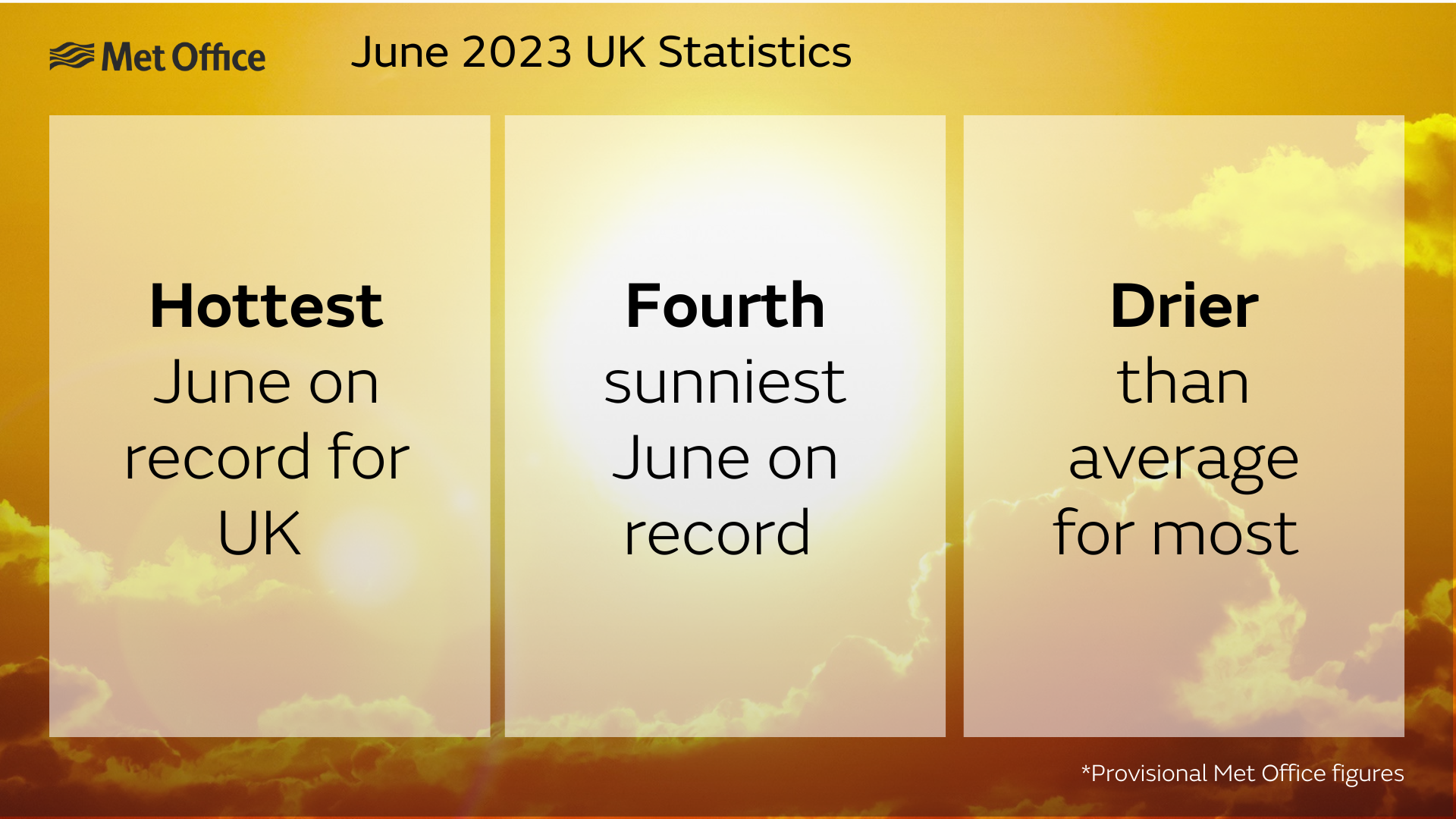
June has been confirmed as the hottest on record for the UK.
According to provisional Met Office figures, the average mean temperature of 15.8°C for June 2023 in the UK is the highest in a series since 1884, with England, Scotland, Wales and Northern Ireland also reporting their respective warmest June on record.
This eclipsed the previous record by 0.9°C, while the previous top three Junes were separated by just 0.1°C.
Fingerprint of climate change
A rapid study by Met Office scientists found the chance of observing a June beating the previous record of 14.9°C, like we have this year, has at least doubled since the period around 1940. The previous record of 14.9°C was recorded in 1940 and 1976.
Paul Davies, Met Office Climate Extremes Principal Fellow and Chief Meteorologist, explains: “We found that the chance of observing a June beating the previous joint 1940/1976 record of 14.9°C has at least doubled since the 1940s. Alongside natural variability, the background warming of the Earth’s atmosphere due to human induced climate change has driven up the possibility of reaching record high temperatures.
“Using our UKCP18 climate projections, we can also see that there is a difference in the frequency of these sort of extremes depending on the emissions scenario we follow in the future. By the 2050s the chance of surpassing the previous record of 14.9°C could be as high as around 50%, or every other year. Beyond the 2050s the likelihood is strongly governed by our emissions of greenhouse gasses, with the chance increasing further in a high emissions scenario but levelling off under mitigation.”
The rapid study used the UK’s climate projections, UKCP18, comparing the chance of surpassing 14.9°C during the period 1925-1955 to that for 1991-2020.