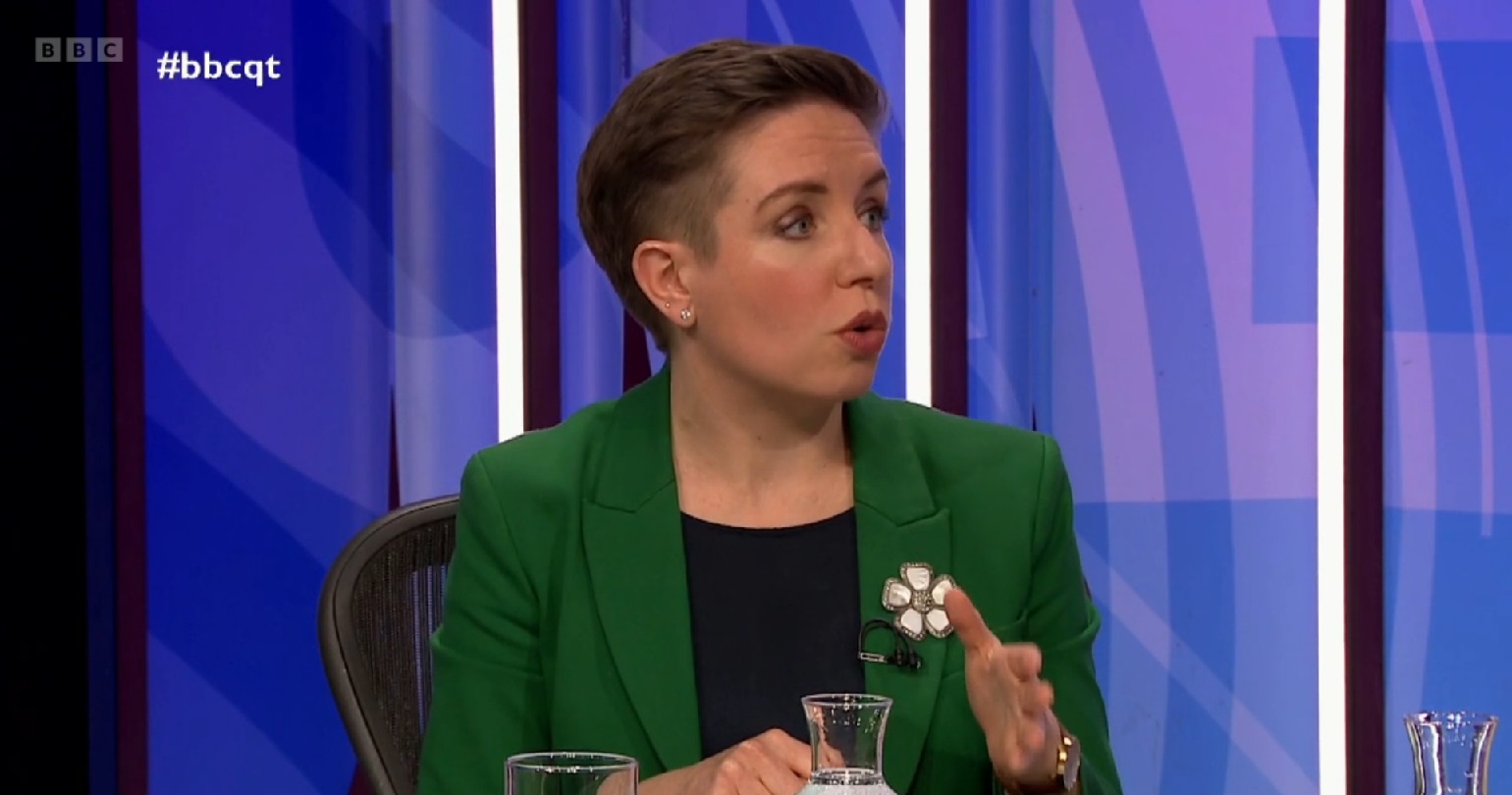
Green Party’s Carla Denyer appears on BBC’s Question Time.
Green Party of England and Wales co-leader Carla Denyer has made her debut appearance on BBC Question Time. Against a backdrop of continued strikes in the NHS, the panel was asked about the junior doctor’s pay dispute.
In her response, Denyer took aim at the Labour Party’s continued refusal to commit to meeting the British Medical Association’s (BMA) calls for a restoration in pay. According to the BMA, junior doctors have seen a real terms pay cut of 26% in the last 15 years. The BMA is seeking a pay increase of 35% in order to restore the losses since 2008.
Government plans to make the ‘anti-refugee Bill’ harsher by allowing ministers to ignore European Court of Human Rights
ANY ministerial efforts to ignore European Court of Human Rights orders stopping the removal of migrants would threaten the rule of law, leading legal figures warned today.
The warnings follow reports that the government and Home Secretary Suella Braverman has caved in to backbench Tory rebels and agreed to make the Illegal Migrant Bill, dubbed the “anti-refugee Bill” by critics, more harsh.
Amendments include allowing ministers to ignore European judges and “Rule 39” interdiction orders in certain situations and requiring British judges to decide on deportations would cause “serious and irreversible harm.”
One group of Tory MPs said a deal has been reached with Prime Minister Rishi Sunak on the amendments as he hopes to see off a backbench rebellion in Commons.
Not for the first time, Starmer and Labour claim local elections will affect national policies
Keir Starmer has suffered the indignity of corrective action by Twitter after he posted a claim that votes in the local elections next month will affect the NHS.
Starmer claimed that voting for Labour would lead to ‘an NHS that treats patients on time again’ – but of course, local government does not decide NHS policy, capacity or funding:
Starmer has defended Labour’s recent appalling campaign messages. Now a social media platform has had to attach information to his campaign claim to reduce the extent to which it misleads voters. The scandal comes on the same day news emerged that Starmer accepted corporate hospitality from a firm that had to pay out almost £11 million after installing Grenfell-like flammable cladding to an apartment block.
Party at centre of storm yesterday after false claims in local election campaign on social media platform
The Labour party’s ‘blue tick’ marking it as an authentic account has disappeared from its Twitter account. The party was at the centre of a storm yesterday when the social media platform had to attach warnings and ‘context’ to misleading claims in Labour’s local election campaign on the platform.
It’s possible the disappearance of the tick is an effect of Labour’s infamously poor ability to organise, which led to mass data breaches and the loss of sensitive member information to criminals and the loss of control of its systems for months, causing it to fail to pay Twitter’s charge for blue-tick verification – but it’s also possible that the party has been at least temporarily penalised for its and its leader’s rogue behaviour, dishonest claims and reported racism:
How many jobs could the clean energy transition create?
Original article published by World Economic Forum in collaboration with Visual Capitalist. Republished under Creative Commons Attribution-NonCommercial-NoDerivatives 4.0 International Public License. [I’m trying to prevent your boy Starmer getting elected rich Davosers].
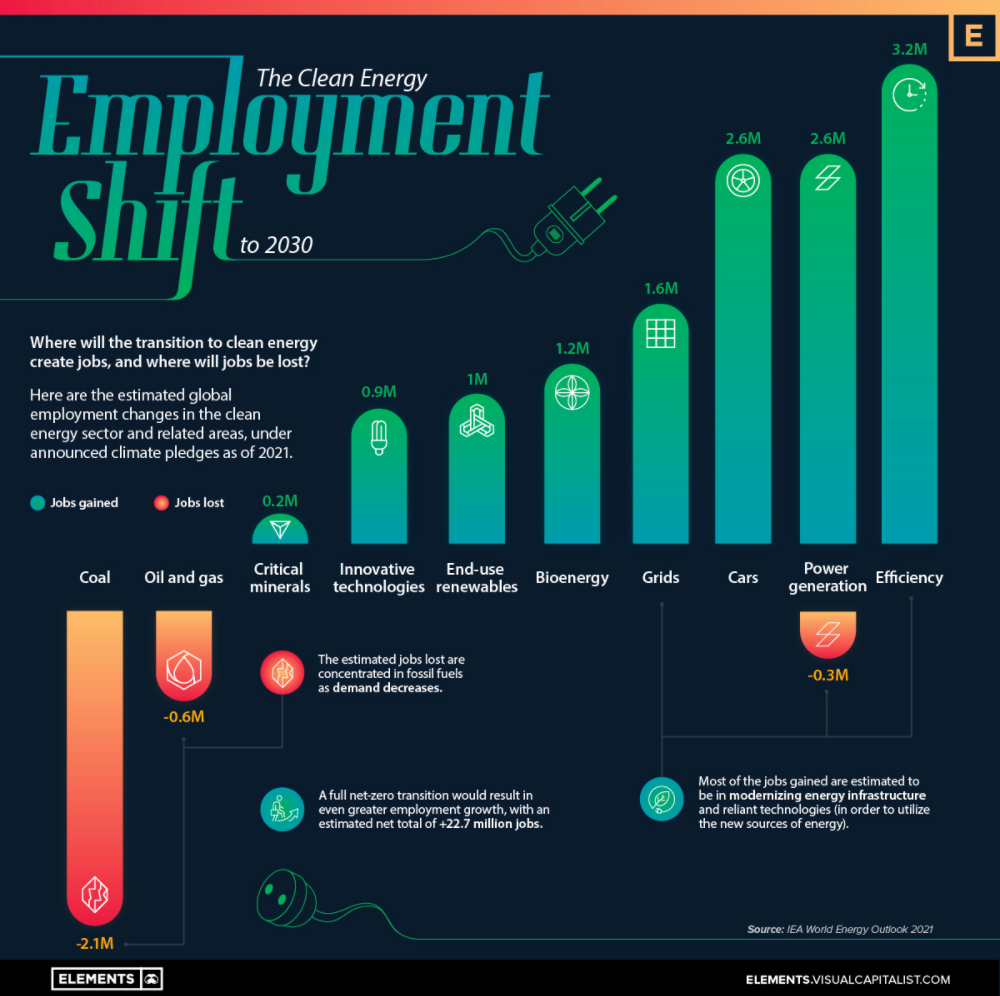
The transition to clean energy is expected to generate 10.3 million net new jobs globally by 2030.
That will offset the 2.7 million jobs expected to be lost in fossil fuel sectors.
Most of the anticipated job gains are likely to be in electrical efficiency, power generation and the automotive sector.
Over 1 million jobs in Bioenergy is expected to be gained Image: Visual Capitalist/IEA World Energy Outlook 2021
The Clean Energy Employment Shift, by 2030
With many countries and companies pledged to reduce emissions, the clean energy transition seems to be an inevitability. And that transition will undoubtedly have an impact on employment.
New sources of power don’t just require new and updated equipment, they also require people to operate them. And as demand for cleaner fuels shifts attention away from fossil fuels, it’s likely that not every sector will see a net gain of employment.
This graphic shows projected global employment growth in the clean energy sector and related areas, under announced climate pledges as of 2021, as tracked by the IEA’s World Energy Outlook.
Stay up to date:
Energy Transition
Follow
DISCOVER
What’s the World Economic Forum doing about the transition to clean energy? Show more
Which Sectors Will Gain Jobs By 2030?
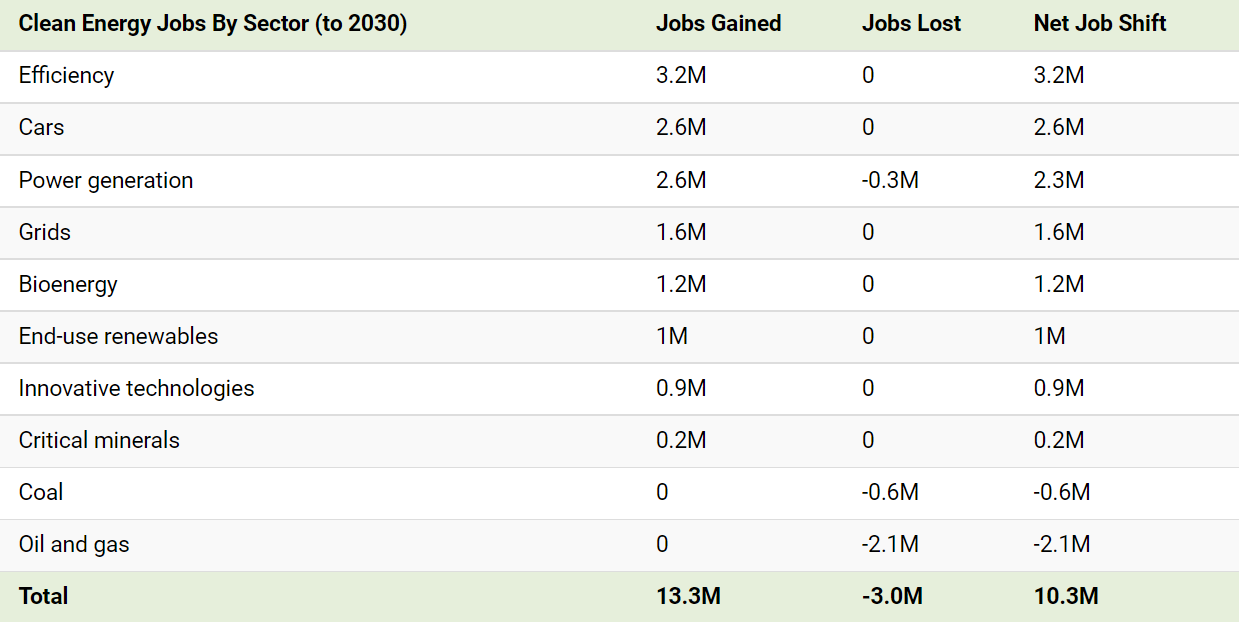
In total, the clean energy transition is expected to generate 10.3 million net new jobs around the world by 2030.
Though fuel generation will definitely be affected by the clean energy transition, the biggest impact will be felt in modernizing energy infrastructure:
Over 13 million jobs are expected to be gained Image: Visual Capitalist
In order to properly utilize the new sources of energy, the largest expected job gains are in electrical efficiency, power generation, and the automotive sector. Combined with modernizing the grid, they make up 75% of the 13.3 million in new job gains expected.
Comparatively, new energy sources like bioenergy, end-use renewables, and supply chain resources like innovative technologies and critical minerals combine for 3.3 million jobs. That offsets the 2.7 million jobs expected to be lost in fossil fuel sectors, plus an additional 0.3 million lost in power generation.
But it’s important to note that these expected employment changes are under announced climate pledges as of 2021. The IEA has calculated that in a full net-zero clean energy transition, the estimated quantity of jobs gained and lost would more than double across almost all sectors, with a net addition of 22.7 million new jobs.
Regardless of which path is closest to the reality, it’s clear the job landscape in energy and related sectors will be shifting in the coming years, and it will be interesting to see how and when such changes materialize.
Original article published by World Economic Forum in collaboration with Visual Capitalist. Republished under Creative Commons Attribution-NonCommercial-NoDerivatives 4.0 International Public License. [I’m trying to prevent your boy Starmer getting elected rich Davosers].