LONDON, Feb 9 (Reuters) – A group of European institutional investors is backing a novel London lawsuit against energy giant Shell’s (SHEL.L) board over alleged climate mismanagement in a case that could have far-reaching implications for how companies tackle emissions.
…
British pension funds London CIV and Nest, Swedish pension fund AP3, French asset manager Sanso IS, Degroof Petercam Asset Management in Belgium and Denmark’s Danske Bank Asset Management and Danica Pension and AP Pension are among those to have written letters supporting the claim.
The investor group has around 450 billion pounds ($543 billion) in assets under management collectively, and owns about 12 million of Shell’s 7 billion shares.
London CIV said its Shell stake was a “primary hotspot of risk and exposure within our portfolio”.
“We hope the whole energy industry sits up and takes notice,” added Mark Fawcett, Nest’s chief investment officer.
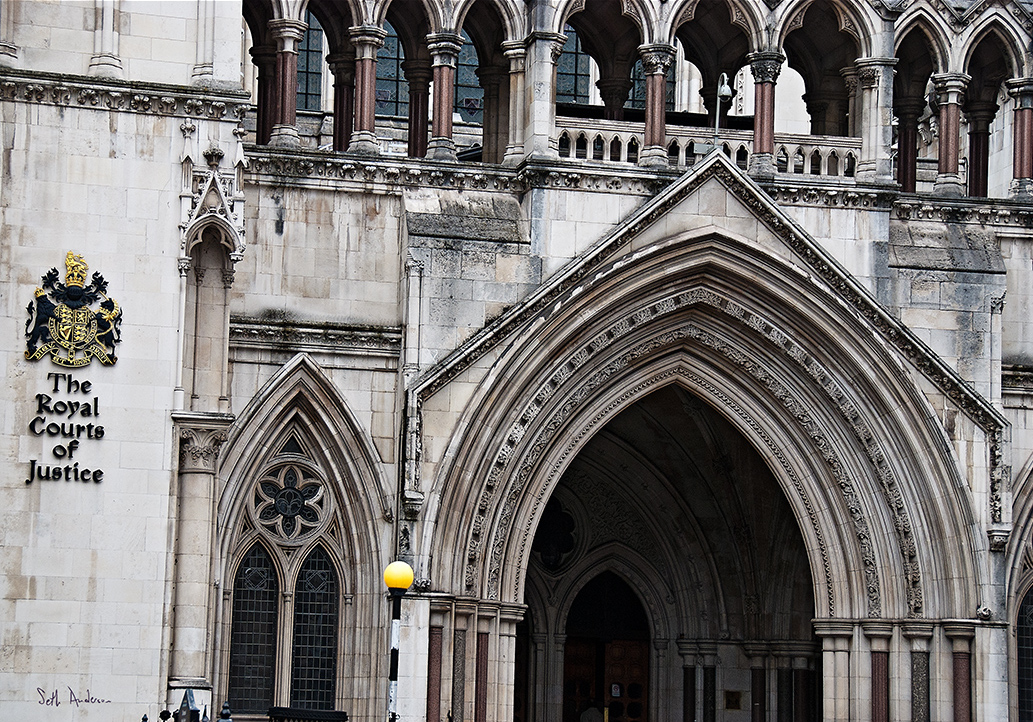
The entrance to the Royal Courts of Justice in London, which houses the UK High Court. Credit: Derived from the original by Seth Anderson, CC BY-NC-SA 2.0
Shell’s board of directors officially has been served with a world-first lawsuit aiming to hold its corporate directors personally liable for alleged mismanagement of climate risk. The lawsuit, filed Thursday by UK-based environmental law organization ClientEarth, contends that Shell’s strategy to address climate change and manage the energy transition fails to align with the objectives of the Paris Agreement and leaves the company in a vulnerable position as society shifts away from fossil fuels.
ClientEarth alleges that inadequate climate strategy by Shell and improper management by the board amounts to violations under the UK Companies Act. ClientEarth, itself a token shareholder in Shell, filed its case in the High Court of England and Wales in London and is suing the company’s 11 directors. Institutional investors with collective holdings of over 12 million shares in Shell are supporting the legal action, which comes on the heels of Shell reporting a record $40 billion in profits in 2022.
“Shell may be making record profits now due to the turmoil of the global energy market, but the writing is on the wall for fossil fuels long term,” ClientEarth senior lawyer Paul Benson said. “The shift to a low-carbon economy is not just inevitable, it’s already happening. Yet the Board is persisting with a transition strategy that is fundamentally flawed, leaving the company seriously exposed to the risks that climate change poses to Shell’s future success — despite the Board’s legal duty to manage those risks.”
This is the first ever case targeting a company’s board over its handling of climate risk and alleged failure to prepare for the energy transition. As DeSmog previously reported, it is likely just the beginning of such litigation against corporate directors.
Climate Litigation Piling up Against Shell
ClientEarth initiated this new lawsuit last year when it gave notice to Shell’s board of its intention to sue and is the latest in a string of legal actions seeking to hold the oil major accountable for its alleged climate and environmental misdeeds. Earlier this month the environmental and corporate accountability group Global Witness lodged a greenwashing complaint with the U.S. Securities and Exchange Commission claiming that Shell was misleading investors and authorities on its renewable energy spending.
That complaint came just days after more than 11,300 individuals and 17 institutions from the heavily polluted Nigerian community of Ogale sued Shell in the UK High Court, adding to existing legal claims filed in 2015 by 2,335 residents of the Nigerian community of Bille — bringing the total to over 13,000 people from the Niger Delta taking Shell to court. These claims are demanding damages from oil spills that have devastated the local communities and their environment.
And in May 2021 the Dutch chapter of Friends of the Earth, Milieudefensie, won a landmark climate court case against Shell claiming the company’s business was not aligned with the Paris Agreement’s goals and human rights obligations. The court ordered Shell to slash emissions across its entire supply chain by 45 percent by 2030. Shell is appealing the verdict and appears to be ignoring its duty to comply, as the company has publicly committed to reducing only part of its supply chain emissions — not those released from using their products — by 2030 while continuing to invest in new oil and gas development.
According to ClientEarth, Shell’s board “has since rebuffed parts of the verdict, indicating that it is unreasonable and essentially incompatible with Shell’s business.” The case against Shell’s board of directors aims to compel the company to comply with the Dutch court verdict and with its legal obligations under the UK Companies Act. Additionally, Shell faces a raft of climate lawsuits in the U.S. brought by states and municipalities over its alleged deception and efforts to derail meaningful climate action despite advanced knowledge of climate risks decades ago.
In response to the new lawsuit targeting the company’s directors, Shell denied that it has acted improperly and said it would oppose ClientEarth’s efforts to pursue its claim through the court.
“We do not accept ClientEarth’s allegations. Our directors have complied with their legal duties and have, at all times, acted in the best interests of the company,” a Shell spokesperson said in an emailed statement.
“We believe our climate targets are aligned with the more ambitious goal of the Paris Agreement: to limit the increase in the global average temperature to 1.5°C above pre-industrial levels,” the spokesperson continued. “Our shareholders strongly support the progress we are making on our energy transition strategy, with 80% voting in favour of this strategy at our last Annual General Meeting. ClientEarth’s attempt, by means of a derivative claim, to overturn the board’s policy as approved by our shareholders has no merit.”
Telling a Different Story Inside Shell
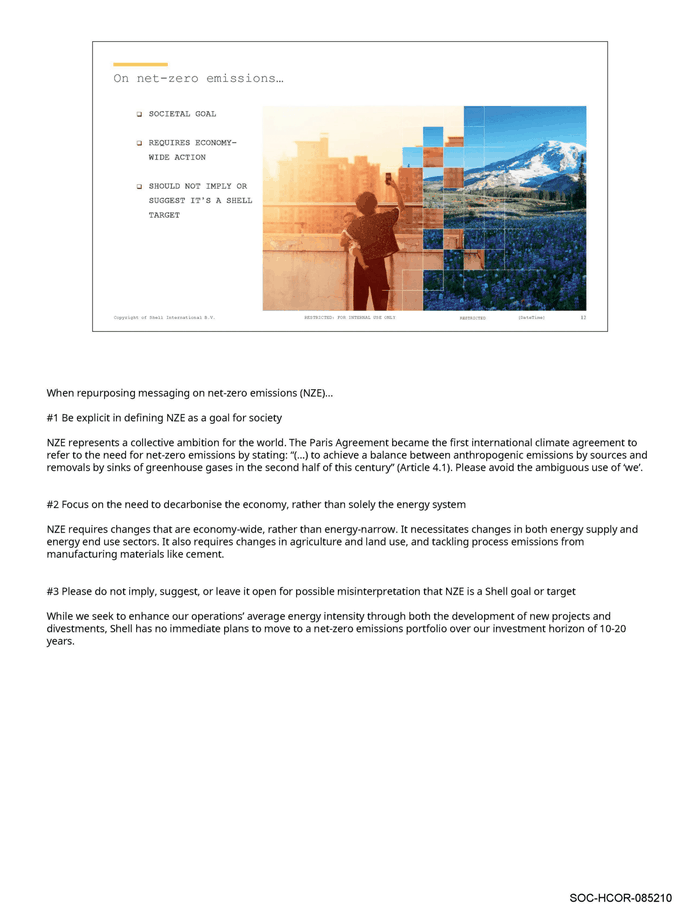
While Shell claims to support the Paris Agreement and says it will achieve net zero emissions by 2050, internal corporate communications obtained through subpoena by a U.S. congressional committee suggest that the company has no intention to genuinely pursue these objectives.
In an internal company slide deck on messaging around the energy transition, Shell clarifies that the net zero emissions goal is a “collective” ambition and challenge for society and is not a Shell goal or target. The company states that it “has no immediate plans to move to a net-zero emissions portfolio over our investment horizon of 10-20 years.”
Shell further advised its employees to refrain from suggesting the company would take climate action that risked its fundamental business strategy, writing: “Please do not give the impression that Shell is willing to reduce carbon dioxide emissions to levels that do not make business sense.”
In ClientEarth’s view, the oil giant’s failure to advance its own transition to net zero will only harm the company in the long run. “Long term, it is in the best interests of the company, its employees and its shareholders — as well as the planet — for Shell to reduce its emissions harder and faster than the Board is currently planning,” Benson said.
The High Court will next decide if it grants permission for ClientEarth’s case to proceed.
Original article by Dana Drugmand republished from DeSmog according to its republishing agreement.
Demonstrators participate in a Fridays for Future protest calling for money for climate action at the COP27 U.N. Climate Summit, Friday, Nov. 11, 2022, in Sharm el-Sheikh, Egypt.
HUGE profits declared by oil and gas firms should be channelled towards compensating for the loss and damages suffered by victims of climate change, campaign group Greenpeace has urged.
Following Shell’s announcement last week of its record high profits of £32.2 billion last year, BP is expected to announce record profits of its own tomorrow.
The firm has already announced more than £20bn profit for the first three quarters of last year.
Collectively, energy giants Shell, BP, Chevron, Exxon, and Total are believed to have pocketed almost £166bn in profits last year, said Greenpeace.
Shell has hit Greenpeace occupation of its oil and gas platform with an injunction, threatening up to two years of jail time and fines.
Shell’s threats backfired as Greenpeace escalated its protest by adding two more climbers to occupy the company’s oil and gas platform using boats unaffected by the court order.
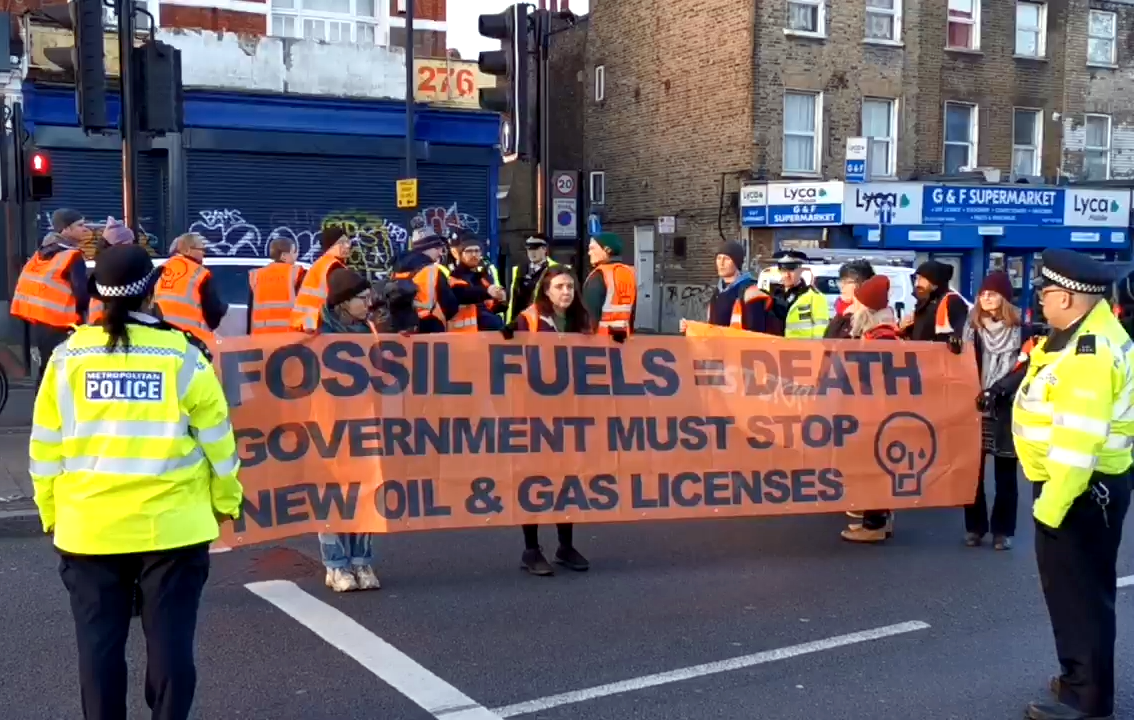
Protestors are demanding that the company stops expanding oil and gas production around the world, takes responsibility for fueling the climate crisis, and pays up for the climate destruction it is causing everywhere.
…
Two Greenpeace protesters used ropes to board the Shell-contracted ship from one of the small boats. They joined four other activists who have been occupying the oil and gas platform since January 31. Three other activists joined the protest from the Merida vessel brandishing banners with the message – Stop Drilling. Start Paying.
Right-wingers hammered in Socialist Health Association elections said to be aiming to disaffiliate SHA on pretext after organisation condemned Starmer and sidekick Streeting for appalling health policy
The Labour right is angling to kick the Socialist Health Association (SHA) out of the party after the faction was crushed in the SHA’s internal elections – and in revenge for the SHA’s resounding condemnation of Labour’s privatisation-friendly health policy.
The right-wing slate had tried to boycott the elections claiming, presumably after seeing how poor their chances were, that the election was set up against them – but left it too late and the vote went ahead, with the right losing by a ratio of roughly six to one. As one wag put it, it must have been quite some fix to achieve that kind of ratio.
The previous SHA exec last month issued a scathing condemnation of Keir Starmer and his health spokesman Wes Streeting’s plan to extend the use of private healthcare in the NHS, the contempt the pair have shown for the health policy unanimously voted for by Labour members at last year’s party conference and the pair’s readiness to accept large donations from donors with private health interests – a position now resoundingly re-endorsed by SHA members:
At the 2022 Labour Party Conference, the Health Composite Motion moved by the Socialist Health Association (“SHA”) stated that Labour would adopt “a position of outright opposition to and commit to vote against any and all forms of privatisation of the NHS” and “commit to returning all privatised portions of the NHS to public control upon forming a Government”. It also banned Labour MPs from accepting donations from private companies interested in outsourcing NHS functions. See Conference Arrangements Committee Report 4, page 12.
The SHA’s motion was endorsed by a compositing process involving rank and file members, local constituency parties, trade unions, and the shadow frontbench. The Labour Conference passed it unanimously.
That is not the position democratically agreed at Labour Conference. And it is simply wrong, for the following reasons.
It is simply wrong to say that the private sector has greater capacity to clear NHS backlogs. The people working in the private healthcare sector are, by and large, the same doctors and nurses who work in the NHS, and with the exception of the overseas health workers, the vast majority of them were trained in the NHS. Every hour of staff time devoted to private healthcare is an hour of staff time taken away from public healthcare for those who need it most.
It is simply wrong to say that the private sector is more “efficient”. One example of this is that the Institute for Public Policy Research has found that Tony Blair’s Private Finance Initiatives cost the NHS almost £80 billion for only £13 billion of investment. The only party which benefits ‘efficiently’ from private finance is big finance – not patients.
It is shameful that the Shadow Cabinet has failed to stand shoulder to shoulder with health unions in demanding fair pay and conditions for their members. The BMA has calculated that junior doctors have suffered a real pay cut of 26.1% since 2008 – meaning an exodus of qualified doctors driven out of the public sector just when patients need them most. Staff working conditions are patient treatment conditions.
The impetus for Labour’s ban on accepting donations from private companies interested in outsourcing NHS functions was a report that, in 2022, Wes Streeting accepted a £15,000 donation from hedge fund manager John Armitage. Mr Armitage’s fund owns shares worth more than half a billion dollars in UnitedHealth. UnitedHealth is America’s largest health insurer. It has spent millions of dollars lobbying US politicians against healthcare reform through seven different lobbying forms. This includes lobbying against the Affordable Insulin Now Act, which would guarantee supplies to insulin to diabetics who depend on it to survive. It is one of the largest profiteers from NHS outsourcing and one of the biggest potential beneficiaries of future privatisation.
It is therefore also beyond disappointing to see that Wes Streeting has accepted a further £60,000 from MPM Connect. Wes Streeting and the other recipients funds from MPM Connect (including Shadow Home Secretary Yvette Cooper and Mayor Dan Jarvis) should urgently confirm just what MPM Connect does; the terms under which they accepted a total of £340,000 from MPM Connect; just what MPM Connect expects in return; and whether its “investments in the employment sector” include further NHS outsourcing.
Accepting donations from private companies interested in NHS outsourcing creates an apparent conflict of interest, and undermines public confidence in Labour’s commitment to rebuilding a publicly owned and provided NHS.
We call on Keir Starmer and Wes Streeting to commit to the policy democratically agreed by the Labour Party – preventing further privatisation and immediately returning all privatised parts of the NHS to public ownership and control.
Mark Ladbrooke SHA Chair
Harry Stratton SHA Secretary
Esther Giles SHA Treasurer
In apparent revenge, Skwawkbox understands that the Labour right – which now dominates the party’s national executive, is planning to table a move to expel or disaffiliate the SHA from the party, on the pretext that the result was somehow rigged despite the massive majority for the left slate, along with the membership status of one or more of the SHA’s elected officers.
But it seems the right is so desperate to eradicate any left strongholds in the party – and to cover up the betrayal of the NHS by what passes for Labour’s ‘leadership’ – that it will resort to even the most grotesque and shameless lengths to achieve it.
SKWAWKBOX needs your help. The site is provided free of charge but depends on the support of its readers to be viable. If you’d like to help it keep revealing the news as it is and not what the Establishment wants you to hear – and can afford to without hardship – please click here to arrange a one-off or modest monthly donation via PayPal orhere to set up a monthly donation via GoCardless (SKWAWKBOX will contact you to confirm the GoCardless amount). Thanks for your solidarity so SKWAWKBOX can keep doing its job.
If you wish to republish this post for non-commercial use, you are welcome to do so – see here for more.