Supreme court rules Rwanda plan unlawful: a legal expert explains the judgment, and what happens next
Spread the love
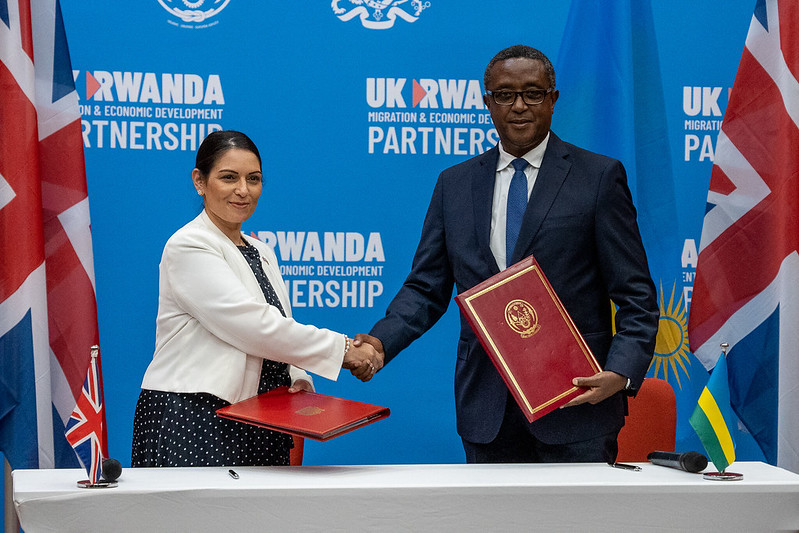
The Rwanda deal was signed when Priti Patel was home secretary. Rwanda visit April 14, 2022. Image: UK Home Office.

Before publishing this article unaltered, I draw your attention to these excerpts:

It is important to note that the supreme court’s decision is not a comment on the political viability of the Rwanda plan, or on the concept of offshoring asylum processes generally. The ruling focused only on the legal principle of non-refoulement, and determined that in this respect, Rwanda is not a “safe third country” to send asylum seekers.


This ruling is likely to revive discussion about the UK leaving the European convention on human rights (ECHR), which holds the UK to the non-refoulement obligation. Some Conservatives, including the former home secretary Suella Braverman, have argued that leaving the convention would make it easier to pass stronger immigration laws.

But while handing down the supreme court judgment, Lord Reed emphasised that there are obligations towards asylum seekers that go beyond the ECHR. The duty of non-refoulement is part of many other international conventions, and domestic law as well. In other words, exiting the ECHR would not automatically make the Rwanda plan lawful or easier to implement.

So it would appear that UK is not going to be sending refugees to Rwanda despite Rishi Sunak and Conservative claims that it will.

Supreme court rules Rwanda plan unlawful: a legal expert explains the judgment, and what happens next

Devyani Prabhat, University of Bristol

The UK supreme court has unanimously ruled that the government’s plan to send asylum seekers to Rwanda is unlawful.

Upholding an earlier decision by the court of appeal, the supreme court found that asylum seekers sent to Rwanda may be at risk of refoulement – being sent back to a country where they may be persecuted, tortured or killed.

The courts cited extensive evidence from the UN refugee agency (UNHCR) that Rwanda does not respect the principle of non-refoulement – a legal obligation. The UNHCR’s evidence questioned the ability of Rwandan authorities to fairly assess asylum claims. It also raised concerns about human rights violations by Rwandan authorities, including not respecting non-refoulement with other asylum seekers.

It is important to note that the supreme court’s decision is not a comment on the political viability of the Rwanda plan, or on the concept of offshoring asylum processes generally. The ruling focused only on the legal principle of non-refoulement, and determined that in this respect, Rwanda is not a “safe third country” to send asylum seekers.

The ruling is another blow to the government’s promise to “stop the boats”. And since the Rwanda plan is at the heart of its new Illegal Migration Act, the government will need to reconsider its asylum policies. This is further complicated by Conservative party infighting and the firing of home secretary Suella Braverman, just two days before the ruling.

How did we get here?

For years, the UK government has been seeking to reduce small boat arrivals to the UK. In April 2022, the UK and Rwanda signed an agreement making it possible for the UK to deport some people seeking asylum in Britain to Rwanda, without their cases being heard in the UK. Instead, they would have their cases decided by Rwandan authorities, to be granted (or rejected) asylum in Rwanda.

While the Rwanda plan specifically was found to be unlawful, the government could, in theory, replicate this in other countries so long as they are considered “safe” for asylum seekers.

The government has not yet sent anyone to Rwanda. The first flight was prevented from taking off by the European court of human rights in June 2022, which said that British courts needed to consider all human rights issues before starting deportations.

A UK high court then decided in December 2022 that the Rwanda plan was lawful.


Catch up on our other coverage of the Rwanda plan:

Why UK court ruled Rwanda isn’t a safe place to send refugees – and what this means for the government’s immigration plans

Rwanda deportations: what is the European Court of Human Rights, and why did it stop the UK flight from taking off?

Suella Braverman is wrong about the UN refugee convention being ‘not fit for purpose’ – here’s why

The government passed a major immigration law last year – so why is it trying to pass another one?

‘A toxic policy with little returns’ – lessons for the UK-Rwanda deal from Australia and the US


Ten asylum seekers from Syria, Iraq, Iran, Vietnam, Sudan and Albania challenged the high court ruling, with the support of the charity Asylum Aid. Their claim was about whether Rwanda meets the legal threshold for being a safe country for asylum seekers.

The court of appeal said it was not and that asylum seekers risked being sent back to their home countries (where they could face persecution), when in fact they may have a good claim for asylum.

The government has since passed the Illegal Migration Act. The law now states that all asylum seekers arriving irregularly (for example, in small boats) must be removed to a safe third country. But now that the Rwanda deal has been ruled unlawful, there are no other countries that have said they would take asylum seekers from the UK.

What happens next?

Former Home Secretary Suella 'Sue-Ellen' Braverman
Former Home Secretary Suella ‘Sue-Ellen’ Braverman continued with the Rwanda policy.

It is clear that the government’s asylum policies will need rethinking. Should another country now be designated as a safe country and different arrangements put in place, these will probably be subject to further legal challenges, including in the European court of human rights and in British courts.

This ruling is likely to revive discussion about the UK leaving the European convention on human rights (ECHR), which holds the UK to the non-refoulement obligation. Some Conservatives, including the former home secretary Suella Braverman, have argued that leaving the convention would make it easier to pass stronger immigration laws.

But while handing down the supreme court judgment, Lord Reed emphasised that there are obligations towards asylum seekers that go beyond the ECHR. The duty of non-refoulement is part of many other international conventions, and domestic law as well. In other words, exiting the ECHR would not automatically make the Rwanda plan lawful or easier to implement.

The prime minister, Rishi Sunak, has said that he is working on a new treaty with Rwanda and is prepared to change domestic laws to “do whatever it takes to stop the boats”.

The UK is not the only country to attempt to off-shore asylum processing. Germany and Italy have recently been considering finding new safe third countries to accept asylum seekers as well.

But ensuring these measures comply with human rights obligations is complicated. International law requires states to provide sanctuary to those fleeing persecution or risk to their lives. As this ruling shows, the UK is not going to find an easy way out of these obligations.The Conversation

Devyani Prabhat, Professor of Law, University of Bristol

This article is republished from The Conversation under a Creative Commons license. Read the original article.
Continue ReadingSupreme court rules Rwanda plan unlawful: a legal expert explains the judgment, and what happens next

Supreme court sinks shameful Rwanda scheme

Spread the love

https://www.morningstaronline.co.uk/article/b/supreme-court-sinks-shameful-rwanda-scheme

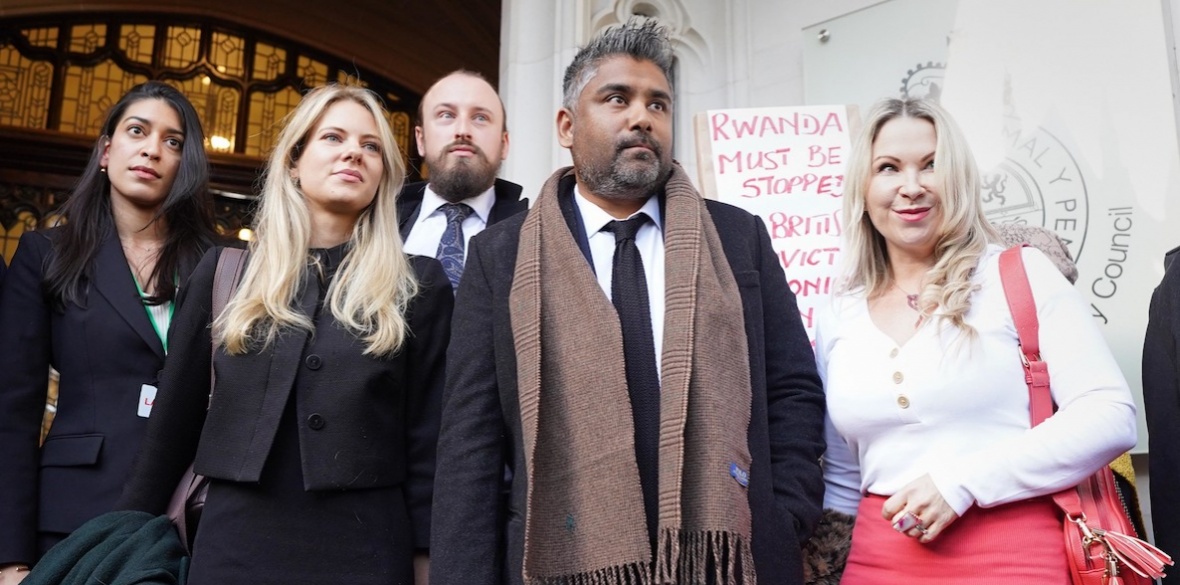
Toufique Hossain, director of public law and immigration at Duncan Lewis Solicitors, (centre) with his legal team outside the Supreme Court in London. Picture date: Wednesday November 15, 2023.

PITILESS Tory plans to deport refugees to Rwanda were ruled illegal by the Supreme Court today, plunging Rishi Sunak’s government deeper into chaos.

The court determined that Rwanda was not a safe destination for asylum-seekers and that there was a high risk of them being returned to their country of origin to be tortured or worse, thus torpedoing what is a flagship Tory policy.

The defiant Prime Minister pledged to fight on to stop destitute refugees crossing the Channel, responding to the judgement by asserting that “illegal migration destroys lives and costs British taxpayers millions of pounds a year. We need to end it and we will do whatever it takes to do so.”

He later claimed that the judges had agreed that the “principle of removing asylum-seekers to a safe third country is lawful” and told MPs he was ready to “revisit” UK laws to block migration if necessary and to seek a fresh treaty with Rwanda.

Labour ducked the moral issues raised by the policy, with leader Sir Keir Starmer and shadow home secretary Yvette Cooper focusing instead on the waste of money and time involved in the failed Rwanda policy.

The judges’ decision was, however, welcomed by a wide range of human rights campaigners.

Amnesty International’s Sacha Deshmukh said: “The government must now draw a line under a disgraceful chapter in the UK’s political history.

https://www.morningstaronline.co.uk/article/b/supreme-court-sinks-shameful-rwanda-scheme

Continue ReadingSupreme court sinks shameful Rwanda scheme

Allowing Cumbria coalmine was ‘disaster’ for climate diplomacy, says Lord Turner

Spread the love

https://www.theguardian.com/environment/2023/nov/16/allowing-cumbria-coalmine-was-disaster-for-climate-diplomacy-says-lord-turner

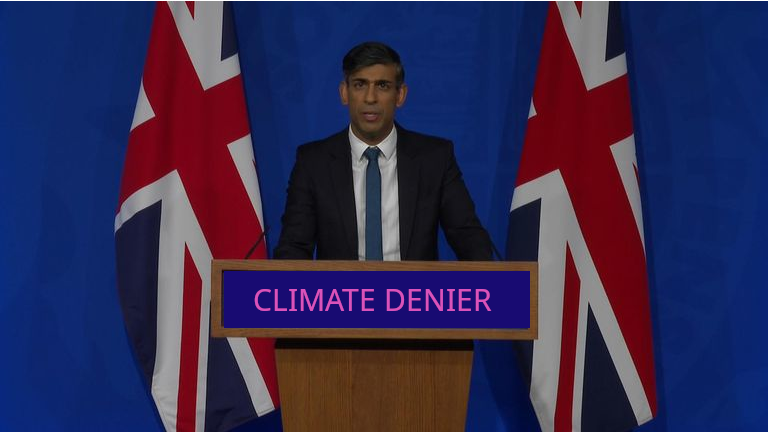
Rishi Sunak podium reads CLIMATE DENIER

Former chair of climate change committee says UK’s decision has encouraged other countries to keep exploiting fossil fuels

The UK’s decision to open a new coalmine in Cumbria was a “disaster” that encouraged other countries to press ahead with fossil fuels, and the continued expansion of North Sea oil and gas is likely to continue the harm, a former chief adviser to the government has said.

Other countries are using the UK as an excuse for pressing ahead with fossil fuel projects despite their climate commitments, according to Adair Turner, the first chair of the Committee on Climate Change and a former head of the CBI.

Lord Turner told the Guardian that he had “literally been involved in discussions” in China and India where UK decisions had been given as a reason for not moving faster on the climate.

“I can tell you that [the Cumbrian coalmine] was a disaster globally, and in China and India, where I was engaged in debates [on reducing greenhouse gas emissions], I have had people say ‘yeah, but you’re building a new coalmine in the UK’,” he said.

“So that was a disaster for our reputation, and it provides arguments for the people within government or within interest groups in China and India to say ‘oh look, the UK is supposedly committed to net zero, but it’s not serious, it’s building a new coalmine’. And the same occurs with new oil and gas fields in the North Sea.”

Turner is now chair of the Energy Transitions Commission (ETC), a thinktank that on Thursday published a report that says the production of and demand for fossil fuels must be reduced rapidly, and that this is achievable. “Unabated” fossil fuel use must be phased out, and there is only limited scope for the use of carbon capture and storage (CCS), the report finds.

https://www.theguardian.com/environment/2023/nov/16/allowing-cumbria-coalmine-was-disaster-for-climate-diplomacy-says-lord-turner

Continue ReadingAllowing Cumbria coalmine was ‘disaster’ for climate diplomacy, says Lord Turner

Greens welcome Supreme Court decision on deportations to Rwanda

Spread the love
Image of the Green Party's Carla Denyer on BBC Question Time.
Image of the Green Party’s Carla Denyer on BBC Question Time.

Reacting to news that the Supreme Court has blocked government plans to send asylum seekers to Rwanda, Green Party co-leader Carla Denyer said: 

“This is welcome news. The government must now admit that its cruel and inhumane policy is finished and drop it.

“The new Home Secretary has the chance now to turn over a new leaf and make clear that there is no intention to quit the European Convention on Human Rights.  

‘He should pledge to create an asylum system that works. That is one with clear, open, safe and legal routes for applicants, quick and efficient determinations and support for resettlement into local communities with properly funded local services.” 

Continue ReadingGreens welcome Supreme Court decision on deportations to Rwanda

‘Hospitals Are Not Battlegrounds’: UN Relief Chief Sounds Alarm as Israel Raids al-Shifa

Spread the love

Original article by JAKE JOHNSON republished from Common Dreams under Creative Commons (CC BY-NC-ND 3.0). 

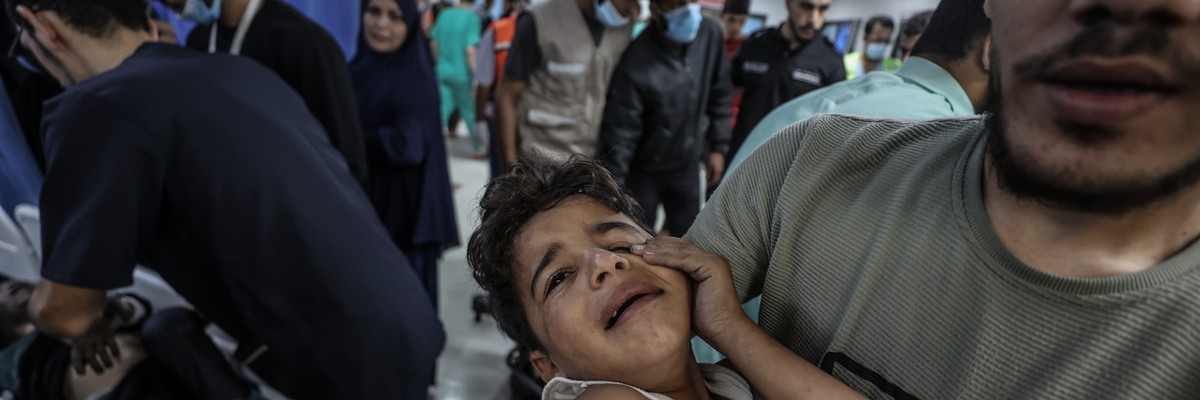
An injured child is brought to al-Shifa Hospital after Israeli attacks in Gaza City, Gaza on October 21, 2023.  (Photo: Ali Jadallah/Anadolu via Getty Images)


“The protection of newborns, patients, medical staff, and all civilians must override all other concerns,” said Martin Griffiths, the United Nations’ emergency relief coordinator.

The head of the United Nations’ emergency relief operations said Wednesday that he was “appalled” by news of the Israeli military’s raid of Gaza’s largest hospital, where hundreds of patients and healthcare workers and thousands of displaced people are sheltering.

“The protection of newborns, patients, medical staff, and all civilians must override all other concerns,” Martin Griffiths, the U.N. under-secretary-general for humanitarian affairs, wrote on social media. “Hospitals are not battlegrounds.”

Israeli forces’ raid of al-Shifa Hospital early Wednesday came days after they encircled the facility and began bombarding it, accusing Hamas of using the hospital and tunnels beneath it for military operations.

The U.S. backed Israel’s assertion on Tuesday, with National Security Council spokesman John Kirby telling reporters that “we have information that Hamas and the Palestinian Islamic Jihad used some hospitals in the Gaza Strip, including al-Shifa, and tunnels underneath them, to conceal and support their military operations and to hold hostages.”

Asked to provide specific evidence, Kirby cited “a variety of intelligence sources” but declined to publicize “a whole lot of granular detail on that.”

Hospitals are protected from military attack under international law and can only lose their protected status if they are shown to have been used for “an act harmful to the enemy.” Human Rights Watch argued in a report released ahead of Wednesday’s raid that the Israeli government has not provided sufficient evidence to justify its attacks on al-Shifa and other northern Gaza hospitals, most of which have ceased functioning due to a lack of fuel and other supplies.

An emergency room employee at al-Shifa toldAl Jazeera that during their raid, Israeli soldiers “detained and brutally assaulted some of the men who were taking refuge at the hospital.”

“Israeli forces took the detained men naked and blindfolded,” the worker added. “[They] did not bring any aid or supplies, they only brought terror and death.”

On Tuesday, according to Gaza officials, around 170 bodies were buried in a mass grave in the courtyard of al-Shifa, as there was no other way to safely bury them outside the hospital compound because of Israeli attacks and firefights with Hamas. A surgeon at the hospital toldReuters that, due to lack of refrigeration, the bodies “were generating an unbearable stench and posing a risk of infection.”

“The Health Ministry said 40 patients, including three babies, have died since Shifa’s emergency generator ran out of fuel Saturday,” The Associated Pressreported Wednesday. “Another 36 babies are at risk of dying because there is no power for incubators, according to the ministry.”

Israel’s bombing campaign, ground invasion, and siege have killed more than 11,000 people across the Gaza Strip, but the recent attacks on the enclave’s hospitals have made it impossible for Gaza health officials to reach the facilities to count the dead and wounded. Thousands more are believed to have been killed since the death toll was updated last week.

Tedros Adhanom Ghebreyesus, director-general of the World Health Organization, said early Wednesday that “we’ve lost touch again with health personnel” at al-Shifa amid Israel’s raid.

“We’re extremely worried for their and their patients’ safety,” he added.

Facing growing accusations of war crimes, the Israel Defense Forces (IDF) called its raid on al-Shifa a “precise and targeted operation against Hamas.” In the wake of the deadly Hamas-led attack on Israel last month, the IDF has claimed repeatedly that it is targeting militants even as it has decimated Gaza’s civilian infrastructure, bombing homes, medical facilities, schools, bakeries, and the strip’s largest refugee camp.

A confidential memo from the Dutch Embassy in Tel Aviv states that Israel is “deliberately causing massive destruction to the infrastructure and civilian centers” of Gaza in an effort to “showcase credible military force” to “Iran and its proxies,” according toPolitico.

Israel’s strategy, the memo states, violates “international treaties and laws of war.”

Original article by JAKE JOHNSON republished from Common Dreams under Creative Commons (CC BY-NC-ND 3.0). 


Continue Reading‘Hospitals Are Not Battlegrounds’: UN Relief Chief Sounds Alarm as Israel Raids al-Shifa