Rishi Sunak is wrong: we polled the British public and found it largely supports strong climate policies

Spread the love
Campaigners take part in a Stop Rosebank emergency protest outside the U.K. Government building in Edinburgh, after the controversial Equinor Rosebank North Sea oil field was given the go-ahead Wednesday, September 27, 2023. (Photo: Jane Barlow/PA Images via Getty Images)

Christian Bretter, University of Leeds and Felix Schulz, University of Leeds

The UK’s Tory government is rolling back climate legislation and is continuing to fund the expansion of domestic oil and gas reserves. Our new research suggests this might be based on a misreading of public opinion.

Since winning a July 2023 by-election in the London suburb of Uxbridge, the UK government has made polarising voters on climate policy one of its main strategies. The Tory campaign had focused on opposing a new low emission zone for cars, and prime minister Rishi Sunak took its victory as vindication of a clear “pro-motorist” and anti-climate policy stance.

The apparent lack of public support for strict climate policies such as a ban of fossil-fuelled cars is now being used as an excuse to roll back policies urgently necessary to reach net zero targets.

In a recently study in the journal Climate Policy, we demonstrate that, by betting on a public tired of stringent climate policies, the government is backing the wrong horse.

We asked 1,911 people that are representative of the UK population in terms of age, gender and ethnicity to indicate the extent to which they support different climate policy instruments. Almost two thirds support the most stringent climate policies, while others receive even higher support.

In short, people in the UK favour all kinds of policy instruments to tackle climate change, even the most stringent ones. There is a lesson here for the opposition too, which should put forward more effective climate policies, and not shy away from regulation.

A vote in favour of UK climate politics

In our study, we asked people about actual policy proposals by UK government bodies and political parties (as opposed to hypothetical ones).

We put each into one of four categories based on the type of policy instrument: regulation (such as banning the sale of fossil-fuel-powered cars or stopping drilling for oil and gas), market instruments (carbon trading, stopping fossil fuel subsidies), informational tools (consumer labels, advertising campaigns), and voluntary initiatives (carbon offsets, non-binding product standards).

Cars in traffic jam on wet day
The UK public is mostly happy to support measures like phasing out petrol cars.
Kittipong33 / shutterstock

Contrary to the government’s rhetoric, our findings point towards a more optimistic view of the UK’s future climate politics – at least from a voter perspective. A large majority supports strict regulations that mandate or prohibit specific behaviour. An even larger share backs market-based initiatives (78%), information tools (86%) and voluntary measures (87%).

While the important thing here is that the UK public wants a package of different policy instruments to decarbonise the economy and reach net zero, one could rightly argue that more still needs to be done to increase support for stricter measures. So what drives public support for climate policies?

Drivers of public support

In line with previous research, our study found that free market and environmental beliefs have the biggest impact on whether someone supports climate policies.

The more people believed that a free market acts in the interests of the public, the less they supported all climate policies. Similarly, people that believe nature is important voiced stronger support for all policies.

Interestingly, support for regulatory and market-based policies didn’t change according to a person’s income. This is important because the current government usually tries to appeal to working class voters in its attempts to demonise ambitious climate policies.

These are important findings that highlight the need to challenge free market ideologies by publicly and repeatedly scrutinising their validity for a functioning and just society. We also should start recognising their detrimental effect on climate policy preferences.

Regional variations in public support

However, only looking at national results might hide important differences. Our research found important regional variation, with London often being an exception compared to the rest of the UK.

People living in other regions were about 30% less likely to support regulatory and market-based climate policies compared to people in Greater London, for instance.
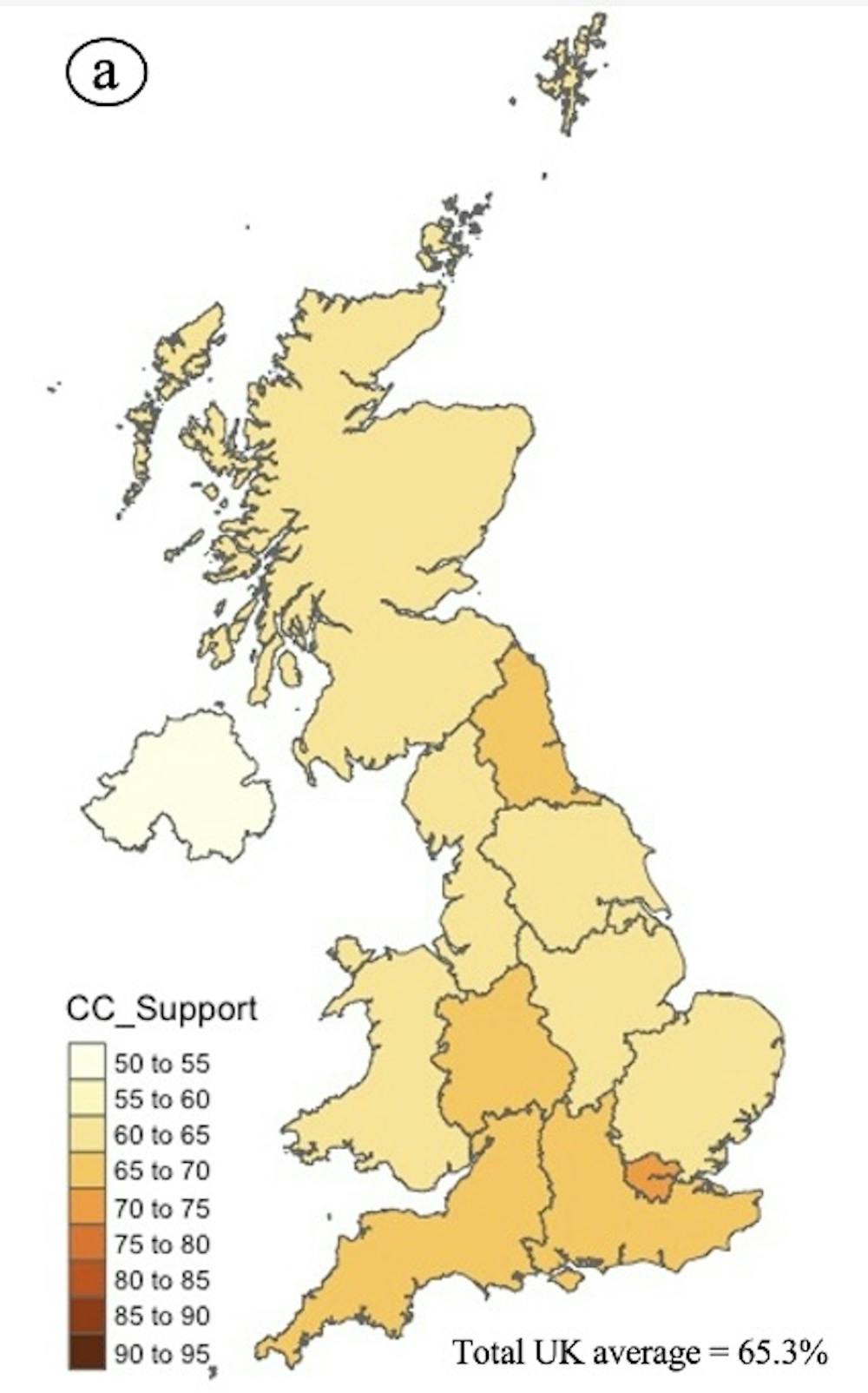
Shaded map of UK
Regulatory measures were the least popular around the country, though still had majority support everywhere and a strong majority in London.
Bretter and Schulz, CC BY-SA

Drivers of these differences are both ideological and structural. People living in Greater London tend to believe less in the free market system compared to people in regions which had significantly lower support for climate policies. This indicates that neoliberal ideology favouring free markets is discouraging climate action.

Yet it is not only what people believe in. Those in more rural regions with higher emissions show less support for stricter climate policies. These tend to be regions with less access to public transport where people have to rely more heavily on high-emitting cars.

More needs to be done to improve public infrastructure in rural areas. This will require investment in affordable, low-carbon transport networks rather than championing the continuation of the combustion engine.

How the media may shape policy support

Of course, our study only captured a snapshot of people’s policy preferences. We are constantly confronted by news stories, particularly through social media.

These often act as echo chambers to reinforce existing ideologies (and by extension, policy preferences), thereby strengthening existing polarisations. This will make it harder to engage people with contrasting beliefs in a discussion on climate policies.

On the other hand, being repeatedly confronted with particular views and ideas can shift one’s beliefs. In psychology, this is referred to as “repeated priming”. In Germany, we have seen how newspaper campaigns against the slow phase-out of gas boilers have further undermined public support for this specific climate policy.

Could something similar happen in the UK? To avoid the gradual weakening of support by particular news outlets, the UK opposition parties need to be consistent and persistent in their communication of climate policies and their effects.


Imagine weekly climate newsletter

Don’t have time to read about climate change as much as you’d like?

Get a weekly roundup in your inbox instead. Every Wednesday, The Conversation’s environment editor writes Imagine, a short email that goes a little deeper into just one climate issue. Join the 20,000+ readers who’ve subscribed so far.The Conversation


Christian Bretter, Research Fellow in Environmental Psychology, University of Leeds and Felix Schulz, Research Fellow, University of Leeds

This article is republished from The Conversation under a Creative Commons license. Read the original article.
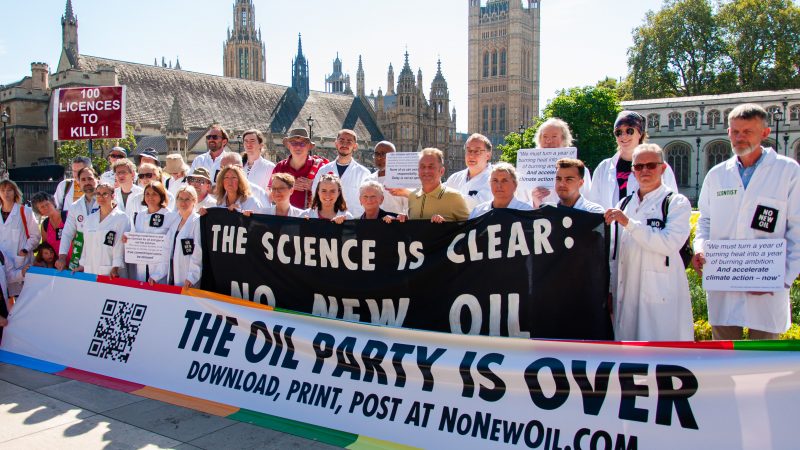
Scientists protest at UK Parliament 5 September 2023.
Continue ReadingRishi Sunak is wrong: we polled the British public and found it largely supports strong climate policies

Craig Murray discusses activating the Genocide Convention

Spread the love
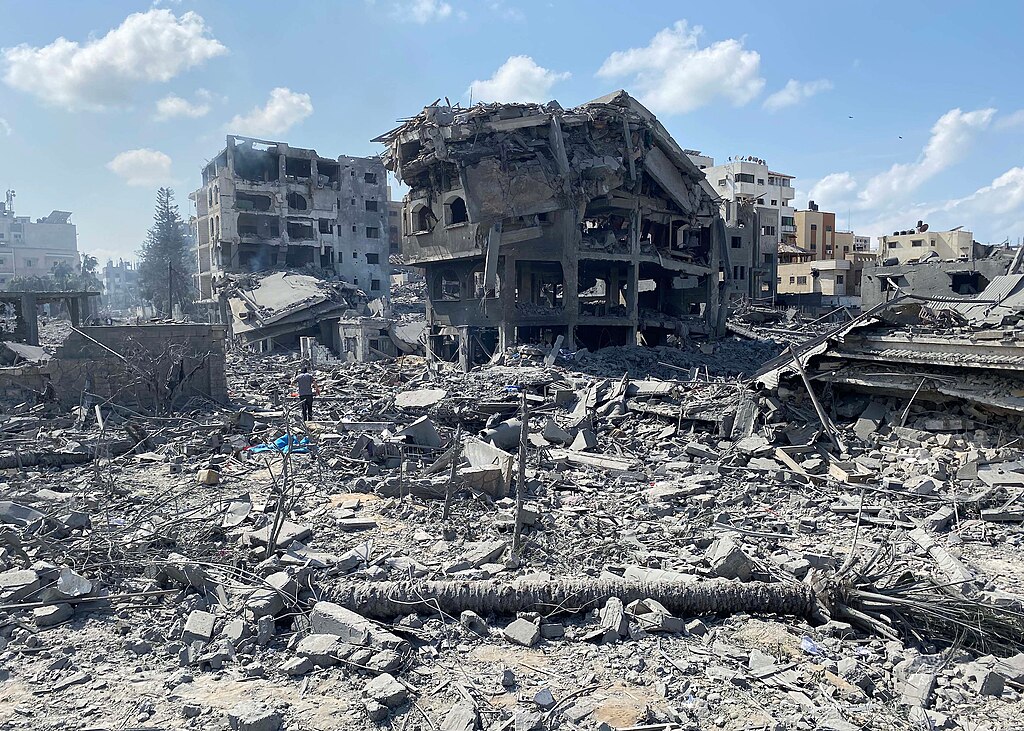
Palestinians inspect the damage following an Israeli airstrike on the El-Remal aera in Gaza City on October 9, 2023. Israel continued to battle Hamas fighters on October 10 and massed tens of thousands of troops and heavy armour around the Gaza Strip after vowing a massive blow over the Palestinian militants' surprise attack. Photo by Naaman Omar apaimages. licensed under the Creative Commons Attribution-Share Alike 3.0 Unported license.
Palestinians inspect the damage following an Israeli airstrike on the El-Remal aera in Gaza City on October 9, 2023. Israel continued to battle Hamas fighters on October 10 and massed tens of thousands of troops and heavy armour around the Gaza Strip after vowing a massive blow over the Palestinian militants’ surprise attack. Photo by Naaman Omar apaimages. licensed under the Creative Commons Attribution-Share Alike 3.0 Unported license.

https://www.craigmurray.org.uk/archives/2023/11/activating-the-genocide-convention/

There are 149 states party to the Genocide Convention. Every one of them has the right to call out the genocide in progress in Gaza and report it to the United Nations. In the event that another state party disputes the claim of genocide – and Israel, the United States and the United Kingdom are all states party – then the International Court of Justice is required to adjudicate on “the responsibility of a State for genocide”.

There is, at the very least, a strong prima facie case that the actions of the United States and United Kingdom and others, in openly providing direct military support to be used in genocide, are complicity in genocide. The point of Article IV is that individuals are responsible, not just states. So Netanyahu, Biden and Sunak bear individual responsibility. So, indeed, do all those who have been calling for the destruction of the Palestinians.

It is very definitely worth activating the Genocide Convention. A judgement of the International Court of Justice that Israel is guilty of genocide would have an extraordinary diplomatic effect and would cause domestic difficulties in the UK and even in the US in continuing to subsidise and arm Israel. The International Court of Justice is the most respected of international institutions; while the United States has repudiated its compulsory jurisdiction, the United Kingdom has not and the EU positively accepts it.

If the International Court of Justice makes a determination of genocide, then the International Criminal Court does not have to determine that genocide has happened. This is important because unlike the august and independent ICJ, the ICC is very much a western government puppet institution which will wiggle out of action if it can. But a determination of the ICJ of genocide and of complicity in genocide would reduce the ICC’s task to determining which individuals bear the responsibility. That is a prospect which can indeed alter the calculations of politicians.

It is also the fact that a reference for genocide would force the western media to address the issue and use the term, rather than just pump out propaganda about Hamas fighting bases in hospitals. Furthermore a judgement from the ICJ would automatically trigger a reference to the United Nations General Assembly – crucially not to the western-vetoed Security Council.

All this begs the question of why no state has yet invoked the Genocide Convention. This is especially remarkable as Palestine is one of the 149 states party to the Genocide Convention, and for this purpose would have standing before both the UN and the ICJ.

Any one of the 139 states party could invoke the Genocide Convention against Israel and its co-conspirators. Those states include Iran, Russia, Libya, Malaysia, Bolivia, Venezuela, Brazil, Afghanistan, Cuba, Ireland, Iceland, Jordan, South Africa, Turkey and Qatar. But not one of these states has called out the genocide. Why?

https://www.craigmurray.org.uk/archives/2023/11/activating-the-genocide-convention/

Continue ReadingCraig Murray discusses activating the Genocide Convention

Emmanuel Macron pledges €1bn to fund research into melting ice caps

Spread the love
Image of an iceberg
The tip of the Iceberg

https://www.theguardian.com/environment/2023/nov/12/emmanuel-macron-pledges-1bn-to-fund-research-into-melting-ice-caps

The French president has called for action at a climate summit in Paris attended by heads of state and scientists before Cop28

France will spend €1bn (£880m) on polar research between now and 2030, amid rapidly rising scientific concern over the world’s melting ice caps and glaciers.

A new polar science vessel will spearhead the effort, and France is calling for a moratorium on the exploitation of the seabed in polar regions, to which the UK, Canada, Brazil and 19 other countries have so far signed up.

French president Emmanuel Macron told a summit of heads of state and scientists in Paris: “We are not talking about a threat for tomorrow, but one that is already present and accelerating. We are talking about a transformation of the cryosphere [the Earth’s ice] that already threatens millions and will threaten billions of the planet’s inhabitants with multiple direct and indirect consequences.”

The plight of the Earth’s polar regions and glaciers has sparked alarm among many scientists, as heatwaves at both poles, which were seen for the first time last year, look set to be a regular occurrence.

This year is already the hottest on record and probably the hottest in 100,000 years, with ocean temperatures so far above normal as to be, in the words of one scientist, “gobsmackingly bananas”.

They heard from polar and glacier experts that temperatures were rising four times more rapidly in the Arctic than the global average, half the world’s 200,000 glaciers were set to disappear by the end of the century and that the rate of sea level rise had doubled in the last two decades.

Glaciers were melting across the world, warned the head of the World Meteorological Organisation, Petteri Taalas. As they vanish irrecoverably, more than 1 billion people who depend on them for water and agriculture will face increasingly severe shortages. As well as cutting greenhouse gas emissions overall, there are also urgent measures that scientists believe could be taken now that would reduce or delay the risk of the collapse of glaciers or a tipping point at the poles.

https://www.theguardian.com/environment/2023/nov/12/emmanuel-macron-pledges-1bn-to-fund-research-into-melting-ice-caps

Continue ReadingEmmanuel Macron pledges €1bn to fund research into melting ice caps

Over 50 Bodies Pulled From Rubble of Gaza School Bombed Amid Israeli Assault

Spread the love

Original article by BRETT WILKINS republished from Common Dreams under Creative Commons (CC BY-NC-ND 3.0).

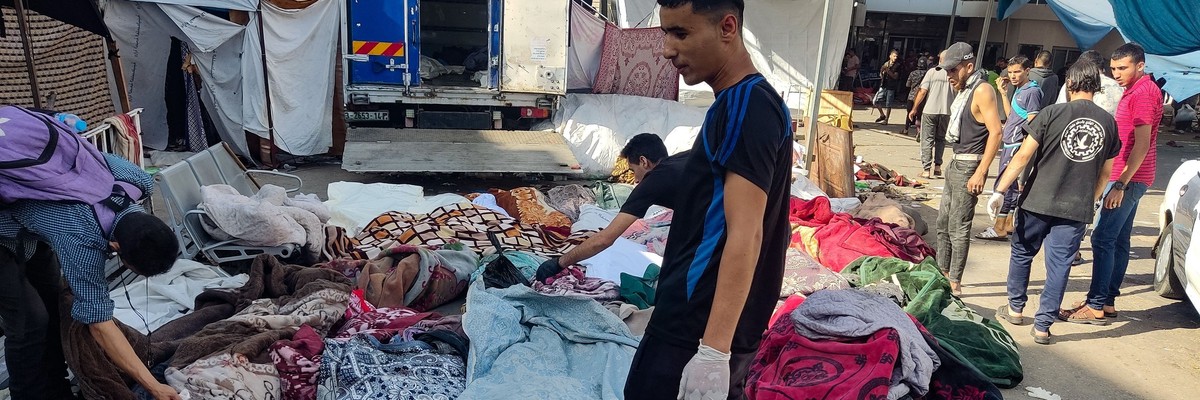
Men check the bodies of people killed in bombardment that hit a school housing displaced Palestinians, as they lie on the ground in the yard of al-Shifa hospital in Gaza City on November 10, 2023.  (Photo: Khoder al-Zaanoun/AFP via Getty Images)

As the death toll from Israel’s obliteration of Gaza topped 11,000, U.S. Secretary of State Antony Blinken said “far too many Palestinians have been killed”—while the United States’ armed aid to Israel continues.

Palestinian civil defense officials said Friday that more than 50 bodies were recovered from the rubble of a school in northern Gaza where civilians were sheltering when it was destroyed during overnight Israeli bombardment.

Palestine’s WAFA News Agency reported civil defense and ambulance rescue teams removed the blasted and crushed remains of victims of Thursday night’s missile and artillery strikes on the al-Buraq School in the al-Nasr neighborhood of Gaza City. The outlet said that most of those killed were women, children, and elders.

The Times of Israel reports that Israel Defense Forces (IDF) officials have not yet commented on the attack.

Injured survivors of the attack were rushed to al-Shifa Hospital, which was hit by Israeli airstrikes at least four times over the past 24 hours.

https://twitter.com/PalestineChron/status/1722988640320516470?ref_src=twsrc%5Etfw%7Ctwcamp%5Etweetembed%7Ctwterm%5E1722988640320516470%7Ctwgr%5Eb7a1a887a55b4dcb904301bcc9c73e5116d2a6e4%7Ctwcon%5Es1_c10&ref_url=https%3A%2F%2Fwww.commondreams.org%2Fnews%2Fisrael-bombing-schools-and-hospitals

As Common Dreams reported earlier Friday, Israeli strikes targeted the courtyard and obstetrics department of the hospital, where doctors have been forced to operate on patients without anesthesia after running out of critical supplies to treat an overwhelming number of wounded victims. Gaza officials said 13 people died in the attacks on al-Shifa.

In an interview with Al Jazeera, al-Shifa general director Muhammad Abu Salmiya called Friday “a day of war against hospitals.”

Israeli officials have made unsubstantiated claims of Hamas fighters operating from inside or under al-Shifa and other Gaza hospitals.

On Friday Israeli warplanes bombed in the vicinity of the Indonesian Hospital in Bait Lahia—where doctors announced a cessation of surgeries—while Mustafa al-Kahlout, director of the al-Nasr hospital and al-Rantisi Children’s Hospital in northern Gaza, told CNN that Israeli tanks had “surrounded” the complex.

Jens Laerke, spokesperson for the U.N. Office for the Coordination of Humanitarian Affairs, said Friday that northern Gaza resembles “hell on Earth” due to Israel’s bombardment and a lack of aid.

Nearly 200 health workers, over 100 United Nations personnel, and dozens of journalists have been killed by Israeli forces during the war.

The Gaza Health Ministry said Friday that at least 11,078 Palestinians—including more than 3,000 women and over 4,500 children—have been killed and upward of 27,000 injured by Israeli bombs and bullets since October 7, when Hamas-led attacks on Israel killed around 1,200 civilians and soldiers, with another 240 or so people taken hostage. Israeli officials on Friday revised down their death toll, which they previously said was higher than 1,400.

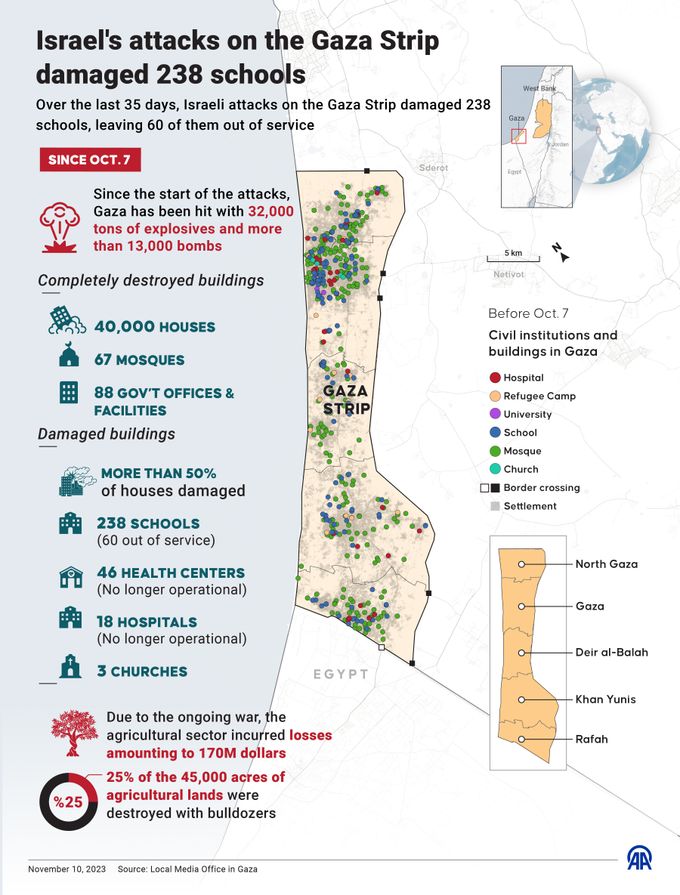
According to Gaza officials, around 70% of Gaza’s 2.3 million people have been forcibly displaced, while half the homes in the besieged strip have been destroyed. Officials also said 238 schools, 67 mosques, and 88 government buildings have been wiped out by Israeli attacks.

In the illegally occupied West Bank and East Jerusalem—whose residents were already suffering the deadliest year since the second intifada, or uprising, a generation ago—Israeli soldiers and settlers have killed at least 182 Palestinians while wounding thousands more since October 7.

A growing number of legal expertsactivists, and other observers are calling Israel’s war on Gaza “genocidal”—a characterization rejected by Israeli and U.S. leaders, with a handful of exceptions.

(Image: Andalou via Getty Images)

After 35 days of relentless and indiscriminate bombing—an IDF spokesperson acknowledged early in the war that “the emphasis is on damage and not on accuracy”—U.S. Secretary of State Antony Blinken said Friday during a visit to India that “far too many Palestinians have been killed.”

However, the U.S. continues to stand staunchly behind its number one Middle Eastern ally, with the Biden administration and Congress working on a $14.3 billion military aid package to Israel, atop the nearly $4 billion the country already receives from Washington annually. The U.S. also provides diplomatic cover for Israel, including a recent veto of a Brazil-led United Nations Security Council cease-fire resolution.

While Israel on Thursday agreed to daily four-hour humanitarian pauses for at least three days so that civilians have a chance to flee the constant bombardment and advancing IDF ground forces, Israeli officials—and U.S. President Joe Biden—stress that no cease-fire is imminent.

Israeli leaders have said a cease-fire is off the table until all hostages held by Gaza-based militants are freed. Abu Hamza, the military spokesperson of the al-Quds Brigades, the armed wing of Palestinian Islamic Jihad, said Thursday that the group was preparing to release an elderly woman and teenage boy in its custody.

United Nations Relief and Works Agency for Palestine Refugees in the Near East Commissioner-General Philippe Lazzarini wrote in an opinion piece published Thursday by The Washington Post that “the present course chosen by the Israeli authorities will not bring the peace and stability that both Israelis and Palestinians want and deserve.”

“Razing entire neighborhoods to the ground is not an answer for the egregious crimes committed by Hamas,” Lazzarini asserted. “To the contrary, it is creating a new generation of aggrieved Palestinians who are likely to continue the cycle of violence. The carnage simply must stop.”

Original article by BRETT WILKINS republished from Common Dreams under Creative Commons (CC BY-NC-ND 3.0).

Continue ReadingOver 50 Bodies Pulled From Rubble of Gaza School Bombed Amid Israeli Assault

‘Can You Hear the Screams?’ Physician Says Western Leaders Complicit in Israeli Attacks on Gaza Hospitals

Spread the love

Original article by JAKE JOHNSON republished from Common Dreams under Creative Commons (CC BY-NC-ND 3.0). 

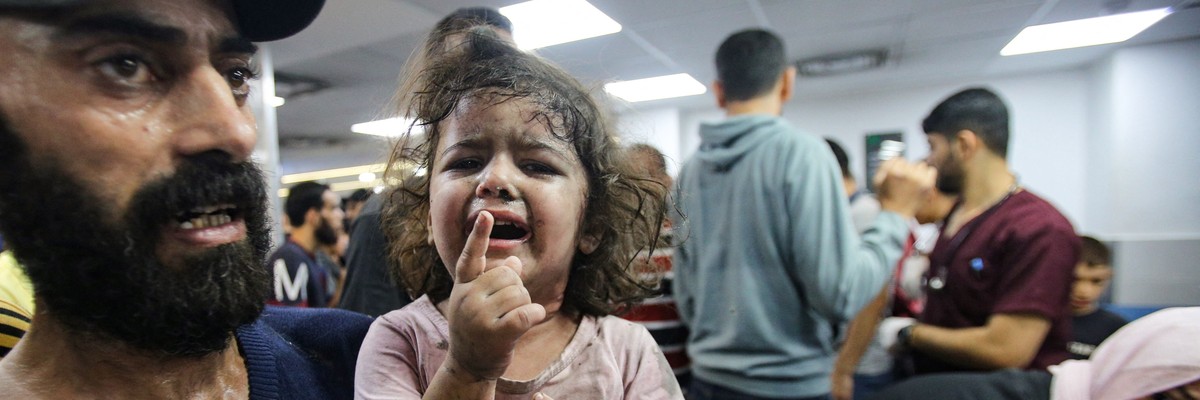
An injured toddler cries as she awaits treatment at the emergency ward of the al-Shifa hospital in Gaza City on November 5, 2023. (Photo: Bashar Taleb/AFP via Getty Images)

“When are you going to stop this?” Dr. Mads Gilbert asked U.S. President Joe Biden and the leaders of European nations.

A Norwegian physician who has volunteered in Gaza for decades said Friday that Western leaders, including U.S. President Joe Biden, are complicit in Israel’s intensifying assault on the Palestinian enclave’s hospitals, which are overwhelmed with airstrike victims and displaced people seeking refuge.

In a video message posted to social media as Israeli forces bombarded al-Shifa—Gaza’s largest hospital—and other medical facilities, Dr. Mads Gilbert asked, “Can you hear the screams from innocent people, refugees sheltering, trying to find a safe place, being bombed by the Israeli attack forces this morning inside the hospital, hospitals that are the temples of humanity and protection?”

“When are you going to stop this?” Gilbert added, with audio of screams from Gaza’s al-Shifa hospital playing in the background. “You’re all complicit.”

Gilbert’s plea for immediate action from world leaders who are supporting and arming Israel’s military came as Israeli forces surrounded al-Shifa and other hospitals in northern Gaza, claiming that Hamas is using the facilities as command centers—an assertion that hospital directors have denied.

Targeting hospitals is a war crime under international law.

Israeli airstrikes and sniper fire on Gaza hospitals have forced thousands of people who were sheltering at the facilities to flee, but many others “remain trapped inside,” the U.K.-based humanitarian group Medical Aid for Palestinians (MAP) said Saturday.

The charity said it has heard “chilling testimony from inside Gaza’s largest hospital, al-Shifa,” including reports that “the intensive care unit has been bombed and damaged.”

“Staff moving between buildings have been shot at and critically wounded,” said MAP, which is calling for a cease-fire. “Those who have tried to flee have come under fire, and lie dead or wounded in the street as rescue is impossible. With the mortuary shut down, a hundred bodies are piled up and cannot be buried.”

“Power has gone out, and staff are having to hand ventilate critically ill patients to keep them alive,” the group continued. “At least one patient in intensive care has already died. Babies in the neonatal intensive care unit which MAP has supported over many years are beginning to die from lack of oxygen. More will die soon unless the power supply is restored. Day after day, week after week, we have been warning of catastrophic consequences if world leaders fail to protect healthcare in Gaza. Our worst fears are coming true.”

Doctors Without Borders, which has been providing emergency assistance in the Gaza Strip, offered a similarly harrowing account.

“We are currently unable to contact any of our staff inside al-Shifa, and we are extremely concerned about the safety of patients and the medical staff,” the group said late Friday. “Patients are still in the hospital, some in critical condition and unable to move.”

Mohammed Obeid, a Doctors Without Borders physician at al-Shifa, said that “there is a patient who needs surgery. There is a patient who’s already asleep in our department. We cannot evacuate ourselves and [leave] these people inside. As a doctor, I swear to help the people who need help.”

Early Saturday, the group wrote on social media that its staff “are witnessing people being shot at as they attempt to flee the al-Shifa hospital.”

Original article by JAKE JOHNSON republished from Common Dreams under Creative Commons (CC BY-NC-ND 3.0). 

Continue Reading‘Can You Hear the Screams?’ Physician Says Western Leaders Complicit in Israeli Attacks on Gaza Hospitals