ANTI-WAR and pro-Palestinian groups are defying Metropolitan Police calls to postpone a demonstration demanding a ceasefire in the Gaza Strip that they have planned for Armistice Day.
Thousands of protesters are expected to descend onto central London once again this weekend as Israel’s bombardment of the Palestinian territory continues.
Prime Minister Rishi Sunak heaped further pressure on Metropolitan Police Commissioner Sir Mark Rowley yesterday to ban Friday’s protest, claiming that it would be “provocative and disrespectful.”
The Met urged the march organisers to “urgently reconsider” their plans, but it has not yet formally requested the power to ban the event under section 13 of the Public Order Act 1986.
The Act would only apply if there was a threat of “serious public disorder” that could not be controlled by other measures.
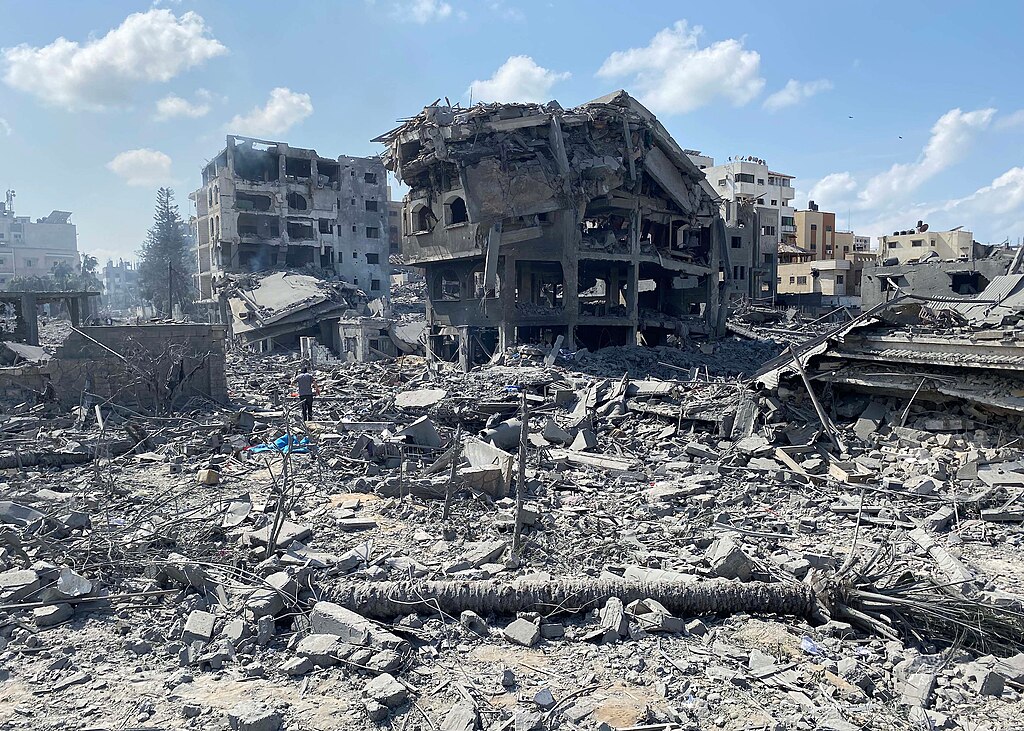
Palestinians inspect the damage following an Israeli airstrike on the El-Remal aera in Gaza City on October 9, 2023. Israel continued to battle Hamas fighters on October 10 and massed tens of thousands of troops and heavy armour around the Gaza Strip after vowing a massive blow over the Palestinian militants’ surprise attack. Photo by Naaman Omar apaimages. licensed under the Creative Commons Attribution-Share Alike 3.0 Unported license.
“We have fallen off a precipice. This cannot continue.”
United Nations High Commissioner for Human Rights Volker Türk declared Wednesday that “the collective punishment by Israel of Palestinian civilians amounts… to a war crime, as does the unlawful forcible evacuation of civilians.”
Israel’s monthlong war on Gaza has killed over 10,500 Palestinians, wounded thousands more, displaced 70% of the strip’s 2.3 million residents, and decimated civilian infrastructure, including homes, religious buildings, and hospitals.
Türk’s comments came after he visited the Rafah border crossing that connects Egypt to Gaza, which he described as “the gates to a living nightmare—a nightmare where people have been suffocating, under persistent bombardment, mourning their families, struggling for water, for food, for electricity and fuel.”
Long before October 7, when a Hamas-led attack killed over 1,400 Israelis and triggered Israel’s retaliation, Gaza was “described as the world’s biggest open-air prison… under a 56-year occupation and a 16-year blockade by Israel,” he highlighted.
“Even in the context of a 56-year-old occupation, the current situation is the most dangerous in decades, faced by people in Gaza, in Israel, in the West Bank, but also regionally.”
The U.N. rights chief also stressed that “the atrocities perpetrated by Palestinian armed groups… were heinous, brutal, and shocking. They were war crimes—as is the continued holding of hostages.” Israeli officials say there are about 240 hostages.
“We have fallen off a precipice. This cannot continue,” he warned. “Even in the context of a 56-year-old occupation, the current situation is the most dangerous in decades, faced by people in Gaza, in Israel, in the West Bank, but also regionally.”
Türk emphasized that “parties to the conflict have the obligation to take constant care to spare the civilian population and civilian objects,” and as an occupying power, Israel is required “to ensure a maximum of basic necessities of life can reach all who need it.”
“I call—as a matter of urgency—for the parties now to agree [to] a cease-fire on the basis of three critical human rights imperatives: We need urgent delivery of massive levels of humanitarian aid, throughout Gaza,” he declared.
The official also called for all hostages to be freed without condition and said that “crucially, we need to enable the political space to implement a durable end to the occupation, based on the rights of both Palestinians and Israelis to self-determination and their legitimate security interests.”
People in #Gaza are suffocating, under persistent bombardment, mourning their families, struggling for water, food, electricity & fuel. @volker_turk calls on parties to agree to a ceasefire on the basis of key human rights imperatives: https://t.co/5z0WW6Rdjupic.twitter.com/mdde76rapL
U.N. Secretary-General António Guterres—who has also been pushing for a cease-fire—called out Israel’s aerial and ground operations for their impact on civilians during a Reuters conference on Wednesday.
“There are violations by Hamas when they have human shields. But when one looks at the number of civilians that were killed with the military operations, there is something that is clearly wrong,” he said.
“We have in a few days in Gaza thousands and thousands of children killed, which means there is also something clearly wrong in the way military operations are being done,” the U.N. leader added.
According to the Palestinian Ministry of Health in Gaza, the Israeli war against Hamas has killed over 4,300 children.
“It is also important to make Israel understand that it is against the interests of Israel to see every day the terrible image of the dramatic humanitarian needs of the Palestinian people,” Guterres said. “That doesn’t help Israel in relation to the global public opinion.”
While French President Emmanuel Macron’s plans to hold a Gaza-focused “humanitarian conference” in Paris on Thursday, the government of Israeli Prime Minister Benjamin Netanyahu is refusing to participate in the event.
Ahead of the conference, 13 human rights and relief groups called on attendees “to do everything in their power to achieve an immediate cease-fire; take concrete steps to free civilian hostages and protect all civilian populations; and ensure the entry of humanitarian aid into Gaza and respect for international humanitarian law.”
Among them was Amnesty International—which, over the past month, has compiled “damning evidence of war crimes as Israeli attacks wipe out entire families.” Some global experts and critics have demanded action from the International Criminal Court on “escalating Israeli war crimes and genocide of the Palestinian people” in Gaza.
In a resignation letter to Türk last month, Craig Mokhiber, who was serving as the New York director for the Office of the High Commissioner for Human Rights, condemned Israel’s war as “a textbook case of genocide.”
“In the immediate term,” Mokhiber wrote, “we must work for an immediate cease-fire and an end to the long-standing siege on Gaza, stand up against the ethnic cleansing of Gaza, Jerusalem, and the West Bank (and elsewhere), document the genocidal assault in Gaza, help to bring massive humanitarian aid and reconstruction to the Palestinians, take care of our traumatized colleagues and their families, and fight like hell for a principled approach in the U.N.’s political offices.”
Governments plan to increase oil and gas production until at least 2050, UN-backed study reveals.
Major fossil fuel-producing countries plan to extract more than double the amount of fossil fuels in 2030 than is consistent with the Paris climate accord’s goal for limiting global temperature rise.
This is despite frequent and devastating heatwaves, droughts, floods and wildfires in recent months.
Coal production needs to ramp sharply down to address climate change, but government plans and projections would lead to increases in global production until 2030, according to a United Nations-backed study released Wednesday.
Global oil and gas production, meanwhile, would increase until at least 2050, the Production Gap Report states.
This conflicts with government commitments under the climate accord, which seeks to keep global temperature rise below 1.5 degrees Celsius.
Glaring gap between climate goals and fossil fuel extraction
The report examines the disparity between climate goals and fossil fuel extraction plans, a gap that has remained largely unchanged since it was first quantified in 2019.
“Governments’ plans to expand fossil fuel production are undermining the energy transition needed to achieve net-zero emissions, creating economic risks and throwing humanity’s future into question,” Inger Andersen, executive director of the United Nations Environment Programme, said in a statement.
As world leaders convene for another round of United Nations climate talks at the end of the month in Dubai, seeking to curb greenhouse gases, Andersen said nations must “unite behind a managed and equitable phase-out of coal, oil and gas – to ease the turbulence ahead and benefit every person on this planet.”
Image of InBedWithBigOil by Not Here To Be Liked + Hex Prints from Just Stop Oil’s You May Find Yourself… art auction. Featuring Rishi Sunak, Fossil Fuels and Rupert Murdoch.
The UK government is in breach of international law over failing to tackle extreme levels of poverty and destitution in the country, according to a scathing assessment made by the UN’s special rapporteur on extreme poverty and human rights.
It comes after the Joseph Rowntree Foundation recently released a report showing that almost 4 million people experienced destitution in 2022, including more than a million children.
Government data recently revealed that 14.4 million people lived in relative poverty in 2021-22 – a million more than the previous year.
With a cost of living crisis and soaring food and fuel prices as well as increasing housing costs, Olivier De Schutter, the UN’s special rapporteur on extreme poverty and human rights, slammed the UK’s woefully inadequate welfare system, citing research showing universal credit payments of £85 a week for single adults over 25 were “grossly insufficient” and described the UK’s main welfare system as “a leaking bucket”.
The pace of change among governments and corporations is set to form a central part of the COP28 climate talks in Dubai.
Half of the world’s 2,000 biggest listed companies have set a target to get to net-zero emissions by 2050 but just a fraction meet tough United Nations guidelines for what constitutes a quality pledge, a report released on Monday shows.
That is according to the latest analysis of the Forbes Global 2000 – a list of the world’s largest companies – by Net Zero Tracker, an independent data consortium including Oxford University.
It says that the number of companies setting net zero emissions targets has risen by 40 per cent from 702 in June 2022 to 1,003 in October 2023.
Quantity over quality?
The group warns, however, that despite progress in terms of the number of companies setting net-zero targets, there is an urgent need to ensure these targets are credible and deliver on promised emissions reductions.
Just 4 per cent of targets meet the criteria laid down by the UN’s Race to Zero campaign for example, by ensuring that they cover all greenhouse gas emissions, start to cut them immediately, and include an annual progress update on interim and longer-term targets.